What’s wrong with Priya the poorly Poodle?

IMG_8057
Priya the poodle’s health was deteriorating but we didn’t know why. She wasn’t her normal bouncy self.


RenderedImage
Priya, seen here with Joey, was diagnosed with Addison’s Disease which can be fatal. Now she’s on  medication and is full of beans once again

We’ve had another dog-related drama this week, and as it is something I’ve not personally had to deal with before, despite ten years of looking after other people’s pooches, I am assuming there are some of you who also may not know about it. Therefore it is an important story to share.

We were looking after a couple of poodles, Joey, a miniature and Priya, a standard, who are regular guests of ours. A week after they had returned home the owner contacted us to ask if anything had happened while the dogs were with us, as Priya was a bit below par. There was nothing we could put our fingers on. She had eaten well, played happily and was enthusiastic to go on dog walks.

Her owner explained that she had become a bit lethargic and had lost her appetite. He had been to the vet with her, but they just said to keep an eye on her. The dogs were due to come back to us because the family were going on a long-awaited holiday abroad. We agreed that they should still come, even though by the time they dropped the dogs off, Priya still wasn’t herself.

Over the weekend, my son Jasper and I became increasingly concerned. Priya refused all food despite tempting her with treats like cheese and roast chicken that dogs usually gobble up. She spent most of the time sleeping, and whenever she did get up, her normally waggy tail was limp and lifeless.

Thankfully, one of my other customers is a vet and is our go-to if we are worried about any of our charges (if you run a professional dog care business, it is a requirement of your license to be registered with a vet, even if you don’t own a dog yourself). When I messaged her with the symptoms, she quickly replied that we should take her to the emergency surgery right away.

The owner’s own vet was based a good hour away, so we needed his permission for them to share Priya’s health details with the practice we wanted to use which was much closer. It meant we had to interrupt his holiday to let him know what was happening and to ensure we got the necessary consent.

Permission gained, Jasper whisked Priya to our vet who took blood from her to conduct tests in the hope of getting to the root of the problem. She was also hooked up to a drip and had to spend the night in the animal hospital.

The vet who did the initial examination had a suspicion of what it might be. “Addison’s disease, or something like that,” Jasper explained to me when he got back. I thought he must have the name wrong, because that was a human disease, wasn’t it?

When I looked it up, it was indeed a rare autoimmune disease of the adrenal glands that afflicts around 9,000 people a year. However, it is also found in dogs, and when I read the symptoms, it was spot on – lethargy, lack of appetite, and ‘just not themselves’. Other symptoms include vomiting and diarrhoea, increased thirst and limb weakness. Symptoms can come and go, too, but they get progressively worse, so it is important to not delay in getting a dog checked out. Although pretty rare in humans Addison’s Disease is quite common in dogs.

The results of the blood tests came the next day and confirmed Priya had the disease. It is caused by the adrenal glands ceasing production of two essential steroid hormones, cortisol and aldosterone, both of which are essential for life. It can affect any dog but is most common in certain pedigree breeds between the ages of four and six, such as the Standard Poodle, West Highland White Terrier, Great Dane and St Bernard’s. Left untreated the condition is fatal.

From now on, Priya needs to take a steroid pill every day for the rest of her life to replace the cortisol and also needs an injection once a month to replace the aldosterone. She quickly recovered and is back to her old self.

If you have pet insurance that you started before any symptoms appear, then you should be covered. If not, then I’m afraid a diagnosis of Addison’s Disease will be a rather costly affair!

I’d love to hear from you about your opinions, memories and ideas for columns. Use the ‘Contact’ button on the top right of this page to get in touch. This column appeared in the Darlington & Stockton Times on Friday 12th and the Ryedale Gazette and Herald on Wednesday 10th July 2024.
Nobody wants a hot dog

IMG_3233
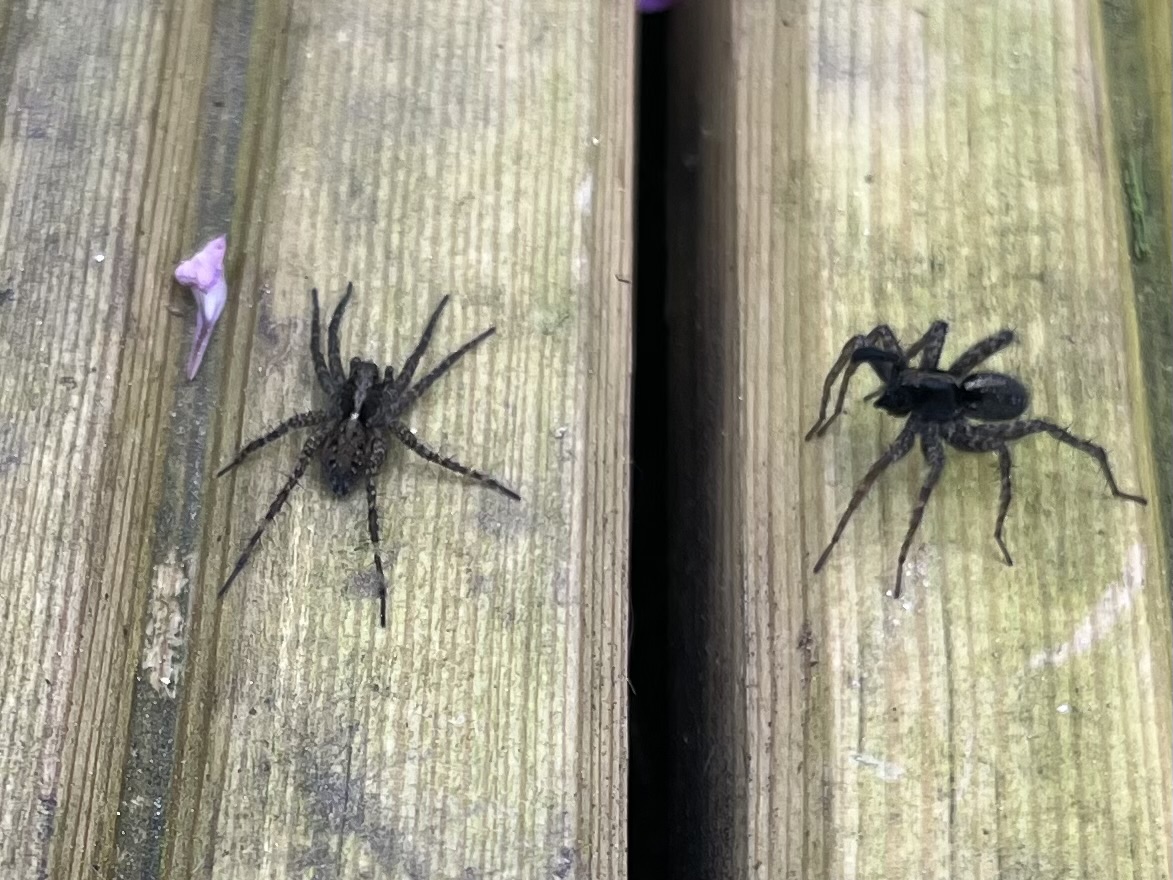
A couple of spiders had a stand-off on my decking during a recent warm spell


I write this column some time before it is published, and today as I put finger to keyboard, it is gloriously sunny. I am outside basking in the rare heat, determined to make the most of it while I can, even if I can barely see what I am writing on my screen. As we Brits know only too well, this beautiful weather is likely to be short lived so I’m happy to squint as I work.

It is blissful and I think the wildlife in my garden are celebrating too. The birds seem extra chirpy and excitable, the bees and flies extra busy and buzzy, and the ants and beetles extra industrious as they hurry about their daily business.

My attention is caught by a couple of spiders on the decking having a standoff. They look to be eyeing each other up, keeping very very still, until one moves a bit, then so does the other, without getting too close. It is quite a captivating little dance and I wonder if it is some kind of mating ritual, or whether one is preparing to attack the other. Unfortunately, I don’t get the chance to find out, as something startles them, and they scuttle off to safety below the decking.

The swift change in temperature over the past couple of days has come as a shock to the system. It seemed to increase almost overnight by a whopping 15 degrees and took many of us by surprise when it comes to knowing what to wear. Moseying about town, some people were in coats and sweaters, while others wore shorts and flip flops.

It has also affected our four-legged friends, who are certainly unprepared. I have noticed them panting more and drinking far more water and we have cut short our dog walks, using routes that offer plenty of shade. It takes dogs a lot longer than us to adjust to changing weather conditions, and even when it seems pretty cool, they can still overheat.

My son Jasper was walking along a local shaded path when he came across a distressed woman with a large Dalmatian. Although she didn’t know Jasper, they had crossed paths regularly on their walks and so she asked him for help. The dog was panting very heavily and kept lying down and refusing to move. Thankfully, they were not far from our house and they managed to coax the dog into walking and once it got here, it promptly flopped down on the lawn while Jasper dashed in for a bowl of water. The owner was clearly upset, and said she only lived 15 minutes away, but was fearful that her dog would not survive that short distance without a drink.

She was right to be concerned, because heat exhaustion can affect a dog very quickly, and can be fatal. A dog pants to cool itself down but finds it hard to regulate its body temperature in warm conditions. If you notice excessive panting, then it’s best to take it into the shade and give it some water as soon as possible. Other signs of heat exhaustion include difficulty breathing, excessive drooling, lethargy and lack of coordination.

If you think your dog has been affected, the immediate priority is to bring its temperature down. Cool tap water sprinkled across its body is best, making sure to avoid the head (a gasping dog can inhale water into its lungs). Avoid excessively cold water though, as this can cause the animal to go into shock. Don’t be tempted to cover it with wet towels either as this can trap heat in and make the situation worse. Keep sprinkling the water over the dog until the panting eases. Try offering it small drinks of water too. If you are at all concerned, take it straight to the vet.

What I didn’t know was that, according to the RSPCA, heat-related illnesses affect 10 times more dogs than leaving them in hot cars, and the charity is running a campaign to raise awareness of the issue.

I’m delighted to report that the Dalmatian made a full recovery and the grateful owner, who happened to own a café, has offered myself and Jasper a free meal to say thank you.

Now that’s what I call a happy ending.

I’d love to hear from you about your opinions, memories and ideas for columns. Use the ‘Contact’ button on the top right of this page to get in touch. This column appeared in the Darlington & Stockton Times on Friday 31st and the Ryedale Gazette and Herald on Wednesday 29th May 2024.

Doggy do do Down Under

IMG_3281
Sarah Tyson from Australia composts her dog poo in biodegradable bags


Who knew that the debate about dog poo disposal would resonate across the globe? Sarah Tyson got in touch all the way from Hahndorf in South Australia with this interesting idea: “I discovered, entirely by accident, that dog poo composts very well if placed in an open-bottomed bin with an equal volume of vegetable matter. I have two large dogs who generate the poo, and two large teenagers who generate a lot of food and paper scraps. I place both kinds of waste in my 220L compost bin and they disappear very quickly. And no smell! (caveat: I have affixed a mesh base to the open bottom of the bin to deter rodents).”

This message sparked so many questions in my head that I wanted to ask Sarah directly, so I got back in touch with her. I particularly wanted to know how well the rat-deterring mesh worked. Sarah replied that although she has been rat-free for the past five years, it was a case of trial and error before she got it right.

“We did have an issue with rodents after the first six months,” she says. “I tackled this by moving to another spot (it took them a while to learn where the bin went, and I needed the first layers to start decomposing, and not be eaten!).” Sarah tried nailing a circle of wire mesh across the base but it dawned on her that if the mesh was soft enough for her to cut through with her snippers, it was unlikely to be any match to a determined rat’s incisors. But then she had an idea. She cut a circle of mesh matching the circumference of the bin, then laid it on top of a few sheets of chicken wire, which she overlapped in different directions to make the holes smaller. “I chose the chicken wire because it was just there and available, along with some crummy scrunched up wire lying around on my friend’s farm.” It worked, and since then the eco-friendly compost bin has not attracted any rodents. I hope the up-cyclers among you are impressed with Sarah’s ingenuity!

I wondered if, like here, there are thoughtless dog owners in Australia who also toss poo bags into trees. It’s interesting to discover how other countries deal with the same problems as ours, so I hope you’ll forgive me for devoting quite a bit of space to Sarah’s reply.

“The issue with poo bags depends on where you walk,” she says. “In most dog parks some people leave their bags where paths meet but almost always pick them up on the return journey. I have found that people pick mine up too which is fantastic, especially if I am having a bad day. In return I always pick up other people’s bags when I am having a good day!”

As for the open countryside (which Australians call ‘bushland’) she says: “I have never seen bags or unbagged poo left behind in natural bushland.” Applause for the Aussies then!

But stop applauding now, because it is a different story in public parks. “I often see poo on bike and walk tracks in the more formal parks and bikeways and it almost always has been stepped in or ridden through so it’s EVERYWHERE and so, so gross!” She adds, however, that in towns and on suburban footpaths no-one leaves dog mess or bags behind. Resume your applause!

She continues: “There are always poo bag dispensers everywhere and plenty of rubbish bins to put them in. The bins at dog parks are very very full and although they are emptied regularly, they stink and I feel sorry for anyone living within smelling range.” That sounds very familiar to us, doesn’t it! But Sarah has a suggestion: “Perhaps the council should adopt my idea of compost and poo. It would be pretty simple for them to drive past and dump some plant clippings in once a week. Our poo bags recently changed from regular plastic to biodegradable plastic. I think this may sow the thought of composting with other dog owners.”

Are any of you tempted to have a go at composting your own dog poo? Or should we suggest it to our local council? It could just be the answer to a very messy and long-standing problem.

I’d love to hear from you about your opinions, memories and ideas for columns. Use the ‘Contact’ button on the top right of this page to get in touch. This column appeared in the Darlington & Stockton Times on Friday 24th and the Ryedale Gazette and Herald on Wednesday 22nd May 2024.