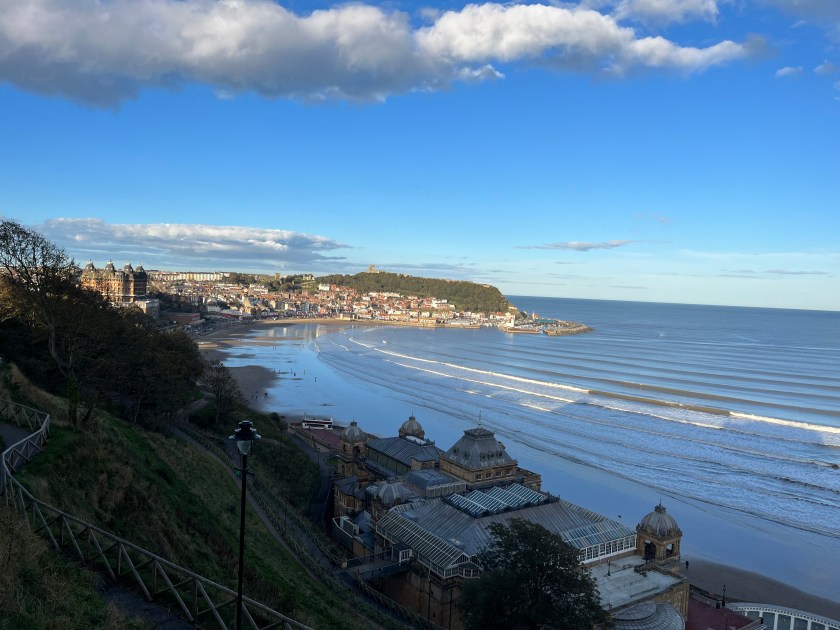
When I visited Scarborough a few weeks ago, I was struck by the size and grandeur of the buildings lining The Esplanade, the main seafront road that spans the South Cliff where I was staying. The properties have spectacular views out to sea and as with most resort towns, some of the houses were well looked after, while others were in need of a fair bit of TLC.
Scarbrough is said to be Britain’s first proper seaside resort, thanks to a woman called Thomasin Farrer who in 1626 discovered a mineral-laden spring trickling down the South Cliff. In 1660, a book written by Dr Robert Wittie extolling the health-giving virtues of this spring led to an influx of people seeking cures for their various ailments. This in turn led to the first ‘Spaw House’, built in the early 1700s on the site of the current Scarborough Spa building, and soon wealthy families from as far away as London were travelling up north to take in the sea air, bathe, and benefit from the medicinal properties of this now famous spring water. Scarbrough became a very fashionable place to be seen and was one of the first to use bathing machines, mini beach huts on wheels that could be rolled into the sea so that the modesty of the well-to-do swimmers could be preserved as they entered the water.
When I trained as a journalist in the early 1990s, I was sent to the south coast town of Hastings in East Sussex on a six-month residential training course. My trip to Scarbrough reminded me of my time there, both towns having that air of shabby elegance about them. I knew nothing about Hastings back then, except that the famous Battle of 1066 was named after it.
I found it unexpectedly beautiful, perched on the edge of the English Channel with glorious ocean views from the wide boulevard that spanned the width of the town. And yet, there was an air of abject neglect that hung around the huge and very beautiful Georgian, Victorian and Edwardian buildings, a contrast which was difficult to reconcile in my young head. The term ‘faded grandeur’ could not have been more apt, and I was genuinely saddened to see these beautiful pieces of architecture lapsing into dereliction.
You could tell that this was once a most fashionable seaside destination. It was the Napoleonic Wars (1803-1815) that were instrumental in bringing to an end the tradition of the ‘Grand Tour’, a ‘coming of age’ trip made by English society’s affluent youth who travelled down through Europe and into Italy. This, along with the expansion of the steam railway network, meant that these bright young things searching for fashionable destinations in which to be seen landed in coastal resorts like Hastings. Hastings, which had been a small fishing town until the early 1800s, expanded rapidly, and imposing town houses, along with assembly rooms, dance halls, coffee shops, shopping arcades, theatres and recreation parks began to be built to cater for this influx of the rich and influential, whose bathing machines began lining up on the beach.
The resort thrived until well into the 20th century, and one of the most striking buildings is where we had our training school, Marine Court, otherwise known as The Ship due to the fact its Art Deco design was based on the recently launched Cunard liner, the Queen Mary. The white building, which at the time of opening in 1938 was the largest residential apartment block in the country, can be seen for miles around, and now, like more than 500 other buildings in Hastings, has Grade II listed status. Our digs were round the corner in Warrior Square, a beautiful green park surrounded on all sides by Georgian and Victorian town houses, most of which were badly run down.
The demise of these once splendid resorts is attributed in the most part to the rise of affordable foreign travel. I haven’t been back to Hastings for years, but a quick look via the trickery that is Street View on Googles Maps shows that most of the buildings are in a much better condition than when I was there. There is evidence of scaffolding on many, suggesting they are being regenerated, which must be a good sign. Will these beautiful coastal towns rediscover the glory and status they once enjoyed?
Contact me via my webpage at countrymansdaughter.com. Follow me on Twitter @countrymansdaug.
This column appeared in the Darlington & Stockton Times on Friday 24th and the Ryedale Gazette and Herald on Wednesday 22nd November 2023.

 The Countryman's Daughter