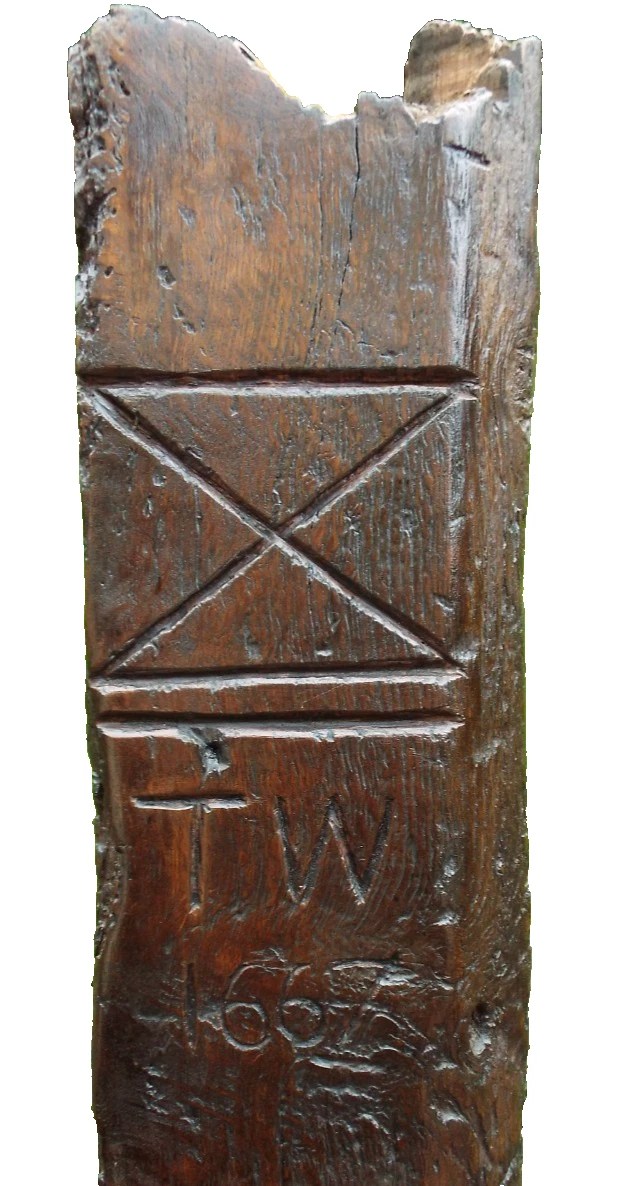
I never know who is going to contact me, nor where they come from, and so I was intrigued when I received the following message from a gentleman called Stanislav Stefane:
“Will you be publishing your father’s papers on the so-called witch posts? There is limited information available online, and I find them fascinating. I am also interested in one that is for sale, dated 1667. Is there perhaps an example with this date mentioned in your father’s papers?”
I replied to him that Dad had composed a whole book about them but sadly died before the final draft made it into print. At the moment there are no plans to publish it, but his extensive historical research is still there in his study. Dad had a very strong Catholic faith and his findings prompted him to believe that many so-called witch posts were not connected to witches at all, but were in fact related to the famous Catholic Martyr of the Moors, Father Nicholas Postgate.
I discovered that Stanislav was based in Slovenia, and asked him what sparked his interest.
“I collect carved oak antiques from the 17th and 18th centuries, mainly pieces that have a carved date and the initials of their owners. By chance, I came across a reference to the so-called ‘witch post,’ which also occasionally bears a carved date. I find the story surrounding them most fascinating. There is one currently for sale, and I thought that perhaps it might have been known to your father. I am not sure whether the post is even original, but if it had been seen by your father, there would be no doubt about its authenticity. I hope you will publish your father’s findings on them. They are probably among the most mysterious and misunderstood of British oak antiques.”
It sounds like Stanislav may have caught the ‘witch post’ bug which affected my dad in the later years of his life, and he would certainly agree with Stanislav’s use of the term ‘misunderstood’. Having started to research them, Dad became more and more fascinated, and began to believe that many of these ‘witch posts’ were not to ward off evil but to indicate ‘safe houses’ for persecuted Catholics.
Even though the full book has not been published Dad did produce an interim pamphlet in 2008, in which he explains why he became so captivated by the topic.
“I began my research more than a year ago but the subject has developed so greatly and produced so many surprises that I have still not completed my investigations…The task is almost complete and it has proved a most enjoyable and enlightening experience.”
Among his files I found a letter to an interested party in which Dad admits that he made mistakes in earlier writings due to the existing information upon which he was relying being incorrect or inaccurate, of which he was unaware at the time. He only realised this once he’d embarked on his own quest to find out more.
“My research into witch posts has revealed quite a lot of errors on my part (and on the part of earlier writers). I hope my recent efforts will rectify some of those – I relied too heavily on earlier works by authors I thought were infallible!”
As yet I have been unable to find Stanislav’s particular post in my dad’s files, but I will keep looking. It has made me think that I ought to do something about all this information that Dad put so much time and effort into researching.
On another note, Katherine Hill has been back in touch after attending a reunion of the Bean family. Katherine contacted me after reading a column where I mentioned Peep o’Day Farm near Husthwaite. She thought her grandfather, Samuel Bean, may have been born there.
A posse of Beans gathered on Sunday March 1st, including her 99-year-old aunt Sylvia, who was a Bean until she married in 1953. “It was a very enjoyable time reminiscing about our childhood at Burton Garth, Knapton.”
Thanks to the endeavours of some very helpful readers, particularly Rex North, I was able to pass on much more information about the Bean family history to her. I wish Katherine all the best with her continuing research and hope there are more Beans yet to be discovered!
Do you have opinions, memories or ideas to share with me? Get in touch with me using the ‘Contact’ button on the top right.
This column appeared in the Darlington & Stockton Times on Friday 20th and the Ryedale Gazette and Herald on Wednesday 18th March 2026

 The Countryman's Daughter