When a name means a Lot

Reader David Severs’ Auntie Carlotta’s grandfather James Foster standing next to his boiler at Baxter’s Brewery in Thornton Le Moor in the late 1800s


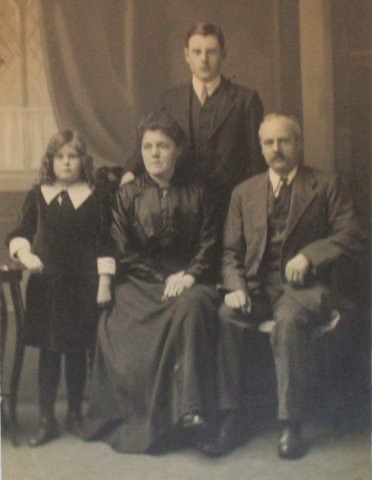
Reader Davis Severs’ Great Auntie Carlotta, far left, with her brother Lancelot standing behind their parents Ada and Robert Armin from Thornton Le Moor.

We return this week to the theme of unusual names. If you recall, Brian Reader contacted me about his quirkily-named relatives Rocious, Fera and Ellengor. In my piece I had found a number of Ellengors from the Northallerton and Bedale areas. They included Ellengor Barker (1862-1955), Ellengor Bramley (1871-1965), and Ellengor Barker Rollins (1889-1977).

After having read my piece, Brian got back in touch to say: “The Rollins and Bramley families are all related to Barker. The earliest Ellengor I have found so far was Ellengor (Ellen) Barker (nee Elliott) born in 1822 in Woodhouse and who died on 4th June 1887 in Northallerton. I have yet to follow up the Elliott family.”

As we have seen from the successive Ellengors, the same name used to live on in a family’s descendants for many years. I wonder if it was considered familial duty to pass down a name, or was it done just because people liked doing it? Today, new parents seem less inclined to follow the tradition, and I wonder why that is too.

Horacio Romeo, who reads my column online, has his own list of uncommon names. He said: “Living in Brazil, unusual names are quite usual to find…Azize, Kilber, Alison (male), Glademir, Suelí, Dagna, Adilson, Claudiceia…I can spend the whole day!”

David Severs comes from a family where quite a distinctive name persisted: “My grandfather Arthur Robert Foster was born at Thornton le Moor in 1879. His sister, Ada Mary Foster, had been born in 1874. Their father, James Foster, was the boilerman at Baxter’s Brewery in the village.

“Ada married Robert Armin, the Armins being a longstanding local family (There is still an Armin House in the village). Robert and Ada called their son Lancelot and their daughter Carlotta. I was always intrigued by my Auntie Carlotta’s comparatively unusual and quirky name, apparently common on the continent as a variant of Charlotte, but not in the UK.

“When I researched my ancestry I found that several successive generations of Armins had been given the biblical name Lot. It seems Robert and Ada did not want to follow the family practice but wanted to recognise it, so they called their offspring LanceLOT and CarLOTta.

“Although I had an explanation I was still intrigued by their use of the comparatively unusual name Carlotta.”

Some years later, David discovered what could be the answer when a history of the village was published in the year 2000 to mark the Millennium. The book explained that the driving force behind Baxter’s Brewery was a man called Newsome Baxter who died in 1889.

David continues: “He left the brewery to his son William Newsome Baxter who died only three years later. The brewery then passed on to William’s wife Emma, their two sons and their daughter Ethel Carlotta.”

It was the earliest date in his research that David had come across the name: “So now I knew whence Robert and Ada Armin found the name Carlotta.”

David did wonder what the wealthy and influential Baxters would have made of their lowly boilerman’s daughter snaffling the family name for her own child.

I’ve recently been watching the series ‘The Yorkshire Auction House’ which features Kirkbymoorside-based Ryedale Auctioneers and their charismatic owner Angus Ashworth. Angus was helping to clear the house of a retired policeman whose daughter was called ‘Myron’ or ‘Meiron’ (I only heard it so am unsure how it would be spelled). It was a new name to me and upon a quick Google I discovered ‘Myron’ is Greek in origin and is normally the male version of ‘Myra’. Meiron, however, is a Welsh girl’s name meaning ‘the admired one’.

This show has captivated me because it deals with a subject close to my heart, and one which almost all of us will have to face at some point in our lives – that of having to sort through the possessions of a loved one after they have passed away. What do we do with it all? It is a very emotional and difficult process, and I have to say that Angus and his team deal with it in a very sensitive manner.

My dad accrued so much ‘stuff’ over his lifetime that having someone like Angus on hand to deal with it all might be just what we need!

Do you have opinions, memories or ideas to share with me? Get in touch with me using the ‘Contact’ button on the top right.

This column appeared in the Darlington & Stockton Times on Friday 3rd and the Ryedale Gazette and Herald on Wednesday 1st Oct 2025

Deceivers spell it out

22686E16-3640-4D5C-9501-9ECDE1C05F75
The graveyard of St Cuthbert’s Church, Crayke, where many of the Severs’ family ancestors lie

My columns about the graves at St Cuthbert’s Church in Crayke continue to bear fruit. If you remember, John Severs from Middlesborough solved the mystery of a set of initials on one of the headstones I mentioned. This week I was contacted by David Severs from Northallerton, who shares a common ancestry with John through the shoemaking Severs and Sivers of Crayke. John’s ancestors moved to Teesside while David’s settled in and around Settrington, near Malton.

David wrote: “John told you about the earliest record of his Severs ancestors at Crayke, the marriage of Richard Siver [sic] to Ann Dunning in 1771. The first Severs entry in the registers is actually even earlier: ‘Thomas, a Bastard-child of Jane Leckonby (charg’d by her on Thomas Siver) was Baptised on ye 28th day of January 1700’. The very next entry reads ‘Thomas Siver & Jane Leckonby were Marryed on ye 10th day of February 1700’. It seems Thomas waited to see if the child survived before he was prepared to marry Jane. Despite this inauspicious start, the couple’s marriage seems to have thrived for they had four more children.” Although this is yet another variation on the spelling of ‘Severs’ (others were Siver, Seaver and Seiver, with and without an ‘s’ at the end), David believes that Thomas Siver must also be an ancestor.

He explains how names came to be spelled differently. “All the Crayke entries from 1700 to 1734 are Siver. After the burial of the vicar in 1735, all the entries but two were Seiver, so the change of vicar brought about the change in spelling. From 1767 to 1784 it was always Siver and then became Seiver again. The first ‘s’ on the end is to be found in 1789. Only two Severs appear in the registers and they include the signature of a witness at a wedding in 1808.”

He adds: “William and Mary Severs of Settrington had a daughter in 1803, but they were recorded as Siver when a son was born in 1805, Sivers when a daughter was born in 1807, Siver again when children were born in 1809 and 1810 and Sivers again when four children were born between 1813 and 1818. The spelling depended on who made the entries. This is confirmed by the censuses: in the 1841 census the brothers Joseph and Benjamin  were recorded as Sivers, in 1851 Joseph was Sivers and Benjamin was Severs – different villages and different enumerators – and in 1861 both men were Severs.” So it looks like whoever was writing the name down decided how it should be spelled, rather than families themselves.

David goes on: “Even within families, spelling varied and I found a flagrant example of this at an Aysgarth wedding in 1779 when the vicar wrote Spensley, the groom signed Spenceley and the witnesses signed Spencely, Spensly and Spencley respectively!”

David then recalls a tale of teasing his son. Upon discovering that his ancestors’ name was recorded as ‘Seiver’, David announced he was going to change his name back to that of his forbears. His 10-year-old son protested that he should not do it when his employers, their schools and the government all knew them as Severs.

“Continuing to pull his leg,” says David, “I said he knew how important family history was to me and it could be done. It clearly bothered him, for at breakfast the next morning he told me he had been thinking about it and it would be most unwise because changing my name to Seiver would make me ‘deceiver’ (D.Seiver)! I purported to change my mind about my intentions immediately.”

David finishes his letter with two other fascinating stories to one day follow up. “One of the Crayke Severs collected the tolls on the Helmsley to York road and went to the debtors prison in York after he failed to pay the sum he had agreed to pay for the right to collect them. More recently a distant Severs relation murdered his parents.” That relative is a man called Roger Severs, from Leicestershire, who was jailed for life in 1993 for murdering his father Derek and mother Eileen after they refused to support him financially.

Many thanks to David for all of this fascinating stuff. I wonder if you have found any shady characters lurking in your own ancestors’ past?

Contact me, and read more, at countrymansdaughter.com. Follow me on Twitter @countrymansdaug

ENDS

This column appeared in the Darlington & Stockton Times on 6th and the Gazette & Herald on 4th August 2021