Flowers for Hannah

6DB04A9C-A0BA-4894-AD8C-CA853AD5CDD5
I had a quiet moment of reflection after placing my tulips on Hannah’s grave in Glaisdale.
5506F44B-683E-4744-80DB-E35BA3FC6E7A
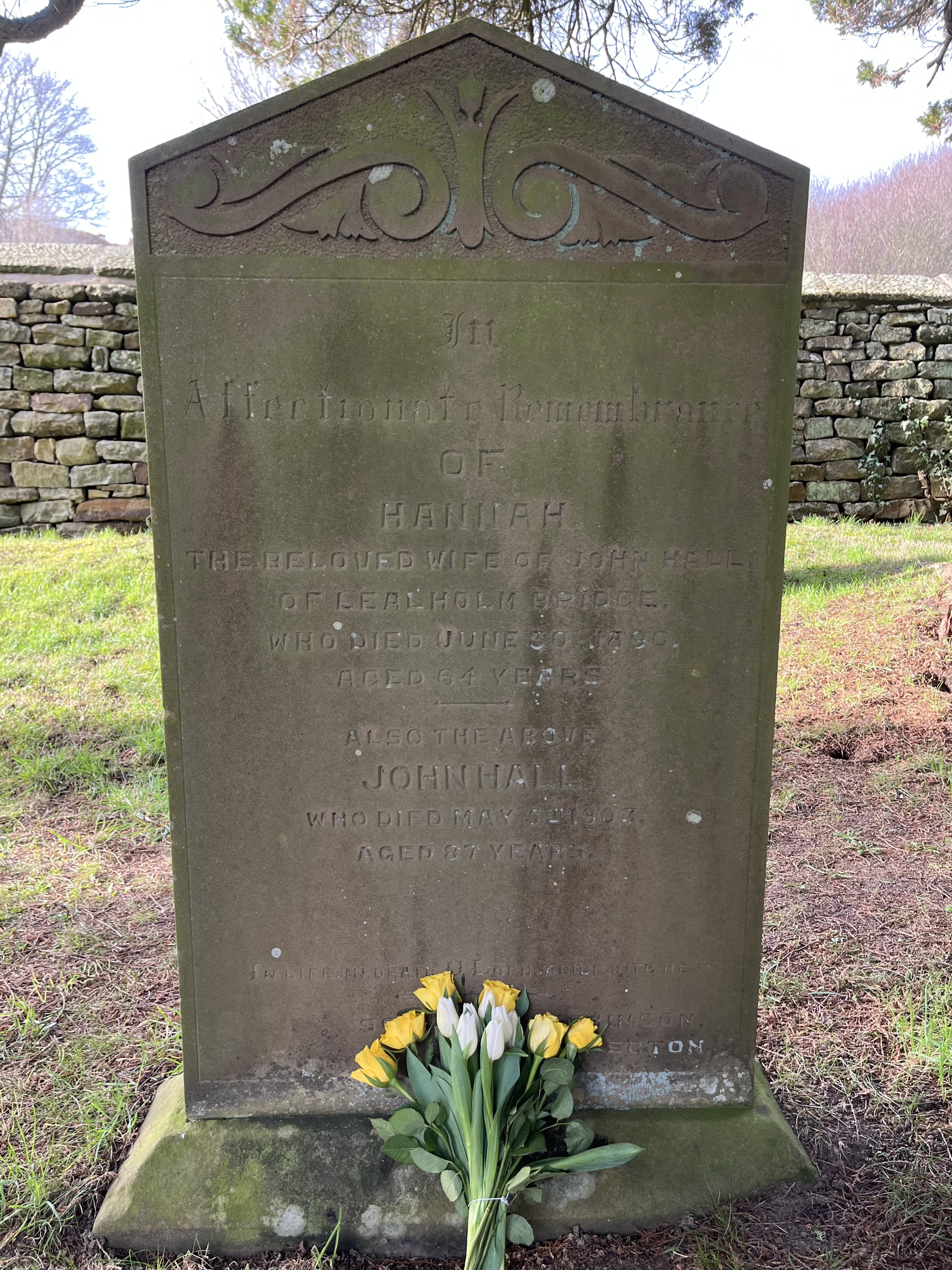
The inscription on Hannah Raw/Hall’s grave, where she is buried. She died in 1890 at the age of 64. Readers’ detective work helped me track the grave down.


The quest to find out more about Hannah Raw has produced some excellent information, thanks in a large part to reader Marion Atkinson’s endeavours. Best of all, Marion told me where she was buried.

If you remember, nine-year-old Hannah’s 19th century sampler is on my mum’s kitchen wall alongside two by my ancestors Mary Atkinson and Jane Lacy. We didn’t know anything about Hannah or how we came to have her sampler, but for many years it was kept rolled up with Jane Lacy’s at my Nana’s home. I wanted to find out who Hannah was, and why we had possession of her pretty piece of sewing. Thanks to Marion, and to sampler and family history enthusiast Gillian Hunt, we had started to build a picture of Hannah’s life (we also discovered that, remarkably, Marion and I are distant relatives!).

We found out that sadly Hannah’s parents had died when she was young, her mum Ellis in the same year that Hannah created her sampler (1835) and her father Matthew when she was just 13. By the time of the 1841 census, 15-year-old orphan Hannah was in service living with the Adamson family. Initially we thought that there was no trace of her after the 1841 census. But we were wrong!

Thanks to Marion’s detective work, we can now flesh out much of the rest of Hannah’s story.

On 23rd December 1850 when she was 24, Hannah married John Hall, 34, a grocer and draper born in Castleton and they set up home in Lealholm. By the time of the next census ten years later, the couple had had two children, Sarah, aged nine, and six-year-old Ellis, named after Hannah’s late mother. Husband John was now listed as a joiner and wheelwright. Not much of note changed for the next ten years, but by the 1881 census, when Hannah was 55 and John 65, 26-year-old Ellis had left home, while 29-year-old Sarah, listed as a dressmaker, was still living with her parents.

In fact Sarah never married, and lived with Hannah and John all their lives. Sadly, Hannah died in 1890 at Lealholm aged 64 (and not in the Whitby district a year later, as we had wondered in my last piece about her). Marion also told me that John died in 1903 at Lealholm when he was aged 87 and that both were buried in the graveyard of the Church of St Thomas, Glaisdale.

Now I don’t need much of an excuse to go for a spin across the North York Moors, especially to the village where my dad was born, so last Sunday, a friend and I jumped in the car and set off on the hunt for Hannah’s grave. I was determined to lay some flowers and pay my respects to this child/woman whose nearly 200-year-old piece of embroidery on our kitchen wall sparked such curiosity, and whose start in life had been so difficult.

The grave wasn’t hard to find, as I was armed with a picture of it that was already available online. Finally I was as close as I was ever going to get to meeting Hannah Raw. I lay down my tulips, and read the inscription:

‘In Affectionate Remembrance OF HANNAH, BELOVED WIFE OF JOHN HALL, OF LEALHOLM BRIDGE, WHOE DIED JUNE 30, 1890, AGED 64 YEARS.

ALSO THE ABOVE, JOHN HALL, WHO DIED MAY 5TH 1903, AGED 87 YEARS.’

I spent a quiet moment thinking of Hannah, of how difficult her childhood must have been and hoping that, against the odds, she had found some happiness in life.

And it seems she did. Her youngest daughter Ellis married Glaisdale joiner William Hodgson in 1878, and thanks to them, Hannah became a grandmother to eight children, four boys and four girls.

Therefore, we can conclude that there must be some living descendants of Hannah Hall (nee Raw), and wouldn’t it be wonderful if one of them is reading this piece? If you think that is you, then please get in touch by either contacting this paper, or through my contact page at countrymansdaughter.com.

One of my goals was to find a picture of Hannah, but as photography was in still its infancy when she was alive, it’s unlikely one exists. There is a tiny glimmer of hope though. Famous Moors photographer Frank Meadow Sutcliffe (1853-1941) was active during Hannah’s lifetime, so who knows? Maybe he snapped our long lost lady!

Read more at countrymansdaughter.com. Follow me on Twitter @countrymansdaug

This column appeared in the Darlington and Stockton Times on 24th and Ryedale Gazette and Herald on 22nd February 2023
City rocks the boat

D4B7E9B4-8B63-46FB-BD80-8CA4463E9304
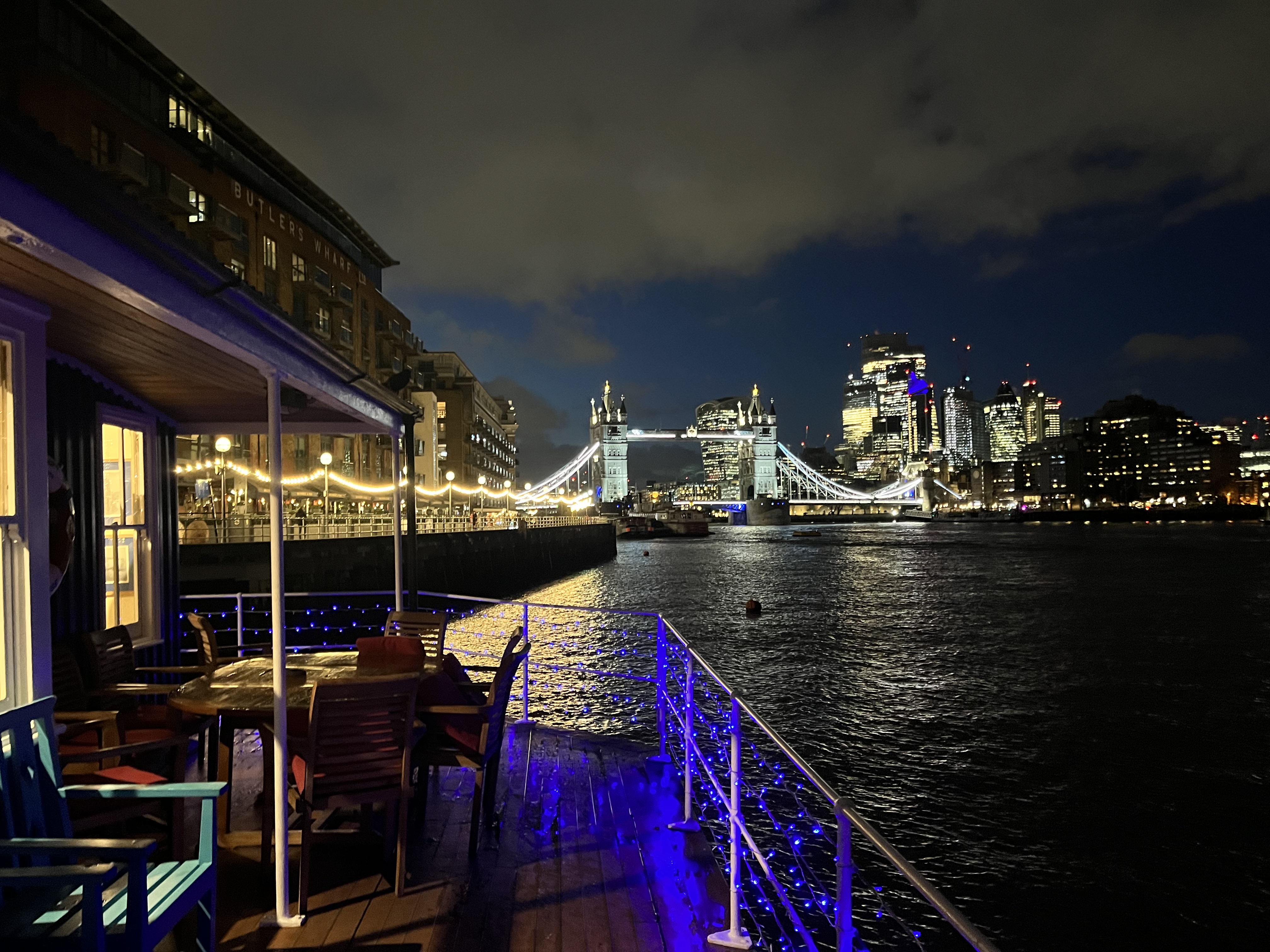
The view of Tower Bridge at night from our houseboat on the River Thames

73DFA674-6A2A-4671-9B99-5D55DC3C6C47
Houseboats became popular thanks to the Henley Royal Regatta

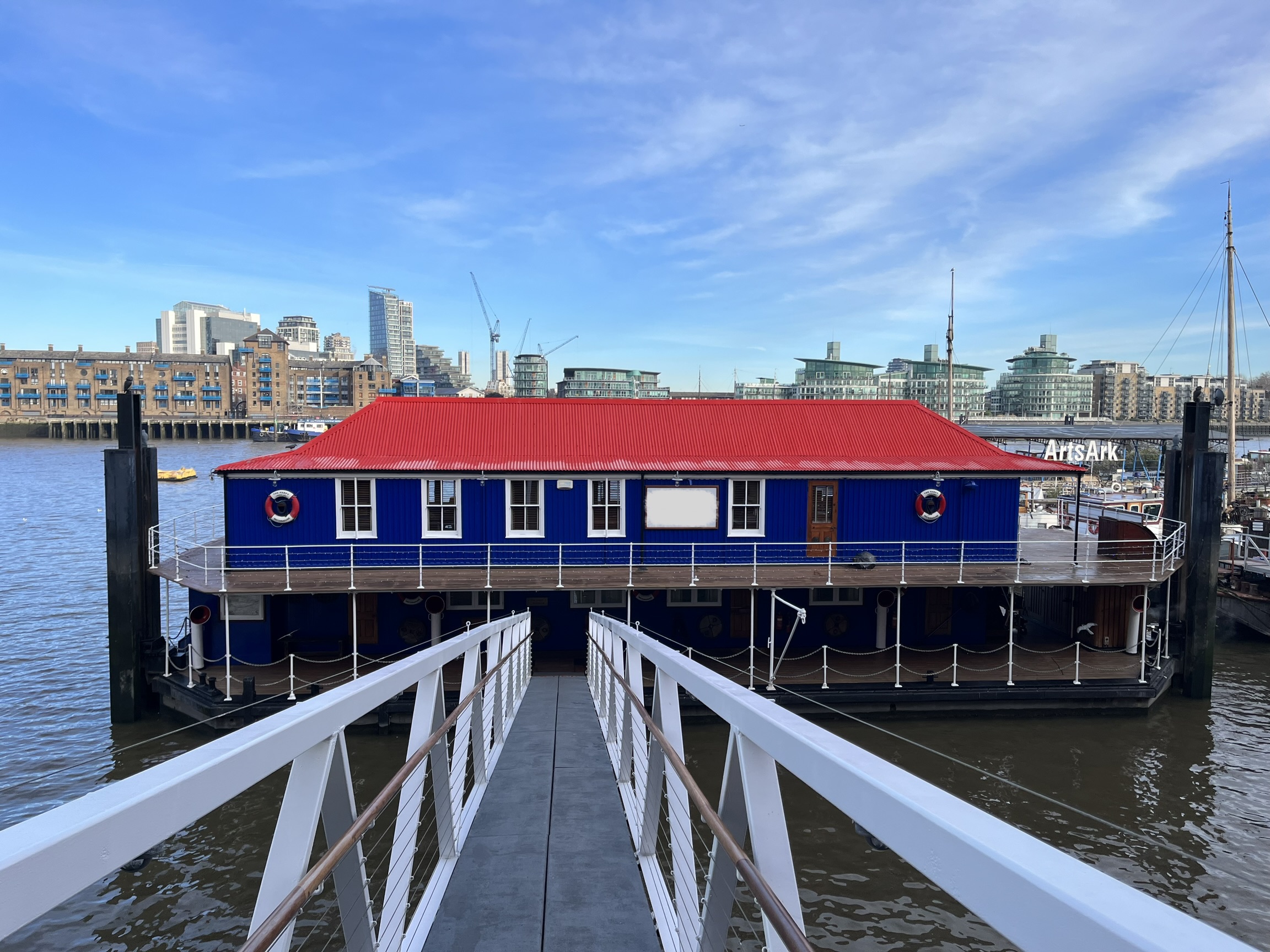
I was very fortunate recently to be invited to a friend’s 40th birthday celebration which involved staying on a houseboat on the River Thames just a few hundred metres east of Tower Bridge.

The boat, which was constructed in 1904, is permanently moored and commands spectacular views of the famous bridge and central London. We were blessed with glorious weather which enhanced the amazing modern architecture of iconic glass buildings such as the Shard, the Walkie-Talkie Building and the Gherkin (I know some of these structures have proper names, but as I don’t have a clue what they are, nicknames it is!).

Because it was a midweek in January, and despite being in the heart of the London tourist trail, where we were was relatively quiet which made it a pleasure to walk along the river, through the famous Borough Market and past the Tower of London without having to fight our way through hoards of people. I even got a seat on the tube whenever I needed one.

Staying on the boat was a wonderful experience. As the sun went down, the pink-gold light reflected upon the multitude of glass windows in the City, and as the sky gradually darkened, lights began to come on along the streets and in the buildings, including on Tower bridge itself, until the whole lot was illuminated like the set of a Christmas film. It was a privilege to be able to sit on the upper deck in the dark and just marvel at the uninterrupted and very special view in front of us. Because we were on a boat, despite being so close to the City, it was very quiet, apart from the sound of lapping water and boats passing by.

For some reason, because we knew it was permanently moored, it took us by surprise to find that the houseboat would rock on the water, especially when other vessels passed by. Lying in bed, it felt like it had set off, even though we went nowhere. It was quite a strange sensation. We soon learned that the Thames has two rush hours, just like the roads. The first one is between 6am and 9am, and the second, between 4pm and 7pm, and that’s when our boat was at its rockiest. For one of our guests, it was all a bit much, and she became genuinely seasick. She was quite relieved that she could only stay one night!

Thankfully, I didn’t suffer in that way, and found the gentle undulating motion quite relaxing. The boat was very smart, with oak flooring over its two storeys, expensive furniture, four double bedrooms, two bathrooms, and all the other mod-cons you’d expect in an upmarket holiday let.

Owning houseboats became popular in London in the wake of the Henley Royal Regatta, the first of which was held in 1839. The mayor of Henley-on-Thames, which lies around 40 miles west of London, decided that his town needed a public attraction, and it was originally set up as an annual fair with amusements, stalls and boat races.

The races were extremely popular with attendees, and so the emphasis of the event focussed on rowing contests for amateur oarsmen across two days of competition (which has stretched to five today). In 1851, HRH Prince Albert consented to be the regatta’s patron and since his death in 1861, the reigning monarch has always agreed to be patron, allowing the event to add ‘Royal’ to its title.

The regatta became the must-see occasion for anyone who was anyone in Victorian times, and the fashionable elite who could afford it started to buy fancy houseboats so that they could watch the races from an unparalleled position on the river itself. Soon, the water was bustling with houseboats, so much so that other rich spectators started to show a preference towards more permanent holiday homes along the riverside. And as such, the popularity of houseboats waned and by the dawn of the 20th century, they had became a less common sight upon the River Thames.

There are thousands of people who live on houseboats today, and it is considered a more eco-friendly and sustainable way of life. How would you feel about living on the water?

Read more at countrymansdaughter.com. Follow me on Twitter @countrymansdaug

ENDS

This column appeared in the Darlington and Stockton Times on 17th and Ryedale Gazette and Herald on 15th February 2023

Tea with a presidential touch

54DB4FE0-20FC-438E-8A1D-FA593B6FA749
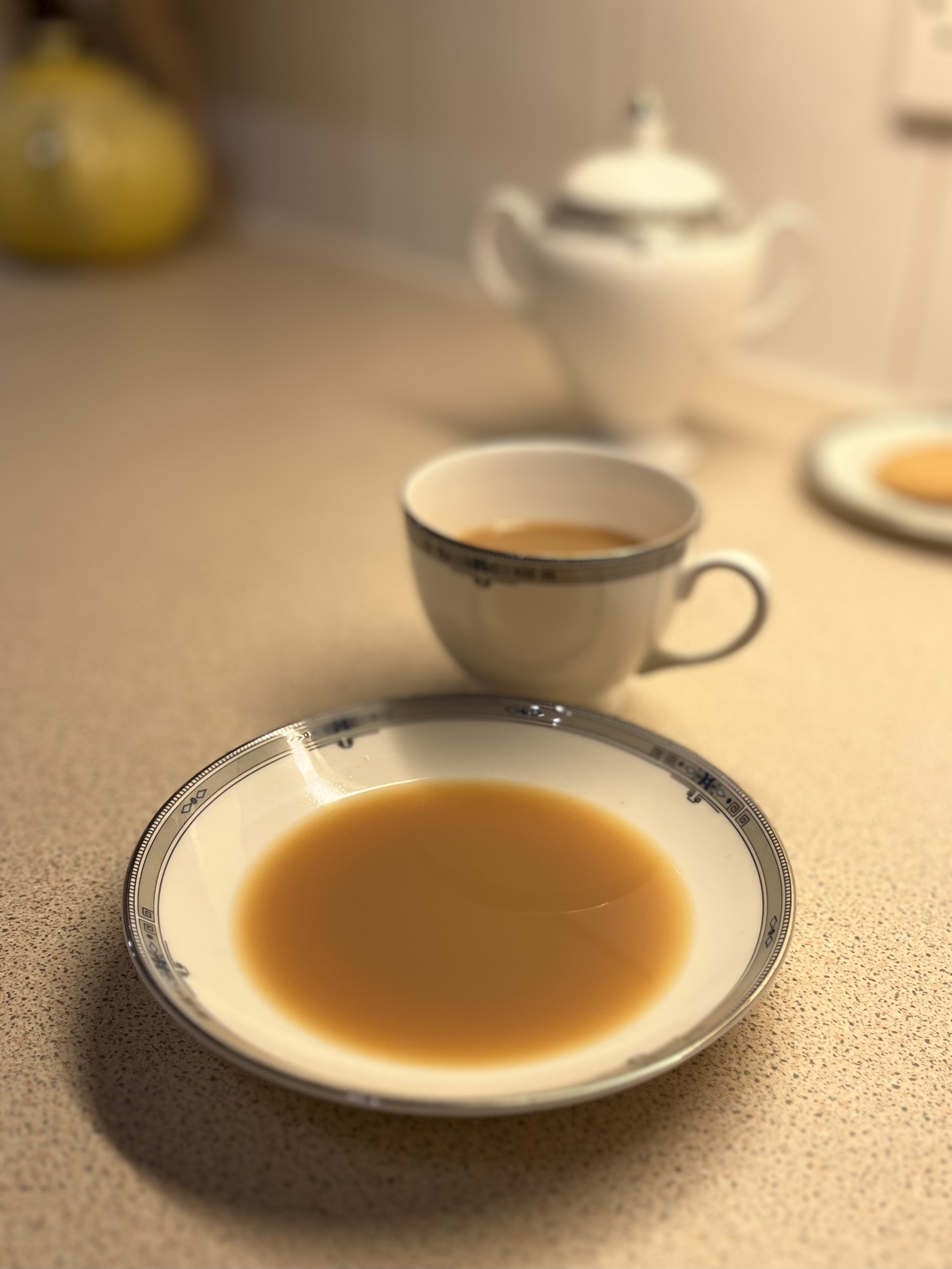
Why do some people people pour their tea into a saucer before drinking it?

Following my columns about tea, I have discovered that we not only have our quirks about the way we make tea, how we add milk, and what shade of brown we like, but there also those who have their own ways of physically drinking it.

I have a specific mug that is my favourite, and if that is in the wash, I have the second best and so on. I like drinking out of a cup and saucer when I’m out at a nice tea shop, because it makes it feel rather special, but I choose not to at home as a cup simply doesn’t contain enough tea for the amount I consume in one sitting. I down three mugs in rapid succession in the morning, so if I was restricted to dainty little cups, I’d be constantly having to fill them up.

But there are some people who don’t drink from either a mug or a cup. I was contacted by Phil Collier from Farndale who told me: “It brought to mind my grandfather, Jack Wardell, who farmed at North Farm, Fadmoor. Grandfather’s tea was always milk first and tea leaves, not bags. He always took his tea in a big cup and saucer. Said tea was then poured into the saucer and drunk from it. Quite a delicate touch for someone with agricultural hands. He drank his tea this way until his death. Thank you for the articles, always something to remind us of the old times.”

I asked Phil if he thought pouring tea from a cup into a saucer was just a quirk of his grandfather, or whether it was a peculiarly North Yorkshire way of supping the brew. He didn’t know, and so both of us asked our mothers if they knew of anyone who drank tea in this rather unusual way, and neither of them did.

After discussing it with his wife Shirley Ann, Phil discovered that her father had also drunk his tea that way. “He was a fruit grower in Norfolk and she thinks it was to cool it so he could get back onto the land. It sounds quite plausible,” he says. So I wondered then if it could it be a quirk of farmers rather than simply a North Yorkshire thing?

Having done a bit more research on this, I can confirm that Shirley Ann is absolutely right. Tea used to be drunk to quench thirst far more than plain water, and usually labourers would only get short breaks. So to be able to drink the steaming hot brew comfortably but within the limited time window, the workers would pour a little bit into their saucers to cool it quickly and allow them to satisfy their thirst.

When tea first started to be drunk many centuries ago in China, it was out of small bowls, which didn’t have handles like today’s teacups. If you’ve been to a Chinese restaurant recently and ordered tea, you will likely still have been served it in little cups without handles. But the green tea popular in China is meant to be drunk warm, rather than hot, and so holding the cup in your bare hands is not an issue.

Back in 18th century Europe, the popularity of Chinese green tea waned to be taken over by Indian black tea, which was drunk at a much higher temperature. It was difficult to hold the cup with bare hands, and that’s when we begin to see cups being made with handles on them, the first purportedly appearing in 1707 Germany thanks to a porcelain inventor named Johann Friedrich Bottge.

The problem of drips and spillages meant that soon after that saucers began to be made upon which you could set these daintily-handled little cups, saving scorched hands as well as protecting tables and fine cloths from stains due to spilt tea.

In the 18th century, pouring your tea into your saucer wasn’t just the preserve of lowly labourers, but was a fashionable thing to do among the well-to-do. There is a story that when Thomas Jefferson was questioning why the USA needed a Senate, George Washington explained that the Senate’s job was to ‘cool’ the heat of suggested legislation in the same way that Jefferson poured tea into his saucer to cool it down.

So it seems Phil Collier’s grandfather’s method of drinking tea was actually inspired by presidents.

Read more at countrymansdaughter.com. Follow me on Twitter @countrymansdaug

This column appeared in the Darlington and Stockton Times on 3rd and Ryedale Gazette and Herald on 1st February 2023

A witchy coincidence

D3FF3A2C-E2F4-4739-A30F-86F16CE76C4E
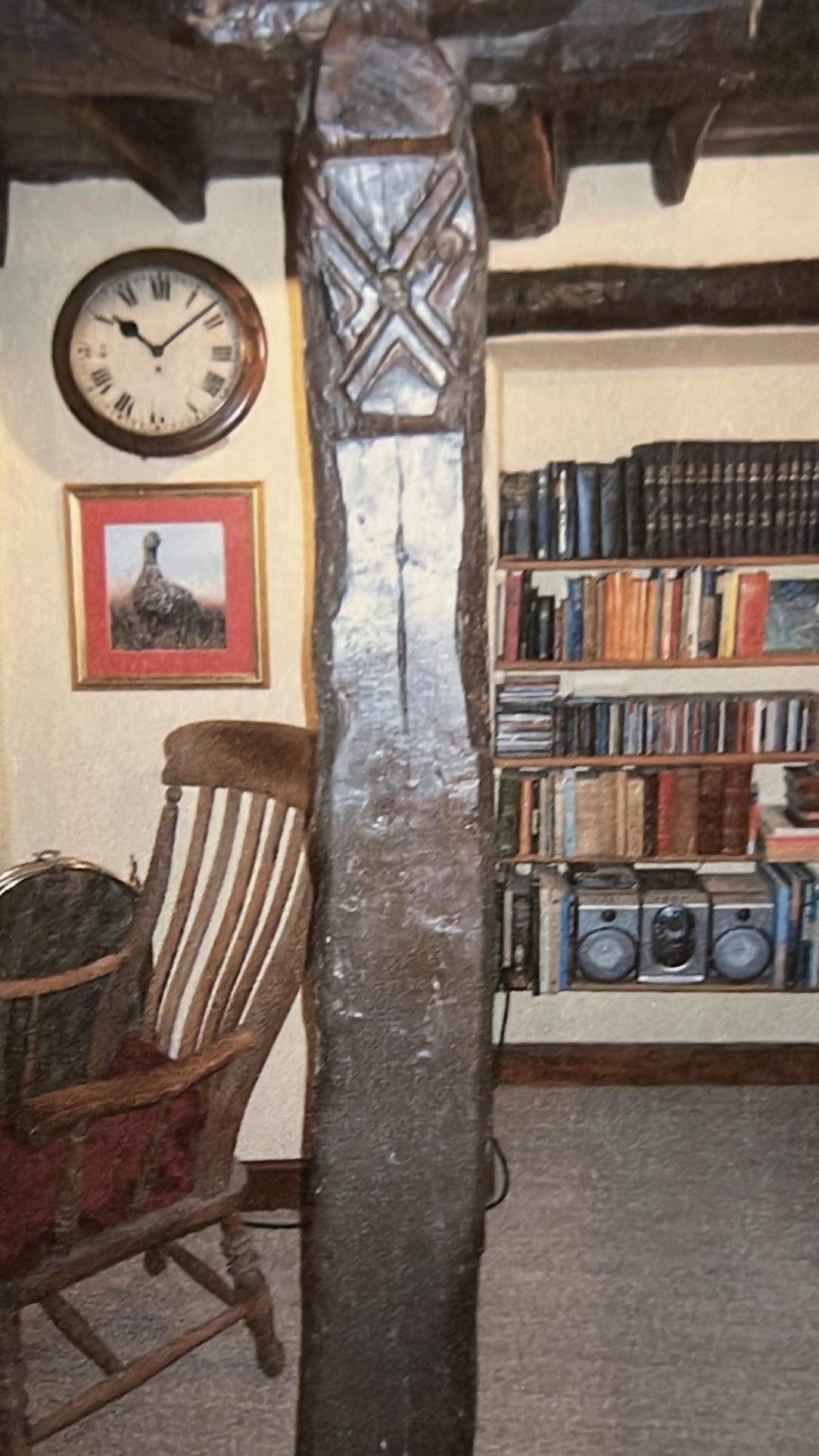
The photo taken by my dad in 2008 of the witch post found in the house belonging to my friend Stephen Peill’s parents. Until now, neither of us knew our parents had ever met. 

Following my piece about witch posts I had some interesting responses. If you remember, these carved posts are usually found near fireplaces in very old houses and originally it was thought that the carvings, often featuring crosses, were intended to ward off evil spirits and witches, hence the name. But over the years, Dad came to believe they were in fact associated with the legendary Martyr of the North York Moors, Father Nicholas Postgate.

A friend of mine, Stephen Peill, got in touch to say that there had been one at his father’s house when they lived in Newton-on-Rawcliffe, near Pickering. I’m so grateful to people who get in touch like this because, firstly, it means they are  reading my column, and secondly it means I can go all detective and have a good rummage in my dad’s study, one of my favourite pastimes.

I found a couple of ring-bound folders labelled ‘witch posts’ and listed at the front were all the examples that, through exhaustive research and letter-writing, dad had managed to track down. And sure enough, there, at number 29 on the list, was an entry called ‘Old Pond House, Newton-on-Rawcliffe’.

I pulled out the relevant documents, which included information about the post itself, and also correspondence between my dad and the home-owners, who at the time were Stephen’s dad Doug and stepmum Sue.

Dad had written them an approach letter in January 2008, addressing it ‘Dear Witch Post owner’, so it is clear that he did not know them. He explains his purpose for contacting them, that he was conducting research for a book about witch posts, and included a questionnaire to fill in. Dad explains: “My research to date has led me to believe that these so-called witch posts are a valuable and largely neglected part of our northern history.”

Thankfully, Stephen’s parents were very happy to help, and a series of letters were exchanged, resulting in my mum and dad visiting the house in August 2008.

At the time, he wrote: “The cross post formed part of the inglenook hearth, but alterations have marooned it near the centre of the present dining room where it supports a massive beam, and indeed the ceiling.”

Afterwards, Dad sent them a thank you letter, and what I find especially interesting is the way he describes how he had tracked that particular post down: “Sue, you asked how I knew you had a post…I found a newspaper cutting dated 4th October 1984. It is from the Malton Gazette and Herald and it features the sale of your house. It says it contains a ‘witches post’. I am enclosing a copy for you to keep – and you’ll see the asking price of the house was £33,000. Quite a bargain!”

Stephen and I have known each since the mid-1980s when he used to frequent the local pub in which I worked. Despite that being almost 40 years ago, our little band of pub goers still meets regularly at parties and various social occasions. The remarkable thing is, until Stephen mentioned the witch post in the house at Newton-on-Rawcliffe, neither of us had had any idea that our parents had ever met!

I was also contacted by writer Terry Ashby who says: “I recall in the mid-1980s there was an historic cottage for sale in Beck Hole. It’s many years since I was in Beck Hole and I can’t remember the name of the property but it is at the far end of the green on the left side coming from the Birch Hall Inn. I’m sure there is a witch post near the open range.”

I think Terry is right, because in the same file is an entry about ‘Murk Side, Beck Hole’, an old thatched cottage which is mentioned in the Civil Recusant Returns for Egton from 1604-1778. So clearly this house was associated with Catholic resistance during the time of persecution, which backs up my dad’s theory that the ‘witch posts’ were somehow connected. The extremely sad thing is that Murk Side was pulled down in the early 20th century, but the post was moved into another house nearby, where I believe it still stands. There is too much information on this particular post to go into here, it could fill a whole other column.

And that then begs the question, should I finish the book that my dad started?

Read more at countrymansdaughter.com. Follow me on Twitter @countrymansdaug

This column appeared in the Darlington and Stockton Times on 27th and Ryedale Gazette and Herald on 25th January 2023

Hannah’s story goes on

Hannah Raw’s sampler that hangs on my mum’s wall

The letters MR and ER on the bottom right are her parent’s initials. The letters ‘ER’ are in dark thread showing that her mother, Ellis, was dead before Hannah made this sampler.

Following my pieces about North York Moors orphan Hannah Raw, I have been contacted by Gillian Hunt from Newcastle, who loves to study samplers and also enjoys tracing family histories. Great news for me, and for any of you who are also intrigued by this expanding tale.

If you recall, nine-year-old Hannah’s 19th century sampler is on the wall of my mum’s kitchen alongside two done by my ancestors Mary Atkinson and Jane Lacy. We didn’t know anything about Hannah or how we came to have her sampler, but for many years it was kept rolled up with Jane Lacy’s at my Nana’s home. We had some clues (featured in my last piece) from my distant relative Marion Atkinson, who believed that Hannah’s parents died when she was quite young. 

Gillian suggests that there may be a Scottish influence in the sampler design because the peacock with the fanned tail at the lower left corner and the band of capital letters across the top are very characteristic of that region. Scottish samplers also contain a lot of red and green threads, which Hannah used, although it may be that these were all she had available. She adds that Scottish samplers often featured the initials of other family members which, if sewn in black or dark thread, meant they pre-deceased the sampler’s creator. Hannah’s sampler has two sets of initials after the date; MR, which is in pale blue, and ER, which is in dark grey. 

Gillan says: “I picked up Hannah on the 1841 census, but it is of limited use to genealogists as it does not give places of birth, relationships between the members of a household, and the ages may be slightly inaccurate. On the Library edition of Ancestry.com, often more information is pulled through at the right hand side of the page if you click their name on the census list. For Hannah, it pulled up only a record of baptism: ‘Hannah Roe, baptised 23 September 1825 at Glaisdale, daughter of Matthew Roe, a labourer, and his wife, Ellis of Hartoff (Hartoft)’.”

Gillian goes on: “Hannah’s parents’ names fit the initials MR and ER on the sampler. If Hannah worked the sampler early in 1835, she would still be nine years old at the time. The fact that the name has been recorded as Roe rather than Raw is not particularly concerning – names were often misheard and misspelled, even by curates. Ellis as a female name is very unusual. It is common for a mother’s maiden name to be given to a son as a first name but I have never come across it as a daughter’s name. Is it a corruption of Alice or Elise/Elisa?”

Gillian discovered that there was a marriage recorded at Danby on 29 August 1820 of Matthew Raw to Ellis Winspear, which must be Hannah’s parents due to the unusual name of the bride. Both signed the register with their mark, which meant they could not write. She also found a record of Ellis Raw being buried at Danby on 15 February 1835. There will not be a death certificate for her as civil registration did not begin until 1837 and given that her children were born at approximately two-yearly intervals, Gillian thinks it is possible that Ellis died as a result of pregnancy or child birth. As the initials ER are in dark thread, it means Hannah completed the sampler after her mother died and sometime before 23 September 1835, as she would have turned 10 years old by that date.

“There is a burial for Matthew Raw in the Pickering registration district (which covered Hartoft) registered between April and June 1838. This fits with your information that Hannah’s parents died when she was young. I can’t find any other information about him, except for the baptisms of his children,” says Gillian.

In conclusion, Gillian writes: “Hannah was born in 1825, the third of seven children of Matthew, a farmer, and Ellis Raw of Hartoft. Her sampler was completed in 1835, prior to 23 September 1835. Both parents had died by the time Hannah was 13. This probably meant that Hannah had little choice but to go into service, living with the Adamson family in 1841. There is no trace of Hannah after 1841 although it is possible she died unmarried in the Whitby registration district between April and June 1891 aged 76.”

Read more at countrymansdaughter.com. Follow me on Twitter @countrymansdaug

This column appeared in the Darlington and Stockton Times on 20th and Ryedale Gazette and Herald on 18th January 2023

How do you take it?

E46B4BCD-A8E4-4401-BBC3-8944C7FC28A8
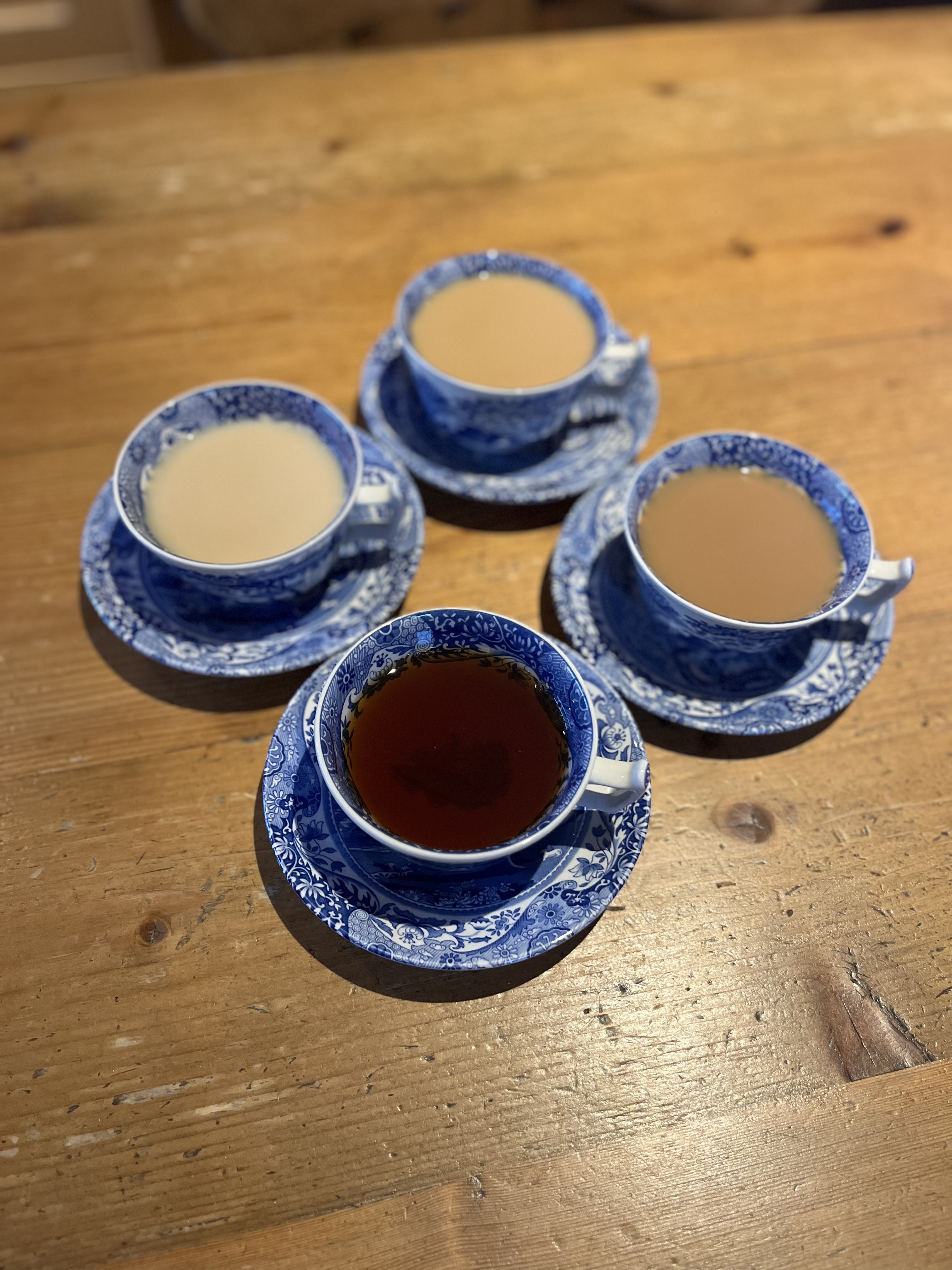
Which is the ‘right’ colour of tea?

My recent column about tea bags resulted in some spirited feedback. If you recall, I wrote that I make time each day to switch off and enjoy a pot of proper tea made with good quality leaves. It is an essential part of my routine, and for me, is like therapy, having seen me through many a stressful time in my life. When teabags were first invented, though, they were viewed as rather posh, but over the years they became more popular than leaves, and thus the roles have reversed, with leaf tea now being seen as a bit more upmarket.

Reader Sarah Mason says that her family have always preferred tea leaves over bags. She writes: “Sacrilege in my house to use tea bags…Way back when, Mum and Dad didn’t even use a tea strainer. So it was dangerous to empty your cup completely. Good for reading your future though, apparently!”

I don’t use a strainer either, and have a habit of always leaving a bit of tea in the bottom of my cup, even when it has been made with bags and so is complete unnecessary. I’ve never tried to read my dregs though, and the art of doing so is known a Tassography (yes, it is a bona fide ‘ography’). The Chinese, for whom tea drinking has been a highly significant ritual for centuries, are thought to be the first to have ‘read’ the leaves, but it became popular in Europe among soothsayers and fortune-tellers during the superstitious 17th century once tea-drinking had become commonplace.

Clare Proctor, who could claim to be an expert on the brew due to the fact she owns a rather nice tea shop on the Shambles in York, says: “I was brought up with the idea that proper tea was made with loose leaf tea in a pot and it was terribly vulgar to use bags…By the way, you could start another debate – which goes in the cup first – milk or tea?”

She has a point. I asked Clare what she did, and she replied that she fills her cup half way, then adds milk until it is the right colour. But what is the ‘right’ colour? For me it would be a deep brown, akin to what those of us of a certain age might know as ‘American Tan’ (for the youngsters, that is a fetching colour of women’s tights from the 1970s). For many others, the right colour is more like off white, due to the fact they seem to put more milk than tea in their cups in a concoction that barely deserves to be called tea. Another reader, Gareth Child, believes putting milk in at all is totally unacceptable!

There is also the question of the water/leaf ratio. Because I like my tea fairly dark, people assume I want a really strong brew. They proffer something akin to tar thinking that’s what I like, and throw in far too much milk. I try to explain that I like an average-strength tea, but with only a small amount of milk. I’m not fussy really. Well, I am, a bit. Or maybe a lot. But when it comes to tea, it matters.

So back to the question of milk first/tea first. What do you do? Are you in the Proctor camp, with milk after, or like me, milk first? Believe it or not the answer is a reflection of your ancestral status in society.

When we first began importing black tea from India in the eighteenth century, only the rich could afford to buy it. They’d sip this precious elixir from fine bone china cups, taking the edge off the bitter taste with a drop of the finest milk poured into the top. As the product became more popular, and thus more affordable, the hoi poloi began to indulge, but when they poured the hot infusion into their rough terracotta mugs, the boiling water cracked the clay causing it to leak. They soon realised that if they put the milk in first, it would cool it down and thus solve the problem. Of course, bone china is incredibly strong and easily tolerated the hot liquid.

So you can deduce a person’s breeding by the way they drink their cuppa. Milk last means you are from fine stock. Milk first and you’re common as muck.

Just like me.

Read more at countrymansdaughter.com. Follow me on Twitter @countrymansdaug

This column appeared in the Darlington and Stockton Times on 13th and Ryedale Gazette and Herald on 11th January 2023

Is the truth in the post?

5ABA3BF6-2E79-4EE0-A4A6-D364A24A8117
Dad continued to research witch posts and their connection to the martyr Father Nicholas Postgate right up until his death in 2017.

Happy New Year and welcome to 2023! I do hope you’ve had a wonderful time over the holiday season. For us, the festive period is always a time of joy alongside reflection, when we think of our lost loved ones who are not here to share it with us, and about other people who suffer loss and illness around this time of year.

If you’ve read any of my dad Peter Walker’s writing, either through his books or columns, you’ll know how proud he was of his home county and he would agree with a commentator I heard saying: “Of all the regions of our great country, Yorkshire seems to pride itself on taking most pride in itself.”

Dad grew up in Glaisdale, a small village in the heart of the North York Moors, and in a 1979 article I found in his study at my mum’s house, he tells us how lucky he was to have a childhood which allowed him to freely roam the rural landscape. He writes: “Remote and beautiful, it boasts several isolated farmsteads and I used to visit friends there, living in solitary splendour and away from the bustle of life in the towns.”

These ancient farmhouses were very sturdily built and Dad found their interiors fascinating, particularly the huge inglenook fireplaces. At least two that he visited had carvings on the wooden posts supporting the smoke hoods of these fires. The posts were known as ‘witch posts’ and they sparked in Dad an interest that lasted right up until his death in 2017. In his later years, it became a real quest to find out more about the stories behind them. What he discovered went against many long-held beliefs but Dad was convinced his research proved him right.

Originally it was thought that these carvings were intended to ward off evil spirits and witches, hence the name. They were usually crosses, some simple, while others were more complicated, with the cross forming the centre and elaborate carvings surrounding it. But over the years, Dad came to believe they were in fact associated with the legendary Martyr of the Moors, Father Nicholas Postgate.

Postgate carried out his ministry in the 1600s at a time when Catholics were being persecuted by the state, and to be caught practicing mass was considered a treasonable offence. Therefore many Catholic priests went underground, and, like Postgate himself, often hid in open sight by being ‘employed’ by wealthy landowners as servants and gardeners. Although these landowners outwardly appeared to support the Church of England, in fact they still secretly practised Catholicism thanks to brave priests like Fr Postgate.

Moorland locals devised cunning ways of letting fellow Catholics know where mass was being celebrated, such as hanging out a certain number of items on a washing line near the home in question. Unfortunately, Postgate was eventually caught baptising a child and was executed in York in 1679. In 1987, his sacrifice was recognised by Pope John Paul II, who beatified him alongside 84 other Catholic martyrs from England and Wales.

During his quest to find out more about Postgate, Dad discovered that witch posts bearing these cross symbols only proliferated during the time of the martyr, and only in areas where he is thought to have visited, which is the main reason why he believed they were connected to Postgate. Their purpose, he suggested, was to secretly indicate to fellow Catholics that they were in a safe house. It is possible that the association with evil spirits and witches was a deliberate ploy by Catholics to spread misinformation so that the true meaning behind the symbols would not be discovered. One of these posts can be seen in the Ryedale Folk Museum in Hutton-le-Hole today.

Dad was finally able to publish his theories in his book ‘Blessed Nicholas Postgate, Martyr of the Moors’, a comprehensive biography of the holy man. As I was researching this piece, I came across a Yorkshire Post interview he did in 2012 and what I didn’t know was that his diagnosis of prostate cancer in 2007 was what inspired him to finally write the book.

“It’s a story I feel very strongly about and thought I should get on with the book before I died,” he said.

I wonder if anyone reading this knows where any more witch posts can be found?

Read more at countrymansdaughter.com. Follow me on Twitter @countrymansdaug

This column appeared in the Darlington and Stockton Times on 6th and Ryedale Gazette and Herald on 4th January 2023

Still hunting for Hannah

Mary Atkinson, left, my mum’s grandmother, standing outside her home in Lealholm on the North York Moors with my mum’s mum, also called Mary.

Mary Atkinson, my mum’s grandmother, whose sampler we have on our kitchen wall, made when she was 12.

My recent quest to find out more about a little 19th century girl from the North York Moors called Hannah Raw has borne fruit.

If you recall I wrote about some 19th century samplers on the wall of my mum’s kitchen. Two were done by ancestors, one called Mary Atkinson, who was 12 when she created hers in 1876 and was my mum’s maternal grandmother, and Jane Lacy, who was 10 in 1837 when she created her sampler, and was Mum’s great great aunt on her mother’s side. The third sampler was by Hannah Raw, who was nine in 1835, but about whom I knew nothing. We don’t know how we came to have her sampler, but for many years it was kept rolled up with Jane Lacy’s at my Nana’s home.

One reader contacted me to say his neighbour had the surname Raw and hailed from the Glaisdale/Lealholm area. I’m trying to get in touch with him to see if he can help. I was also contacted by Marion Atkinson who originates from Lealholm and she believed we were distant relatives on my mother’s side. She wrote: “My father was Dick Atkinson of Lealholm, and I knew your dad and your gran. My 4x great grandfather was John Raw of Fryup.”

She added: “Mary (Polly) Atkinson, b.1864, married Jack Lacy, a blacksmith at Lealholm. She was sister to my great grandfather, Thomas William Atkinson, b.1871.”

This Mary Atkinson that Marion mentioned is the same one whose sampler adorns our wall, and is indeed my mum’s maternal grandmother. So Marion is related (albeit at a distance) to my mum’s side of the family. But could she also be a distant relative of Hannah, via her 4x great grandfather?

She tried to find out a bit more about Hannah, and believes that her parents died when she was still young. If that is the case, in the days when social care did not exist, it is possible, that she was taken in by other nearby families to be looked after, and maybe by the Lacy family, which could explain why we have the sampler she made when she was just nine years old. By the time she was 15, according to the 1841 National Census (which anyone can view online), a Hannah Raw was living in the Whitby area in the household of James and Catharine Adamson, a couple in their 40s, alongside Ann Backer and Sarah Backer, who were 25 and 20 respectively, as well as a boy called Isaac Cacomb, aged 15. We think it is the right Hannah, but what was she doing there?

The fascinating thing about the census is that it lists the occupations alongside the names. James Adamson was a farmer and, as there is nothing listed against Catharine’s name, I am assuming she is his wife (rather than than a brother or sister). Next to the two Backer women is listed ‘Ind’, which I have discovered is the abbreviation for ‘independent’, in other words, living by their own means. This meant they did not have a profession and was applied to men, single women and widows. Young Isaac was listed as a farm labourer, presumably employed by Mr Adamson, and our Hannah had ‘F.S.’ written beside her name, which means ‘Female Servant’, and so it appears that she was employed by the Adamsons as a live-in servant.

Marion has kindly offended to try to find out more, but if you do know anything more about Hannah, please get in touch with me via this paper or on my contact page at www.countrymansdaughter.com.

I mentioned our connection to Marion to my mum, who remembered a little about Mary Atkinson, particularly the fact that people called her Polly. She didn’t get to meet her, though, as Mary died on 21st August, 1935, almost two years before my mum was born. Mum said she recalled seeing a picture of Mary, but wasn’t sure where it was. Of course, that set me off digging into the family archives, pulling out all the old photo albums hidden in various cupboards upstairs. After a good old rummage, I found said picture, and it gave me such a thrill to be able to put a face to the 200-year-old name that has hung on our wall for so many years.

I wonder if the day will come when I can do the same for Hannah?

Read more at countrymansdaughter.com. Follow me on Twitter @countrymansdaug

This column appeared in the Darlington and Stockton Times on 30th and Ryedale Gazette and Herald on 28th December 2022

Sweet excitement of Advent

So the big day is just around the corner and there are not many doors left to open on our Advent calendars. This year might be the first since I had children that I didn’t buy each of them one. Time seemed to run away with me, and before I knew it, we were well into December and so there didn’t seem to be much point. The fact that my children are aged 26, 24 and 20 may also have been a factor!

I was discussing Advent calendars with my mum and when she was a child, they didn’t seem to exist on the North York Moors, or if they did, she certainly never had one. She also didn’t think she gave them to us children after she had become a mum herself. However, I do remember them being around occasionally, and the excitement of opening up the door each day to see what Christmassy picture would be revealed, the anticipation heightening as the closed doors grew fewer and fewer. We didn’t need such luxuries as chocolate because the thrill of revealing the picture was enough.

I’m not sure when calendars containing sweets started to appear, although some of our posher friends did have those big cloth ones that you would hang on a wall with a sweet or a small gift in each of the 24 pockets. But it seemed that by the time my children were of school age, calendars containing chocolate were very much the norm. In fact it was really difficult to find any without them, yet I was determined that my children would experience the same excitement I had but without the need for a sweet treat. I tried it, but the disappointment on the little faces that there was no chocolate hidden behind the door was too much for any mother to bear, and by the following year I had caved in again. I compromised though, and managed most years to find one without sweets, and so for a time, my kids were lucky enough to get both.

The first printed Advent calendars appeared Germany in the early 1900s, although before that the countdown to Christmas Day had been marked by, for example, chalk marks on walls. We are not certain who invented the idea of a calendar with doors, but the most often repeated tale involves a German boy called Gerhard Lang. Gerhard’s mother would attach 24 sweets or biscuits to a large piece of card, and he was allowed to eat one every day until Christmas.

As an adult, Lang recalled the sense of excitement that he felt at being able to eat his treat, and how that increased as he counted down the days to 25th December. He hit on the idea of creating a printed calendar where a different festive picture would be hidden behind 24 doors. He began mass producing these with his business partner until the 1930s when they went bust. By then, though, his idea had caught on, and calendars were being produced and bought all over the Western world. Here in the UK, it was during the 1950s that they really took off and became one of our annual Christmas traditions.

The popularity of chocolate calendars is surprisingly recent though. There were attempts in the 1960s to introduce them, and Cadbury produced its first one in 1971. I was quite pleased to learn that us Brits resisted them for a long time, concerned that Christmas was becoming too focussed on the gifts rather than than the spiritual aspect but, as we might come to expect, commercialisation won out, and Cadbury’ chocolate Advent calendars finally went into continuous production in 1993. They have never looked back.

Today you can get practically anything in an Advent calendar, such as perfume, toiletries and even toys. However I was very happy to come across a traditional pretty cardboard calendar in a shop in my local market town. As she’d never had one in her childhood days, I decided it was time that my mum had the chance to enjoy her very first one.

I don’t know about you though, but every time she opens up one of those doors, the excitement has been replaced by dread that I have so little time left and so much to do!

I’d like to wish you all a very Happy Christmas!

Read more at countrymansdaughter.com. Follow me on Twitter @countrymansdaug

This column appeared in the Darlington and Stockton Times on 23rd and Ryedale Gazette and Herald on 21st December 2022