Author: The Countryman’s Daughter
Calling all you Queans!

I wonder if you are one of the millions of people who has become hooked on the game called ‘Wordle’? This is a daily online puzzle where you have six chances to guess a mystery five-letter word. There is a new challenge every day, and it has become extraordinarily successful since it was launched in October last year by programmer Josh Wardle. It became so popular that it was bought by the New York Times in January for an undisclosed sum.
The beauty of the game lies in its simplicity, and it is enjoyed across the generations. I play along with my children, my colleagues and my mum, and we all compare how well we do each day. It has spawned a plethora of copycats, including Globle (where you guess a new country each day), Quordle (where you guess four words simultaneously), Sweardle and Lewdle (I’ll leave you to work out what they are!).
Being a wordsmith by trade, I love the fact that by taking part, our youngsters are using and expanding their vocabulary each day, and also that we are all enjoying a common pastime, something that is fairly rare nowadays. Sometimes, it’s the simple things that are the most successful. It will be interesting to see if it is just a passing phase, or whether Wordle has the staying power of the giants of the wording world like Scrabble and Articulate.
On the subject of words, I was at a friend’s house for dinner and the nine us (from different parts of the UK and beyond) got to talking about dialects, and we had the usual discussion over the variety words for an alley, such as ginnel, gennel, gunnel, backs, twitten, snicket and snickelway, to name just a few. The word ‘brossen’ also cropped up, which I’d not come across, and is a West Yorkshire term for feeling full after eating. Backy is also used to refer to a lift on the back of a pushbike, although I would always say ‘croggy’. One of my friends moved to Yorkshire from Wales when she was a teenager, and found that when she used words that were common back in Wales, the Yorkshire folk just didn’t understand them.
She said: “People used to look at us funny when we first moved to Yorkshire and used our Welsh words. ‘Cwtch’ means to give a cuddle and ‘chopsy’ means to be a bit mouthy! My dad used to say it to me all the time!” She adds: “Nobbling means you’re freezing. And when I moved to Yorkshire I was baffled when I overheard a conversation saying, “She’s flitting because she’s courting.”
In my dad’s column from 13th March 1982, he refers to some dialect words that were brought to his attention. A reader from Kilburn had asked if he had heard of the term ‘femmer’ meaning ‘weak’. He hadn’t (and neither have I) but having consulted his Yorkshire dialect glossaries, he found it, and it was defined as meaning weak, effeminate and delicate as a result of sickness. It can also mean something or someone that is very slender, and person can be ‘as femmer as a cobweb’.
I wonder, like my dad did back in 1982, whether there is a connection to the word ‘feminine’? Perhaps the etymologists among you will enlighten me. Another dialect word is ‘weeanish’ which comes from ‘weean’, an ancient word meaning ‘woman’. Saying a man had ‘weeanish ways’ was a derogatory term describing him as effeminate. It can also mean childish, and over the years, the term ‘wean’ has come to be associated with adults feeding their young.
There used to be a word bandied about in North Yorkshire which was a derogatory way of referring to women, and that was ‘quean’. In his ‘Merry Wives of Windsor’, Shakespeare uses the line ‘a witch, a quean, and old cozening quean’, to refer to one of the female characters. ‘Cozening’ is another ancient word which means to deceive or win someone over through trickery. ‘Quean’ may come from the Danish word ‘quind’ which was an abusive term applied to women. Obviously, ‘weean’ and ‘quean’ sound very similar, so it is possible they were, at one point, one and the same word.
As I’m due to go out tonight with a few hard-drinking friends, I have a feeling I will wake up in the morning with a touch of the ‘femmers’!
This column appeared in the Darlington and Stockton Times on 11th and Ryedale Gazette and Herald on 9th March 2022.
From a coffin to a squint

One of the fun parts of being a writer is having the opportunity to visit some very interesting places, which I was able to do when researching this week’s piece.
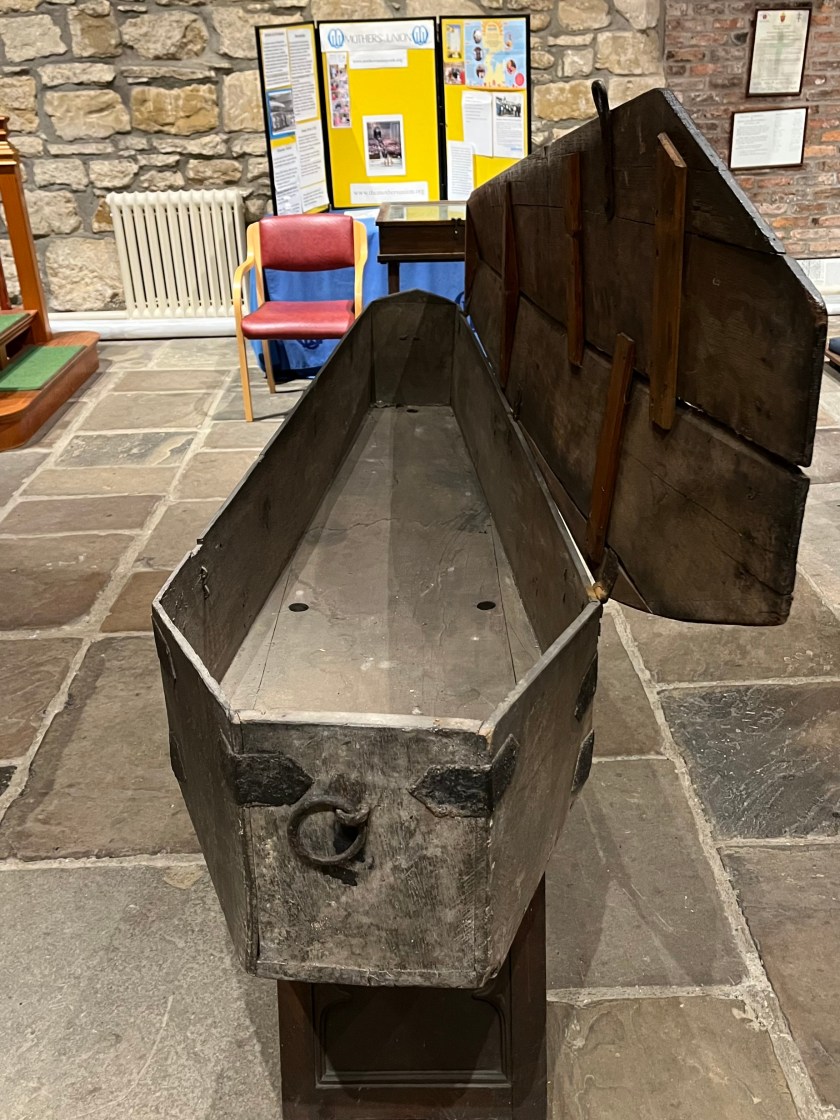
In my dad’s column from 6th March 1982, he mentioned that Easingwold Church still had a parish coffin. A parish coffin was used to convey a deceased person to their grave when they couldn’t afford to buy their own. The corpse would be buried, often in a communal plot, wrapped in a shroud (or winding sheet, as I mentioned in a few weeks ago). Dad suggested that the Easingwold coffin would likely be hundreds of years old, dating possibly from the 13th century.
He wrote this 40 years ago, so I wasn’t sure if the coffin was still there. By a happy coincidence I was due to be passing through the town, so I called the church and asked if they still had it, and whether it was possible to go and see it.
The very helpful chap on the other end of the phone readily agreed and we arranged to meet at Easingwold’s St John the Baptist and All Saints’ Church. We found the coffin hidden at the back among stacked chairs, noticeboards, tables and the like, and if you didn’t know of its existence, you probably wouldn’t even realise it was there.
We moved all the bits of furniture and heaved it out into the open. It was very plain, made of thin planks of dark oak with heavy iron ringed handles around the side. It was much longer than I expected, well over six feet, but surprisingly narrow. I didn’t think I would be able to comfortably lie in it, even though I’m of fairly average size (needless to say, I wasn’t tempted to try it out!). Of course, in previous centuries, if you were a pauper who could not afford a coffin, then you probably couldn’t afford much food either and therefore would not be in any danger of becoming too fat to fit in such a thing.
According to Dad’s piece, although many of these parish coffins had disappeared, there were a few churches in the North East that still had them, including one in Stockton-on-Tees, another in Howden, East Yorkshire, and also at St Oswald’s Church in Durham. Some parish coffins had hinged bottoms, and when they were placed over the grave, the base would open up and unceremoniously dump the unfortunate body into the waiting pit.
Being buried as a pauper was the ultimate humiliation, so many people would try to avoid it. As such, funeral guilds developed, where members would pay a small amount each week into a communal pot, and when the time came, the pot would fund the burial. These clubs died out towards the end of the 19th century as life insurance became more common, and yet a few lingered on into more modern times, including one at Egton Bridge in Eskdale, my parents’ home territory. In fact my Dad’s mum, Nana Walker, was a member of the Egton Bridge guild until her death in 2004. Our family didn’t need to call upon it for support as her late husband, my grandad, was fortuitously an agent of the Prudential Life Assurance Company Ltd. Her funeral expenses were therefore covered.
Today if someone dies in destitution or without any family to arrange a funeral, the local authority has a statutory duty to provide a coffin and engage a funeral director to transport them with dignity to either a crematorium or cemetery. Known as ‘public health funerals’, a simple service is held before the person is laid to rest.
On a slight tangent, I wonder if you have ever visited an ancient Catholic church, and found a strange oblique viewing hole in the outside wall that, if you look through it, gives a perfect view of the altar? This is known as a ‘squint’, or more formally, as a hagioscope, and was designed to allow severely diseased people, or those considered outcasts, to witness Holy Communion. It meant they were still able to take part in the mass without affecting the rest of the congregation.
You can still see these squints in some churches, including the Church of St Andrew in Grinton, near Reeth, St Oswald’s Church in Sowerby near Thirsk, Holy Trinity Church, Goodramgate, York, and St Mary’s Church. Whitby.
This column appeared in the Darlington & Stockton Times on 4th and the Gazette & Herald on 2nd March 2022
A rather grave error

When I read through my dad’s old columns, I often come across references to our family, and what we were doing at the time, events that I may have forgotten or that have been lost in the mists of time.
In his column from 27th February 1982, he writes about the impressive sighting of a great spotted woodpecker trying to eat from a bird feeder in our garden: ‘As this was hanging just outside our kitchen window, we were afforded a first class view of this beautiful bird; a double enjoyment was that we were celebrating my daughter’s 18th birthday and the house was full of teenagers who’d never seen such a colourful bird in the wild.’
Reading this brought a slight lump to my throat as that sentence referred to my late sister, Tricia, who would have turned 18 on 8th February 1982. The words conjured up an image of a gaggle of excitable girls enjoying the festivities, with not a care in the world about what the future held.
Dad wrote his columns two weeks in advance, which is why he was referring to the celebrations some time after they had taken place. I follow his lead on that score, and so am writing this the day after what would have been Tricia’s 58thbirthday (she died of cancer in 2018). If you have lost a loved one, then you’ll know birthdays and anniversaries are always occasions of mixed emotions. The first few are pretty difficult, but as time goes on they become a blend of both sadness at the loss alongside happy recollections from when they were alive. To mark the day, we attended a mass being held in her memory, and then went to spend some quiet time by the grave she shares with my dad, placing some flowers on the headstone.
Dad could not have known it when he wrote the column back in 1982 that the second topic that he writes about is rather appropriate when I read it today, as it concerns epitaphs. The one we chose for my dad and sister’s headstone is very simple, just expressing our family’s sadness at their passing along with the significant dates.
However, some people choose words that reflect more about how that person lived. A reader had contacted Dad saying that the saddest epitaph he had ever seen was on a gravestone at St Mary Magdalene’s Church at Lillington, near Leamington Spa. It was for a William Treen who died in February 1810 and read:
‘I poorly liv’d and poorly dy’d, poorly buried, and no one cry’d.’
Known as Billy Treen, his final resting place is called ‘The Miser’s Grave’ because he had such a reputation for frugal living. According to a local history website, Billy, a labourer and road scraper, would beg his neighbours for discarded potato peelings and vegetable waste.
However on Saturday 18th February 1922, the local paper ran story about a tenant who was now residing in Billy Treen’s former cottage. He had found a purse containing ten silver coins hidden in the rafters dating from 1660 and 1690. Had these belonged to Billy Treen? Perhaps he wasn’t so poor after all!
Dad goes on to mention a few more. One is purportedly from a grave in Selby and reads:
‘Here lies my wife, a sad slattern and shrew.
If I said I regretted her, I should lie too.’
A rather cautionary sentiment is expressed on the grave of 10-year-old John Rose (or it could be John Dose) who died on January 27th 1810:
‘Dear friends and companions all, pray warning take by me.
Don’t venture on the ice too far, as t’was the death of me.’
There is another tale that Dad often told me to make me giggle. It goes like this: When a Yorkshireman’s God-fearing wife died, he asked the undertaker for a special line on her gravestone. It was ‘God, she was thine.’ The undertaker promised his stonemason would include the words and eventually the stone was installed upon her grave. But there was a mistake. The sentence read, ‘God, she was thin.’
The husband rang the undertaker to complain, saying, “You’ve missed off the ‘E’!” The undertaker apologised and said his stonemason would correct the error immediately. A few days later, the husband went to inspect the new lettering.
Now it read, ‘Ee, God, she was thin.’
Read more at countrymansdaughter.com. Follow me on Twitter @countrymansdaug
This column appeared in the Darlington & Stockton Times on 25th and the Gazette & Herald on 23rd February 2022
A Tale to Make You Quake

Following the column I wrote a couple of weeks ago about superstitions held by seafaring folk, reader Lynn Catena got in touch to say: “I remember reading somewhere that people would crush their eggshells before throwing them out so that witches couldn’t sail out to sea and sink the fishing boats.”
She also sent me a copy of a poem featured in a blog by writer and folklore historian Willow Winsham. The poem was written by Elizabeth Fleming in 1934 and the first verse goes like this:
‘Oh, never leave your egg-shells unbroken in the cup;
Think of us poor sailor-men and always smash them up,
For witches come and find them and sail away to sea,
And make a lot of misery for mariners like me.’
She also cites a much earlier reference in Reginald Scott’s Discoverie of Witchcraft (1584): ‘They can go in and out of anger holes and sail in an egg shell, a cockle or mussel shell, through and under tempestuous seas.’
But the earliest reference to the smashing of eggshells comes from Pliny the Elder, writing in his most famous work, Natural History, in about AD77. Comprising 37 books, it is one of the largest surviving works from the Roman Empire, and is considered by many to be the first ever encyclopaedia. It covers a variety of subjects, such as botany, zoology, astronomy and mineralogy, as well as contemporary traditions and beliefs. It is one of the reasons we know that Romans invented water mills for refining grain, and developed the technique of ‘hushing’ (also known as ‘booming’), a mining term where torrents of water are forced through soil to expose mineral veins, a method still used now, nearly 2,000 years later.
In Book 28, he discusses spells and charms: ‘There is indeed no-body who does not fear to be spell-bound by imprecations. A similar feeling makes everybody break the shells of eggs or snails immediately after eating them, or else pierce them with the spoon that they have used.’ He doesn’t explain why people break the shells, but with the ocean as the main form of transport during the expansion of the Roman Empire, one might assume that they held similar beliefs about mischievous gods and goddesses.
Pliny the Elder died two days after the eruption of Mount Vesuvius which occurred on August 24th AD79. His nephew, Pliny the Younger, who was 18 at the time, described what happened in a letter to the historian Tacitus. Writing around 27 years later, he explained that they had witnessed the eruption from across the bay, watching in horror as a huge mushroom plume of smoke burst into the sky. His uncle set out with a rescue party from his home town of Misenum on the northernmost coast of the Bay of Naples, heading by boat towards his friend’s home on the opposite shore just south of Pompeii. Hampered by thick fumes and constant showers of pumice rocks, they made it across the water, but by the time they arrived, it was deemed too dangerous to set off back. They stayed in the home of the friends they’d come to rescue, and in the morning, with the air thick with dust and noxious fumes, and aftershocks suggesting further eruptions, they went back down to the shore to see if it was safe to set sail. But by now the wind had turned, so again they could not leave. Pliny, who was overweight and already suffered from respiratory complaints, was starting to struggle for breath and had to be supported back to the house by two slaves. He passed away the next day.
I can’t imagine how frightening it must have been to have been there, with no comprehension of how or why it was happening. We get some idea of the terror of thinking the world was coming to an end from Pliny the Younger’s eyewitness account: ‘A dense black cloud was coming up behind us, spreading over the earth like a flood…we had scarcely sat down to rest when darkness fell, not the dark of a moonless or cloudy night, but as if the lamp had been put out in a closed room.’
He goes on: ‘I derived some poor consolation in my mortal lot from the belief that the whole world was dying with me, and I with it.’
Read more at countrymansdaughter.com. Follow me on Twitter @countrymansdaug
ENDS
This column appeared in the Darlington & Stockton Times on 18th and the Gazette & Herald on 16th February 2022
The miracle of love

Valentine’s Day is just around the corner and I’m sure there will be many of you who will mark it in some way by perhaps giving your other half a card or a gift, or by celebrating with a romantic meal.
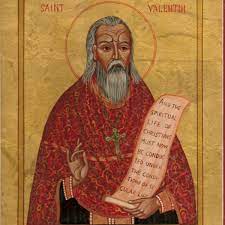
It’s not certain when the Christian Feast of St Valentine became associated with love, and there is some confusion about the identity of the saint who gives his name to this special day. In fact a number of saints called Valentine exist, and up to three can lay claim to the day itself. Generally, a day named after a saint marks the date they passed away.
There is an interesting story that explains the link between the saint and love. Claudius II was a ferocious leader determined to expand the Roman Empire when he became Caesar in AD268. He led ambitious military campaigns, and needed a plentiful supply of soldiers to execute his plans. However, he was struggling to get men to volunteer. Rather than blame their reluctance on the fear of being hacked to death, Claudius claimed the cause was the attachment the men felt towards their wives and families at home. His solution was to ban all weddings and engagements in Rome.
The priest Valentine objected to this and continued to perform marriages in secret. When Claudius found out, Valentine was thrown into prison and condemned to death. While incarcerated, he befriended the jailer’s daughter and left her a farewell message which he signed, “From your Valentine.” He was beaten and beheaded on February 14th in about AD269.
Another version of the tale has the girl being blind, and Valentine miraculously cures her just so that she can read the note (incidentally, you can only become a saint if you have performed miracles during your lifetime). Although it is an entertaining story, and nicely connects the saint with love and romance, it is more than likely to be complete hogwash.
There are ancient accounts which suggest there were two, or even three, saints with this name who were martyred in Rome on 14th February, but it is also possible that they were one and the same man. What we do know is that at least one person with this name was killed on that date and his remains lie on the Via Flaminia in Rome.
As my dad mentions in his column from 13th February 1982, rural folklore states that February 14th is when birds begin to look for their mates. A Valentine was also the name given to a physical gift, as well as to the person giving it.
At one time, apples or oranges would be presented on Valentine’s Day, and later it was more likely to be cakes and buns. Children would go from door to door, a bit like they do for Halloween these days, and when the door was opened, they’d recite a rhyme a bit like this:
‘Good morning Valentine, curl your locks as I do mine,
Two before and three behind, good morning Valentine.’
During the Middle Ages, the custom developed of sending a message or poem to your loved one. The earliest known written Valentine’s message is a 1477 letter by Margery Brews to a John Paston whom she describes as her ‘ryght welebeloued Voluntyne (right well-beloved Valentine)’. In it, she promises to be a good wife, and begs him not to give her up following her parents’ refusal to increase her dowry.
‘Myne herte me bydds ever more to love yowe truly (my heart me bids ever more to love you truly),’ she writes. Margery did get her way, and the pair wed and had a son, William, in 1479.
I’m not sure how many people still exchange Valentine’s cards, but it is certainly not a tradition embraced by my children and their peers. My eldest son is now 25 and when prompted said he might get his girlfriend a card, but will definitely mark it with a gift and a meal out. The other two (aged 23 and 19) said there was no chance they’d ever buy a card as it’s only what old people like me do.
I suppose they have a point, and on February 14th I’m going to wait and see if a telltale red envelope pops through the letterbox. And if it does, then I will definitely start believing in miracles.
Read more at countrymansdaughter.com. Follow me on Twitter @countrymansdaug
This column appeared in the Darlington & Stockton Times on 11th and the Gazette & Herald on 9th February 2022
Hold a candle

February 2nd is Candlemas Day. Candles have held much significance down the centuries.
This week is an important one in the country calendar as the second day of February is Candlemas Day and is traditionally considered the midway point of winter.
Before the Reformation, on this day Christians would gather in church for mass, and the stock of candles that would be used to illuminate services in the coming months would be blessed, with the candles representing Christ, the Light of the World. In the Roman Catholic Church, it is also the day they celebrate the Feast of the Purification of the Blessed Virgin Mary – 40 days after the birth of Christ – and would be marked with a candle-lit procession. However, post-Reformation, when Catholicism was forbidden, the day was downgraded and the anointing of candles was banned. However, it made a comeback and most Catholic churches celebrate in this way today.
Candlemas also marks the old end of the festive season when decorations would be taken down, but over time the Epiphany (6th January) took over. I’ve tried to look into when this change occurred, but what I can find is a bit vague on specific timeframes, and I was in danger of letting my research lead me down a veritable rabbit hole of arguments about when it is the correct time to mark the end of Christmas. So I’ll leave further discussion on that for another day.
Going back to February 2nd, for country folk of old, the behaviour of the elements was the most important factor in their daily lives, as it determined if their crops and livestock would thrive, and thus if they would be able to put food on the table. Farmers would try to predict what was to come in the days and months ahead so that they could decide how much food they would need to store for themselves and their livestock. Would it be mild and sunny, or freezing and snowy? Their decision would be dependent on whether they had made the right judgement call for the previous half of the season and had managed their stocks correctly, leaving them with the right quantity to get them through the next half of winter. If they got it wrong, it could lead to genuine hunger and starvation.
As a result, the traditions and beliefs around weather were legion, and 2nd February held extra significance because they believed that the state of the weather on that day was an indicator of the future. In my dad’s column from 6th February 1982, he mentions the following rhyme: ‘A farmer should, on Candlemas Day, have half his corn and half his hay’ meaning that if you did not still have half your feed stocks left, then you could be in trouble as there was plenty yet that winter could throw at you, even if it was mild on Candlemas Day.
But possibly the most well-known saying around the day goes like this: ‘If Candlemas Day be fair and bright, winter will have another fight. If Candlemas Day brings cloud and rain, winter won’t come again.’
As well as representing Jesus Christ, for centuries candles had held much meaning in the domestic setting. Children’s author Alison Uttley, famous for her Little Grey Rabbit series of books, wrote about growing up in the 1890s:
“As was natural in a candle-lit house, we had an intimate feeling for those soft yellow flames and the white candle. A spark flying from the flame meant a letter. A brightly glowing tip to the wick was a sweetheart in the candle. A tiny shred from the wick, falling into the cup of hot wax, was called a thief. A curl of wax rippling down the side of the candle was a winding-sheet.”
The ‘winding sheet’ referenced the particular shape made by layers of the wax melting down the side of a candle which was supposed to look like the death shroud in which corpses were wrapped. If it happened to be pointing at you when it was formed, then your days would be numbered. Similarly, if the melting wax formed a loop, this was known as the ‘coffin handle’, and if it was facing in your direction, then death was heading your way. Leaving a lit candle in an empty room would also invite death into the household.
I wonder if you’ll spot a winding sheet next time you light a candle?
Read more at countrymansdaughter.com. Follow me on Twitter @countrymansdaug
This column appeared in the Darlington & Stockton Times on 4th and the Gazette & Herald on 2nd February 2022
A bit of a pig

An aunt of mine who lives up on the North York Moors called me after reading the column I wrote last month about robins and the superstitions associated with them. I’d mentioned that in times gone by, seeing a robin was bad luck and some people, if they received a Christmas card featuring a robin, refused to display it. I wondered if that superstition still prevailed today.
According to my aunt, it certainly persists on the Moors and the east coast. A friend of hers, who died just four years ago and lived in the village of Loftus near Saltburn, would tear up any Christmas cards she received with a robin on them as she believed they were portents of death. My aunt also belongs to a local history group that meets regularly in the picturesque fishing village of Staithes, and she reported that a couple of members still refuse to display cards with robins on them.
My aunt’s paternal side of the family hail from Staithes, and she declared they were a ‘superstitious lot’, as were residents of many of the villages dotting that part of the east coast. She also revealed that some members of her group refuse to say the word ‘pig’ aloud and will either spell it out letter by letter, or refer to them as ‘squealers’. It is well known that seafaring communities have many superstitions that have lasted down the centuries, such as not whistling on a boat as that would ‘whistle down the wind’, encouraging a storm to brew. When your way of life is so hazardous, when your very livelihood, never mind your life, lies at the mercy of unpredictable weather, it is not surprising that you resort to whatever means at your disposal to try to keep yourself and your loved ones safe.
But I was mystified as to why the word ‘pig’ was so taboo. I have found a couple of explanations, but none that I would call ‘definitive’. One was that as pigs couldn’t swim, it was considered a temptation of fate to either utter their name or to bring them on board. What confuses me about this theory is that many sailors had never been taught to swim either. So how come their presence didn’t tempt fate too?
Another suggestion is that the pig is one of the most important animals associated with Celtic myths. Manannan was a sea-god heavily associated swine, purportedly being the custodian of a never-diminishing herd. If the numbers reduced for any reason, they would magically and spontaneously replenish. Sows were associated with fertility and wealth, while male boars were symbols of courage. However, they were also associated with deception, disobedience and with bringing about death. So perhaps therein lies the the root of the superstition.
My aunt also mentioned that it was unlucky for seafarers to cross paths with a woman en route to their boats. If they did, they would turn tail, go all the way back home and start their journey again before daring to set sail. Some also believed that having women on board a vessel was unlucky. There were similar beliefs around church ministers too, with one explanation being that this symbol of what they called the ‘new religion’ would earn the wrath of the ancient sea gods.
I found an interesting quote from 1968 in the Penguin Guide to the Superstitions of Britain and Ireland which goes: “We don’t mention pigs. We call ‘em Grecians, jacks, four-legged dinners, ‘owt but a pig. But the odd thing about Staithes people is that while they won’t speak of pigs, almost every fishing family keeps one.” There were similar beliefs around salmon, which would be replaced with the words ‘fine bit fish’ or ‘reid fish’, while rabbits became ‘bob tail’, ‘fower fitter’ or ‘mappin’. Rats and cats are also said to be unlucky (although I was under the impression that a ship’s cat was an essential member of the crew, its job being to keep the rat population down!).
If by some dreadful misfortune the unlucky word was uttered, the only way to turn fortunes back again was to touch something metal and declare the words ‘cold iron’. Others believed that the only way to undo the curse was to spill the blood of the animal in question.
I hope the same didn’t apply to women and church ministers!
Read more at countrymansdaughter.com. Follow me on Twitter @countrymansdaug
Let me share this with you

In these days of instant communication, it is easier than ever to spread both information and misinformation, and it’s a constant mystery to me how seemingly intelligent and wise people get sucked in by propaganda spread from dubious sources.
It’s easy to click the ‘share’ or ‘retweet’ button on things like Facebook and Twitter and it is those items that stir an intense emotion that get the most attention, such as a scare story linked to what is already in the news.
At one point in April 2020, when much was still unknown about Covid-19, I was forwarded a voice recording by a worried friend on the Whatsapp messaging app. The woman in the recording, in a desperate and urgent tone, claimed she worked within the ambulance service and that Public Health England had secretly told staff that the country was about to hit its coronavirus peak. We would be facing 900 deaths a day, one third of which would be teenagers, children and babies with no underlying health issues. She also stressed that when this happened, the NHS would be unable to cope, so would not dispatch any ambulances, even to urgent cases.
She conjured up a scene so horrific that it could could come straight out of a disaster movie, warning that mortuaries were already full and ice rinks were being prepared to accept the bodies of the dead. The message was clearly designed to stir up fear and panic in an already fearful and panicked nation. It was quickly proved to be a hoax, but not before it had been shared by hundreds of thousands of worried people on Whatsapp. The woman who recorded it turned out not to work in healthcare at all, but simply liked the idea of scaring a few million people into panic buying loo roll at the supermarket. What a very strange way to get your kicks.
We all have a responsibility to check if something is genuine and accurate before we go as far as spreading it among people we know, because they will then of course go and share it themselves. But too many of us don’t seem able or willing to do so, despite the fact that the internet makes it easier than ever to do your own research to determine if something is fact or fiction. Don’t get me wrong. There are those who are very clever at twisting things to so that they seem very plausible to an audience willing to believe it (Donald Trump’s unforgettable ‘Alternative Facts’ spring to mind). But most people with a modicum of common sense should be able to work out the truth if they put the effort into doing so.
Conspiracy theories seem to be particularly rife at the moment, whether they be about how Covid came about, about what vaccinations do or about why Trump lost the US presidential election. Apparently, at times of uncertainty, when the reality is really hard to get your head around, we are more likely to believe a conspiracy theory. We want the certainty of a black and white explanation, rather than accepting the unsettling truth about a dreadful situation where certainty cannot be given and no end is in sight.
One of the most famous conspiracy theories involves the moon landings, where on 20th July 1969, Neil Armstrong took the first steps by a human on the lunar surface. Around 650 million people around the world watched live as he made the most famous walk of all time, and yet there are still those who believe it was all faked.
In his column from 23rd January 1982, Dad talks about meeting an old Yorkshire fella who steadfastly refused to believe it had happened (despite there being five further moon landings since that first one).
“Thoo can’t tell me that onnybody’s gotten up yonder. Ah’ll nivver swallow that yarn, nut as lang as Ah live…Ah reckon it was all filmed in yan o’ them television studios, all a mak-believe. It was summat put in t’papers for t’bairns ti larn at scheeal…Ah’s nut daft, thoo knaws – neea fella from this earth has landed on t’moon.”
The chap didn’t give an explanation as to why such a thing would be fabricated, but was steadfast in his refusal to believe it. I wonder what he’d think about the virus? I’m sure he’d have a theory or two.
Read more at countrymansdaughter.com. Follow me on Twitter @countrymansdaug
This column appeared in the Darlington & Stockton Times on 21st and the Gazette & Herald on 19th January 2022
The power of a mighty pen

In his column from 16th January 1981, my dad talks about the links that Charles Dickens had with North Yorkshire, and how much he enjoyed travelling in this region to find inspiration for his famous stories.
Dad was a fan, and at home we still have his full collection of Dickens’ works. He talks about the writer arriving in the North Riding on 31st January 1838 during a particularly harsh winter when he was only 26. Although he was still in the early stages of his writing career, he was already famous after The Pickwick Papers had become a publishing sensation. Dickens popularised the idea of serialising stories in monthly periodicals, and devised the technique of cliffhanger endings to keep his readers keen. The first few instalments were not popular, and it wasn’t until the introduction of the streetwise Cockney shoeshiner Sam Weller that sales took off, leaping from 1,000 a month to 40,000.
By January 1838, Dickens was already publishing instalments of Oliver Twist, which was issued monthly between February 1837 until April 1839. He would often write chapters of his stories on his travels, sometimes changing plots on the hoof in response to the reactions of his readers to previously published instalments.
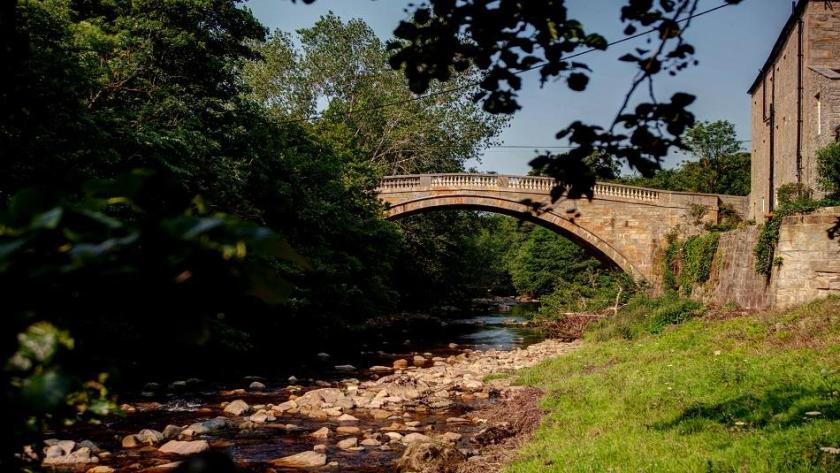
By the time he landed in North Yorkshire on that January night, he had travelled 255 miles by stagecoach in terrible weather, and described his arrival in a letter to his wife Catherine: “There was no vestige of a track. The mail kept on well, however, and at eleven we reached a bare place with a house standing alone in the midst of a dreary moor, which the guard informed us was Greta Bridge. It was fearfully cold and there were no outward signs of anyone being up in the house.”
This inauspicious start was soon overtaken by the warm welcome indoors. “To our great joy we discovered a comfortable room with drawn curtains and a blazing fire. In half an hour, they gave us a smoking supper and a bottle of mulled port, and then we retired to a couple of capital bedrooms, in each of which there was a rousing fire half way up the chimney.
“We have had for breakfast, toast, cakes, a Yorkshire pie, a piece of beef about the size and much the shape of my portmanteau, tea, coffee, ham and eggs.”
From Greta Bridge, Dickens went to explore nearby Barnard Castle before moving on to the village of Bowes (at the time these places were still within North Yorkshire, although now fall inside the County Durham boundary). The area around Bowes was known for Yorkshire Schools, austere boarding institutions where boys were sent for a cut-price education. They had a brutal reputation and, pretending that he was looking on behalf of a boy whose father had died, Dickens persuaded a friend to write a letter of introduction to William Shaw, who had run Bowes Hall for 20 years. This school was to become the main inspiration for the infamous Dotheboys Hall which lay at the heart of his latest novel, The Life and Adventures of Nicholas Nickleby.
Dickens had seen an advert for Bowes Hall in The Times newspaper, and was aware that Mr Shaw had already faced two civil actions in 1823 brought by the parents of children who had suffered sight impairment while at the school. They testified to sharing one single bed per five children, sharing two towels between more than 250 pupils after bathing, and to sharing overflowing and stinking waste troughs in the middle of the dormitories. The maggot-ridden food rations were pitiful, and they were ordered to fill quills with fleas from their bed mattresses. The boys’ evidence was shocking, and it is likely that Dickens used their accounts, rather than what he saw on his own visit, to flesh out his portrayal of the institution.
Despite being convicted of gross negligence and fined a whopping £600, Shaw went back to running his profitable school exactly as before. Dickens’ depiction of Dotheboys Hall came 15 years later, and it was a barely disguised satire of Bowes Hall and William Shaw (the odious schoolmaster Wackford Squeers has the same initials). It was only once the book was published that the idea of reform finally began to be taken seriously and business for the schools dried up. Bowes Hall finally shut its doors to pupils in 1840.
Read more at countrymansdaughter.com. Follow me on Twitter @countrymansdaug
This column appeared in the Darlington & Stockton Times on 14th and the Gazette & Herald on 12th January 2022
 The Countryman's Daughter