Mother used to say

AE211248-6412-40C8-B211-47DC9DB6F044
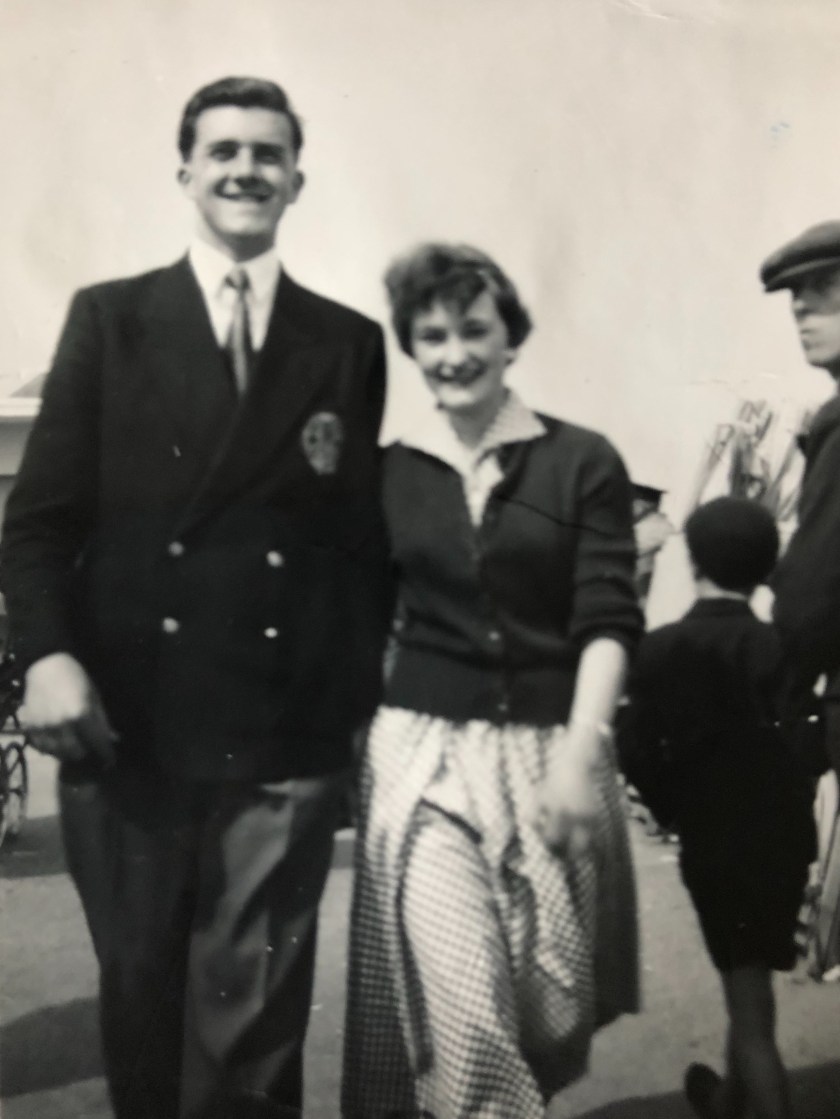
Me at prime teen tantrum age 

As I write this, I’m listening to the March winds blustering and howling in the trees outside, and thinking that the month’s reputation as a windy one is justified.

There is plenty of folklore surrounding wind, which is understandable when you think that our distant ancestors needed to find some explanation for this invisible weather phenomenon. They would have had no idea of the origins of a force that could gently dry their washing one day, then destroy their homes the next.

Obviously, wind was an extremely important source of energy in the days before motorisation, and early explorers of the high seas had a number of charms they used to summon it when needed. You’ve probably heard of whistling down the wind (which now refers to something being done fruitlessly), but woe betide you if you were caught whistling on a boat at any other time, as you risked attracting a hurricane.

Witches used to ‘sell’ wind to sailors. They would give them a piece of string with three knots tied in it to take on board, and when wind was required, they’d undo one of the knots. But they always hoped to not have to reach the last knot, as untying that would summon a gale.

In his column from 24th March 1979, Dad recalls parents telling their children that if they pulled a face when the east wind was blowing, the ugly expression would be fixed there forever.

It made me think back to other things that our parents, especially our mothers, would tell us to scare us into doing what we were told. One was if you sat too near to the TV you’d get square eyes, or if you looked at the sun while cross-eyed, you’d stay like that. Another was that if we swallowed our chewing gum, it would stay in our stomachs forever, and of course, if you eat your carrots, you’ll be able to see in the dark. I’ve eaten plenty of carrots over the years, but can’t say that I ever noticed an improvement.

There’s a whole host of sayings which, pre-parenthood, you swear never to use yourself. Then along come your children, and before you know it they’re tumbling out of your mouth like marbles down a hill. It’s a cycle that will never be broken, words and phrases we pass from generation to generation, because in the heat of an argument with your child, when they are pushing you to the outer extremes of your patience with never-ending cries of “But why?” or “It’s not fair!”, being able to pluck that ready-made conversation-ending logic out of the air is a blessing.

Think back to how many times your mum or dad said “Because I said so!” or “Life isn’t fair” after one of your teen tantrums. It’s only when you’re a parent yourself on the receiving end of such a tantrum, and after you’ve exhausted all your reasons for refusing whatever the request was, that you then understand why “Because I said so!” comes so easily to the lips.

I’ve lost count of how many times over the years I’ve informed my sons of the poor starving children in various nations who would be so grateful to have a plateful of broccoli and green beans, or asked them, “How do you know you don’t like it if you don’t even try it?”

Another phrase I carried with me from childhood, was “Don’t speak with your mouth full” and that regularly echoes around our dinner table. But I’ve just thought of one that I don’t use now, but was told as a child, and that is “Don’t put your elbows on the table.” I’m not sure why you shouldn’t do that, apart from the fact it was just seen as bad manners. But our table is often the scene of lengthy after-dinner chats, and it’s natural to lean on your elbows while listening. I still wouldn’t put them on the table while others are eating though (well, not if my mum is looking anyway).

When I was little, I was self-conscious of the hairs on my forearms, until I was told that having hairy arms meant that you were strong. To this day, I have a reputation on the tennis court for hitting the ball rather hard, so I think of all of them, that one must be true.

Read more at countrymansdaughter.com. Follow me on Twitter @countrymansdaug

This column appeared in the Darlington & Stockton Times  on 22nd March and the Gazette & Herald on 20th March  2019

The Luck of the Irish

I mentioned some time ago that one of the things I have started doing since my dad died is to make my way through his substantial back catalogue of books. As many of them were written when I was very young, I only ever read a few.

In June last year, I was about a third of the way through his tenth novel, Carnaby and the Saboteurs, when, turning the page, I found a pressed four-leaf clover. I must admit, I was rather overcome at the sight of it, as it felt like my dad was sending me a message of good luck from beyond the grave.

The book was published in 1970, and so it made me wonder whether that little clover had been hiding between the pages for almost 40 years. I have no way of knowing, but that tiny, dried and flattened weed suddenly became very special to me.

Some people, myself included, are confused over the difference between a clover and a shamrock, and on Sunday 17th March, there will be many a trefoil displayed both in Ireland and further afield as the Celtic nation commemorates the death of their patron, St Patrick.

As my dad writes in his column from 17th March 1979, St Patrick, who is believed to have been born in around AD385, is credited with bringing Christianity to the country and is said to have worn the three-leaved plant as a symbol of the Holy Trinity. The story goes that while preaching to pagans, he used the leaf to explain the concept of one almighty God, but with three entities within him – God the Father, God the Son and God the Holy Ghost. In the same way, the shamrock had three separate small leaves that joined together to make the whole.

He chose the perfect symbol, as the shamrock was already sacred to the pagans, and some cite it as the reason why he was so successful at converting them to Christianity.

But going back to my four-leaf clover, I decided to find out what the difference between a shamrock and a clover is, if there is one. Its name comes from the Gaelic ‘saemrog’ which means ‘little clover’ and having done some digging, I now know that a shamrock is definitely a member of the clover family. But as there are many species of clover, the burning question is which family does a true shamrock actually come from?

It seems that even experienced botanists differ over that question and they cannot agree which family of clovers the true shamrock derives. We do know that all shamrocks are clovers but not all clovers are shamrocks, and the general consensus is that a four-leaf version can never be a shamrock.

That might come as a surprise to some of our Irish-American friends, who have been known to show their pride in their Celtic ancestry by displaying a four-leaf clover on St Patrick’s Day, believing it to be a shamrock.

And there is even some confusion among the Irish in their homeland as, according to a 1988 survey by the National Botanic Gardens in Dublin, there were four different species that people displayed as shamrocks, only three of which were actually clovers with the potential to be true shamrocks (white clover, red clover and hop clover). The fourth wasn’t a member of the clover family at all, but a lookalike called the black medick. This one can be more easily grown as a house plant, and therefore florists and shops stocked up on it so that eager consumers would buy them as a convenient decoration for St Patrick’s Day. I wonder if the purchasers realised that the verdant main feature of their patriotic display was actually an imposter?

I would be interested to hear from any Irish friends whether they have strong views, or a definitive answer, on what species of clover constitutes the ‘true’ shamrock.

In the meantime, I have made sure that my special four-leaf treasure has its own protective box so that it doesn’t come to any harm. It’s such a delicate thing that I’m terrified it might disintegrate if I handle it too much. And hopefully, with my dad’s blessing from above, it will bring me some good fortune in the future. I’m not asking for much, but something along the lines of a huge lottery win will do (Are you listening, Dad?).

Read more at countrymansdaughter.com. Follow me on Twitter @countrymansdaug

ENDS

This column appeared in the Darlington & Stockton Times  on 15th March and the Gazette & Herald on 13th March  2019

A wolf in dog’s clothing?

EB2AF04F-C4CE-4DF6-9DB9-6B0F76A64FA1
My three boys at one of our favourite spots on the North York Moors where our normally placid canine companion chased a sheep

Lambing season is in full swing and whenever I’m out and about, I love spotting the little lambs gambolling about the fields like excitable toddlers in a playground.

I don’t think the North York Moors are unique in having sheep and lambs unhindered by walls and fences, but it is still pretty special to see them grazing freely across the land, or meandering along village greens in places like Hutton-le-Hole and Goathland.

The beauty of the moors and the Yorkshire Dales means they are a magnet for tourists and many visitors bring their pet dogs with them. Sadly, that can also bring with it a problem that is particularly distressing at this time of year – sheep worrying.

It saddens me to read that the issue has not improved with time, as my dad was writing about it in his column from 10th March 1979. A reader had had his dog shot in front of him by an angry farmer after it had run into a flock of sheep. He was highlighting the fact that, according to the law, a dog doesn’t actually have to attack sheep, but merely has to pose a possible threat, for the farmer to have the right to shoot it. Although I do pity the owner losing his pet, I can’t help but think that if it was on a lead, it would never have happened at all.

It’s not just visitors that are causing the problem though. Apparently, there has been a rise in unaccompanied dogs running amok among sheep, which is being put down to country residents letting their dogs out of their houses, unaware that they are finding their ways to areas of grazing livestock.

Educating dog-owners is one answer, and bodies like the North York Moors National Park, the police rural crime teams and farming and sheep organisations repeat the message each and every year.

But even though owners hear the message, some don’t think it applies to them. They fail to appreciate that their lovely, docile family pet can be a killer where sheep are concerned. All animals have the potential to be unpredictable, and when it comes to sheep, dogs can undergo a complete personality change. And I mean, ANY dog. Even yours.

I know this because I was once one of those people and have witnessed this unexpected, and quite shocking, personality transformation first hand. I was looking after a friend’s dog while she was away and, as it was a warm sunny day, decided to take my boys and the dog up to a lovely spot on the moors by a stream where we could picnic and the children could safely splash about in the water.

The dog was a quiet and submissive soul who I’d known since he was a puppy and I’d never seen an ounce of aggression in him. There were a few sheep about, but they were at a short distance away and as the dog had not shown any interest in them, I assumed it was safe to let him off the lead while we ate lunch.

I was wrong. A ewe on the search for fresh grass pottered into the dog’s view, and suddenly, he was off, snarling and barking at the poor startled sheep. I leapt up and after him and thankfully managed to get the dog back before he caught the ewe. Although no damage was done that time, had it been lambing season, the stress of being chased could have caused the ewe to abort if she’d been pregnant. That taught me a valuable lesson, that as well as you know your dog, there is something about sheep that can make them go a bit crazy.

I have seen pictures of sheep and lambs that have been caught by dogs, and the injuries are horrific, sometimes resulting in the animal being euthanised. Others have drowned after throwing themselves into rivers or lakes in a desperate attempt to escape.

We are not talking about just a few sheep here and there either. According the the famers’s insurance body, NFU Mutual, 2018 saw a 67% rise in attacks over the previous two years. Apart from the obvious distress of losing animals, the financial loss to farmers can run into many thousands of pounds.

So if you have a dog, no matter how docile and calm they are, remember, around sheep, they could be a killer.

Read more at countrymansdaughter.com. Follow me on Twitter @countrymansdaug

This column appeared in the Darlington & Stockton Times  on 8th March and the Gazette & Herald on 6th March  2019

Nutella on your Yorkshires?

Of all the topics I’ve covered in my columns, it seems that Yorkshire puddings and how we eat them gets the most feedback from readers.

And 40 years ago, it was just the same, as I discovered when reading Dad’s column from 3rd March 1979. According to him, a number of people contacted him revealing a variety of customs after they’d read one of his pieces. Some revealed that they ate their puddings as a dessert AFTER the main meal when it would be sweetened with treacle or spread with jam. Others ate their puddings before the meal, but also sweetened them. Another told him that in 1943 when they visited a friend in Galphay, near Ripon, they ate one sweetened Yorkshire pudding before the main meal, swiftly followed by another covered in gravy. Only after that process would they begin the meat course.

The reason for this, which has been backed up by some of my own correspondents’ comments, was that by filling up the diners with puddings first, it meant they would eat less of the meat, the most expensive component of the meal. Another of Dad’s readers said that when they were a child, their parents would quote the saying: “Them that eats most pudding gets most meat,” which was a cunning way to encourage eager youngsters to fill up with with Yorkshires so that by the time the meat did come around, they were no longer very hungry.

I received a message from John Tyreman who reports that when he used to visit his cousins near Northallerton, they ate their Yorkshires with milk and sugar, while Angela Swinbank, also from Northallerton, says they always ate their puddings as a Sunday lunch starter with syrup and gravy. Yes, syrup and gravy. Together.

She adds: “I am the eldest of five sisters who all continue this tradition with their now immediate families. Indeed one family have added mint sauce to the syrup and gravy.” She also says that if there were any puddings left over, they would be eaten with jam and cream for high tea. She wasn’t the only one, as I had several people saying they ate them with jam, but the most popular choice was with golden syrup or treacle.

Well, as they say, the proof of the pudding is in the eating, so I couldn’t possibly pass judgement on these old Yorkshire traditions without trying them myself. So with the help of an expert taster (my 17-year-old son Joseph), I set about putting these concoctions to the test. We had four variations; milk and sugar, jam and cream, syrup and gravy, and lastly our own addition, chocolate spread (by special request from Joseph who eats it on just about anything).

We both tasted each topping, then ranked them, first to last. So now, the votes have been counted and independently verified, and here are the results (drum roll please…):

Milk and sugar: Joseph said the sugar was nice but the milk made it taste like he was biting into a wet shower sponge. He ranked it 4th. I thought it tasted like a pancake and wasn’t as bad as I expected, and ranked it 2nd.

Jam and cream: Joey and I both gave it a thumbs up, and it tasted very similar to a scone. In fact, one reader said her nana made Yorkshires with sultanas in them, and after this taste test, it does make sense. Joey ranked this at 2, whereas it was top of my list.

Syrup and gravy: This was the one we both dreaded the most, as it sounds so disgusting! However, Joseph said it was a welcome surprise that it wasn’t as bad as he expected, but that he wouldn’t want to eat it again! He didn’t like the texture of gravy and syrup together, although the taste was OK. I agreed with Joseph and for me, preferred it once the gravy had all dripped off and only syrup was left. We both ranked this 3rd.

And lastly, Nutella, Joseph’s favourite. He loved this, and it not surprisingly, it was his top choice. I, on the other hand, didn’t like the combination of textures of the pudding and the spread. I ranked it last at number 4 on my list.

After this most scientific of experiments, my belief remains unchanged, in that you can’t beat good old beefy gravy without any sweet distractions. What about you?

Read more at countrymansdaughter.com. Follow me on Twitter @countrymansdaug

ENDS

This column appeared in the Darlington & Stockton Times  on 1st March and the Gazette & Herald on 27th February  2019

A little yellow star

One of the many benefits of walking dogs is that I get to see how the landscape and countryside around me change with the seasons, and in his column from 24th February 1979, Dad refers to February as the ‘Gateway of the Year’ because we begin to feel the hint of warmth in the sunshine, become aware of increasing birdsong, and really start to feel that Spring is just around the corner.

Snowdrops, crocuses and winter aconites have been around for some time now, and when I first spotted them, they really lifted my spirits. A bloom I start to notice around this time of year is the lesser celandine, which is a gorgeous little wild flower with a bright yellow, star-shaped head that you find in clusters, often in shady woodland or under hedgerows (although it can be a rampant pest in a domestic garden).

Despite looking rather delicate, with glossy, heart-shaped leaves, they are a resilient little species, and folklore has a number of interesting associations with them. Its name derives from the Greek word ‘khelidon’, which means ‘swallow’, and it was possibly the ancient Greek philosopher Theophrastus (BC 371-289) who first made mention of it in relation to the bird. The plant’s growing cycle was supposed to mimic the migration of the swallows, which would arrive in Greece as early as February, and then leave again in October.

But as I was researching this article, I found that there is another plant called the greater celandine which, despite the similar name, comes from a different family of flowers altogether. The greater celandine is from the poppy family while the lesser celandine is related to the buttercup. As the lesser version flowers about a month before its larger namesake, my question is, which one was Theophrastus referring to when he said it mimicked the migration of swallows?

I’ve checked, and both plants grow in Greece, and swallows have been known to arrive in Greece from late January, so I think it is probably the lesser version. But to be honest, I don’t really have a clue, and I’d have to speak to a Greek horticultural expert to get a definitive answer (if you know one, please ask them to get in touch!).

The lesser celandine is abundant in this country, which our queen bees will be delighted to hear as they, and other insects, rely on it as one of the year’s earliest providers of nectar. After a long winter of hibernation, ready sources of nectar are vital for the queen to thrive and establish her colony. As she will have mated before hibernation, she will seek out a suitable nesting site, and produce offspring in early summer which then become the worker and drone bees.

The lesser celandine also contains vitamin C, and in days gone by was given to those suffering from scurvy. It can be eaten as a salad, but I recommend you speak to an expert forager, as apparently, if it is too advanced in age, the leaves become poisonous.

The flower also has a reputation as a remedy for haemorrhoids which stems from the appearance of its tubers which resemble the unfortunate condition (try Googling images of lesser celandine tubers and see if you agree!). Knowing that, you can understand why in some quarters it is referred to as ‘pilewort’.

In the 1979 column I mentioned earlier, Dad reflects on what it might be like in a world without the sights and sounds of the countryside coming alive as Spring approaches. He asks if a silent, dead world like this could ever happen, and then answers with a phrase that I think is very relevant today: “It could happen because man refuses to believe that it can.”

He talks about the effects of pesticides on insects and birds, and the disappearance of many of our hedgerows that provided sustenance for so many of our native creatures. He says that we, as a country, were upsetting the natural balance which nature created, and concludes that we could not yet know the long-term impact of our actions.

“With all his knowledge, man is unable to know the precise part played by any animal, insect or plant. Only nature knows that, for it is all part of evolution,” he says.

Forty years on, Dad’s concerns are being proved right, with worrying statistics about the decline in our insect population and its far-reaching implications. Let’s hope we can restore nature’s balance before it is too late.

Read more at countrymansdaughter.com. Follow me on Twitter @countrymansdaug

This column appeared in the Darlington & Stockton Times  on 22nd February and the Gazette & Herald on 20th February  2019

My funny Valentine

3BA404ED-068E-4DD0-8550-6DB44040CEDC
Mum and Dad pictured at Seaham, Co Durham, during their courting days in 1956 when Dad was stationed at RAF Ouston during National Service. They began to court after Dad sent her a Valentine’s card
7D8F44B7-1F54-4551-950D-4F9E1C820C29
Mum and Dad celebrating one year of courtship with a dance at the Royal Albert Hall on 23rd March 1956. They became a couple after Dad had sent her a Valentine’s card

This week is the celebration of St Valentine where couples across the land will exchange cards and gifts and make the effort to spend a bit of quality time with each other. Or maybe they’ll just pretend it isn’t happening.

One year, my husband failed to make any romantic effort whatsoever, declaring importantly that it had all become far too materialistic and that it was just a cynical way for businesses to make more money. I very politely explained that I knew he’d forgotten, and invited him to sleep in the garden.

I have no strong feelings either way about it when it comes to other people and believe that couples should be free to choose whether or not to celebrate it. But I embraced it, at least in a smallish way. We had busy lives which meant we didn’t have much time purely for ourselves for the rest of the year, so Valentines’s Day gave us a rare opportunity to have that bit of time just for us. It also meant that I was on the receiving end of flowers, bubbly and chocolate. What’s not to love?

I can understand that if you are naturally a romantic sort, and you spoil your other half all year round anyway, then you might think Valentine’s Day is a bit pointless. But sometimes in long-term relationships, the romance seeps away over time and can even vanish altogether. Some might need a bit of a prod to spoil their partner, even if it is just for one day a year.

While writing this, I asked my 20-year-old son if he or any of this friends would buy any girls a Valentine’s card, and it was a resounding ‘No’. He said young people would not bother sending a card when they communicate online all the time anyway. He also pointed out that today, if your heart’s desire turns you down, the potential for mass public humiliation is immense. In my day, if a boy sent a card, but his love was unrequited, then only a small circle might ever find out. No instant messaging to hundreds of online friends back then.

So the tradition of sending an anonymous card to someone you have your eye on has pretty much died out. I think it’s a shame, especially as I have discovered that it was just such a Valentine’s card that brought my parents together.

Aged 20, my dad had his eye on a pretty girl with whom he had shared a dance at the Glaisdale Institute at the start of 1956. He knew she lived in the neighbouring village of Lealholm, and as Valentine’s Day approached, plucked up the courage to send her a card from RAF Ouston, near Newcastle, where he had been posted for National Service. As was the tradition, he didn’t sign it, but because of the postmark mum worked out who it was from. She was obviously impressed by the romantic gesture and agreed to meet him on March 23rd 1956 at the Young Farmer’s Annual Dance at the Royal Hotel in Whitby. It was the start of a romance that lasted for more than 60 years until Dad died in 2017.

In his column from 17th February 1979, Dad explains that there were other occasions where practising love divinations was common, but St Valentines Day was considered the most auspicious.

This belief is thought to have first been mentioned by Chaucer in his 1382 work ‘A Parlement Of Foules’ in which Nature decrees that the birds shall choose their mates on St Valentine’s Day. It is also one of the earliest mentions of the day being associated with love and partnership.

Shakespeare refers to it in a Midsummer Night’s Dream with the words:

‘Good morrow, friends, St Valentine is past;
Begin the wood birds but to couple now.’

According to my dad, some girls would go to extreme lengths to secure a love. One ritual was to enter a churchyard at midnight with a handful of hempseed, and walk around the church a number of times. On the way home, the girl would scatter the seed while quoting a bewitching verse.

The first boy she saw picking up the seeds the next day was destined to be her true love.

So how many of you will be putting in your orders for hempseed now, I wonder?

Read more at countrymansdaughter.com. Follow me on Twitter @countrymansdaug

This column appeared in the Darlington & Stockton Times  on 15th February and the Gazette & Herald on 13th February  2019

It’s all a matter of taste

42421846-135E-45D1-A017-C989189F6EE7
Because they were so much older than me, I thought my cousin Catherine (far left) and my sister Janet (centre) were unspeakably sophisticated. They are seen here in 1969 with my brother Andrew (and other sister Tricia just visible on the swing). 

You may recall that in November I wrote about my unimpressive history of making Yorkshire puddings, which was sparked by my dad’s column from 40 years earlier in which he mentioned the tradition of eating Yorkshires as a starter with gravy.

As a result of that article, he received a letter all the way from Canada that he mentions in his column from 10th February 1979. The writer’s ancestors hailed from Coverdale in the Dales and their family tradition was also to eat the Yorkshire pudding as a starter, but they replaced the gravy with – wait for it – milk and sugar!

Milk and sugar? Really? The thought causes me to shudder, even though I know that Yorkshires can be eaten as a dessert with sweet fillings, although I have never tried it myself. But I’ve never heard of it eaten as a sweet starter, and neither had my dad. It begs the question whether any Dales residents still eat their Yorkshires this way?

Dad goes on to recall eating foodstuffs that seemed normal to him as a child, and it was only as an adult that he realised it was not usual practice outside of his part of Yorkshire. He grew up in the area around Eskdale where it was common to eat shredded lettuce placed in a bowlful of vinegar and sprinkled with sugar. He also mentions a friend who ate sugar with green peas, tomatoes and lettuce, and another who always had marmalade on his bacon and eggs.

I remember as a child sprinkling a large lettuce leaf with sugar, then rolling it up like a cigar before gnawing my way along it. I used to love it, but can’t imagine eating it now (although I might get my boys to try it – anything to get them to eat more greens). I also used to love pouring salad cream the full length of a piece of celery before munching my way through it. I’ve tried to get my kids to try it today, but they look at me as if I’m trying to force-feed them arsenic. To them, the very notion of eating raw celery is as alien as eating their own fingers.

It’s funny how foodstuffs loved by some are innately detested by others. I cannot abide bananas in any shape or form. I hate the smell, I hate the taste, I hate the texture and I especially hate it if someone eats one noisily near me. On the other hand, one of my favourite vegetables is the humble garden pea, but my son has exactly the same kind of aversion to them as I have to bananas. I can’t fathom it, as peas are so harmless tastewise, whereas bananas, as everyone knows, are the noxious food of the devil.

My older sister Janet can’t tolerate butter, cream and other similar dairy products. This distaste for dairy runs in the family, and I remember one day having lunch at my nana’s house with my cousins and we were offered some bread and butter before the main meal. I noticed that my cousin Catherine, who was 10 years older than me, refused the butter, as did Janet, who was six years older. To me, they were both unspeakably sophisticated and obviously eating bread without butter was the utmost in unspeakable sophistication. So when my nana asked me if I was sure I didn’t want any butter, I vigorously shook my head, then spent the next 15 minutes chewing my way through the equivalent of a mouthful of sawdust. That foolish mistake was never repeated, and the bitter experience taught me that the best way to eat bread is slathered with chunks of butter so big that you can see your teeth marks after you have bitten into it.

When my children were young, we often had little guests over for tea, and some of them had some rather strange eating habits. One would put vast quantities of malt vinegar on absolutely everything he ate, and then tip his plate up so it pooled at one end, then use a teaspoon to finish it up. Another would only eat tinned tuna in brine, but drained dry with no dressing on it all. Then there was the one who ate nothing but chicken nuggets and potato smiley faces every single day.

What are your strange family eating habits?

Read more at countrymansdaughter.com. Follow me on Twitter @countrymansdaug

This column appeared in the Darlington & Stockton Times  on 8th February and the Gazette & Herald on 6th February  2019

It’s pandemonium among the birds

2A1D8C39-04B6-40D5-8388-51757E26C599
Dad with Ferdinand the pheasant 

In my Dad’s column from 3rd February 1979, he talks about the proliferation of pheasants among the fields and lanes around the village where we lived, and the fact that the shooting season came to an end on February 1st.

These handsome birds have been known for possessing quite feisty characteristics, such as one that was a self-appointed guardian of the post office in a nearby village. It was called Hector and had been reared from a chick by the postmaster’s son. Unfortunately, Hector took a dislike to some of the customers and would guard the path leading up to the door. He was even known to attack on occasion. Obviously, a vicious guard-pheasant can’t have been very good for business, so at some point, Hector was locked away.

But pheasants can make quite lovely, and peace-loving, pets and can grow very attached to the humans that look after them. In his column Dad mentions one such visitor to our own garden who would wander around our lawns, flower beds and vegetable patches seemingly untroubled by the appearance of any people. This was a good 30 years before young Ferdinand appeared on the scene.

Ferdinand the pheasant was a more recent regular caller and would potter around looking for seeds, insects and leaves to feed upon. My parents, especially my dad (who named him), became rather fond of him, and whenever he appeared Dad would head to the garden with a handful of bird seed which Ferdinand was very grateful to receive.

As I have mentioned before, Mum and Dad were very keen on bird watching and made sure the feathery visitors were all looked after, with plenty of bird boxes and feeders in a number of sites around the garden. It ensured that there was always plenty of avian activity to observe from our living room window.

Like the pheasant, there were other species whose fear of humans lessened once they got used to having them around. The blackbirds and robins were the bravest, and would venture very close if they thought there might be a few crumbs dropped from the table if ever my parents dined al fresco on a warm summer’s day.

One thing that fascinates me is the variety of strange and wonderful words used to describe a group of birds gathered together, be it on the ground or airborne. Dad mentions a collective noun for pheasants that was more commonly used down south, rather than here in the north, and that was a ‘nye’, but I have also found others, such as bevy, bouquet and nide, none of which I had heard before.

There are some words which can be used for all gatherings of birds, such as flock, colony, fleet, parcel or dissimulation. However, there are specific terms for specific species, and the weird and wonderful words chosen often reflect the characteristics of the birds in question.

For example, most of us know that a group of owls is called a ‘parliament’, while several geese together is a ‘gaggle’ and starlings in flight are referred to as a ‘murmuration’.

You might even have heard of a ‘murder’ of crows. But have you heard of a ‘scold’ of jays, or a ‘mischief’ of magpies? Unless you are a committed birder, then I am willing to bet you have not. I wish I could list them all here, as they are just brilliant, but sadly, I am inhibited by space. Some bird species have several terms to themselves, so I have just selected the one which I felt summed them up. I’ve put down my favourites, and congratulate whoever it was who came up with such fantastic descriptions.

You might recall that last week I mentioned the heron’s reputation for raiding garden ponds, so it doesn’t come as much of a surprise to learn that a group of them is known as a ‘siege’. I’m not sure how my nerves would cope, though, if I came across a ‘pandemonium’ of parrots, a ‘mob’ of emus or a ‘quarrel’ of sparrows. And I’d definitely steer clear of an ‘unkindness’ of ravens, a ‘cauldron’ of hawks and a ‘wake’ of vultures. Perhaps I’d need to seek out a ‘shimmer’ of hummingbirds, a ‘ballet’ of swans or a ‘prayer’ of godwits, to ease my frazzled soul.

I wonder if you have any favourite or unusual words for collections of birds?

Read more at countrymansdaughter.com. Follow me on Twitter @countrymansdaug

ENDS

This column appeared in the Darlington & Stockton Times  on 1st February and the Gazette & Herald on 30th January 2019

Where the wild things are

One of the best things about spending time in the countryside is that you regularly get to see members of our wildlife community going about their daily business. I see any number of animals, such as rabbits, hares, foxes, deer and a whole host of fascinating bird life on my dog walks and drives about North Yorkshire.

I don’t know about you, but I always get extra giddy if a I see a larger-than-average bird, even if it is not especially uncommon. One of my favourite ever unexpected wildlife sightings was on the way back from a night out with friends. We were heading home on a quiet country road in the hills not far from Helmsley. A wood ran alongside the road, and suddenly, out of its depths appeared a large owl that started to fly in the beam of our headlights just in front of us. It flew with us for some time, and we were all overcome by the sight of this graceful creature as it glided along. None of us have forgotten that moment and we felt privileged to witness it.

One afternoon, I saw a barn owl flying back and forth near a river, and slowed the car right down to watch. It’s fairly unusual to see barn owls in the daytime as they normally prey on small nocturnal creatures. I wonder if it was suffering from the owl version of insomnia?

And just the other day, my brother and I witnessed two bird of prey sightings within a couple of minutes. I’ve often seen kestrels hovering high above the verges searching for small animals, but this time we actually witnessed it dive and land right next to the car as we passed. The speed with which it plummeted to the ground was quite awesome, although we couldn’t judge whether it had caught its intended victim.

A few minutes later, a very large brown bird of prey flew directly in front us across the road and began to fly along the edge of a wood. It was a very quiet single-track road, so we were able to stop and watch, to see if we could work out what species it was. We decided it was probably a buzzard, and there was an astonishingly large nest in the trees nearby, which we deduced must have been its home. Newly-built buzzard nests are around one metre in diameter and about 60cm deep, while reused ones can be up to one and a half metres wide. This one looked bigger than a metre, so I don’t think it was a recent construction. The bird eventually flew out of sight, so we continued on our journey, grateful for being able to observe the wonders of nature so vividly and at such close quarters.

Another large bird that fascinates me when I spot it is the heron. Although it has a reputation for stealing fish from domestic ponds, while it is in flight, it can itself be a target for smaller birds such as rooks or gulls, as my dad mentions in his column from 27th January 1979. He describes a pair that used to regularly fly over our cottage to some lakes nearby, and how ungainly they looked, with their long outstretched necks, large grey, white and black bodies, slow-flapping wings, and skinny legs dangling beneath them.

The most effective way to deter herons from a pond is to incorporate preventative measures at the planning stages, such as building vertical sides, not having the water level too high, and ensuring there are plenty of surface covering plants, like water lilies, where fish can shelter. Large ponds with gently sloping sides, substantial areas of open water and a heavy population of fish are a heron’s version of MacDonalds. The quick and easy fast food will be irresistible and they will become a repeat customer.

The RSPB says it is quite difficult to stop herons raiding your pond once they have found you and some deterrents are detrimental to the other wildlife that visit it.

So I suggest, if you can’t beat them, join them. Instead of bemoaning ever-disappearing fish, why not encourage the herons and other water-loving visitors into your pond? Who knows? You might just find yourself host to a whole menagerie of wildlife you might not otherwise get to see. Worth a try, I’d say.

Read more at countrymansdaughter.com. Follow me on Twitter @countrymansdaug

This column appeared in the Darlington & Stockton Times  on 25th & the Gazette & Herald on 23rd January 2019

A ring around the heart

a648f681-5d58-4e71-bf99-3766b865d384
I wonder if the plain gold band wedding ring will ever be back in fashion?

Following on from my discussion last week about wedding anniversaries, in my dad’s next column, which was 20th January 1979, he mentions a letter he received from a reader in Ripon who asked why we wear rings as a sign of marriage.

According to Dad, it’s a tradition going back to the ancient Egyptians, and the 2nd century Greek historian, Appian of Alexandria, is supposed to have described a vein that ran down the finger directly to the heart called the ‘vena amoris’ or ‘vein of love’. Wearing a ring on that finger meant that a couple’s romantic feelings for each other were bound by the never-ending circle of the ring and therefore could not escape through the end of the finger.

Having done some research myself, I’m unsure whether Appian actually did write about that vein, or just the practice of wearing rings, but there is no doubt that Henry Swinburne, a 17th century York-born ecclesiastical lawyer, did.

In his work ‘A Treatise of Spousals, or Matrimonial Contracts’, published in 1686 (after his death), he wrote: “The finger on which the wedding ring is to be worn is the fourth finger of the left hand, next unto the little finger, because by the received opinion of the learned in ripping up and anatomising men’s bodies, there is a vein of blood, called vena amoris, which passeth from that finger to the heart.”

Unfortunately, despite how romantic and fitting it all sounds (apart from the ‘ripping’ and ‘anatomising’ bits), Swinburne and his learned colleagues were talking utter claptrap. There is no such vein, and all the veins in our hands are pretty much the same, with no unique heart-bound one.

What is interesting though, is that he says the ring should be worn on the left hand. Swinburne was a staunch Anglican, and in 1593 began to work for the Dean of York Minster. This was a mere 50 years or so after the Reformation where Anglicism became the state religion and Catholics were ruthlessly persecuted.

The Church of England established its ‘Book of Common Prayer’ in which it stated that a wedding ring had to be worn on the left hand. They wanted to obliterate anything associated with Catholics and up until then, in most other religions throughout Europe including Catholicism, wedding bands had been worn on the right hand.

So if you were caught with your ring on the wrong finger in England, you would be identified as a Catholic, accused of treason and possibly executed.

That bit was of particular interest to me because I was married to a Dutchman for almost 20 years and had always wondered why in the Netherlands they wore wedding rings on the right hand. So now I know!

Possibly the most common precious metal associated with rings would be gold, although it is less popular these days. In ancient times, wedding rings could be made of string, leather or even bone. Metal grew in popularity in Roman times, with iron being the most usual, while gold and silver were reserved only for the very rich.

In the Middle Ages, those who couldn’t afford a ring could hire one from the local priest, or slightly wealthier families would have a ‘family’ ring that was brought out just for the marriage ceremony. Sometimes the local community would rally round to find a ring to be used for the service, or the couple would wear rings made from dried grass or other common materials until they had saved up enough to buy a real one, which could be a long time after the actual wedding.

There were a number of superstitions associated with a wedding ring, such as its loss or removal was either bad luck, or a portent for a marriage break-up (which wasn’t very helpful if you had to borrow a ring for your nuptials). And did you know that a gold wedding ring taken from a dead woman’s body had the power to cure a stye in one’s eye, if rubbed upon the injury? (Just to clarify, I’m not advocating pinching rings from corpses to treat eye infections, so please don’t try it.)

Today it seems the glitzier and more expensive a ring, the better, with a proliferation of diamonds, coloured jewels and any number of precious metals, all fashioned into a dizzying array of intricate shapes.

I wonder if the plain gold band will ever become fashionable again?

Read more at countrymansdaughter.com. Follow me on Twitter @countrymansdaug

This column appeared in the Darlington & Stockton Times  on 18th & the Gazette & Herald on 16th January 2019