Litter crisis goes nuclear

9F1B96FB-9E26-4E43-9BF7-182AE2C9DFD4
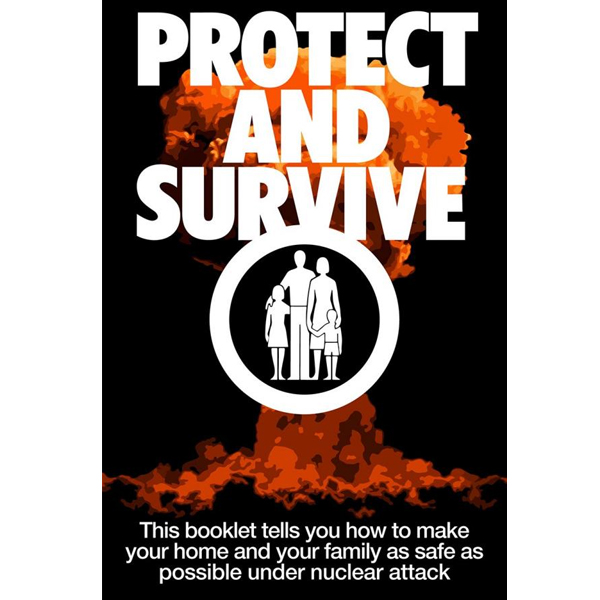
The 1981 Government leaflet telling us how to protect ourselves from nuclear attack
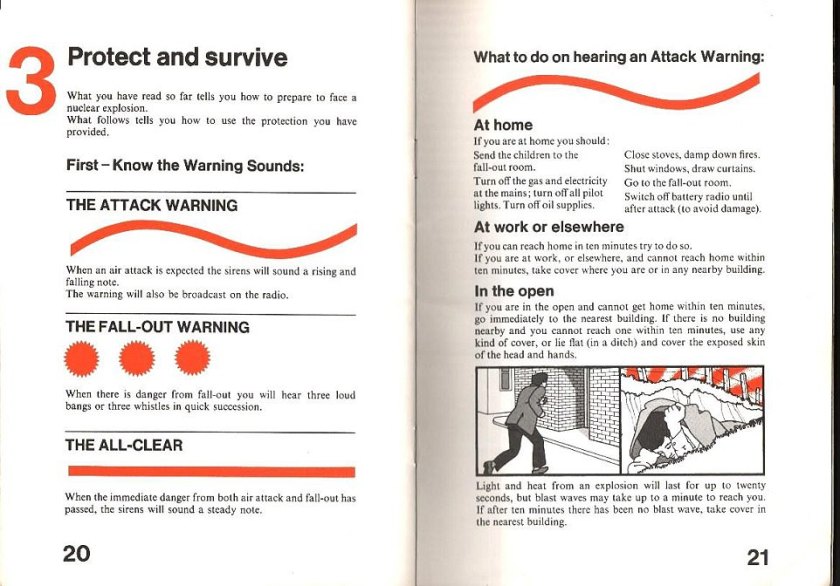
Protect and Survive
Some helpful tips on how to survive a nuclear attack
23BC1D3C-D0F2-4AD7-8CAD-EB7D77751056
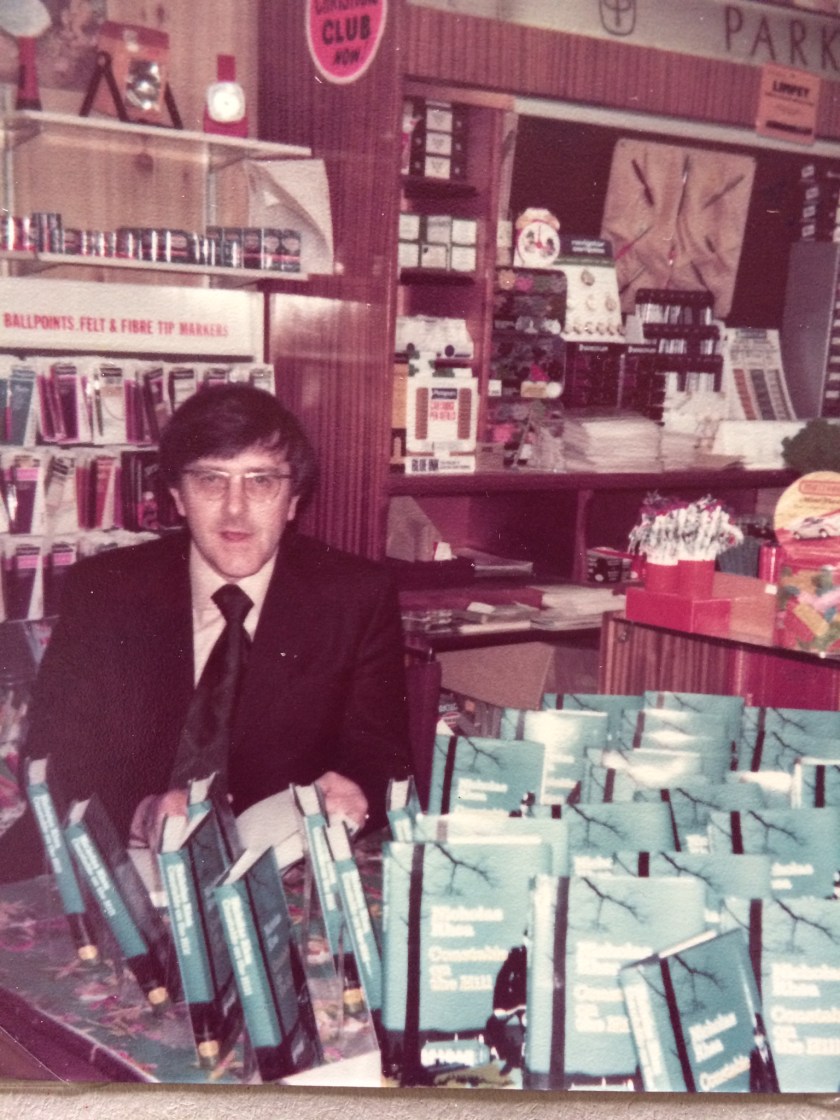
The book my dad signed for reader Edith Bennison

I had a lovely letter recently from reader Edith Bennison who has been a long-term follower of my dad’s Countryman’s Diary, and now my own column.

Following my recent piece about litter, Edith recalls the days when most villages still had their own street sweepers, and we had one in the village where I grew up. You’d see him, with his orange high-vis vest, flat cap and cart, out in all weathers keeping the pavements, verges and roads clean. I’m guessing the tale Edith tells must have occurred during the late 1970s or early 1980s when concern about the nuclear threat to the West from Russia was at its height.

The threat was taken extremely seriously, and Margaret Thatcher’s government implemented a public information strategy known as ‘Protect and Survive’, a series of leaflets and TV and radio broadcasts informing us of what to do in case of an attack.

This included creating a ‘fall-out’ room within your home to protect yourself from radioactive dust. You were told to seal all windows and doors and block them up with thick materials, like bricks, books, or furniture filled with clothes. You were also told to create an ‘inner refuge’ within that room where you would be expected to shelter for at least the first 48 hours after an attack. This would be made out of something like a dining table, which again would be surrounded on all sides, including the top, by heavy items, such as sandbags, mattresses or earth-filled chests of drawers.

Thanks to the magic of the Internet, I was able to take a look at a ‘Protect and Survive’ leaflet myself. It does make pretty alarming reading, so it’s no wonder we were all a bit on edge about it. I remember my school educating us about the possibility of nuclear war, and I also remember writing an essay about the pros and cons of nuclear power, which of course is a separate issue. But I ended my essay with a paragraph explaining that there was nothing to worry about with nuclear power, but then I stopped mid-sentence and my pen left an illegible scribbled trail across the page which ended in a little drawing of a mushroom cloud.

Needless to say my teacher was not very impressed, and I was chastised for associating nuclear power with nuclear war, and for concluding my essay in such a silly way.

But my little drawing did reflect the worries that were in many minds at the time, and the news outlets were full of the negotiations between Reagan, Thatcher and Brezhnev. The culture of the day also reflected the mood of the nation. Pop group Frankie Goes to Hollywood used the sinister voiceover and warning siren from the government Protect and Survive public information film on their single ‘Two Tribes’. And graphic author Raymond Briggs, famous for writing ‘The Snowman’, published ‘When the Wind Blows’ in 1982, which describes the impact of a nuclear war on an ordinary couple.

In dark times, we Yorkshire folk are known for our typical ‘keep calm and carry on’ attitude and our down to earth sense of humour. I have a feeling that Edith’s sweeper was rather fed up, not only with endless depressing news bulletins about the nuclear threat, but also with thoughtless people closer to home who persistently dropped litter. She tells me in her letter that he had written a message on his cart which made me giggle: ‘If there is a nuclear attack, hide in a bin, because nothing ever hits it.’

She also recalled meeting my dad at a book signing in Dressers of Northallerton, which sadly is no longer there. Although Edith couldn’t remember the year, the book was Constable by the Stream, published in 1991. Dad was always thrilled when fans turned up to his signings, and also when people wrote to him in response to his column, as he describes on 30th June 1979, where an earlier column about bees had attracted discussion. Someone had responded that ‘telling the bees’ was important because it was believed the bees were once the souls of the recently departed.

I’m delighted to hear, as would he, that Edith still has quite a collection of his books, and receiving letters and messages like this shows that he touched many peoples’ lives. It fills me pride knowing that his legacy is set to go on for many years to come.

Read more at countrymansdaughter.com. Follow me on Twitter @countrymansdaug

ENDS

This column appeared in the Darlington & Stockton Times  on 28th June and the Gazette & Herald on 26th June 2019

Better tell the bees

6119D532-A199-45EB-B8B6-DF2080B22568
The buzzy mass of bees I spotted in a dog walk
7C120108-AE03-4EFE-960D-DB00000ECA81
The victorious male mates with the queen

I was walking the dog this morning when a big, black, buzzy, mass of something fell from the air and plopped to the ground.

As I got closer, I realised it was a cluster of bumblebees all behaving rather aggressively towards another, larger, insect that was, at first, difficult to identify through the throng of yellow and black furry bodies. Several bees seemed to be attacking this creature, but because of the way they were all clinging on, I couldn’t really tell what was happening.

So I stood and watched a while, and soon, some of the bees flew off, leaving just one, and the creature beneath became visible. Only then did I realise it was in fact a rather large queen bumblebee, and the one remaining bee was not actually attacking her, but mating with her. That cheered me somewhat, as you can’t fail to be aware of the decline in our insect population. Bees are incredibly important for pollination, the very key to human survival, so I was delighted to see healthy bees doing just what they should in my little corner of North Yorkshire.

As soon as I got home, I looked up the mating habits of bumblebees so that I could understand what the ‘cluster’ behaviour was all about. Had all the bees mated with her?

A queen bee comes out of hibernation as the spring temperatures rise, having lived underground in the soil all winter. She will have survived on stores of body fat created by consuming large quantities of pollen and nectar during autumn. When she comes out, she looks for a suitable nesting site, which could be a hole in the ground, a bird box, under a garage, in a compost heap, or in any other dark cavity.

When she finds her home, she collects pollen to bring back to the nest and builds a kind of ‘pot’ from waxy bodily secretions into which she lays her eggs. She will incubate them for about two weeks by sitting on the pot and shuddering to keep them warm. They then hatch into larvae, and she continues to feed them with pollen. After another two weeks, the larvae spin cocoons around themselves as they develop into adult bees. This first batch of new bees are all female, and will either be worker or future queens.

The queen can then sit back and relax while her workers fuss around her, guarding and cleaning the nest and gathering pollen. She will produce more eggs that will become male bees, whose job, it seems, is merely to eat and reproduce. The male bees leave the nest, never to return, and live independently outside.

When bees mate, the males vie for the queen’s attention, and this is what I was witnessing on my walk. They cling on to her in the hope they will be the chosen one, until she decides which she will mate with.

Once a queen has founded her colony and reproduced then her work is done, and she will die, along with most of her colony. It is only the new, future queens who hibernate to emerge the following spring to start a new colony.

In his column from 23rd June 1979, Dad talks about some ancient superstitions associated with bees, particularly the custom of ‘talking’ to them. Apparently, if you had bee hives, you were duty-bound to inform them of any important family news, such as births, deaths and marriages. The bees were very important to the household in providing a ready supply of honey, which in those days was a precious and essential resource. If you didn’t keep your bees happy, they might desert the hives.

The bee keeper took the role very seriously, and could often be seen standing among the hives, solemnly informing the buzzing audience of the latest news, and this was called ‘telling the bees.’

This tradition forms the centre of a charming novel by successful York author Fiona Shaw called ‘Tell it to the Bees’, where a young boy shares his family secrets to the bees in his garden. The story has been turned into a feature film which had its worldwide premier in Toronto last year and, happily, is due to be released in the UK from July 19th.

So I think I might just be the first in the queue for tickets.

Read more at countrymansdaughter.com. Follow me on Twitter @countrymansdaug

This column appeared in the Darlington & Stockton Times  on 21st June and the Gazette & Herald on 19th June 2019

Sweet sweet memories

4D5A33B1-59C7-43C2-814D-A12AF4CDEFF9
Traditional 1970s sweets
F0F940F5-9031-44AD-8931-1BABD5373A1A
Stamps commemorating 150 years of professional police officers issued in 1979

Forty years ago this week, my dad was marking the 150th anniversary of this country’s professional police force in his column of 16th June 1979. Over the months following the article, a number of events were planned nationally to mark the occasion, including concerts, parades, services and shows.

Another memento was the publication of some commemorative stamps, and what fascinated me were the prices. At that time, a first class stamp was just 10p, and the new 10p stamp featured a bobby on the beat, while the 13p was a female police officer on horseback, and the 15p was the image of a police patrol boat on duty. But the one that made me take most notice featured an officer directing traffic. That one would set you back 11½p.

I’d almost forgotten we used to have half pences until I read Dad’s column. Although they weren’t in existence for that long, they were around for most of my childhood, having been introduced in February 1971 as part of decimalisation. It was worth about the same as 1.2 pence in old money so that it would make the re-pricing of lower-value items more accurate. It bit the dust in December 1984 when it was was no longer considered a useful member of our coinage family.

I’d also forgotten that back then, it was possible to buy a single halfpenny stamp, and although it has never officially been withdrawn, it stopped being sold from 21st June 1985. Ha’penny stamps were only ever issued in turquoise, although there were many versions over the years, and some are quite prized by collectors. An original from the 1970s could today set you back anything from 15p to £25, and if you have any lurking in your drawers, you could legally still use them, although obviously you’d have to use two on your envelope to make it up to a round penny.

The half pence came in handy on pocket money days when I tried to eke out my 10p allowance while scrutinising the array of sweets on the penny tray. You had to ask the man behind the counter at the post office to bring it out, which only added to the excitement and expectation. He would then wait patiently while I dithered about what to pick. Should I be canny and go all halfpenny fruit salad chews, meaning I’d get twice as many sweets for my 10p? But then wouldn’t it be a bit boring having all the same thing when there were so many other tempting delights on offer? What about the one penny foam bananas and the shrimps? Or the flying saucers, which were like holy communion wafers but with fizzy sherbet in the middle? Or the shocking pink Bubbly bubble gum? I don’t think I was ever tempted by that aniseedy reprobate, the black jack. But then, who was?

I would usually select a combination of halfpenny and penny sweets so that I would feel that I’d got my money’s worth and then make my hoard last as long as possible. But every so often, I’d throw caution to the wind and buy the extravagantly-priced Refresher chew, a big hunk of a sweet that could put your jaw out, but it was worth it when you got to the sherbet in the middle. At 2p a pop though, it took a significant bite out of my 10p budget. I had the same dilemma over the Swizzle double lolly, a slightly fizzy, slightly powdery yet hard ball of deliciousness that, if you were savvy with your sucking, could last most of the afternoon.

If I was really lucky, I had extra money from a birthday or Christmas, and then I would go all out and buy a double lolly, maybe even two, or a sticky Drumstick lolly, and possibly a few candy cigarettes, and most excitingly, a quarter of rainbow crystals. This was basically just a bag of coloured fizzy sugar which I’d then spend all day dipping my lollies into. It may have been terrible for my teeth, but boy, did it taste good.

You can still buy many of the sweets that we used to love, and there are plenty of websites selling these glucose-laden blasts from the past. I’m tempted to go and order my favourites, although I’m not sure I’ll have any luck finding halfpenny chews these days.

Read more at countrymansdaughter.com. Follow me on Twitter @countrymansdaug

This column appeared in the Darlington & Stockton Times  on 14th June and the Gazette & Herald on 12th June 2019

Feeling ticked off

02D0A1F6-950D-4CB4-9036-9A89C5323292
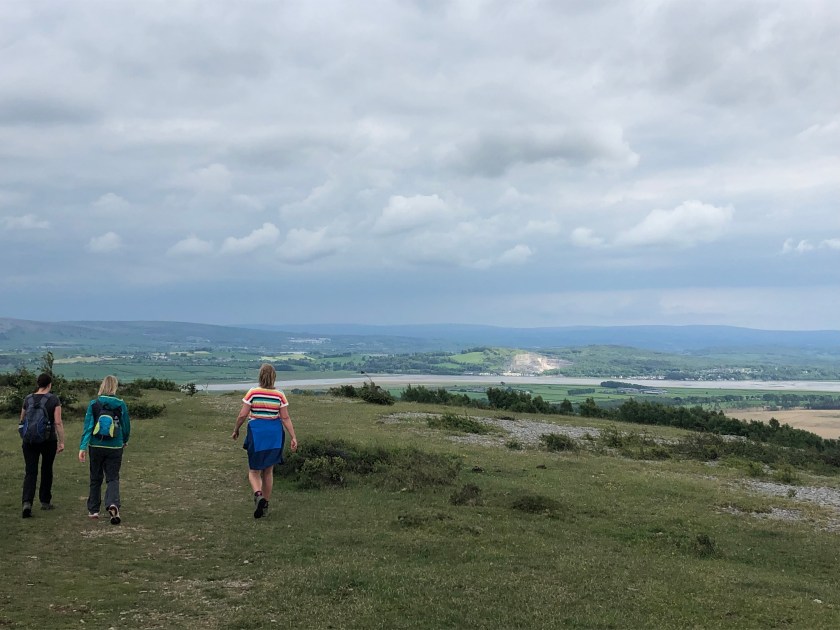
The view from the top of Whitbarrow in the Lake District
31B8F2D7-B914-47A2-9B3D-7200AA1ED92D
A full tick that fell off Roly
05434A83-1627-4C0B-BF55-CB575FEEB81C
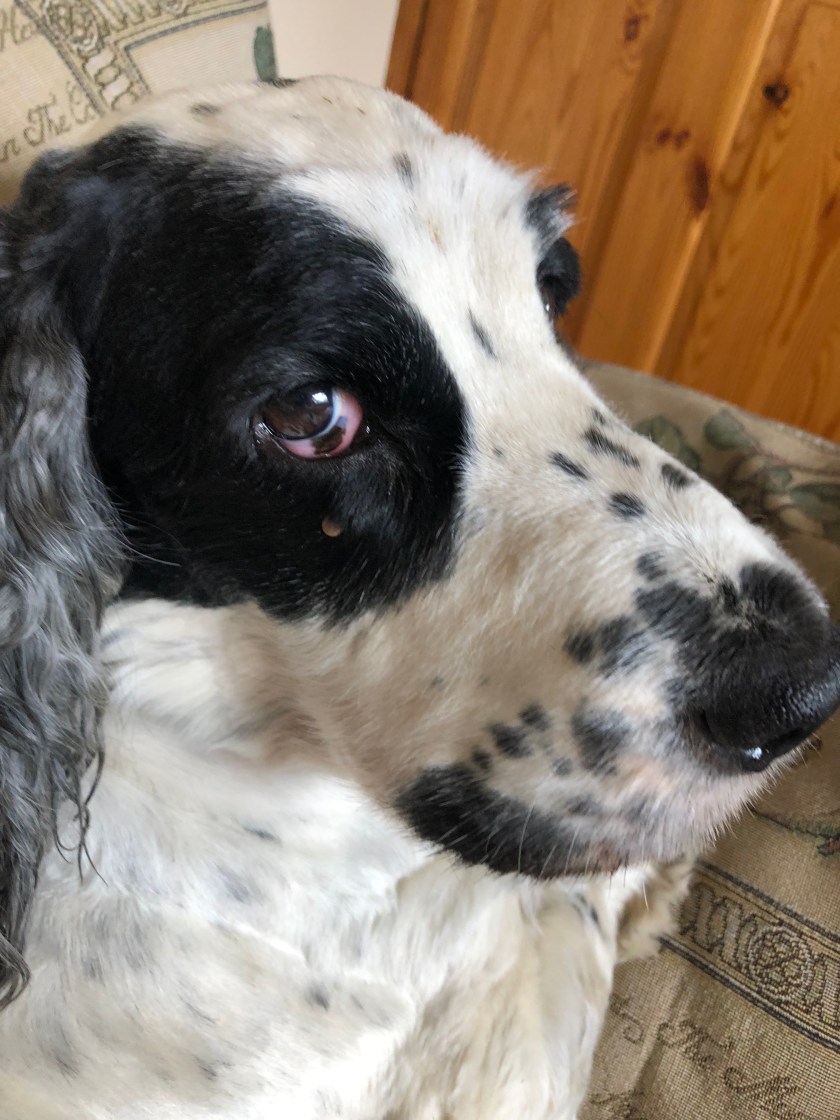
Roly with a tick just visible below his eye

I’ve just come back from a lovely break in Cumbria, staying not far from Grange-Over-Sands, near Whitbarrow National Nature Reserve. It’s an area of special scientific interest due its exceptional limestone habitats created as a result of the last ice age. As the ice retreated, it exposed the limestone to the elements and over time, an uncommon collection of boulders, crevices and escarpments was formed around the imposing rock face of Whitebarrow Scar, which can be seen from miles around.

There were some lovely walks, including one to the summit of Whitbarrow, which I, my friends and our canine companion Roly, completed. Although the climb was hard, it was worth it for the spectacular 360-degree views from the top. We could see Morcambe Bay to the south, the fells of the Lake District to the north, Ingleborough in the Dales to the east, and Furness peninsula to the west.

Much of Whitbarrow is covered in trees, and the descent took us through some lush green woodland. At this time of year, not only does the area attract human visitors, it also seems to be the prime leisure resort for hungry ticks.

Even though I look after dogs, I don’t often come across ticks, probably because most of my guests are protected against them by various methods such as special collars, pills or potions. Also, where I live is not a particularly popular tick hideout. Cumbria, though, with its abundance of lakes, woodlands, sheep and deer, is a tick’s idea of Nirvana.

Unfortunately, Roly was unwell recently, and during treatment had his tick collar removed, which meant that he was temporarily unprotected from these greedy little blood suckers.

The squeamish among you might want to stop reading now, because the day after the walk, we spotted one of the blighters near Roly’s eye. This was not the last, and over the following days, more kept appearing, either on Roly’s body, or crawling across the floor. Yes, it was gross (and if, like me, you’ve ever accidentally stood on a replete, post-gorging tick, you’ll know exactly how gross).

This led me to do some in-depth research on these horrible yet strangely fascinating creepy crawlies. The reason they are so difficult to spot initially is because they are quite tiny, but then their bodies swell up to many times their original size while they feed on the blood of their living host. If you haven’t already removed them, once they have had their fill, which can be up to seven days later, they drop off to go and find a suitable place to lay eggs.

Although thinking about what ticks do makes me shudder, most of the time, they are pretty harmless. However, there is a small risk of contracting the serious illness, Lyme disease, which is carried by those that have previously fed on infected animals.

Therefore, if you have been bitten by a tick, it’s important to remove it as quickly as possible, ensuring you do not squeeze the body or leave any of the mouth parts behind in the skin for fear of infection. You can get special tools to do this, or use a pair of tweezers, but do look up how to do it properly, as you could cause problems by getting it wrong.

You also need to keep an eye on the area for several weeks afterwards, and if you notice a slow-developing circular rash, or start to feel unwell with flu-like symptoms, then do go and see your doctor as soon as possible.

I can’t find any record of traditional beliefs relating to tick bites, but there are when it comes to other members of our insect population, particularly bees, as my dad mentions in his column from 9th June 1979. It was a long-held belief that bee stings could cure arthritis and other painful joint conditions. Indeed, someone my dad knew, who had a persistently painful thumb, reported that he had been stung after putting on a gardening glove with a bee hiding in it. From that day, his thumb was never sore again.

This is not just the stuff of old wives’ tales. Today, research is ongoing into the curative benefits of bee venom, although some trial patients have reported that the pain of the venom injections is worse than the condition itself.

I wonder if any arthritic readers have ever tried bee-sting therapy?

Read more at countrymansdaughter.com. Follow me on Twitter @countrymansdaug

This column appeared in the Darlington & Stockton Times  on 7th June and the Gazette & Herald on 5th June 2019

Between a frog and a hard place

A71D591A-2766-49DE-A1FD-9B43311BEE36
A toad that took refuge in my parents’ greenhouse
E7AF557E-7F7E-4A18-9D84-7D6DDE13B4F3
Dad holds up the toad. His golden eyes show that he’s not a frog

The first house I owned had a lovely back garden with a pond. We had planned to fill in the pond as with a young toddler, it was a bit of a hazard.

But once we’d lived in the house a while, we realised that the pond was absolutely teeming with life, and if you sat a while and observed, you would witness non-stop activity among the water, insect and bird population. I soon began to realise that if we filled it in, all these amazing creatures would lose their natural habitat.

So we kept it, and fitted a grille across the top to prevent our wobbly toddler from toppling in. It was around March or April time that the pond was at its noisiest, with a rather amorous community of frogs making their presence known, and the fruit of their activities would soon become visible in the form of masses of frogspawn lying across the surface.

Sometimes there would be so much of it, we’d wonder if our small pond could sustain the new generation but, it seems, there can never be too much frogspawn. This is because only about one out of every 50 eggs laid will ever make it to adulthood, thanks to them being hunted by a variety of predators at every stage of their lives. Not sure lawnmowers count as predators but ours certainly claimed its fair share of victims hiding in the long grass.

In my dad’s column from 2nd June 1979, he talks about superstitions around toads, and it made me wonder if you, dear reader, would know the difference between a frog and a toad. For the record, frogs have smoother skin and longer back legs which means they can hop quite a distance, especially when startled from a hiding place (sadly not always in time to beat the blades of the mower!).

Toads on the other hand have warty skin, golden eyes and crawl rather than hop. Frogs breathe through their skin, and need to stay near shallow water, whereas a toad’s skin is more waterproof, so they can survive long periods away from water. Toads also tend to stay still if they are startled.

I had believed that toads were bigger too, but in fact, there is not that much difference in length, with male frogs reaching up to 8cm, while male toads can be up to 9cm. Females of both species are larger and grow to around 13cm. The main difference is their shape. While frogs are slim and athletic-looking, toads are like their couch-potato siblings, with dumpier, more rounded forms.

There are just two species of frog and two species of toads in the UK, although you are most likely to only see the common varieties as the others are rare and found in very few areas (the pool frog and the natterjack toad). Common frogs tend to be green or brown, but can be many shades, from cream and red to orange or black, while common toads are mainly various shades of greeny-brown.

In my dad’s column, he talks about an old belief that toads were able to live for centuries without food or moisture at the centre of a large rock or boulder. The belief followed reports of quarrymen breaking open rocks to find what they thought were mummified toads, only for the creatures to suddenly start moving.

This belief persisted until well into the nineteenth century, and my dad quotes the Rev George Young, writing in his 1828 ‘Geological Survey of the Yorkshire Coast’, who was talking about incidents of finding toads within rocks. “We are the more particular in recording these facts because some modern philosophers have attempted to explode such accounts as wholly fabulous,” writes the esteemed reverend.

Various attempts were made to scientifically prove and disprove the belief. One nineteenth-century scientist recreated the conditions by placing toads in hollowed-out rocks which he then re-sealed and buried in his garden for a year. When he dug them up again, most were dead. Amazingly, one or two were still alive, although only just. So he buried the poor things again for another year and, unsurprisingly, none survived the second trip. Poor toads! Thankfully, such cruel experiments are not acceptable these days.

I’ve heard it said that you have to kiss a lot of frogs before you find your Prince Charming. Well, I’d better pucker up then.

Read more at countrymansdaughter.com. Follow me on Twitter @countrymansdaug

This column appeared in the Darlington & Stockton Times  on 31st May and the Gazette & Herald on 29th May 2019

Brought to book

006251FA-AFBD-4EE1-9048-B4A41C136AAC
Dad signing copies of his first ‘Constable’ book at Grover’s of Northallerton on 24th May 1979. This was the series of books that led to Yorkshire TV making Heartbeat.

As I have mentioned before, one of the most exciting times in our family story is when we heard that Dad’s Constable series of books was going to be made into a TV programme by Yorkshire Television. I could be wrong, but I imagine that it is many a writer’s dream to have someone decide that your stories and characters are worthy of the money, time and effort it takes to create a popular TV show.

And what a good job they did, with Heartbeat becoming instantly popular and attracting millions of viewers per episode. When my dad first had the idea to write some stories about the life of a country bobby, I can’t imagine that he had a notion of what it would eventually lead to.

Having said that, he was well acquainted with a certain local vet who had found success with his books and TV shows. Alf Wight, otherwise known as James Herriot, had in fact asked my dad for advice when they had been in the same pub together in the late 1960s. He’d explained to Dad that he had written a collection of funny stories based on his experiences as a vet and, as Dad was already a published author, wondered what he thought.

Dad had recently had the idea for some lighthearted books based on his life as a country bobby, but it was rejected by publishers declaring, “There’s no call for Yorkshire humour.”

So he passed on this sage piece of wisdom to Alf White who, thankfully, ignored it and his first book, If Only They Could Talk, hit the shelves in 1970. And the rest, as they say, is history.

So it must have been a very proud day indeed when those humorous tales that Dad had dreamed of publishing finally came to fruition on May 24th 1979 with the publication of Constable on the Hill, the first of what would become a series of 37 books.

Dad informs us, in a column that was published just two days after publication, that extracts of his new book had been already featured in the Sunday Express, and his publisher said it was destined to be a bestseller.

“For a rural columnist like myself, this is very exciting, and regular readers of this page might recognise some of the yarns, and indeed, some of the characters,” he writes.

I can’t tell you how wonderful it is to read the words he wrote all those years ago, and feel the sense of excitement he must have experienced at the time. Knowing as I do just how hard he worked, the sense of accomplishment must have been great. However, it would be another 13 years before Heartbeat would hit the screens, and that brought a whole other new exciting world into our lives.

As I think it is today, author signing events were quite common to help promote a new book. According to the column, his first ever signing session for Constable on the Hill was on the afternoon of May 26th 1979 at Grovers Bookshop in Northallerton. I believe Grovers is still there, but their website does not mention anything about books, so I wonder, do they still stock them? Perhaps someone reading this will know, and might also be able to remember meeting my dad at the book signing.

It always delights me when I hear from people who were fans of Dad’s books. I was recently contacted by Gurli Svith from Denmark who has copies of almost all of his books and only needs one more, Siege for Panda One, to have the full collection. Unfortunately, she has been looking for a copy for some years and has not found one. So if you happen to have one gathering dust on your shelves, do get in touch with me. Another lady, Ruth Pollard, is also very keen to get hold of my dad’s collection of crime books, most notably, The Sniper, which I mentioned a few weeks back, and also his Carnaby series. Again, if you can be of help, do get in touch.

In the meantime, I should get back to working on that novel that I’m half way through. And if one day I achieve just a tiny modicum of the success of my dad then I will be mightily chuffed.

Read more at countrymansdaughter.com. Follow me on Twitter @countrymansdaug

This column appeared in the Darlington & Stockton Times  on 24th May and the Gazette & Herald on 22nd May 2019

Is there a solution to pollution?

57C0BBE1-E6C4-4194-A0E4-60D9D24AE122.jpeg
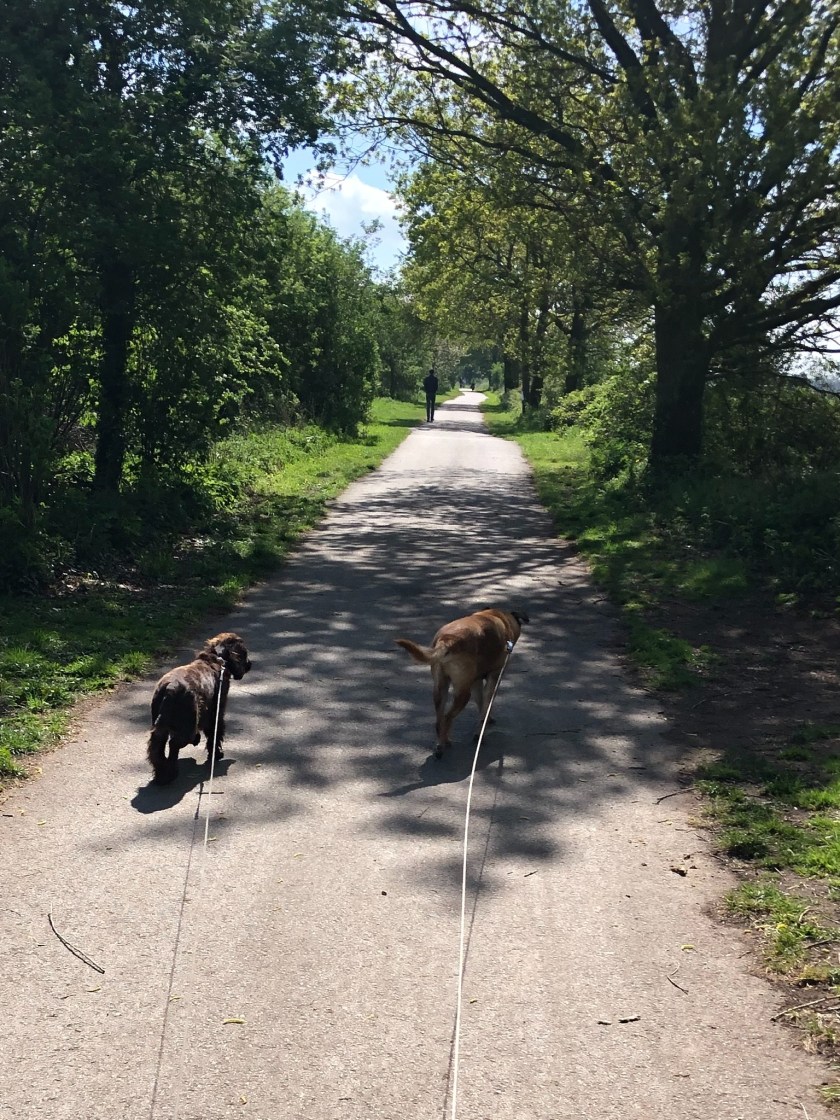
The dogs on the lovely York-Selby cycle path near Bishopthorpe on Saturday 27th April where I encountered a large group of young people who left their litter behind

The problem of waste and and plastic pollution is, quite rightly, a very hot topic at the moment and I have previously discussed the rise in fly-tipping and the lack of a sense of personal responsibility for litter among our youngsters.

Just the other day I was walking dogs along a country path at Bishopthorpe near York, and I came across a large group of teenage ramblers, plus a few adults, split into a number of smaller posses. They looked like they were on a Duke of Edinburgh Award challenge and were well kitted out, with sturdy boots and large rucksacks on their backs.

One group had decided to take a break by the side of the path. We greeted each other, and they were very friendly and cheerful as they ate their snacks. I walked on further with the dogs, watching other groups of the teenage hikers ahead of me as they made their way good-naturedly along the route.

After a while, it was time for me to turn back and once again I passed the spot where they had taken their break. To my utter dismay, scattered across the ground were several freshly-empty crisp packets and sweet wrappers. I was so cross that they blatantly disregarded the beauty of the countryside within which they were walking, and now they were nowhere to be seen.

Had I met them again, I would have asked if any of them had attended the recent ‘Fridays for the Future’ climate strikes where, instead of attending school, thousands of pupils took a day off to join marches against pollution and climate change. I have a feeling that a good number of them will have done that, not registering the hypocrisy of leaving their litter behind to pollute the environment they claim they want to protect.

I do think the issue of littering is worse these days, and yet, it is nothing new. In his column from 19th May 1979, my dad wrote: “It seems we are a careless society, whose people care not for the landscape, their environment or the lives and health of wild creatures.”

And the particular threat of plastic pollution was already concerning him back then too. He expressed disappointment that so many of our groceries were being packed in plastic wrapping and containers: “Many plastics will not deteriorate, and will consequently lie in the grass or on the moors forever, unless some hapless animal like a cow or a sheep attempts to eat it.”

But there are people out there who are coming up with clever ways to help combat the problem. I came across a fascinating video on social media featuring Balinese social entrepreneur Kevin Kumala. He has invented a new kind of carrier bag using starch from the cassava, a root vegetable grown in many Asian countries. The carrier bags are strong enough to hold your groceries, and yet 100% biodegradable and harmless to nature, being totally safe if animals ingest them. Unlike conventional plastic bags, which take hundreds of years to break down, these take just three to six months and are made without using any harmful oil-based chemicals. In fact, they completely dissolve in warm water which is then safe enough to drink.

Is it time our big supermarkets start leading the way by ditching their conventional bags and choosing those that are kinder to our environment?

Another entrepreneur, Toby McCartney, has also come up with a groundbreaking idea, this time to turn plastic waste from the household, commercial and agricultural sectors into pellets that can be used in the construction and repair of roads. It means less waste going to incineration or landfill and, so he claims, results in stronger road surfaces that are less prone to potholes. That will be a welcome solution to many of us in Yorkshire who are well acquainted with that problem.

Cumbria County Council is the first in the country to start using this new plastic compound on its roads, so I wonder if North Yorkshire has any plans to follow suit?

Lastly, if you are a teacher, adult leader or parent associated with the large group of teenagers who were walking down the York to Selby cycle path, past Bishopthorpe, on Saturday 27th April, then please get in touch with me via this paper so we can discuss what we can do to help our young people be more responsible around litter.

Read more at countrymansdaughter.com. Follow me on Twitter @countrymansdaug

This column appeared in the Darlington & Stockton Times  on 17th May and the Gazette & Herald on 15th May 2019

In the dog house

DB33F535-2F91-4AE3-AABF-465E43BB3D10
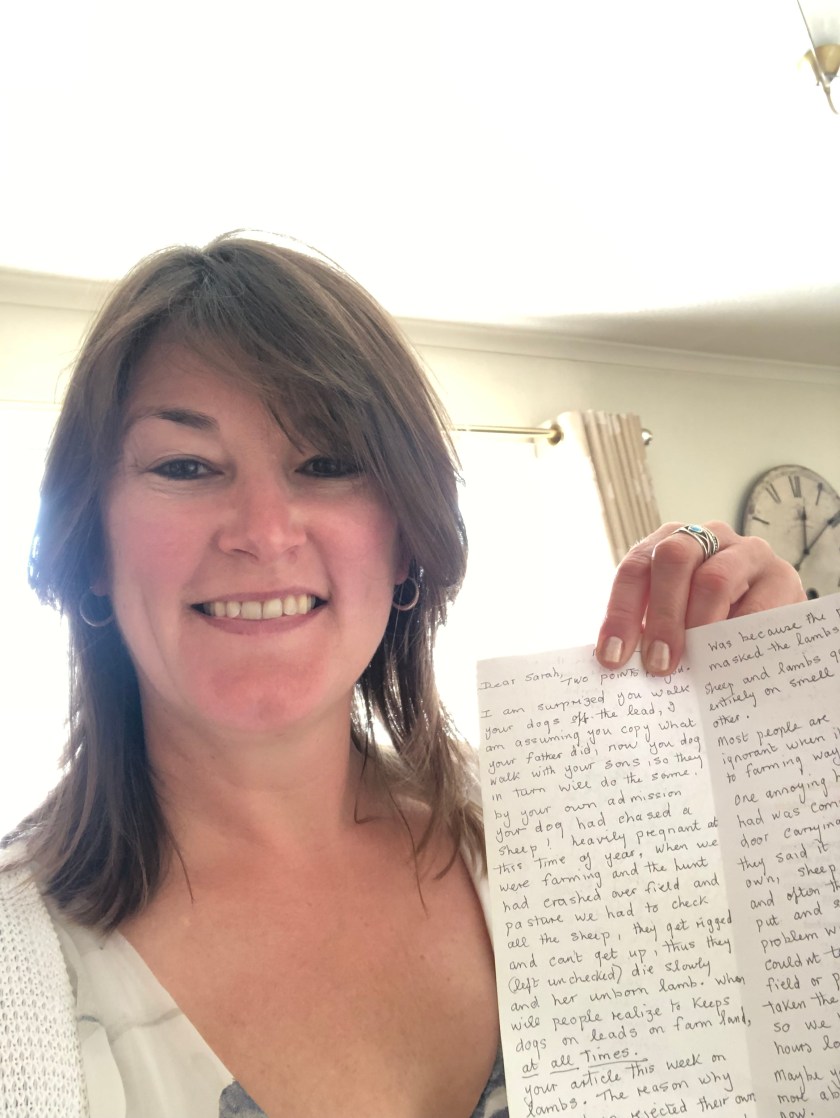
Me with the letter I received from a rather disgruntled reader

I have received a rather stern letter from a reader who seems somewhat annoyed with me. I’m quite pleased that I have reached almost 100 columns (this is number 99) and it is the first message that has not been positive and encouraging, so I will take that as a good sign!

I love to receive letters and communication from readers, even the negative ones, as it proves that people are reading what I am writing, which can only be a good thing for our newspaper. And if I demonstrate my ignorance then I am more than happy to be corrected. After all, every day is a school day!

The column I wrote in early March entitled ‘A wolf in dog’s clothing’ discussed the dangers of letting dogs off leads in the countryside, especially at lambing time, and it was this one which prompted the letter.

I think my dad will be looking down and chuckling at what my son jokingly called my first ‘hate’ mail, because I know Dad received his fair share of critical mail too. Of course, it is far from ‘hate’ mail, and is written by someone who has seen first-hand the carnage caused by sheep worrying incidents so is understandably angry with irresponsible dog owners. I’d like to thank them for taking the time to get in touch, and for imparting other nuggets of country wisdom that I don’t have the room to include here.

But in relation to the column, the writer seems to have the wrong end of the stick and make assumptions that are wrong. They did not include their address, so I can’t reply to them personally, so I shall set them straight here, just in case any of you reading are also living under similar misconceptions.

The letter-writer states, “I am surprised you walk your dogs off the lead. I am assuming you copy what your father did, now you dog walk with your sons, so they in turn will do the same.”

In fact, my dad never owned a dog in my lifetime, and so I have not learned anything about walking dogs from him to pass on to my sons.

The writer then goes on to tell me how dangerous it is to walk dogs off leads around sheep at lambing time, and of the potential costs to pregnant ewes and the farmers who own them.

Now this makes me wonder if the reader had actually read the whole of my column, or was so incensed at the first few paragraphs that they had to stop and immediately put pen to paper to express their anger.

The whole point of the column was to demonstrate the dangers of having a dog off-lead around livestock. Some cases of sheep attacks are because owners do not believe their dog has the capacity to attack, and so I shared my own case precisely to demonstrate that even the most placid of dogs can chase sheep. This was one occasion in the early 2000s outside of lambing time and no harm came to the sheep. I certainly learned from it, and I hope that others, including my sons who were there at the time, do not make the same mistake.

If that point wasn’t clear, then I apologise.

The reader also suggests that country folk are not at fault, but lays the blame for thoughtless behaviour at the door of uneducated ‘townies’. Perhaps they have missed recent police rural crime team and National Farmers Union statements which declare that country dwellers who allow their dogs to roam free from their own homes are a major part of the sheep-worrying problem.

I would like to assure the writer that I am not one of those (I don’t actually own a dog, but look after other people’s). Nevertheless, one of the greatest pleasures of dog walking is letting well-behaved pooches roam freely off the lead, but ONLY when it is safe to do so, away from livestock and other dangers. I see many farmers, and rural and urban residents alike, doing the very same thing, as they have done since time immemorial, and I will continue to do so myself. It is just a small irresponsible minority who ignore those dangers.

I hope this has set the record straight, and assure the letter-writer that myself and my boys take our dog-walking responsibilities very seriously indeed.

Read more at countrymansdaughter.com. Follow me on Twitter @countrymansdaug

This column appeared in the Darlington & Stockton Times  on 10th May and the Gazette & Herald on 8th May 2019

May the (police) force be with you

087E5D5C-D68A-4B0A-9726-CBD76A87A84B
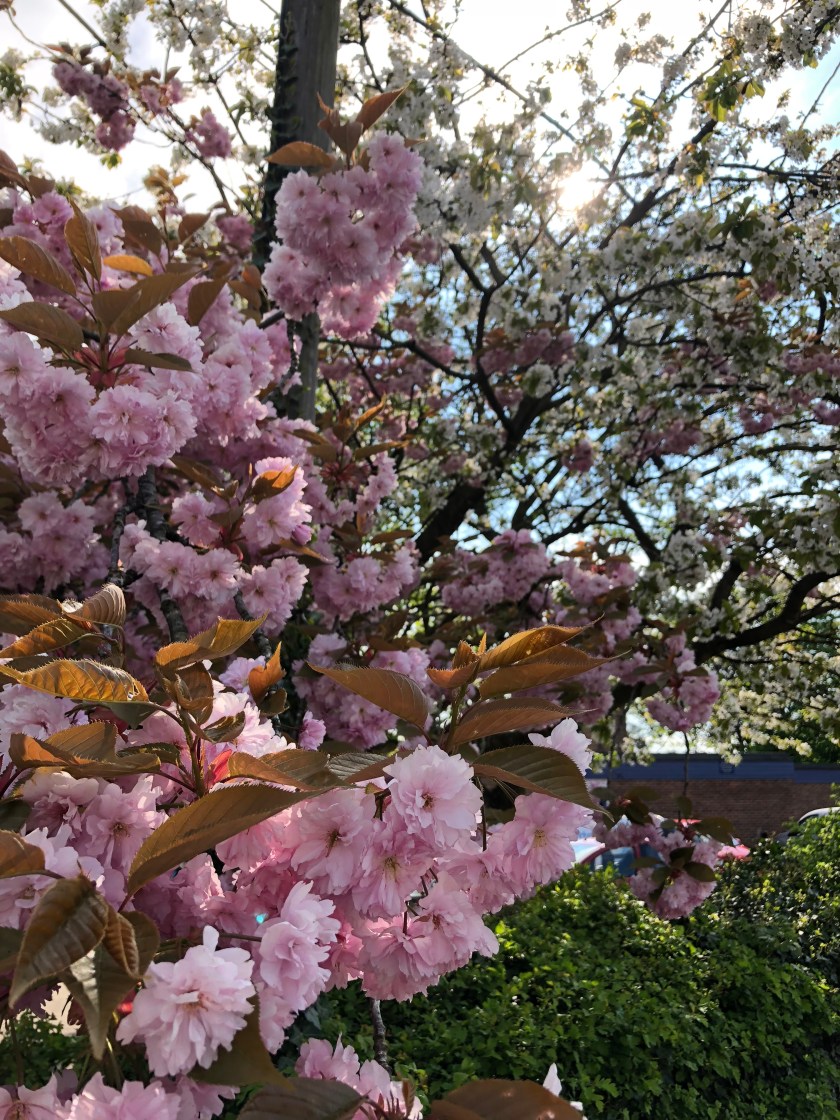
May is my favourite month thanks to the abundance of blossom
F46EF0CB-471E-4338-BF0F-CC1CC2DCA149
May is my favourite month thanks to the abundance of blossom
C710998B-1005-48A5-BB90-8274C15AE1F2
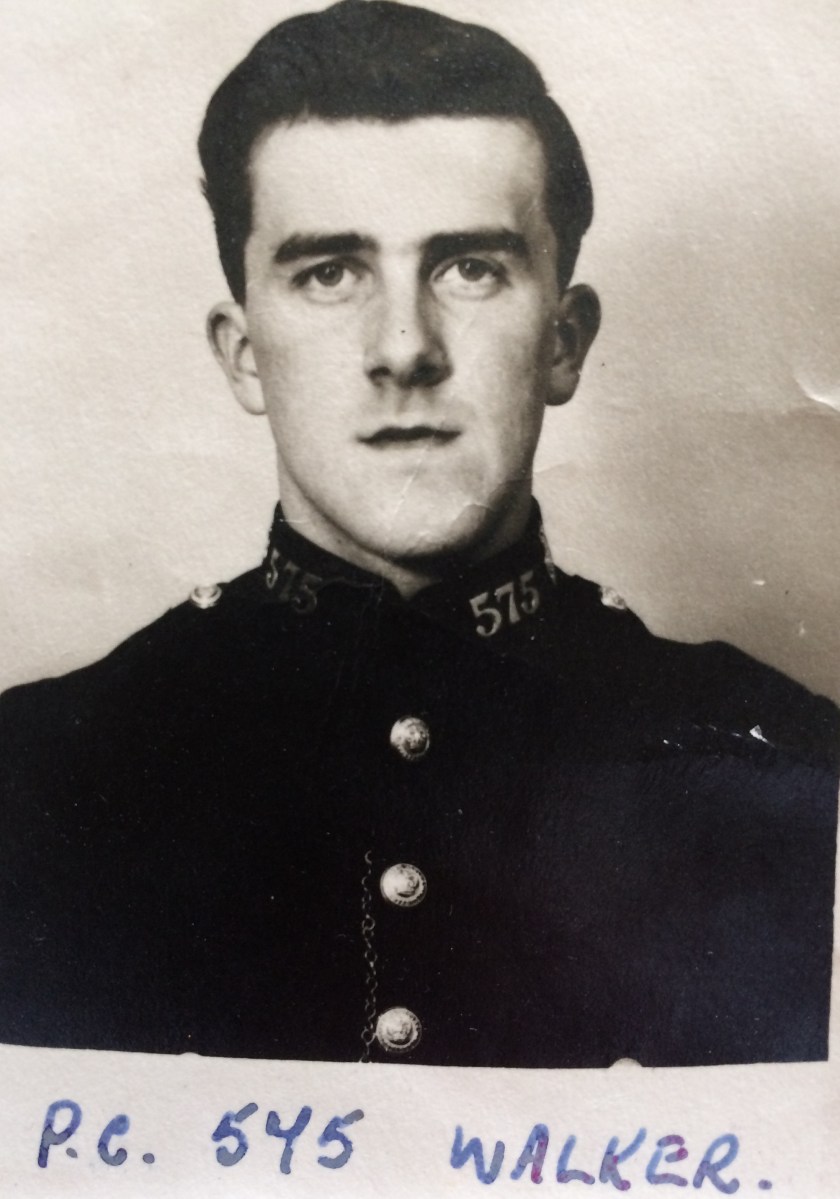
Reader Chris Lumley trained with my dad in 1956 and they had consecutive collar numbers. He was 574 and dad was 575

Ahhhh, May is here! I feel a sense of winter tension being released whenever this month arrives. It is my favourite month of the year, thanks to the abundance of blossom on the trees, the increased activity of our wildlife and the bright yellow fields of oil seed rape which are at the peak of their resplendent yellow glory right now.

We know that we are just about out of the woods, cold weather-wise, and the race is on to see who will be the first to boast about leaving the central heating off for more than 24 hours at a time. On a fine day, we can hang the washing outside knowing it will be dry by the end. When we gather it in, we inhale its unique fresh smell which simply cannot be matched by indoor drying (although sometimes I wonder if my neighbour takes my washing on the line as a sign to burn his garden rubbish).

May was also a favourite of my dad’s, as he explains in his column of 5th May 1979: “I consider this the most attractive month of the year, a time when the year seems to beckon us to enjoy life. Perhaps I am biased because my birthday falls during this month, but I think I am not favouring May for that reason.”

In fact, my birthday is exactly a week after my dad’s, which meant I felt an extra special connection to him, so maybe I am biased. But how can you not love May?

There is much folklore about this glorious month, and country dwellers know to treat it with respect, and not take any fine weather for granted. There is a saying that goes “A hot May makes a full churchyard” and another “Shear your sheep in May and shear them all away”, but the following little ditty is one of my favourites:

“He who bathes in May will soon be laid in clay;
He who bathes in June will sing a merry tune;
He who bathes in July will dance like a fly.”

Going by this, we Yorkshire folk had better postpone our annual baths until at least next month then.

Following my column from three weeks ago where I talked about ‘beastlings’ I had some lovely reminiscences sent in by readers. They are memories that could be lost forever, so by documenting them here, I hope I am doing my bit to preserve them.

Helen Hatton wrote: “I spent many magical hours of my 1950s and 60s childhood visiting a farm in High Farndale. A highlight was being taken in the horse and trap to deliver the milk to the Milk Marketing Board collection point lower down the dale.

“If a cow had calved, a bottle of ‘bisslings’ (a two-pint vinegar bottle), would be dropped off at the other farms that milk was collected from. This would be returned unwashed, but with salt in. I didn’t ever see curds being made but did eat the curd tart made from it. My understanding is that the curd was made by heating the bisslings with milk from the kitchen jug. Raw milk of course! Milking was done by hand at this time.”

And Chris Lumley contacted me with the following: “I grew up on a smallholding near Pickering in Ryedale. We had a small dairy herd and all our milk, except what we used at home, went to the Milk Marketing Board. When one of our cows calved, its milk could not go to the MMB as it was often bloodstained and we called it “bislings”. Mother used it to make curd tarts or ‘cheesecakes’ as you describe. It was also used to feed the newborn calves for their first few days and I never heard it said it was not suitable for this purpose. Like your Dad we still like Yorkshire curd tarts and often buy them in town.”

Amazingly, he also goes on to reveal a connection to my dad: “I joined the old North Yorkshire Constabulary in October 1956 at the same time as your dad. We had consecutive ‘collar numbers’. I was 574 and he was 575. We went through training at Newby Wiske Hall and I was posted to Malton when your Dad went to Whitby…Keep up the good work continuing his column.”

Read more at countrymansdaughter.com. Follow me on Twitter @countrymansdaug

ENDS

This column appeared in the Darlington & Stockton Times  on 3rd May and the Gazette & Herald on 1st May 2019

The butterfly effect

FC2DB3D5-AD8E-4C59-A9C8-4F92643176CD
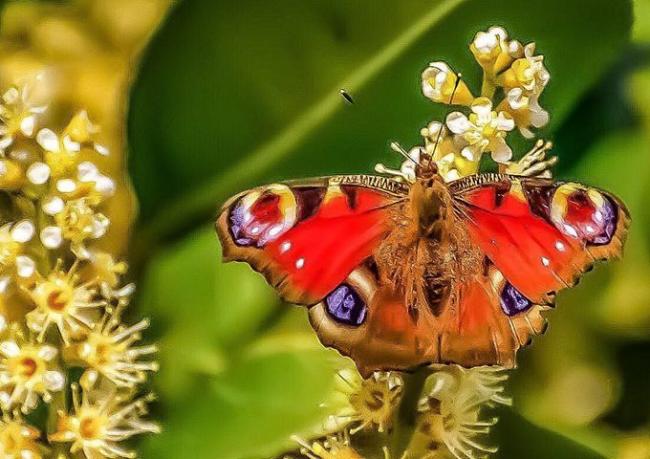
A peacock butterfly, which has seen numbers fall by 58 per cent, according to the Butterfly Conservation Picture: Keely Woodberry

You may recall that round about this time last year I wrote about the dwindling numbers of our beautiful butterfly population, with many familiar species in long-term decline, such as the Small Tortoiseshell and the Common White (large and small).

So I was delighted to hear about a recent report from the charity Butterfly Conservation which stated that, following a prolonged spell of decline after successive poor summers, overall numbers have ‘bounced back’ after the long, warm and dry summer of 2018.

According to the report, numbers of the endangered Black Hairstreak boomed by more than 900% compared to 2017, while the threatened Large Blue was up 58% over the same period. This was attributed to the good weather in early summer, which is when these species fly, along with cold snaps in February and March which will have helped the survival of caterpillars and chrysalises.

The common whites have also fared well, with the Large White up 115% and the Small White 158% after a run of poor years.

Unfortunately, the news is not so good for the Small Tortoiseshell, which was down 38% and the Peacock, which fell by 58%, a worry when you know that the Tortoiseshell’s large namesake is already extinct. The reduction in numbers was attributed the prolonged drought conditions last June and July which were detrimental to the survival of late-emerging caterpillars.

One of the most severely affected was the Red Admiral butterfly which saw its numbers crash by 75% after a good year in 2017. Had he been here, my dad would have been very sad to hear this, having written about this particular species in his column from 28th April 1979. It was there that I discovered that butterflies like the Red Admiral are rather amazing.

We all know about the astounding journeys made by birds from countries like Africa to our shores, but what I didn’t know was that there are a few butterflies that do that very same migratory journey, including the Red Admiral. Although it is officially considered a ‘resident’ species to the UK, it has established itself relatively recently and only in small numbers in the south of England as most cannot survive our cold winters. The UK has 59 species in total, and only two of those are truly migratory, which are the Painted Lady and the Clouded Yellow.

The vast majority of Red Admirals head south in the autumn to warmer climes, where they hibernate, but then return to Europe in late spring when their food sources become abundant again, enabling them to breed.

It’s almost impossible to fathom how something as delicate as a butterfly can make such a perilous crossing, but they fly high on air currents which help to carry them along, expending as little energy as possible. Most will stop and breed along the way in Southern Europe, before continuing further north as the weather here gets warmer. It is unlikely than one individual butterfly will do the whole journey, but like a migrating relay team, they produce offspring en route that will continue the pilgrimage.

Although 2018 was considered, for the most part, good for butterflies, severe weather events like last summer do have significant long-term impacts on our flora and fauna, and butterflies are not out of the woods, with two-thirds of our species showing negative tends over the long term. But there are things we can do in our own back yards to help, and I would encourage you to visit ‘butterfly-conservation.org’ to find out what simple things you can do to help the struggling insect and butterfly population as it is the disappearance of their habitats that is the main cause for their decline.

There is a trend, which I can’t get my head around, of people swapping their natural lawn for artificial grass, and I have also seen fake topiary-style ornaments and hanging baskets adorning some homes. These plastic alternatives might be convenient, but they are not providing any of the essential elements of a natural garden, namely pollen and insects which are essential for the survival of our wildlife. If we let our pollinators disappear, the consequences for the environment and the food chain will be catastrophic.

How awful would it be if, after their perilous journeys across land and sea, these beautiful creatures then disappear because we have decimated their habitats. We mustn’t let that happen.

Read more at countrymansdaughter.com. Follow me on Twitter @countrymansdaug

This column appeared in the Darlington & Stockton Times  on 26th April and the Gazette & Herald on 124th April 2019