Driving me mad!

1348BF28-419D-4E43-B573-8EC8E350BD15
My youngest son Joey having his first go behind the wheel on his 17th birthday last year


8FFADE71-E043-4AEA-B70D-6B00F535FD4C
My middle son Jasper with his first car on his 17th birthday

Sometimes, I long for those halcyon days when my children did not have driving licences. There are two reasons for this. One is that every time they take the car out I worry about them being involved in some horrific accident. The second is because now they are very vocal critics of my own standard of driving.

Before you become a driver yourself, you don’t really pay much attention to how someone is doing behind the wheel, as long as they get you from A to B safely. But as soon as you pass your test, not only do you get a full driving licence, but it seems you also get another licence – the licence to criticise someone else’s efforts behind the wheel. It’s certainly true for me. My boys have suddenly become driving experts, despite the fact I have driven mostly incident-free for the past 33 years. They could not care less that studies by road safety charity Brake show that women are the safest drivers, and young men the most accident-prone.

Today’s road users have many distractions to contend with, not least the sheer volume of traffic, which keeps increasing year on year. It’s a common complaint from those in the older generation who recall when the roads were less busy. But today, most households have at least two or three cars. When I passed my test in the 1980s, there was only one of my peers who had their own car, the rest of us having to rely our parents’ generosity in lending us their pride and joy (thanks Mum!). But now, having asked my kids (who share a car between them), most of their driving friends have their own car. A friend of mine has five cars in her household, one for each parent, and one for each child.

It’s a far cry from the days recalled in a letter to my dad that he mentions in his column from 16th February 1980. A Mr Percy Smith from Carlton Miniott near Thirsk had written to describe what it was like driving in the 1920s: “There were no heaters, no doors, and no windscreen wipers. Oil lamps were used for illumination and traffic on the roads was negligible.”

Back in those days, owning a car was something only the privileged few could afford, and it was more akin to a sporting pastime than an everyday necessity. It wasn’t just for men, either, as women were equally fond of getting behind the wheels of these exciting new machines.

In his archives, Dad has an account written by a female driver of the time, who offers some very useful advice to any fellow ‘lady automobilists’ as they were called. She describes how ‘the dress of ladies playing sports like lawn tennis, croquet, or when skating, cycling, hunting or cart driving, was always excessively becoming’. But in the case of motor driving, there were only two things to consider – how to keep warm in winter, and how not to be suffocated by dust in the summer. There was also the problem of headwear as the fancy large-brimmed hats, so fashionable at first, had a habit of blowing off.

So outfits were designed specifically for female drivers that were more practical than becoming, and included a heavy coat, gloves, under garments and appropriate headwear. The writer suggested choosing grey clothes to disguise the effects of flying dust.

She also acknowledges that anyone serious about driving would have to make certain sacrifices. “Alas, if women are going to motor, and motor seriously – that is to say, use it as a means of locomotion – they must relinquish the hope of keeping their soft peach-like bloom. Perhaps the hardest concession a woman can make if she is going to motor is to wear glasses, not small dainty glasses but veritable goggles. They are absolutely necessary, both for comfort and the preservation of the eye-sight.”

So having read that, I’m quite pleased that those tasked with improving the original versions of the motor vehicle ultimately saw fit to include doors, a roof, windows, windscreen wipers and heaters.

Of course, despite what I wrote in the first paragraph, there are advantages to having children who can drive, the main one being that I can go for a night out, have a few glasses of wine, and always be guaranteed to have my own personal taxi home.

Read more at countrymansdaughter.com. Follow me on Twitter @countrymansdaug

This column appeared in the Darlington & Stockton Times  on 14th Feb and the Gazette & Herald on 12th Feb 2020

Beauty spot’s ghostly reputation

651C2558-2903-4527-9EA6-86BF9831DA27
Sutton Bank, one of the finest views in England
F3BF10E8-C753-4369-84A8-B0399971C901
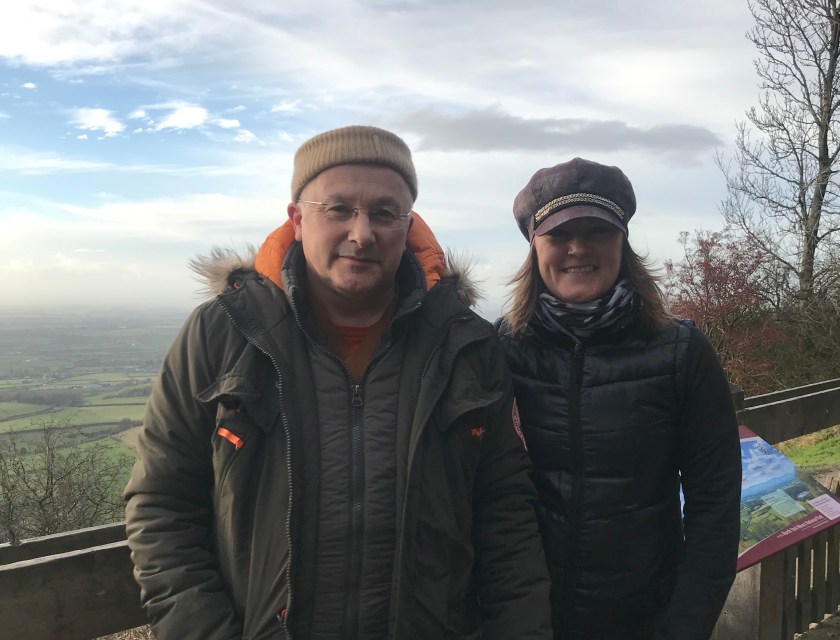
Me with my brother at Sutton Bank where we’d gone to remember our late sister Tricia
F55D89EC-3B4C-4C9D-A184-616C24114EA4
Me with my sister Janet at Sutton Bank on the 2nd anniversary of my late sister’s death

The view from Sutton Bank top has to be one of the most glorious in the country and for me, going up there is like taking medication for the soul. It was one of my late sister Tricia’s favourite spots, and I recently visited it with my family to mark the second anniversary of her death.

It was a glorious day, and we felt that Tricia was with us as we looked out over the spectacular North Yorkshire countryside in quiet reflection. James Herriot wasn’t kidding when he described it as ‘the finest view in England’.

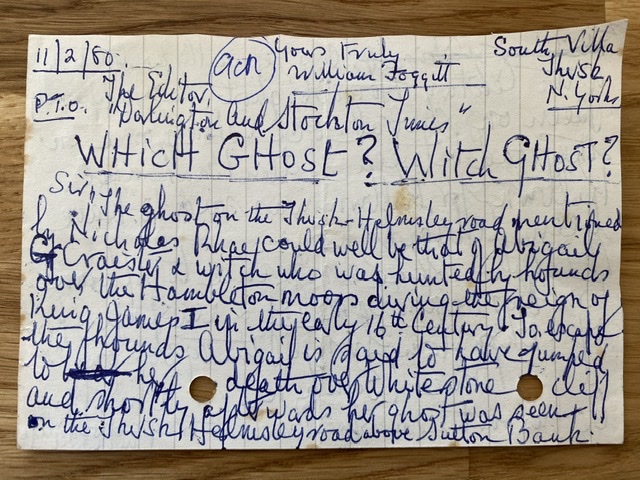
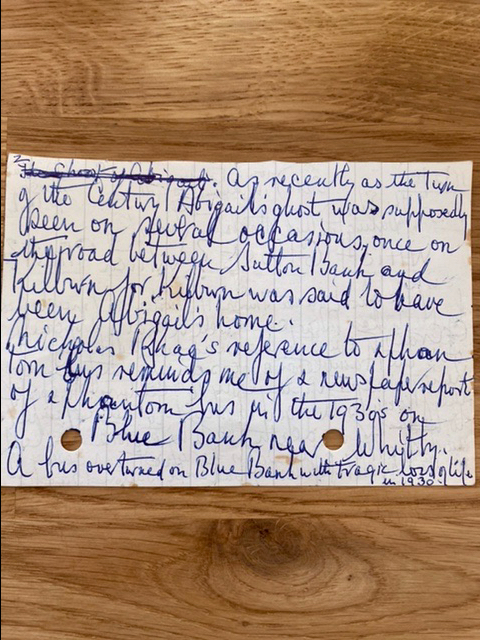
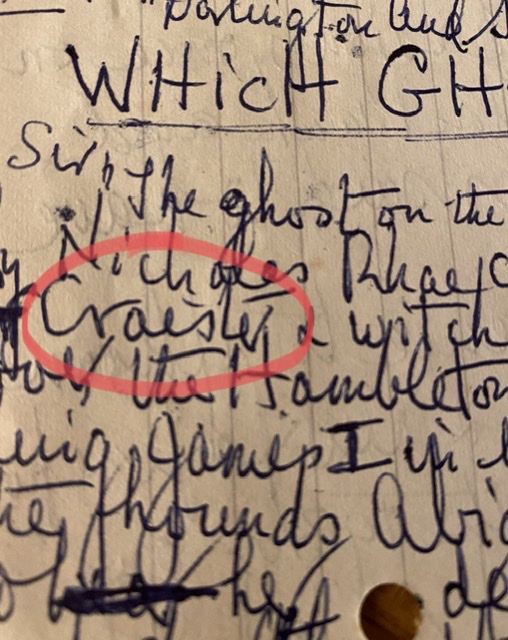
It was also one of my dad’s favourite places and regularly cropped up in his writings. In his column from 9th February 1980 he wrote about the ghost of Sutton Bank and expanded the tale in his book ‘Murders and Mysteries from the North York Moors’, published in 1988.

A reader from South Otterington had contacted him to say that late one night he had encountered a ghost on the road down to the gliding club from the summit of Sutton Bank. He claimed he’d seen a young woman dressed in dark period costume among the trees lining the road, but she vanished as he approached. The mysterious figure was picked out by his headlights and he was adamant that he hadn’t imagined it.

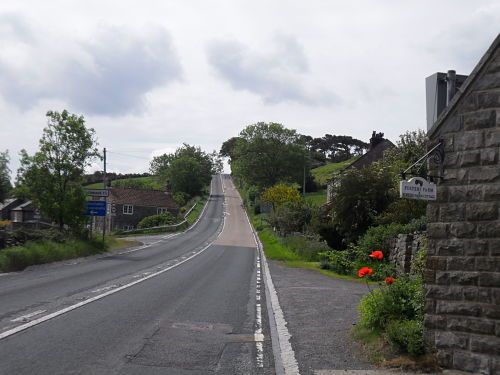
Dad drove that route many times at night, as have I, and neither of us ever came across this ghost. However, there have been several other sightings. One lady described how she was driving along the A170 near the Hambleton Inn with her husband when they saw a distressed woman, dressed a long black dress, trying to flag them down. Her husband stopped the car to assist, but by the time he got out, she had vanished. They were being followed by friends in another car who saw the ghost too and verified their story. Other sightings describe a very similar tale.

Many believe this is the ghost of Abigail Glaister, who lived in the nearby village of Kilburn in the 1600s during the reign of James I. Abigail was accused of being a witch, and was hounded out of the village by locals wanting to execute her. She was chased up Sutton Bank, and tried to flag down passers by on what is now the A170, but no-one stopped to help her. She fled down the path along the top of the hill towards Lake Gormire, finally leaping in terror off Whitestone Cliff to her death. Having said that, I did find one reference that said Abigail did not die, but landed in the ‘bottomless’ waters of Lake Gormire and was swept by the underwater current to a subterranean stream which took her to a well nine miles away, from which she emerged alive.

I tried to find out more about this tale, but the only information I could discover was from my own dad’s book. If anyone can shed more light on the unfortunate Abigail, or knows of any more sightings of the ghost, I’d love to hear from you.

Whitestone Cliff, which is a sheer drop from the top of the bank to the woods that encircle the serene lake below, is also known as White Mare Crag, a name which reflects another ghost story.

Local knight Sir Harry de Scriven was jealous of the abbot of nearby Rievaulx Abbey who owned a stunning white mare. The abbot enjoyed indulging in wine, and Sir Harry plied him with drink in the local hostelry, then concocted a story about a nearby farmer urgently needing the abbot’s help. As the weather was stormy he lent the abbot his own horse, explaining that it was much faster and stronger than the mare. Sir Harry offered to accompany the abbot part of the way and they set out, each one on the other’s horse, and it soon turned into a drunken race. As the dastardly Sir Harry had planned, the abbot, in his alcoholic stupor, urged his galloping mount on, straight over the cliff edge. However, Sir Harry had miscalculated the distance, and he and the white mare also careered over the cliff to be consumed by the dark waters of the lake below.

The unfortunate ghosts of Sir Harry and the horse were doomed in perpetuity to fall from the top of White Mare Crag. Have you seen them?

Read more at countrymansdaughter.com. Follow me on Twitter @countrymansdaug

This column appeared in the Darlington & Stockton Times  on 7th Feb and the Gazette & Herald on 5th Feb Jan 2020

Thieving little magpie?

C35505E9-A714-4D75-A832-BF6FCB638FC7
There are many superstitions surrounding magpies

It may seem a bit daft, but despite being brought up a Catholic and educated in faith schools, I still feel compelled to acknowledge some of the old pagan superstitions that have been passed down through time.

For example, if I am on the road, or out for a walk and I spot a lone magpie, I always have to look for its mate as the lines of the well-known rhyme trot naturally into my head, ‘One for sorrow, two for joy…’ Seeing one by itself is meant to be bad luck, so I can’t stop myself from casting my eyes around in the hope of spotting at least one more magpie to raise my chances of encountering ‘joy’ in the near future.

If I don’t see a second one immediately, I will continue keeping an eye out for the duration of my journey in the hope of seeing one at some point. It makes no sense that a rational person like me, who was brought up to believe in God, but who now harbours my own unique brand of belief in something (although I’m not really sure what) should still hang on to a superstition that has no place in either Christian belief, nor in my current ‘something but not sure what’ kind of spirituality.

But we humans can be complex and contradictory in our ways, can’t we. I have seen lone magpies many a time, and yet I can’t recall any kind of ‘sorrow’ befalling me soon afterwards. There are many variations of the rhyme, and in Scottish folklore, a lone magpie is meant to bring joy, not sorrow. In other versions, three magpies mean that a marriage is pending, whereas elsewhere it is seeing four that relates to forthcoming nuptials. They can’t all be right!

A friend of mine, who is of Irish Catholic descent but was brought up in Wales and South Yorkshire, salutes a magpie if she sees one, and also says: “Hello Mr Magpie. How is Mrs Magpie and all the little magpies?” And, like me, she will always look to find a partner. She says that as long as you salute him and see a second one at any point during the same journey, then it neutralises any bad luck.

We are not sure where these superstitions come from, as my dad explains in his column from 2nd February 1980, but farmers would pay great heed to them, as a lone magpie did mean bad luck for them, in as much as they were notorious for stealing eggs and attacking young game birds and farmyard poultry.

And as we all know, they also have a reputation for stealing shiny objects which they supposedly take back to their nests. This reputation has continued for many centuries through folklore, and yet we don’t really know why or where it came from. Italian composer Gioachino Rossini was inspired to pen his opera La Gazza Ladra in 1817 by a French play that told the story of a servant girl who was sentenced to die by guillotine, only to be saved at the last minute when it was found to be her master’s pet magpie that had been nicking the silverware, not her.

It seems this reputation for kleptomania is undeserved, and there have only been two reported cases in recent years of shiny objects being discovered in magpie nests. A study conducted in 2014 at the University of Exeter concluded that a more likely explanation is that we take particular notice of magpies when they do pick shiny things, which they often discard soon afterwards, but we perhaps take less notice when they collect average, non-shiny bits and pieces like twigs and insects, which is the bulk of what they like to take back to their nests. In fact, in that study, piles of tempting shiny bolts, keys and ring-pulls were actively avoided.

Magpies are highly intelligent, quick to learn and easy to tame and in the 1800s, when the original French play was written, they were commonly kept as household pets. Because they are highly inquisitive in nature, they would pick up any trinkets that took their fancy, and in a domestic setting, many of these would naturally be shiny. It is this habit that is believed to have inspired the original play, and the popularity of Rossini’s opera ensured the magpie’s reputation for thievery became enshrined in history for ever.

Read more at countrymansdaughter.com. Follow me on Twitter @countrymansdaug

This column appeared in the Darlington & Stockton Times  on 31st Jan and the Gazette & Herald on 29th Jan 2020

A rum rodent

C2A077AC-9683-4CC1-9074-8C5FB11AB0FB
Coypus were originally brought over from South America to be bred for their fur but became an invasive pest in this country
Brian Watson with the large rodent he killed
Brian Watson, who caught a ‘giant rat’ in County Durham in 2012. This is believed to be the last known sighting in the UK of a coypu in the wild

I am an unashamed animal lover, and cannot abide any cruelty shown to creatures great or small. Through my columns, I occasionally highlight the plights of some members of our native species that are under the threat of extinction.

However, I am also a hypocrite, in that there are living creatures that I would not hesitate in disposing of if they were bothering me, namely ants, wasps, hornets, house flies, fleas, ticks and rats. I know, it makes no sense.

So when I read an old article about a three-foot-long giant rat that had been killed in County Durham, I was mightily relieved it had been caught. The picture of farmer Brian Watson holding up the massive rodent made me shudder with revulsion.

However, all was not as it seemed, and it appears that it was not a rat at all, but more likely to have been a coypu, a large rodent native to South America. The creature looks a bit like a beaver, but while they have a flat, paddle-like tail, a coypu’s is round, like a rat’s. Its snout is also not as rounded as a beaver’s. So I can understand the confusion.

This story appeared in 2012, and is supposed to be the last known case of a coypu running free in this country. It is the only reported sighting of a coypu after 1989, when they were believed to have been completely eradicated from Great Britain after first being imported in 1929 to be bred for their fur.

Forty years ago, as Dad wrote in his column from 26Th January 1980, they were still a very real pest living wild in the British countryside, colonising the shores of our waterways. The problem had come about thanks to some of the original fur farmers being less than diligent with their security, and of the 49 farms that started to breed them, more than half reported escapees between 1929 and 1939.

At first these subtropical invaders were not considered a threat, as everyone thought they’d die off in the colder climate, but the clever creatures quickly adapted to the British weather, finding their way into our wetlands and river systems where they created large burrows in the banks, while feeding themselves on weeds, rushes and local crops of beets, cereals and flower bulbs.

Coypu are prolific breeders, and mate all year round, producing four or five babies each time. These youngsters are fertile from just a few months old, and quickly move on to establish their own burrows, find mates and raid the local crops.

The proliferation of coypu soon began doing serious damage to the river banks and flood defences of Norfolk and north Suffolk, which began collapsing, threatening the surrounding low-lying land, another alarming consequence for local farmers. The coypu began to spread further afield, working their way into neighbouring counties, and by the 1960s it was firmly established here, with numbers peaking at 200,000. It became clear that something had to be done, and such was the threat that rather than trying to control the population, a programme of complete eradication was implemented. The main technique was to use a team of trappers in the most densely affected areas. At first it seemed to be successful, and by 1963, the population of coypu was reduced by 90%, so the large team of trappers was scaled down. However, we now believe the main reason for the decline was in fact the harsh winter of 1962/3, as not long afterwards, the coypu population was yet again on the march.

By 1980, they were extremely troublesome and Dad wrote: “The coypu destroys plant crops, wreaking havoc among reed beds, sugar beet and cereals…One wonders if it will replace the otter, whose numbers are declining.”

Thankfully, Dad’s concern did not come to fruition as, realising the original eradication strategy was ineffective, the Government introduced a new, more sophisticated plan following a long-term study of the ecology and breeding characteristics of the animal. The aim was to eradicate them from our shores within 10 years, and by 1989, they had achieved that goal.

So now, the only place you should see a coypu in this country is in the zoo. But a quick search of the internet still reveals regular sightings of ‘giant rats’ all over the UK. The question is, are these actually rats, or has the coypu outwitted us yet again?

Read more at countrymansdaughter.com. Follow me on Twitter @countrymansdaug

This column appeared in the Darlington & Stockton Times  on 24th Jan and the Gazette & Herald on 22nd  Jan 2020

A shoe on the wrong foot

98B2D5E8-114D-4E8E-9CC5-103EA2D7AE5C
My collection of shoes I couldn’t throw out

I’ve recently moved into a new bedroom following the construction of an extension to our home. We now have three good-sized bedrooms, and my son has decamped into my old room from the pokey box he put up with for several years following our move to this house.

It was an opportunity to have a good old clear out of all clothing that I’ve inexplicably hung on to, clothes that I bought but barely wore, or was hoping one day to fit back into. It’s quite cathartic getting rid of all that stuff, and I filled bag upon bag of unwanted items. As you do it, you ask yourself why on earth you hang on to it all. There were not enough days in the year to wear everything I kept in my wardrobe. Thankfully, there are plenty of clothing banks nearby and I hope someone will now be benefitting from all that excess of fabric in some way.

One of the most difficult things to get rid of is shoes. I love a pair of glamorous heels, although now I’m at the age where comfort is more important than glamour. I used to be able to convincingly rock a pair of stilettos and walk elegantly down the street with my head held high. Nowadays, if I’m in heels, it’s more of a wobbly-legged stagger you’d associate with a man in drag.

I did manage to let go of a few pairs, although I have hung on to more than I should, knowing that it is unlikely I will wear them again. But I just can’t bring myself to give them away. Not yet, anyway.

There are many beliefs and superstitions relating to shoes, as my dad reveals in his column from 19th January 1980. A friend had asked him why a shoe is tied to the back of a car used by a newly married couple. I’ve not been to a wedding for a number of years, but in the 1990s when I got married, it was common to have empty cans tied to the back bumper and they’d make an almighty clatter as they bounced along behind you.

In ancient Egypt, the bride’s father would hand her shoes to the groom, signifying that the responsibility for his daughter had now passed to his son-in-law. In Anglo-Saxon times, the father would give the groom one of his daughter’s shoes, and she had to lightly touch her own head with it to signify that she would be obedient to her new husband. By Tudor times, it became customary to throw shoes after the departing couple, and if one hit the groom, it would bring good luck. It is this custom that we think evolved into the tying of shoes behind the vehicle (somewhat less hazardous, one would imagine).

But it’s not just bridal couples who had to watch out for flying footwear. Shoes were also thrown after departing ships, or after people setting off on a long journey, or after those embarking on a new enterprise, to bestow good fortune on all involved.

But shoes are not always associated with good luck. Criminals would be beset by fear if they came across a boot or shoe left on a table, as that meant someone was bound to die by hanging, either the owner of the shoes, the householder, or the person who spotted them.

I’ve inherited a useful book from my dad about superstitions, and it features a bewildering number linked to shoes. There are superstitions associated with burning shoes, with shoes and Christmas, with putting shoes on a table, with putting shoes in a particular position, with shoes squeaking, with the act of putting shoes on, with throwing shoes and with simply wearing shoes.

But there is one of which I think we all need to take note, and that is to make sure we put the correct shoe on the correct foot first. According to Scottish folklore, if you want to ensure you have a good day, then you need to put the right one on before the left. However, according to Yorkshire folklore, putting your right one on first is unlucky. So it’s a lucking minefield!

But both traditions agree that if you inadvertently put your left shoe on the right foot, then an accident will soon befall you.

I think I’ll play it safe and just go barefoot.

Read more at countrymansdaughter.com. Follow me on Twitter @countrymansdaug

This column appeared in the Darlington & Stockton Times  on 17th Jan and the Gazette & Herald on 15th  Jan 2020

Keeping the fires burning

59644617
Members of the Clavie Crew carry the burning clavie through the streets of Burghead, Scotland, on January 11 2018. The ‘Burning of the Clavie’ marks the ‘new year’, according to the ancient Julian calendar. 

January is possibly my least favourite month of the year. It’s at this time that I experience a slump in my mood because all the festivities of Christmas and New Year are over, the decorations have come down, and the weather outside is mostly dark and damp. And having checked the long-range forecast for January, it doesn’t look like anything exciting will be happening on the weather front any time soon. I apologise to all those who are not fond of snow, but I’m still a bit of a kid at heart, getting ridiculously giddy when I see big fat white flakes floating down from above.

So I do feel a wee bit jealous of those lucky people who live in Burghead, a fishing port in Morayshire, Scotland, which my dad mentions in his column from 12th January 1980. The villagers are lucky because they celebrate New Year’s Eve twice over, once on 31st December, and again on 11th January. So they know they still have one more celebration to look forward to, which must surely help get them through the mid-January funk that people like me experience.

The 11th January is known as Old New Year’s Eve, or Old Hogmanay, created when the Julian calendar was replaced by the Gregorian calendar. Although the new calendar was introduced in 1582 by Pope Gregory, it was not adopted fully by Great Britain until 1752. Eleven days were ‘lost’ in order to make our dates align with the rest of Europe, which had adopted the new system many years earlier. It meant that September 2nd 1752 was immediately followed by September 14th.

Although many people were dissatisfied with the new calendar, they did adapt to the new date to mark the start of the year. The villagers of Burghead, known as Brochers, embraced the ‘new’ New Year, but they also decided to celebrate twice instead of just the once, refusing to let their traditional festivities, normally held 11 days later, disappear.

This celebration is known as the Burning of the Clavie, and continues to this day, remaining exactly the same as it always has done. Its origins are unclear, but it is similar to Scandinavian fire festivals and is likely to have its roots in pagan folklore.

The clavie is an oak barrel that has been cut in half and mounted on a pole. The staves from the other half of the barrel are placed inside, along with wood chips and tar. The outside of the barrel is also coated in tar.

Then, villagers gather at the home of the Clavie King for a wee dram, before he ceremoniously sets the whole thing alight, after which it is hoisted aloft by his 20-strong Clavie Crew made up of men born and bred in Burghead. The current Clavie King has held the post for 32 years, having been elected after the previous king died. He leads the Clavie Crew and the flaming barrel, along with the rest of the villagers and spectators, in a procession through the streets. Along the way they throw burning staves onto the doorsteps of certain villagers to bring them good luck for the coming 12 months.

The parade then heads up the nearby Doorie Hill and places the Clavie upon the ruins of a Pictish fort where it is stoked up with more wood and creosote or tar to ensure a huge spectacle of smoke and flames. Eventually it starts to burn itself out, and embers tumble down the hill, which are eagerly gathered up by residents who take them home to light the first fire of the new year, and hopefully benefit from the luck that the clavie is said to bring. Blackened embers are also sent away to Brochers who no longer live in the village.

It must be quite unusual that such a celebration still exists, especially in today’s health and safety-conscious society. And yet there is something heartwarming about the fact that this long-held tradition prevails, thanks to the determination and persistence of one small village. I know there are a number of North Yorkshire villages that have their own quirky traditions, such as scarecrow festivals, maypole dancing and morris dancing, but I’ve not come across anything in our region that is as unique, or that has lasted unchanged as long as the Burning of the Clavie seems to have done.

Can anyone tell me any different?

Read more at countrymansdaughter.com. Follow me on Twitter @countrymansdaug

This column appeared in the Darlington & Stockton Times  on 10th Jan and the Gazette & Herald on 8th Jan 2020

Handy New Year!

46DD4927-7D9E-4E63-8840-009B0BAE1181
A ‘Hand of Glory’ which can be seen at Whitby Museum.
8CB745E9-7158-4FAE-B16B-779C4A910EE3
I can now open a my dad’s 1980 folder which is a treasure trove of memories

A very Happy New Year to you and welcome to the new decade of 2020! Who’d have thought we’d make it this far?

Some of you may still be feeling the after-effects of the Christmas and New Year celebrations, but I hope the excesses of the season are not taking too much of a toll on you.

It’s now that I have the exciting task of closing away last year’s folder of Dad’s columns, and opening up a new one. Each folder is stuffed full of columns, reader letters and my dad’s replies, as well as copies of the original hand-typed version that he would have posted to the editor. It’s a real treasure trove of memories, and I can’t wait to get my hands on it!

So now we are into the 1980s where we leave behind the glitter and funk of 1970s disco, the safety pins and pogo-ing of punk, and move towards the less scary soft, pastel-coloured fashions and synthesisers of the New Romantics. I would turn into a teenager in this year, so who knows what dreadful recollections will be dredged up through reading my dad’s columns over the next decade!

True to form, his first column of the year, dated 5th January 1980, is full of interesting topics including Twelfth Night & the Epiphany, Wassailing, and a revisit to Yew trees following a reader letter he’d received.

But I’m not choosing any of those lovely topics. Oh no. My eye was caught by something far more gruesome, known as the Hand of Glory (if you’re eating while reading this, I suggest you finish your food before carrying on).

Criminals believed that this ‘lucky charm’ would bring them success in their nefarious activities. The ghastly object could be obtained from only one source – the body of a hanged man – and it had to be cut from the corpse as soon as possible after death. So criminals would hang about public executions in the hope of stealing one.

Once the hand was severed, it was wrapped in a shroud which was tightened to squeeze out every last drop of blood. Sometimes it would then be moulded into a loosely closed fist, although not always, and be put through a curing process involving a salt and pepper mixture spread upon the hand and left for about two weeks, just like curing a ham or a side of bacon.

After curing, the hand was then hardened by placing it in the sun or popping it into a clay pot over a gentle heat.

The closed fist was formed to hold a candle, but not just any candle. The Hand of Glory candle had to be made from the fat of a hanged man, virgin wax and Lapland sesame, the latter being a plant from which oil was extracted. The wick was usually made from the hanged man’s hair, although hair from a dead child was also deemed acceptable.

Some hands had the fingers outstretched, and in this case, the five fingers themselves would be lit. If one finger went out or refused to light, it meant that one of the householders was still awake.

When the hand or candle was alight, the ne’er-do-wells believed it had magical properties which included rendering the user invisible, paralysing anyone who set eyes upon the flame (except the owner of the hand), and keeping nighttime burglars awake while making sleeping householders stay asleep. And so it was an indispensable tool to any self-respecting burglar, and its power was broken only once the flames were extinguished.

To complete this ritual, a special verse had to be quoted immediately after lighting the candle or fingers. It went:

Let those who rest more deeply sleep, let those awake their vigils keep.

Oh, Hand of Glory, shed thy light, and guide us to our spoils tonight.

The Hand of Glory is recorded to have been used in North Yorkshire on at least three occasions. The earliest was in 1797 when a felon raided the Spital Inn at Stainmore between Bowes and Brough. Another report came from 1820 in Danby, Eskdale and that Hand is now on display in Whitby Museum. The last recorded use was in 1824 during a burglary at the Oak Tree Inn, Leeming Bar, on the old A1 or Great North Road.

Well Glory Be!

Read more at countrymansdaughter.com. Follow me on Twitter @countrymansdaug

This column appeared in the Darlington & Stockton Times  on 3rd Jan and the Gazette & Herald on 1st Jan 2020

New year, new decade?

2046CDA3-799D-4E31-B6F5-566EBF061E3E
My boys a decade ago in 2010
DA0E0627-C33E-4531-92BD-6EA5CED41B16
My children have grown from boys to men over the past 10 years.

As the year draws to a close, we reflect on what has happened over the past 12 months and whether it turned out better than, worse than, or just as, expected. My year has been pretty good on the whole, and my remaining family all survived it, so things are looking up!

But not only is it the end of a year, it is the end of a decade, and I can’t quite get my head around the fact that it is ten years already since 2010, and 20 years since the turn of the millennium. Although I’m in a persistent state of shock at the speed of passing time, I do have daily reminders in the shape of my children. My two older boys were born in the 1990s, but the youngest wasn’t even a twinkle in my eye in the year 2000, being born as he was in early 2002. By the end of 2010 he was nearly eight years old and not even close to five foot tall, whereas now he is nearly 18 and a good six foot!

Despite him growing at a rate that suggests he keeps fertiliser in his socks, it is only this week that he has finally been able to escape the confines of a high ‘cabin-style’ single bed and migrate to a proper, ground-dwelling double bed. Poor child, how he has suffered. Until recently his room was just too small to fit in a normal bed plus furniture, but thanks to a house extension that is almost finished (after nine long months), his enduring patience has been rewarded with a large bedroom of his own, dominated by a king-sized bed, far more appropriate for a lanky, soon-to-be adult.

In my dad’s column from 29th December 1979, he debates about whether a decade begins in the year ending in ‘0’, or the following year.

Dad argues that the decade in which he is writing began on 1st January 1971 and would end on 31st December 1980. But surely, the 1980s started in 1980, didn’t they? Not according to Dad, who adds: “The end of the century should be December 31st, 2000, and not 1999, as the new century begins on January 1, 2001.”

But it just doesn’t work as well, does it? I mean, three nines turning into three zeros is far more party-worthy than plain old ‘001’ changing to ‘002’. It’s simply not as satisfying, and popular culture prefers it that way.

I remember at the new millennium having an argument with a lad called Fred with whom I used to work. He loved a heated discussion and would debate incessantly until you either lost the will to live, or stormed out in a huff of frustration.

He was arguing that the new millennium wouldn’t exist until 2001, whereas I was arguing that it would start on 1st January 2000. This went on for some time, with him barely allowing me to get a word in edgeways, until I said, crossly: “So if you’re right, then you’re telling me you did not exist for the first year after your date of birth?”

He stared at me open-mouthed, trying to find the words to counter-argue, but it was logic that couldn’t be contested. Eventually, he said: “I think this is the first time in my life I’ve ever been stumped!”, and as far as I can remember, it was the only time I ever heard him cave in during an argument.

As it turns out, he was technically right (and if you’re reading this, sorry Fred!) but the debate still rages on. The confusion can be traced right back to Dionysius Exiguus, a sixth century monk from the Eastern Roman Empire, who came up with ‘Anno Domini’ (meaning ‘the year of the Lord’) which was the concept of dating forward from the birth of Christ. The dates before that were then called ‘Before Christ’ or BC. However, it wasn’t until around 200 years later that the system was popularised by our own eighth century monk, the Venerable Bede, who included it in his most famous work, the Ecclesiastical History of the English People in AD731.

The problem was, the dating system jumped straight from 1BC to AD1, skipping the year zero. And thus, 2,020 years of confusion and debate were set in motion.

I wonder what the Venerable Bede would have said had he known we’d be arguing about it still?

Read more at countrymansdaughter.com. Follow me on Twitter @countrymansdaug

This column appeared in the Darlington & Stockton Times  on 27th and the Gazette & Herald on 24th December 2019

Most wonderful time of the year?

ADC3BF96-CEB6-4728-8555-650B36C62AF4
My favourite time is when the turkey is on the table and I can finally relax
09C2C910-AC99-4E2C-A1C1-C80D607816C8
My mum and I have hosted our fair share of Christmases so know how exhausting it can be

Well the big day is just around the corner and no doubt any youngsters in your life will be bursting with excitement in anticipation of the arrival of the fat man in the red suit.

I heard a rather interesting statistic the other day following this question: ‘According to a recent survey, what percentage of adults think that Christmas is the most wonderful time of the year?’ There were two answers to choose from, 34% or 54% (Which do you think is correct? I’ll tell you at the end of this column).

My teenage son immediately expressed shock that the higher number was not even higher because, surely, everyone MUST love Christmas?

Ahhh, the optimism of youth! I said the answer would depend on who the respondents were. If it was mainly young people and men, who have no idea of the amount of effort, work and stress that goes into making a wonderful Christmas, then the answer would be the higher one. If most of the respondents were women, then it would be the lower one (apologies to any males who take on the behemoth of Christmas, but statistics show it is still mostly women). Of course, you also have to factor in those who are alone, sick or missing loved ones, for which this time of year is especially difficult.

“You mean you don’t think Christmas is the most wonderful time of the year?” my son asked in dismay.

I had to explain that I love lots of things about Christmas, particularly the bit where the turkey comes out of the oven and is on the table, as that’s when I know my job is done and I can start to relax. But for those of us who have to shoulder the responsibility of almost everything to do with Christmas, it is blooming hard graft. It should be compulsory for every person who has organised Christmas to be sent on an all-expenses-paid spa retreat for the whole of January to recover.

OK, so I know I am being a bit bah-humbug, and there is lots that I genuinely love about the festive season, but I do feel there is a distinct lack of awareness among those who do not have to do the bulk of the organising to understand the immense effort it takes to make it the ‘most wonderful time of the year’. And don’t get me started on the expense (I do have a 750-word limit, after all!).

Possibly what I enjoy most of all are the frequent gatherings with friends and family. I love it when we all get together over delicious food and overflowing drink to enjoy each other’s company.

As my dad explains in his column from 22nd December 1979, back in the day (and as I remember in the 1970s), it used to be customary for any visitors to be offered a slice of traditional Christmas cake and maybe even a glass of sherry. I’m not sure if that custom still persists, as fewer and fewer people make the traditional cake these days.

The cake would be big enough to last many servings, and as Dad wrote in 1979: ‘The milkman, butcher, postman and others must receive countless portions during their Christmas rounds.’

He remembers a local doctor who would keep several sheets of greaseproof paper in his bag, and politely ask his generous patients if he could take the cake home to share with his wife. By the time he’d finished his rounds, his bag would be bursting with slices, but at least he hadn’t offended anyone by refusing it, nor made himself ill by eating too much!

My mum still makes a deliciously moist traditional fruit cake, and I recall as youngsters, my three siblings and I were all invited to take a turn stirring the mixture. It would be a couple of months before Christmas, and would have been the first exciting hint that it wasn’t far away.

Although I wasn’t a massive fan of fruit cake, the best bit about it was that it would be coated in a thick layer of marzipan, and then another thick layer of rock-hard white royal icing. Some were even decorated with a ribbon around the outside and a collection of jaunty festive plastic figures on top.

Now back to the survey. The answer was 34%.

I wish you all the best for Christmas, and a very happy new year.

Read more at countrymansdaughter.com. Follow me on Twitter @countrymansdaug

This column appeared in the Darlington & Stockton Times  on 20th and the Gazette & Herald on 18th December 2019

Earning our stripes

0B2E8802-2AC5-4833-BE90-866FAFBB7BDB
The lonely hearts ad on the reverse side of my dad’s column
381ECCEA-B4CF-47E1-8887-37F1B32C7A55
A typical hand-drawn full page advertisement from 1979
3B5E884E-1FD3-467B-B20A-9F5ECF9E3040
A handsome, rather angular, gentlemen, sporting his stripy Viyella House shirt, stares moodily across the Binns Christmas advert

When I read my dad’s columns from 40 years ago, I often look at the reverse side of the cutting, which can have a variety of fascinating items to peruse. There may be adverts, letters to the editor, local notices, news stories and announcements, all accompanied by photographs or illustrations that evoke the 1970s and bring back memories of living through that memorable decade.

The content often reflects the time of year, so on the back of a February 1979 column is a letter to the editor discussing the harsh winter they were experiencing, while in March there are adverts for footwear and camping equipment to suggest Spring is on its way. Move on to July and August and there are notices for agricultural shows, gymkhanas and barbecues, whereas in December we see a huge advert from Binns department store trying to tempt us through its doors for our Christmas shopping.

And who could resist a Sanyo music centre with ‘3 wave band radio PLUS belt driven turntable, magnetic cartridge and diamond stylus’, not to mention the ‘front-loading Cassette deck’? Clearly, the ‘Cassette’ is a very important aspect of the music centre to warrant its own capital letter. What strikes me about these large newspaper adverts is that all the images that accompany them are hand-drawn, rather than photographs of the products. I presume this is because they were unable to reproduce quality photos of the product via black and white newsprint.

I wonder what became of all those genuinely talented advertisement artists? In the Binns advert, gazing across the page towards the Sanyo music centre is a rather moody and distinctly angular gentleman looking very dashing in his stripy ‘Viyella House’ shirt and fat kipper tie, also stripy. Gosh, how we loved stripes in the 1970s.

I discovered that Binns, a familiar name to many of us northerners, had mostly disappeared by the mid-1980s after being absorbed into the House of Fraser brand. However I was surprised to find that Viyella is still going, and despite a chequered history of buyouts and near bankruptcy, it still has many branches all over the country, as well as an online shop.

The name Viyella originally referred to a fabric made up of 55% merino wool and 45% cotton that was trademarked in 1894 by William Hollins and Co., becoming the first ever ‘branded’ fabric. However, Hollins and Co soon began to make clothes too, and so Viyella became a fashion brand in itself. In the 1970s it was synonymous with the stripy shirt, but a quick check on their website today, and out of the 120 shirt designs available, a mere four are stripy, while 12 are plain.

So what pattens are on the remaining 104 shirts? Can you guess?

Before you discover if you are right, I want to mention one advert that caught my eye on the back of Dad’s column from 15th December 1979. You can tell it’s winter, as there are many adverts placed by farm labourers looking for work, presumably having been laid off during the lean winter months. But below them is a single entry under the ‘Personal’ section that reads: ‘LONELY- UNATTACHED? Don’t be this Xmas. Contact Kate’s Intro Bureau for details of special offer and sample list of friendship-marriage partners. Thousands of members.’

How discreet this little ad is, although I do wonder if the grand claim of ‘thousands of members’ is a bit exaggerated, as back in those days, approaching a dating agency for help was seen as quite desperate and shameful. You’d never have admitted you had gone to one, even if you had.

How times have changed! The internet has revolutionised the dating scene, with countless apps and websites making it so much easier for singles to find partners. It has shed its somewhat seedy image, and couples are willing to talk about having met online. In fact, only this morning I heard that it is predicted that within the next decade, 40% of couples will have met via apps and websites, and that 2037 will be the ‘tipping point’ year, when more babies will be born to couples who met online than through a face to face date.

Did you get the shirt pattern right? I bet you’re not surprised to learn that the men of today prefer the ubiquitous checked shirt above any other. Will stripes ever come back?

Read more at countrymansdaughter.com. Follow me on Twitter @countrymansdaug

This column appeared in the Darlington & Stockton Times  on 13th and the Gazette & Herald on 11th December 2019