
A June 1961 image of Roye New British Cemetery at Somme in France showing the conifer tree to the right of the stone cross memorial (Photo Commonwealth War Graves Commission copyright).
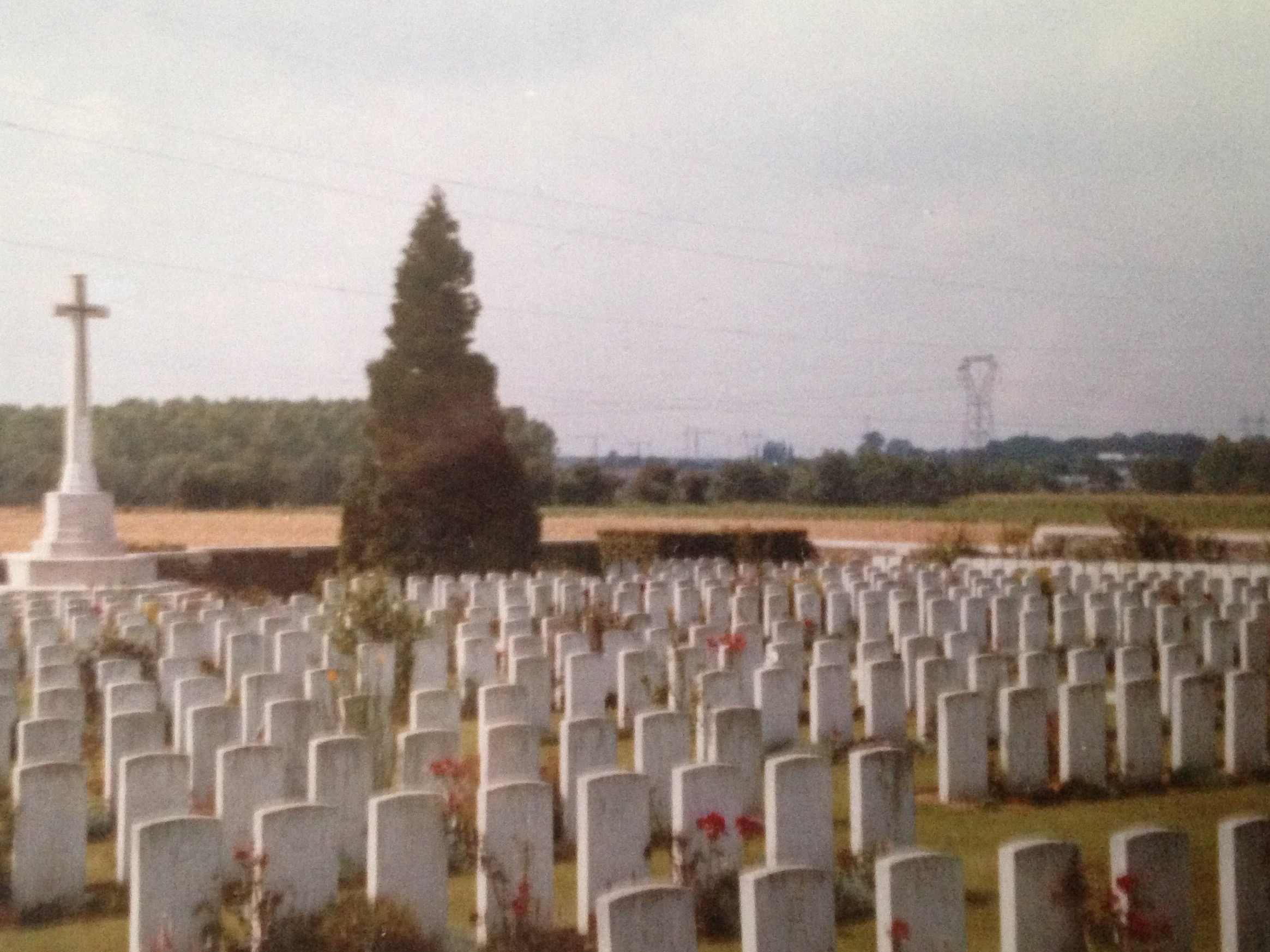
A couple of weeks ago, I featured an old photo of a graveyard on one of the Somme battlefields and asked for your help to identify which one.
As usual, you have come up trumps! Reader Andrew Jackson says: “I think the photograph was taken in Roye New British Cemetery.”
Andrew directed me to a website documenting World War I cemeteries and commemorating the men interred there. It has recent pictures of Roye New British Cemetery, but it was difficult to work out if it was the same place. It was only when I came across some older photos that I began to recognise it. There was one in particular taken in June 1961 from the same vantage point as mine. The fir tree to the right of the stone cross memorial gives it away – although by the time my 1979 image was taken, it had grown somewhat! In the more recent photos, the tree has gone which is why it was harder to identify.
What makes the website so moving is that they have tracked down photos of some of the men interred there, putting faces to the names on the rows and rows of silent headstones. It brings home the stark reality of the massive sacrifice made by the soldiers and the families that had to continue to live without them. Interestingly, there are no special places for the higher-ranked men, no separating the rank and file from the captains and majors. As reader Tony Eaton from Northallerton pointed out, in death, everyone is equal.
Tony, a self-confessed World War I ‘buff’, enlightened me on a few things. I had wondered if the army had stopped recruiting members of the same families into the same regiment as a result of the disastrous ‘pals’ initiative, where the army canvassed groups from the same locality, enticing them with the promise that they could serve alongside people they knew (in other words, their ‘pals’), rather than randomly being assigned to regiments. Unfortunately, because they served side by side, so they died side by side, leaving gaping holes in communities and families. The strategy was abandoned after the Battle of The Somme in July 1916.
Tony explained: “You mentioned family brothers joining up which was common in the early part of the war and many households lost several of their sons during that conflict, but far as I know there was no embargo on family groups joining up until 1915, when the Conscription Act was passed, becoming law in 1916.
“The Somme showed the folly of the Pals Battalions. Conscription was the way of recruitment due to high numbers of highly qualified specialist personnel being taken out of the industrial and scientific side of prosecuting the war. This act may have precluded brothers being called up until the desperate times of 1918.”
Tony also mentioned a friend of his, Stanley Bewsher from Ripon, who went ‘over the top’ on that fateful day in July 1916. Despite his comrades being gunned down around him, Stanley bravely forged on, picking up a discarded machine gun and advancing towards the enemy.
“He was then struck in the helmet by a shell fragment that indented it into his head. He was taken from the battlefield back to England and after lengthy treatment and rehabilitation stayed in the army acting as a driver…he was awarded the Military Medal,” says Tony.
Tony also explains that the casualties of the Somme battle, although high, were not quite as high as I mentioned. “It is generally accepted that the Allies suffered c900,000 to 1,000,000 casualties…I highly recommend a book by Gordon Corrigan entitled ‘Mud, Blood and Poppycock’ where Corrigan states that 74% of all British and Empire troops that fought on the Somme came out without the proverbial scratch. It is true that on 1st July only six miles of ground was captured, but by the end of the battle, the Germans began withdrawing behind the Hindenburg Line some ten miles eastward.
“The Battle of Arras campaign in the spring of 1917 had a higher rate of attrition, dead and wounded than did the Battle of the Somme.”
Whatever the true number, we must never forget the sacrifice of every singe person whose life was lost during that terrible time of war.
Do you have opinions, memories or ideas to share with me? Get in touch with me using the ‘Contact’ button on the top right.
This column appeared in the Darlington & Stockton Times on Friday 10th and the Ryedale Gazette and Herald on Wednesday 8th Oct 2025

 The Countryman's Daughter