Slave to history


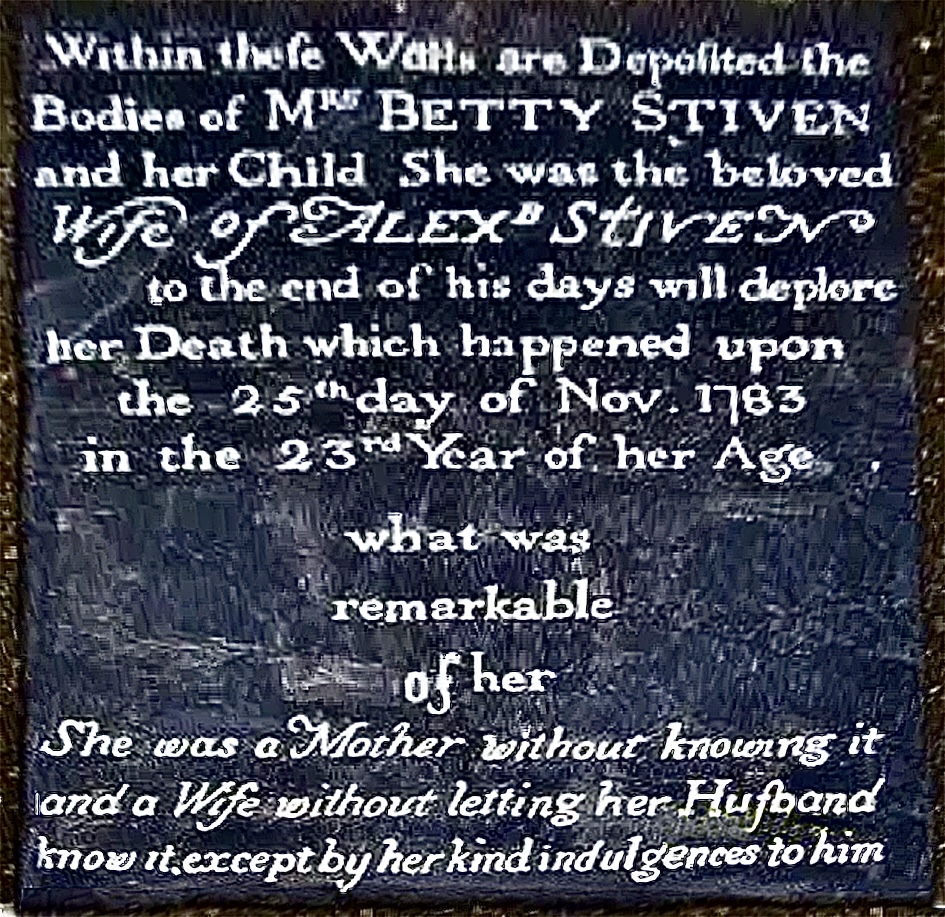
The baffling inscription on Betty Stiven’s grave on the island of Tobago in the Caribbean, spotted by reader Peter Sotheran. Do you know what the last sentence means?

Another family connected to Hamer Inn has been in touch with me following previous columns about Joseph Ford and his descendants, who include readers and cousins, David and Ian Ford.

In one of my columns I mentioned the Eddon family. James and Elizabeth Eddon took over running the inn from the Ford family, and Annie Eddon, later Turnbull, was born at Hamer in 1906. Annie was the second youngest of 11 children.

I previously mentioned a column written in the 1990s in which Annie remembered: “On the Glaisdale side of the house is a beck (Bluewath) and I can remember going down to the beck with my mother to wash clothes. We took a big cauldron and lit a fire under it to boil the water and clothes.

“We had a pump in the pub yard but in summer it ran dry and we had to carry water from the beck…One of the outbuildings was used by my father for making besoms from heather, and on Mondays, Mother would ride a pony to Pickering market to try to sell them.”

It was Annie’s sister, Lily Boddy, who took over from her father in 1914, and you might recall a fabulous photo I shared a few weeks ago showing Lily next to the well with (I presume) her mum Elizabeth Eddon bending over it, bottom in the air!

Following that, I have been contacted by Susan Ellis who wrote: “Further to your piece…my mum has asked me to contact you. My mum is Pauline Elizabeth Ellis (nee Turnbull) one of 6 children, all still alive, and who originate from Wrelton.

“My mum’s grandma and grandad are James and Elizabeth Eddon. One of their daughters, Annie, is my mum’s mum and Annie had some time growing up at Hamer House.

“We would be very interested in any photos you might let us look at, along with any more information.”

I replied to Susan, and sent her some articles and links to the columns about Hamer where I featured photos of the property before it became derelict (which you can find on www.countrymansdaughter.com). Type ‘Hamer’ in the search box and they should come up.

A few days later, Susan wrote to me again: “Thank you Sarah. I’ve just been reading everything out to Mam. It is all fascinating isn’t it? What hardy folk they all were! Mam and I will have a chat and see if any stories surface that can be shared.”

Now to a different, yet equally interesting, query which another reader has brought to my attention, and upon which I am hoping you might be able to shed some light.

Peter Sotheran got in touch because in the past I have written columns discussing the historical resting places of various people. I’ll let Peter explain:

“Many thanks for your columns – always unearthing something fascinating! A while ago, I think you wrote about various gravestones and that stirred in me a memory of a mysterious gravestone that I discovered whilst on holiday on the Caribbean island of Tobago.

“Plymouth on the north-west coast of Tobago is a small coastal community with a population approaching 10,000 residents. English settlers arrived there 400 years ago, hence the prevalence of British place names; Scarborough, Roxborough and Speyside are principal towns on the island.

“One of the island’s greatest curiosities is the inscription on the grave of a local lady, Betty Stiven. After recording the date of her death, the gravestone carries the following message:

‘She was a mother without knowing it and a wife without letting her husband know it, except by her kind indulgences to him.‘

“I wondered if your ever-erudite readers can suggest an explanation?”

I read the inscription (which you can see above) and came up with the conclusion that because her child is interred with her, she died in childbirth, in which case, she would not have experienced motherhood at the age of 23.

I find the last part of the sentence is quite baffling. Perhaps she died soon after getting married? Or was she the unmarried mistress to a plantation slave master? The inscription is quite loving, though, so perhaps it was a genuine marriage? Peter thinks the size and style of her gravestone suggests she was more likely part of the white elite rather than the poorer indigenous community, but is not certain.

I’d love to hear what you think!

This column appeared in the Ryedale Gazette and Herald on 15th and the Darlington and Stockton Times on 17th April 2026

Crossing the Fords to Haymoor


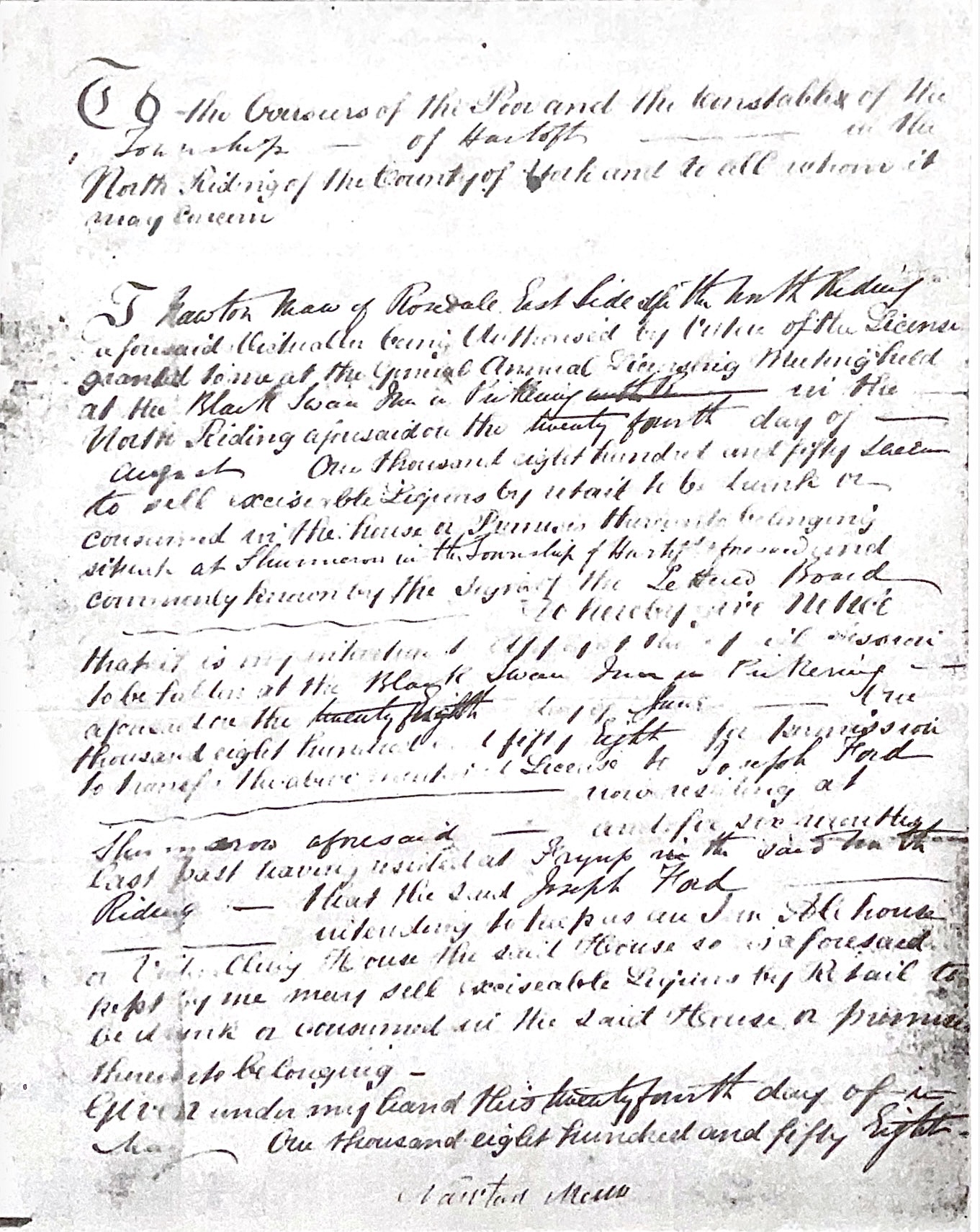
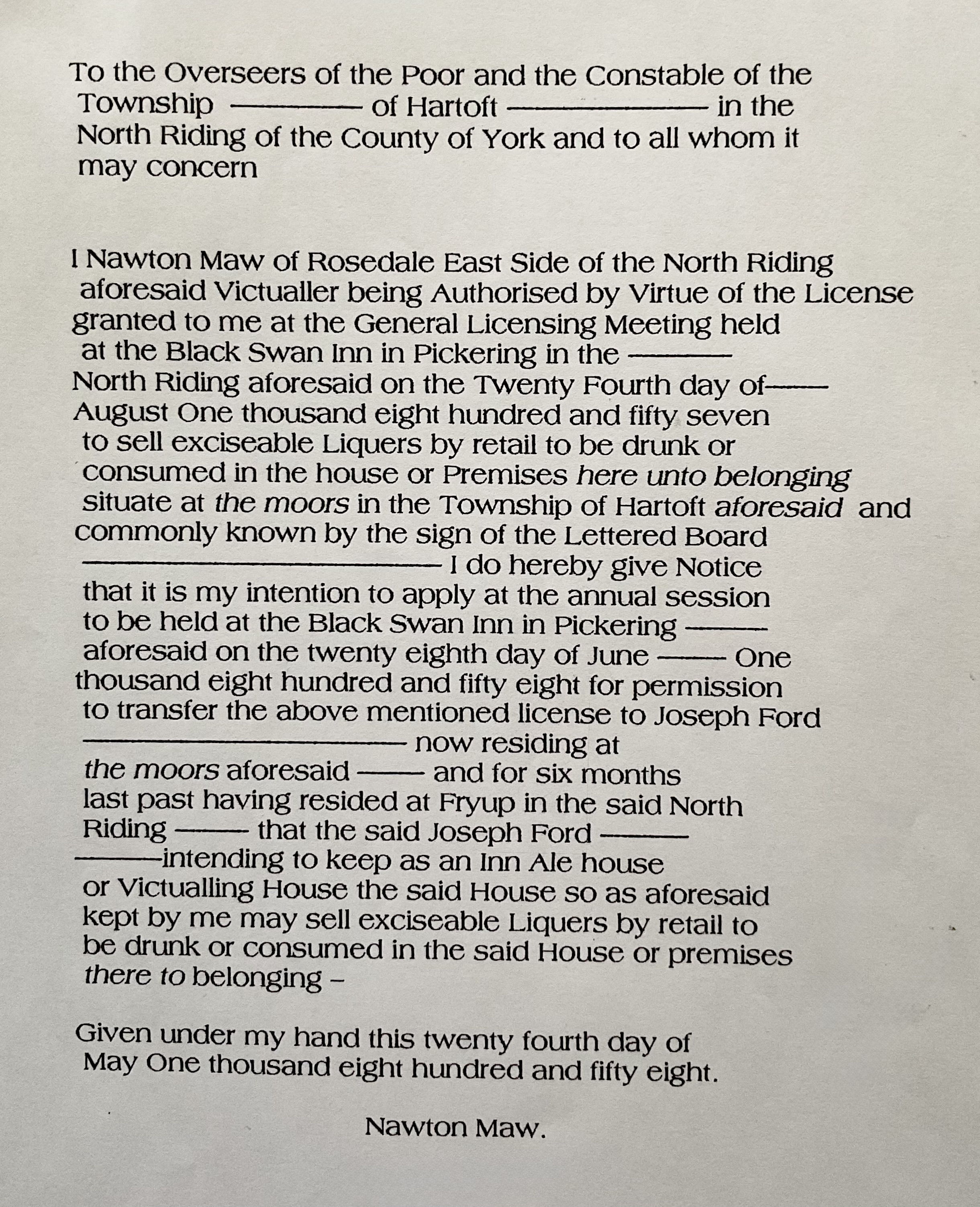
The copy of the liquor licence transferring the lease of the Lettered Board to Joseph Ford, dated ‘fourth day of May One thousand eight hundred and fifty eight’
A transcript of the liquor licence
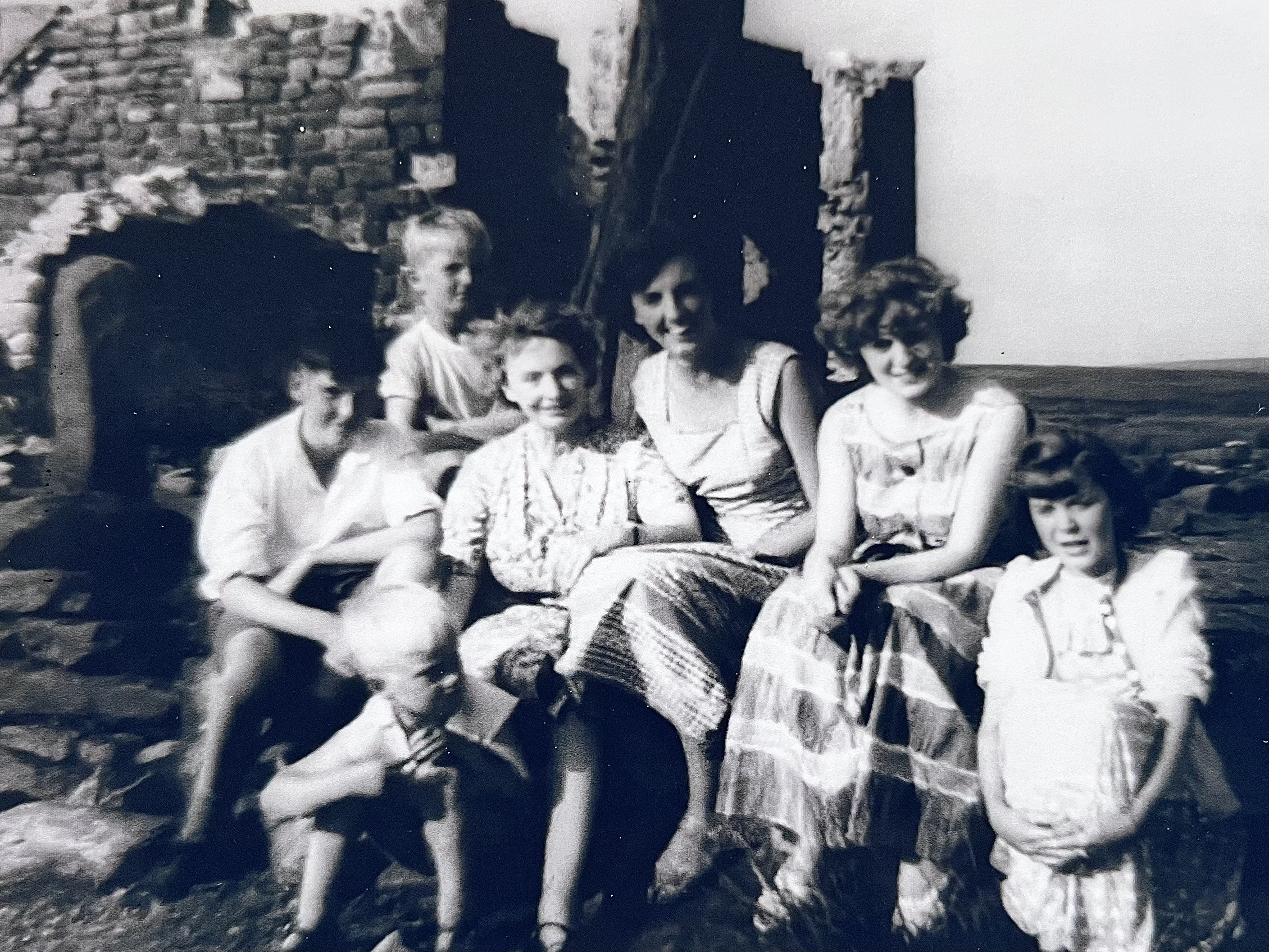
L-R Ian Ford, David Ford (back), Richard Ford (front), Ada Ford, Margaret Ford, Sylvia Ford and Eileen Roe on a family day out in about 1959. The ruins of Hamer House can be seen in the background.

I’m continuing to be surprised by how many memories my columns about Hamer Inn have jogged.

The latest contact came from reader Ian Ford. As his surname suggests, he is related to the Fords who were licensees of the inn in the mid-1800s. Ian is the cousin of David Ford, whose original message to me asking for photos of the inn sparked off this whole chain of columns. Ian is the great great grandson of Robert Ford who was born at Hamer in 1860. Robert was the son of Joseph Ford who took over the licence in 1858 and the brother of Joseph Ford Junior, who wrote a book about life on the North York Moors called ‘Some Reminiscences and Folk Lore of Danby Parish and District.’

Ian sent me copies of correspondence between himself and my dad from 2007 relating to Hamer, including some old family photos taken in the 1950s with the inn in the background, which by then was derelict but still clearly a building of some sort. As you know if you’ve read my previous columns, all that lies there today is a pile of old stones.

I’ve referred to Hamer as a property ‘of many names’ and they include The Lettered Board, The Wayside Inn, Hamer Inn and Hamer House. Ian revealed there was yet another name – Haymoor House. Surely that is its ‘posh’ name, because if you say it in a local accent, you get to Hamer (pronounced Hay-mer).

Ian included a copy of the original licence from when Joseph Ford took it over in 1858. You might recall that I mentioned that my dad had a copy of that licence:

‘Hamer’s role as an inn declined after 1870, the year a local writer called Joseph Ford was born at the remote house. His father was landlord and I have a copy of a licensing application dated 1858 in which the liquor licence of the Lettered Board was transferred to Joseph Senior.’

I searched for the licence in my dad’s files, but was disappointed when I was unsuccessful. What I didn’t know then was that there was a reason I could not find it, and that reason was revealed in the letters that Ian sent me.

Ian had contacted my dad after reading his book ‘Murders and Mysteries From the North York Moors’ in which both Joseph Fords are mentioned. He cites the tales Dad covered in the book, including those about the Lettered Board, and goes on to explain his family connection. He’d asked if he could see a copy of the old liquor licence transferring the lease to from the previous landlord to Joseph Ford.

Dad’s letter of reply states: “So far as the liquor licence for The Lettered Board at Hamer is concerned, I enclose my copy of it. It is dated 1858 and Joseph’s name was quite clear. It is an ancient photocopy – and I can’t remember where I got it from – but I doubt if it would reproduce any better on our modern equipment. As I can’t think I am likely to have any further use for it, please accept it with my compliments.”

So my dad had given it to Ian – no wonder I couldn’t find it! Yet another minor mystery solved thanks to you wonderful readers.

Incidentally, Ian reminded me that he had been in touch with me a couple of years ago regarding Joseph Pilmoor, the illegitimate son of Joseph Foord, the groundbreaking hydro engineer who came up with ways of ensuring remote moorland communities were served with fresh running water. Foord had had a liaison with a lady called Sarah Pilmoor from Fadmoor near Kirkbymoorside, and as a result, he was thrown out of the Quakers. Born in 1739, his son, inspired by founder of Methodism John Wesley, grew up to be one of the most successful preachers who travelled to the USA to recruit followers. Today there are around six million Methodists 30,000+ churches in the USA. He has countless plaques and memorials dedicated to him in many states and is described by them as a ‘pioneer missionary’. A remarkable feat for a lad from North Yorkshire.

Ian thinks both families might be connected, and indeed his branch used to spell their surname ‘Foord’ until the  19th century. Does anyone out there know for sure?

This column appeared in the Ryedale Gazette and Herald on 8th and the Darlington and Stockton Times on 10th April 2026


Watch what you wish for


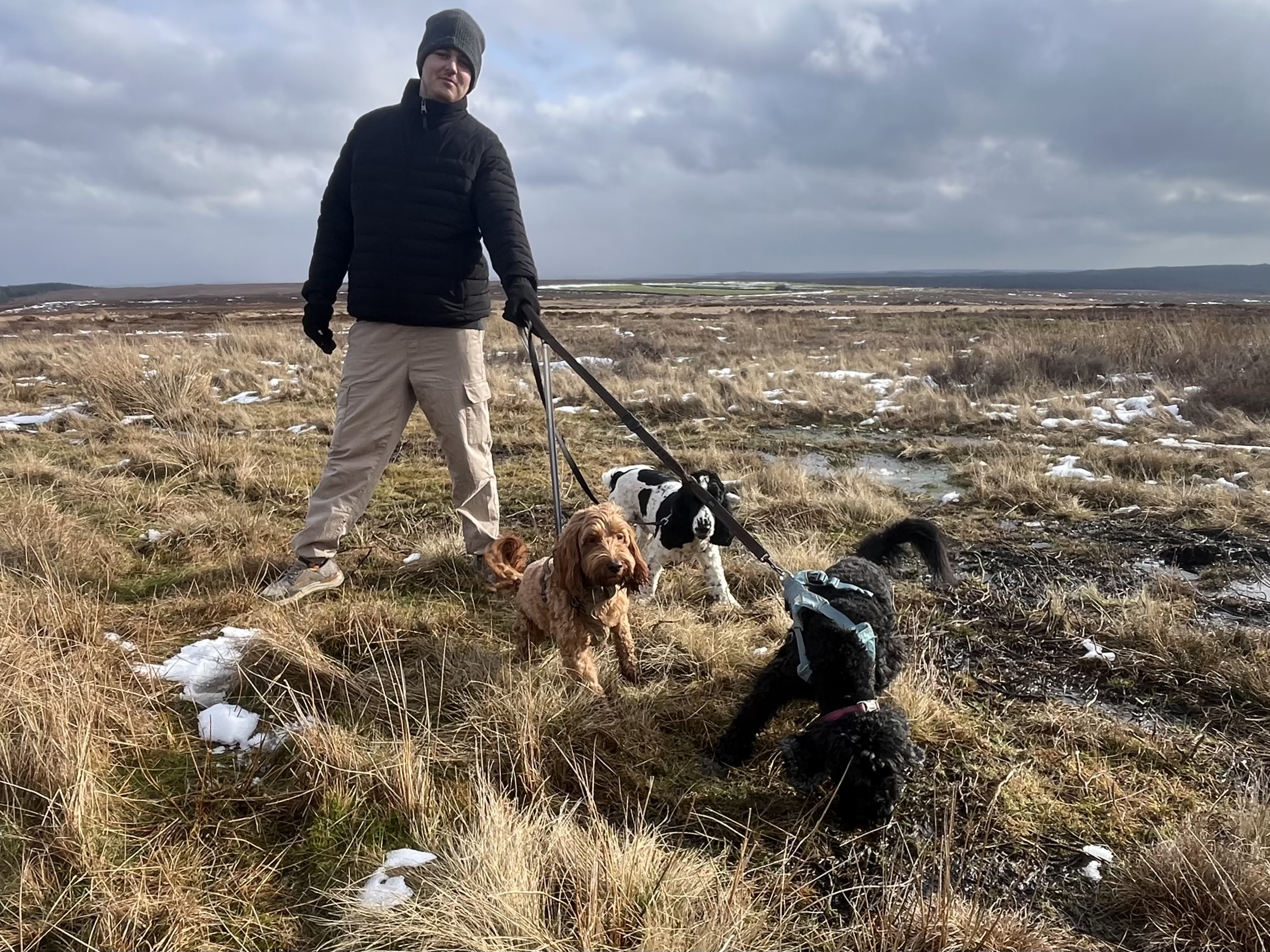
My son Joey and I went to the North York Moors near the site of Hamer Inn to look for the Corkseller’s Grave but were unsuccessful

I’ve had some interesting information about the Corkseller’s Grave that I mentioned a couple of weeks back. If you recall, I quoted a 1990s article written by Paul Grantham in which he explained that our corkseller would have been trekking the moors in the 18th century. Sadly, his threadbare clothes were not enough to protect him one savage winter, and he perished. Hard-up locals would not have been willing to bear the cost of a funeral and so they would have buried him where he was found, which was legal at the time.

My son Joey and I tried to find his grave, but were unsuccessful. I’m thrilled that the writer himself, Paul Grantham, got in touch after reading the column: “I was told, and shown, the Corkseller’s Grave by Dick Bell, the first head ranger of the Moors. He kept the grave marked, and tidied up the stones whenever he passed the site. He told me because he was sure that I would continue to keep it tidy. Sadly, it now appears to be neglected and is in desperate need of some TLC.

“I have records of many unconsecrated graves across the country, some in danger of being lost forever. There is (at least) one other grave on the Moors which beggars belief and will make a wonderful story if written up by someone more skilful than me. There is another story of a missing body which revolves around the little known group of cunning folk called St Mark’s Maidens who operate on the eve of St Mark’s Day. This is April 24th…so it will be here soon.”

I’m looking forward to hearing more from Paul about these mysterious tales, and will of course pass them on to you once I read them for myself.

His comment about St Mark’s Maidens made me want to find out about them, but there was not much that I was able to discover specifically with that name, although there is plenty about St Mark’s Eve.

St Mark the Evangelist was one of Christ’s 12 apostles and is best known for having one of the Bible’s four Gospel books of the New Testament attributed to him. He is the patron saint of many things, including lions, lawyers, opticians, pharmacists, painters, secretaries, interpreters, prisoners and people with insect bites!

I can’t find anything suggesting he is connected with predicting the future or romantic love, which is why it’s a bit odd that the day before his saint’s day is all about ‘divination’, specifically people trying to either find their life partner or determine who is going to die in the coming year.

All sorts of curious practices took place in the hope that at the end, the supplicant would discover the identity of their intended one. Both men and women performed these customs, so would it be that the women were known as St Mark’s Maidens? Would the men then be ‘Masters’?

Rituals included women walking backwards towards a well before circling it three times, also backwards, while wishing to see their future husband. After the second circle, she would peer into the water where the face of her intended would reveal itself. Presumably if she didn’t like the look of him, she’d not complete a third turn!

Another custom was to set the dinner table and leave the front door open. The next person through the door would be your true love. If you didn’t like cooking you could instead visit a church yard at midnight, pluck some grass from a grave and leave it under your pillow. When you awoke, the next person you saw would be THE one.

As for predicting who would pass away, ‘watchers’ would sit in the church porch and at midnight the apparitions of those to die in the coming year would file past. If the watcher at any time fell asleep, then they would be the one to perish. A similar custom was ‘chaff riddling’ where the watcher had to sit by a barn door riddling chaff all night. At midnight the spectres of those who would pass away would parade past. In his book ‘Yorkshire Days’, my dad tells the a story of a female watcher from Malton seeing a coffin being carried by two men.

She was dead within the year.

Do you have opinions, memories or ideas to share with me? Get in touch with me using the ‘Contact’ button on the top right.

This column appeared in the Darlington & Stockton Times on Friday 3rd  and the Ryedale Gazette and Herald on Wednesday 1st April 2026

Snippets from the past all sewn up


A needlework sampler showing a view of York Minster created in 1841 by 16-year-old Ann Raw. She included a depiction of a stained glass window and grazing sheep and cattle next to the building. Picture by Witney Antiques.

Another family mystery has landed in my inbox after a reader came across a series of columns I wrote in late 2022/early 2023 about a set of three needlework samplers that had been hanging in my family kitchen for years.


Two were done by ancestors on my mum’s side of the family while the third was by a little girl called Hannah Raw, who was only nine when she created it in 1835, but about whom we knew nothing.


Following some expert internet sleuthing by my wonderful readers, over the following weeks and months we managed to flesh out much of Hannah’s story, discovering that by the age of 13 she was an orphan, but later married a John Hall, had two children, and even later became a grandmother. She died in 1890 aged 64 and was buried at St Thomas’ Church, Glaisdale. I was ultimately able to find her grave and go and pay my respects.


Sarah Duce, who is based in Limerick, Ireland, got in touch: “I am interested in a school of samplers based around Lastingham. My great aunt Hannah Stonehouse…in 1808 completed a sampler which is quite rare apparently and recently sold to the States for a tidy sum because it depicted the Napoleonic Wars.”


Sarah’s family came originally from Lastingham, but moved first to Hartlepool then to Scunthorpe. Sarah moved to Ireland 30 years ago and is trying to piece together her North Yorkshire roots.


She goes on to explain that Hannah Stonehouse’s sampler was one of four about which she is trying to find out more. “I believe one might have been by a Mary Wilson who was born around 1791 in Hartoft, and wondered if there might have been some sort of connection…I believe my Great Grandma x5, Sarah Harding (nee Smith), may have been the teacher of these girls…She was schoolmistress of Lastingham following the death of her schoolmaster husband from consumption at the young age of 30.”


It was not unusual for widows to take on the work of their late husbands to earn a living to support themselves and their children. Sarah had three little ones, the youngest just two weeks old, and was still the schoolmistress at the age 80, as revealed in her entry on the 1841 census.


Sarah wondered if Hannah Raw was one of the girls sent to the Lastingham sewing school. She explains that her 5x great grandmother Sarah would have had no formal education and was likely illiterate at the time of her marriage  “…so must have brushed up her skills quickly, but maybe sewing was the backbone of her teachings…I also saw during my research…a newspaper of 1997 illustrating a 1841 sampler by Ann Raw, age 16, entitled the ‘South View of the Minster’…I wonder if there might be a connection there?”


I cannot answer that question, and Lastingham is a good 15 miles away from where Hannah Raw lived in the Lealholm area. But perhaps a family history sleuth reading this might be able to help, as they did before when finding out such useful information about Hannah. Raw is a common name, and I would imagine that to produce an image of that view of York Minster in 1841, Ann would have had to have sat in front of it to know what it looked like. That would possibly mean she would have been living in York, which in the 19th century was a long journey from the North York Moors. She was a similar age to Hannah Raw, so perhaps they were cousins?


I found an image of the sampler in question on a Facebook page run by Witney Antiques, an Oxfordshire-based specialist in embroidery and samplers. They describe it as follows:


‘This sampler, which shows a view of York Minster, was completed by 16-year-old Ann Raw on 14th February 1841. Her handling of the cathedral’s stained glass window is incredibly charming, as is the depiction of grazing sheep and cattle in the grass next to the building.’


Sarah ended her message by saying: “You never know where little snippets of info can come from, so you have to keep asking!”


You do indeed, Sarah, and I am hoping that someone reading this might just have the key to the little snippets we are looking for.

Do you have opinions, memories or ideas to share with me? Get in touch with me using the ‘Contact’ button on the top right.

This column appeared in the Darlington & Stockton Times on Friday 13th and the Ryedale Gazette and Herald on Wednesday 11th March 2026

Mark of respect for lowly corkseller

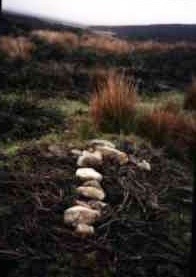
The corkseller’s grave near Bluewath Beck, high on the North York Moors , in a photo taken by reader John Severs in the 1990s.


I’m am getting some wonderful extra information coming in from you brilliant readers on topics I have covered in recent weeks.


If you recall, I’ve been writing about Hamer Inn, which was a thriving coaching stop on the North York Moors on the high road between Glaisdale and Rosedale Abbey. It had a number of previous names including the Lettered Board, and the Wayside Inn, ultimately ending up as Hamer House before it became derelict sometime in the late 1930s we believe. All that remains now are a few stones on a patch of smooth grass.


I first mentioned the inn thanks to reader David Ford, who is trying to trace a picture of it before it became derelict. Sadly we have yet to find one, but his message led me to re-read what my dad had written about it, including three stories of mysterious deaths at the inn. In the first, two apparently healthy guests retired to bed, only to be found dead the next day with no apparent cause. The second was a licensee who killed his wife, and the third involved a fight ending with a man being bludgeoned to death with a poker.


There was another sad story that occurred not inside the inn itself but nearby. A corkseller was a regular visitor, and David Ford’s ancestors, who were licensees, knew him well. One ferocious winter, he succumbed to the elements and his body was found much later not far from the Lettered Board Inn, his basket of corks lying nearby enabling him to be identified.


Reader John Severs got in touch and said: “After reading your article…I rummaged in my documents and photos to find something which may interest you. The photo that I took approximately 30 years ago shows the corkseller’s grave.”


The corkeseller’s grave? I was astounded, because I never imagined that such a thing existed, nor that it is still visible to this day. My dad did not mention it in his book and I don’t recall him talking about it to me, which might explain why I remained in ignorance.


I wonder if you agree with me, that it is quite a moving and remarkable image, showing the full length of the grave, marked out in stones in the unmistakable shape of a human body.


John also sent me a copy of an article written about the same time (1990s) about unconsecrated graves, with a focus on this particular one. The text, written by Paul Grantham, is an extract from the North Moors Association magazine and describes how well received itinerant tradespeople like the corkseller were:


‘As well as plying their trade they would bring news of the outside world, provide an extra pair of hands for heavy jobs and when necessary, act as entertainer and confidante…such was the prevailing attitude that they would generally receive, at the minimum, some sustenance and overnight shelter.’


Grantham believes our corkseller would have been active on the moors in the 18th century, trekking between isolated farms and inns peddling his wares. He would have been a familiar face and his arrival expected by local farmers and licensees.


Sadly, his threadbare clothes were not enough to protect him from one particularly savage winter, and he perished, his body being discovered some time later with his meagre belongings nearby.


At the time, no-one would have wanted to take responsibility for transporting him to the nearest church for burial because of the costs involved and so, as was perfectly legal at the time, they would have buried him where he was found.


Although this tale was passed down by word of mouth, there are no official records revealing the man’s name or anything else about him. But over the years, passers-by would realign the stone markers and someone occasionally placed a wooden cross at its head (the previous ones being ruined by the elements).


I would like to pay my respects next time I am over that way, and if you do too, you will find the grave on the road between Glaisdale and Rosedale Abbey. Stop by the small bridge over Bluewath Beck and walk for 50 yards heading east along the south bank of the stream.


I’m not sure if anyone still places a cross there, but if you know anything at all, do tell!

Do you have opinions, memories or ideas to share with me? Get in touch with me using the ‘Contact’ button on the top right.

This column appeared in the Darlington & Stockton Times on Friday 27th and the Ryedale Gazette and Herald on Wednesday 25th Feb 2026

Homing in on Hamer


The 1989 Malton Gazette and Herald article about Hamer House sent to me by Howard Campion. Do you know who wrote it?

A couple of weeks ago I mentioned that reader Howard Campion was sending me a copy of a 1989 article that talked about Hamer Inn that once stood on the road between Glaisdale and Rosedale Abbey on the North York Moors. Also known as the Lettered Board, all that now remains is a pile of stones on an expanse of smooth grass surrounded by heather. It used to be a thriving inn providing rest and sustenance for weary travellers and workers from the coal mines operating nearby.


Howard wondered if the article had been written by my dad (there was no writer’s name attached to it) and now that I have had a chance to read it, I think not. The writing style is a little different and because my dad was not an employed ‘reporter’ as such, he rarely conducted interviews like those that are featured. Unless the writer recognises his work and gets in touch, we might never know! I have attached a picture of said article, so that you can see it for yourself. It is a fascinating piece!


The article features first-hand accounts from those who remember it before it became derelict, which is highly useful when putting together a historical record. What I found really interesting is that this inn of many names had yet another, according to writer Joseph Ford, who was born there while his father, also called Joseph, was licensee in the mid to late 1800s. Joseph Ford junior, who died in 1944, was the great great uncle of David Ford, the reader who first contacted me, setting off this whole chain of Hamer-related columns.


The article states: ‘Ford, who said Hamer was then called the Wayside Inn, described how wagoners leading lime from Cropton would rest their tired horses at Hamer and feed them bags of clover while they partook of beer and egg-and-bacon pie.’


A lady called Annie Turnbull was born at Hamer in 1906, after the Ford family had left. ‘The pub was run by her father and mother, James and Elizabeth Eddon, and Mrs Turnbull was the second youngest of 11 children. They supplemented their income by farming a few acres adjoining the inn, and when last there, Mrs Turnbull could still trace the paddocks.’


Annie remembered: “On the Glaisdale side of the house is a beck (Bluewath) and I can remember going down to the beck with my mother to wash clothes. We took a big cauldron and lit a fire under it to boil the water and clothes.


“We had a pump in the pub yard but in summer it ran dry and we had to carry water from the beck. For reasons I can’t remember, one of the paddocks was called Pig’s Lug. One of the outbuildings was used by my father for making besoms from heather, and on Mondays, Mother would ride a pony to Pickering market to try to sell them.”


Annie’s sister, Lily Boddy, took over from her father in 1914, and it remained an inn for some time thereafter. Wilf Turnbull, Annie’s husband, recalled visiting Hamer in 1943: “All the outbuildings had been pulled down. Only the old pub was still standing and it was being used as a shooting house.”


Terry Ashby has also contacted me about Hamer: “At school in the early 1960s I discovered the delights of the one-inch OS maps and having moved to the North York Moors, I bought ‘Sheet 86 Redcar & Whitby’. There was Hamer House clearly marked. I wondered what it was and I probably pestered my dad to drive there to have a look. There wasn’t much left of it even then. I found out later that it had been an inn and later still I found it mentioned in an historical novel. I can’t remember the title or the author. I find these old ruins fascinating and quite poignant as they always pose questions about who lived there and when and why they were abandoned.”


Does anyone know the novel Terry refers to? And don’t forget, David Ford is still  searching for a photo of the inn before it became derelict. Do any of you have one lurking at the back of a drawer somewhere? Maybe it’s time to have a clear out. You never know what you might find!


Do you have opinions, memories or ideas to share with me? Get in touch with me using the ‘Contact’ button on the top right.

This column appeared in the Darlington & Stockton Times on Friday 13th and the Ryedale Gazette and Herald on Wednesday 11th Feb 2026

Hamer Home a family story

A 1955 photo of the ruins of Hamer Inn, previously known as the Lettered Board. David Ford’s ancestors lived there. Do you have a photo of the inn before it became derelict? Photo: P.W.Hanstock


I received an interesting message from reader David Ford: “I’ve just spotted a picture of the ruins of Hamer House on Facebook…My great grandfather Robert Ford was born there, along with several of his siblings. He emigrated to the USA as a young man seeking a better life, and tried gold mining. However he did not find it any easier over there and returned to Glaisdale. His brother Joseph wrote a book about life and times in Danby Dale…I would like a photo of Hamer when it was open as an inn.”

Although I’d heard of Hamer House, I didn’t know much about it. The first article that came up on Google was a piece written 15 years ago by none other than my dad. It jogged a memory of seeing it in one of his books and sure enough, on my very own bookshelf was a copy of Dad’s ‘Murders & Mysteries From The North York Moors’ with a whole section on Hamer.

Dad wrote: “It is believed the licence of this old inn continued until 1929, although it did survive as a private house into the 1930s. The last family living there was called Boddy, and I recall the old house still standing when I cycled past as a child.”

The building had a colourful past, and no doubt makes David’s family history research intriguing. The reason the inn was featured in the ‘Murders’ book is because there are three separate tales of deaths associated with it.

The inn stood at one of the highest parts of the moors, on the road between Glaisdale and Rosedale Abbey at the point where an old monk’s trod, or path, crossed it (where the Lyke Wake Walk traverses that road now). All that remains is a pile of stones, and yet the inn’s ghostly silhouette can be detected in the form of a wide expanse of smooth grass amongst the rough heather, hinting at what was once there – a busy, thriving coaching inn providing rest, warmth and succour for weary travellers. There were active coal mines nearby which drew men to the moors for work, and Eskdale farmers would send wagons of coal to supply places like Cropton, Hutton-le-Hole and Kirkbymoorside.

Although known by many as Hamer Inn, its previous name was the Lettered Board, and my dad believes it had been there for around three centuries. He talks about David’s ancestors in his book:

‘Hamer’s role as an inn declined after 1870, the year a local writer called Joseph Ford was born at the remote house. His father was landlord and I have a copy of a licensing application dated 1858 in which the liquor licence of the Lettered Board was transferred to Joseph Senior.

‘The younger Joseph Ford, who died in 1944, has left behind some stories of Hamer and they provide a vivid picture of the windswept and snowbound inn. He relates how elderly travelling salesmen would trek onto these moors, even in the height of winter, to sell trinkets.’

One sad story concerns a cork-seller who supplied local inn keepers and farmers, and Joseph Ford’s mother knew him well. He succumbed to the ferocious winter weather, and his skeleton was found much later not far from the Lettered Board Inn, his basket of corks lying nearby enabling his body to be identified.

The three cases of deaths at the inn include that of two apparently healthy guests retiring to bed, only to be found dead the next day with no apparent wounds or obvious cause. They may have been poisoned by noxious fumes resulting from recent replastering of the room, but no-one was ever sure.

The second case was a licensee who killed his wife, and quickly moved elsewhere in the dale. He was never prosecuted or imprisoned. The third story tells of a fight breaking out in the bar, and a man being bludgeoned to death with a poker.

Dad writes: “The only remnant of that tale was a heavy iron poker that was chained to the hearth to ensure this sort of thing never happened again. That poker was still there within the memory of my grandparents, but I never saw it.”

Can any of you reading this help David Ford track down a picture of Hamer Inn before it became derelict?

Do you have opinions, memories or ideas to share with me? Get in touch with me using the ‘Contact’ button on the top right.

This column appeared in the Darlington & Stockton Times on Friday 16th and the Ryedale Gazette and Herald on Wednesday 14th Jan 2026

The tragic lives of some famous names

Maria Branwell, who fell in love at first sight with the Reverend Patrick Brontë and went on to give birth to six children, including the famous literary sisters. Picture used courtesy of the Brontë Society

A few more people have contacted me about nominative determinism, where a person ends up in a job that reflects their name. Strangely, these all seem to be in the medical or related fields.

Anne-Marie Samuel used to work with a Dr Hurt, while Janet Pearce worked alongside a Nurse Nurse! And LJ Stevens says: “There was a probate registrar in the Ipswich District Probate Registry called Mr De’Ath.” You really couldn’t make it up, could you?

On using maiden names as middle names, Gareth Child says: “I was very nearly given my grandmother’s maiden name as a forename. Luckily for me my mother didn’t want her son to be called Crowther.”

Gareth is a registrar and explains: “At work in the register office I do see relatives’ surnames given to babies as middle names. It’s not frequent, but it is in double figures every year. Also, a growing trend among married women who take their husband’s name is for them to keep their maiden name as a middle name after marriage.”

By that, he means officially adopting their maiden name as a middle name, rather than creating a double-barrelled surname.

He adds: “We have the record of every birth, marriage and death in York since 1837, and it’s a fascinating living record of the city.”

Gareth contacted me again a little later with this piece of trivia: “A buried memory has been niggling away at me for a few days and it finally surfaced today. Branwell Brontë was given that name because it was his mother’s maiden name.”

As I am sure you know, Branwell was the brother of Charlotte, Emily and Anne Brontë, but Gareth’s comment made me more curious about the people in that famous family about whom we hear much less, such as their mother, Maria. And the more I learn, the more tragedy I discover.

Maria Branwell was born in Penzance, Cornwall in 1783, but lost both parents within a year of each other. In 1812, she decided to go and stay with her Aunt Jane in Yorkshire who had married a chap called John Fennell, headmaster of Woodhouse Grove School in Appleby Bridge near Bradford. Maria hadn’t planned to move there permanently but soon after arriving met her Uncle John’s friend, Irish clergyman Patrick Brontë. According to the sources I’ve read, the pair fell instantly in love, and married in December 1812. By then, Maria was 29 and Patrick 35, which was considered a bit long in the tooth to be newly wed, but the pair seemed very happy and their first child, Maria, was born in 1814, swiftly followed by their second, Elizabeth, the following year. Charlotte came along in 1816, followed by Patrick Branwell in 1817. He was given his mother’s maiden name as a middle name, but it was the one by which he was known. Maria gave birth to two more children, Emily in 1818, and finally Anne in 1820.

Unfortunately, in January 1821 when Anne had just turned one, Maria began to feel unwell. She became gravely ill, and died in the September, likely from some form of cancer. Four years later in 1825, the two eldest children, Maria, aged 11, and Elizabeth, aged 10, also died. Poor Patrick Brontë was destined to outlive his whole family, with Branwell and Emily dying in 1848, Anne in 1849, and finally Charlotte in 1855.

The Brontë children were all very intelligent and, as we know, excellent writers. Most would assume their literary prowess was inherited from their learned father, but in fact their mother was talented in that department too, as Charlotte discovered when her father gave her some letters that Maria had written to him during their courtship, 40 years earlier.

“It was strange now to peruse, for the first time, the records of a mind whence my own sprang,” she wrote, “And most strange, and at once sad and sweet, to find that mind of a truly fine, pure, and elevated order…There is a rectitude, a refinement, a constancy, a modesty, a sense, a gentleness about them indescribable I wish she had lived and that I had known her.”

Isn’t it fascinating where the topic of using maiden names as middle names has led me? I wonder where I will end up next week?

Do you have opinions, memories or ideas to share with me? Get in touch with me using the ‘Contact’ button on the top right.

This column appeared in the Darlington & Stockton Times on Friday 12th and the Ryedale Gazette and Herald on Wednesday 10th Dec 2025

For the ones who never came home

Lynne Catena’s uncle, Arthur Pearce, who was killed in WWII during the North Africa campaign in 1941. This picture was taken before the war, in his early 20s, and proudly dressed for a military tattoo.

A few more responses have come in on recent topics. Maxine Gordon contacted me about the convention of incorporating a maiden name into a child’s given name: “Both my sister and I and my best friend from Kirkcaldy have this tradition. We have our grandma’s maiden names as our middle names…I think it was unusual and raised some eyebrows at school etc, so probably dying out even in the 1970s. We might have been a last generation – my mum doesn’t even have a middle name.”

Maxine mentioned something which had not before occurred to me: “As kids you don’t want to stand out, so when they read your name at primary school and people laughed, that wasn’t so nice.” An unusual name certainly could make you a target for mockery among your childhood peers.

Until Fiona White contacted me, I had only come across the maiden name used as a middle name. But her family did something different: “My brother was given my mum’s maiden name as his first name – Innes.” Like Maxine’s family, the name Innes is Scottish. Are there more maiden names given as first names in that part of the world I wonder?

A couple of weeks ago I told the story of Lynn Catena’s Uncle Arthur, who was killed at age 24 while serving in the North Africa campaign in WWII. The war generation are notably reluctant to talk about their experiences. While Clare Proctor was watching the recent Remembrance commemorations, she was particularly captivated by the recollections of a veteran who, like her own father, had served in Burma (now Myanmar). “This veteran was saying that when returning from that war zone they were instructed by their superiors not to go home and talk about their war, because the people of Britain had suffered enough! So, he said, they never talked about it. My father certainly didn’t.”

She adds: “My cousin (30 years older than me) said our family did not celebrate VE Day because her Uncle Allan was still at war in the Far East. Their big day was VJ Day.” It’s satisfying to see that VJ Day is now being suitably commemorated, considering how many of our soldiers fought and died out there.

Robert Carter contacted me after seeing my piece about the Alamein Memorial a couple of weeks ago. Robert visited the Commonwealth, German, and Italian memorials and the Al Alamein Military Museum.

He says: “I was particularly interested to see the number of joint graves which were the last resting places of mainly armoured vehicle crews who presumably could not be separated because of the circumstances of their deaths. As a former soldier I thought it very apt that as they had fought and died together that they should be buried together.”

He adds: “The German and Italian memorials were built in the fifties which involved collecting the bodies from both nations that were widely distributed across the former battlefield and as a result many are listed as ‘Unknown’. The Italian memorial is, as you might expect, a tall very elegant building whereas the German is more sombre and fortress-like. Interestingly, inside the German building is a ring of sarcophagi, each one dedicated to each of the German states, ie Brandenberg, Mecklenburg, and so on, with a list of the servicemen from that state who died during the course of the battle…The museum was an excellent tribute to all of the nations involved with each being given equal status and range of exhibits.”

It is a sombre reminder that ordinary families on both sides of the conflict suffered equally with the loss of their loved ones.

When Lynn told me the story of her Uncle Arthur, I was saddened that I didn’t know what he looked like and assumed that I was unlikely to ever see a picture of him.

But I was wrong. Lynn found a photo and explains: “This is an old photo of Arthur Pearce that I took from my mum’s collection. She told me he wanted to be a career soldier. I believe, in this photo, he’d taken part in a military tattoo. RIP to the uncle I never met.”

Using his picture here is my small tribute to just one of the many young men who never came home.

Do you have opinions, memories or ideas to share with me? Get in touch with me using the ‘Contact’ button on the top right.

This column appeared in the Darlington & Stockton Times on Friday 5th and the Ryedale Gazette and Herald on Wednesday 3rd Dec 2025

A war to remember

The Alamein Memorial at the entrance to the El Alamein War Cemetery in Egypt which commemorates WW2 fallen servicemen who fought in the North Africa campaign and whose remains have never been found. Lynn Catena’s uncle, Arthur Pearce, can be found on Column 32 (Picture CWGC)
The huge El Alamein War Cemetery in Egypt which commemorates more than 20,000 fallen servicemen (Picture CWGC)

In response to my column about the six Smith Brothers of Barnard Castle, five of whom were killed in World War I, Lynn Catena contacted me to say: “My mum’s brother was killed in action on December 19th, 1941, at 24 years of age. Apart from a tatty telegram there was no further word (that I know of). Several years ago I discovered the Commonwealth War Graves Commission (CWGC). I messaged them with the scant details I had and within 24 hours they responded with a list of the deceased (including my uncle), along with the cemetery and memorial reference. His name is etched on Column 32 at the Alamein Memorial in Egypt. He was my grandparents’ only son.”

His name was Arthur Pearce, and Lynn’s grandmother was long gone before the record was found. I can’t imagine the grief she must have suffered knowing her only son died in a country more than 3,000 miles away. The lingering pain of not knowing where his remains lay, of not being able to visit his final resting place, must have been acute. Did the fact that many other familles were suffering in the same way at the same time help, alongside the fact that they died heroes defending the freedom of their home and country? Sadly, most of those who could answer this question are no longer with us, but do let me know if you have ever spoken to your relatives about it. They came from a generation that was not used to discussing such deep internal emotions, and therefore may not ever have felt able to express their memories openly.

Lynn’s message prompted me to visit the CWGC website again, to see if I could find her uncle’s record – and sure enough I did, but not before I had to scroll past pages and pages of names engraved on the Alamein Memorial. It was truly sobering to see hundreds of fallen men, most of whom were aged in their 20s and 30s. The oldest was 50, and the youngest a mere 16 years old. They came from the various countries that united in the North Africa campaign to oppose German and Italian forces in a battle over control of the Mediterranean. The sea gave access to the East via the Suez Canal, a vital supply route leading to Russia via the oil-rich Middle Eastern block. As well as the UK soldiers from the Royal Artillery, there was air support from Australia, and infantry from New Zealand, South Africa and a few other countries.

What caught my attention was that 9th December 1941 was a particularly bad day for casualties. Where most dates listed from a few deaths into the 10s and 20s, on 9th December more than 300 servicemen were killed. My knowledge of WWII is what you might call at ‘headline’ level, and I know even less about the North Africa campaign. I felt I owed it to the men whose memorial I was looking at to educate myself a bit more.

The 9th December 1941 was just two days after the Japanese bombing of the US naval base Pearl Harbour on the island of Hawaii which prompted the States and a number of other countries to officially enter the war. It was also around the mid-point of Operation Crusader, the allied offensive to once and for all take the strategically important Mediterranean port of Tobruk on the north Libyan coast, 150km west of the border with Egypt. Rommel’s German troops supported by Italian allies had been trying to capture the port since the previous April in what is called The Siege of Tobruk. The new offensive, made up of British, Indian, New Zealand, South African and Free French forces, drove the Germans and Italians back into Libya enabling allied troops to gain firm control of the port.

The Alamein Memorial forms part of the huge El Alamein War Cemetery where more than 20,000 fallen commonwealth soldiers are commemorated. There are around 8,000 graves (812 of which are unidentified), and nearly 12,000 more names listed on the memorial because, like Lynn’s uncle, their remains have never been located.

Statistics like that make me grateful that I have never had to face the horror of a world war. I hope such a thing is never allowed to happen again.

Do you have opinions, memories or ideas to share with me? Get in touch with me using the ‘Contact’ button on the top right.

This column appeared in the Darlington & Stockton Times on Friday 21st and the Ryedale Gazette and Herald on Wednesday 19th Nov 2025