Is it Written in the Stars?

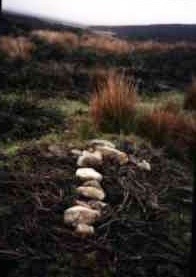
A rather blurry old photo of the Corkseller’s Grave. But the shape of the hills in the background might help us identify the location. Can you recognise it? (Picture: Paul Grantham)

I am constantly surprised by how far and wide my columns are read.

Chris Starfire contacted me with the following: “Hello, I’m far away in Oregon in the USA but fascinated by your story of the Corkseller’s Grave.” Chris, I am fascinated how you found me – and by your surname too! Where does an exotic name like Starfire come from?

Chris read the piece a few weeks ago in which I described trying to find the grave with the help of my son Joey. We were unsuccessful, and Chris got in touch with a couple of helpful ideas: “Poking around online, I noticed that there are two sets of instructions to find the grave and they differ in 30 yards.”

He spotted that in my piece I said ‘…you will find the grave on the road between Glaisdale and Rosedale Abbey. Stop by the small bridge over Bluewath Beck and walk for 50 yards heading east along the south bank of the stream.’

But he found an further piece written by Paul Grantham, other than the 1990s article of his which I had used for my column. He noticed that it said: ‘The isolated grave lies just south of the road junction one mile north of Hamer House, at a point where the road crosses the beck. Park on the bridge and follow the stream east for about 20 yards.’

There was a small photo accompanying the article, and Chris pointed out: “The photo is quite small on the Grantham website, but could be useful for a sight line on the surrounding hills… Best of luck finding the grave if you go looking again!”

I have tried my best to improve the image, which I’ve included with this piece, and it’s not the best quality, but indeed the shape of the background hills can clearly be seen in the distance. Could this be useful for identification? Someone who knows the area better than me might be able to recognise it. If so, please do get in touch!

I have also been contacted by yet another arm of the Eddon family, who you may remember were at one time the licensees of Hamer Inn. James and Elizabeth Eddon took over from the Ford family at the end of the 18th century, and had 11 children. Lily, took over the running of Hamer Inn in 1914 when her parents moved on.

“Following on from your articles about Hamer House, I am David Turnbull grandson of Elizabeth and James Eddon. My mother was Annie Eddon, daughter of Elizabeth and James, and she married Wilfred Turnbull. She was sister to Lily Boddy. Annie was one of 11 children and was born at Hamer Inn. The family moved at some point to run the Black Bull pub on the Pickering/Malton Road where James was unfortunately kicked by a horse and killed. We presume Lily was left behind to run Hamer. My sisters think Lily died quite young but we have no dates. I hope this information is of interest to you.”

It certainly is of interest, David, and I am very grateful to you for getting in touch. I was very sorry to learn about the way James died, which Paul Grantham had mentioned in his 1990s article that I featured. It must have been in 1923 because my research shows that Annie, who was born in 1906, was 17 at the time.

As for David’s question about how long Lily lived, I think she reached a fair age judging by the photos that I published a few weeks back, but I’m not sure how long, or the year that she passed away. Perhaps one of her many relatives out there will be able to tell us?

In the meantime, I have another mystery that has landed in my lap. I was invited on a trip into the Yorkshire Dales last weekend, and on a lovely walk, I spotted a cave in the side of a hill.

I was informed that the legendary Grassington murderer Tom Lee used the cave to hide from his pursuers.

Grassington murderer? Of course that set me off on another quest to find out who the heck Tom Lee was, and what had happened. If you are reading this and know that story, I’d love to hear from you!

Do you have opinions, memories or ideas to share with me? Get in touch with me using the ‘Contact’ button on the top right.

This column appeared in the Darlington & Stockton Times on Friday 24th and the Ryedale Gazette and Herald on Wednesday 22nd April 2026
Watch what you wish for


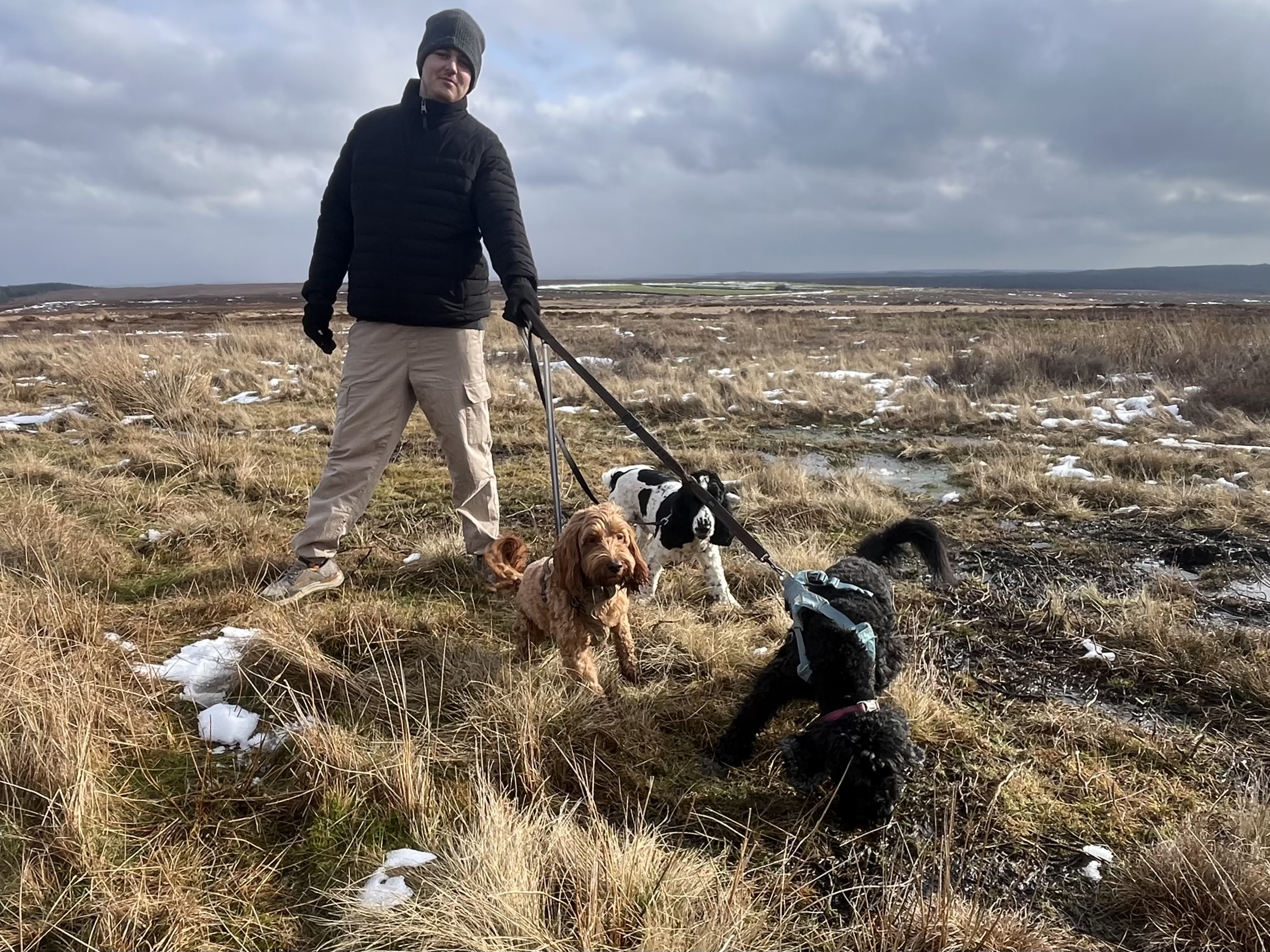
My son Joey and I went to the North York Moors near the site of Hamer Inn to look for the Corkseller’s Grave but were unsuccessful

I’ve had some interesting information about the Corkseller’s Grave that I mentioned a couple of weeks back. If you recall, I quoted a 1990s article written by Paul Grantham in which he explained that our corkseller would have been trekking the moors in the 18th century. Sadly, his threadbare clothes were not enough to protect him one savage winter, and he perished. Hard-up locals would not have been willing to bear the cost of a funeral and so they would have buried him where he was found, which was legal at the time.

My son Joey and I tried to find his grave, but were unsuccessful. I’m thrilled that the writer himself, Paul Grantham, got in touch after reading the column: “I was told, and shown, the Corkseller’s Grave by Dick Bell, the first head ranger of the Moors. He kept the grave marked, and tidied up the stones whenever he passed the site. He told me because he was sure that I would continue to keep it tidy. Sadly, it now appears to be neglected and is in desperate need of some TLC.

“I have records of many unconsecrated graves across the country, some in danger of being lost forever. There is (at least) one other grave on the Moors which beggars belief and will make a wonderful story if written up by someone more skilful than me. There is another story of a missing body which revolves around the little known group of cunning folk called St Mark’s Maidens who operate on the eve of St Mark’s Day. This is April 24th…so it will be here soon.”

I’m looking forward to hearing more from Paul about these mysterious tales, and will of course pass them on to you once I read them for myself.

His comment about St Mark’s Maidens made me want to find out about them, but there was not much that I was able to discover specifically with that name, although there is plenty about St Mark’s Eve.

St Mark the Evangelist was one of Christ’s 12 apostles and is best known for having one of the Bible’s four Gospel books of the New Testament attributed to him. He is the patron saint of many things, including lions, lawyers, opticians, pharmacists, painters, secretaries, interpreters, prisoners and people with insect bites!

I can’t find anything suggesting he is connected with predicting the future or romantic love, which is why it’s a bit odd that the day before his saint’s day is all about ‘divination’, specifically people trying to either find their life partner or determine who is going to die in the coming year.

All sorts of curious practices took place in the hope that at the end, the supplicant would discover the identity of their intended one. Both men and women performed these customs, so would it be that the women were known as St Mark’s Maidens? Would the men then be ‘Masters’?

Rituals included women walking backwards towards a well before circling it three times, also backwards, while wishing to see their future husband. After the second circle, she would peer into the water where the face of her intended would reveal itself. Presumably if she didn’t like the look of him, she’d not complete a third turn!

Another custom was to set the dinner table and leave the front door open. The next person through the door would be your true love. If you didn’t like cooking you could instead visit a church yard at midnight, pluck some grass from a grave and leave it under your pillow. When you awoke, the next person you saw would be THE one.

As for predicting who would pass away, ‘watchers’ would sit in the church porch and at midnight the apparitions of those to die in the coming year would file past. If the watcher at any time fell asleep, then they would be the one to perish. A similar custom was ‘chaff riddling’ where the watcher had to sit by a barn door riddling chaff all night. At midnight the spectres of those who would pass away would parade past. In his book ‘Yorkshire Days’, my dad tells the a story of a female watcher from Malton seeing a coffin being carried by two men.

She was dead within the year.

Do you have opinions, memories or ideas to share with me? Get in touch with me using the ‘Contact’ button on the top right.

This column appeared in the Darlington & Stockton Times on Friday 3rd  and the Ryedale Gazette and Herald on Wednesday 1st April 2026