Watch what you wish for


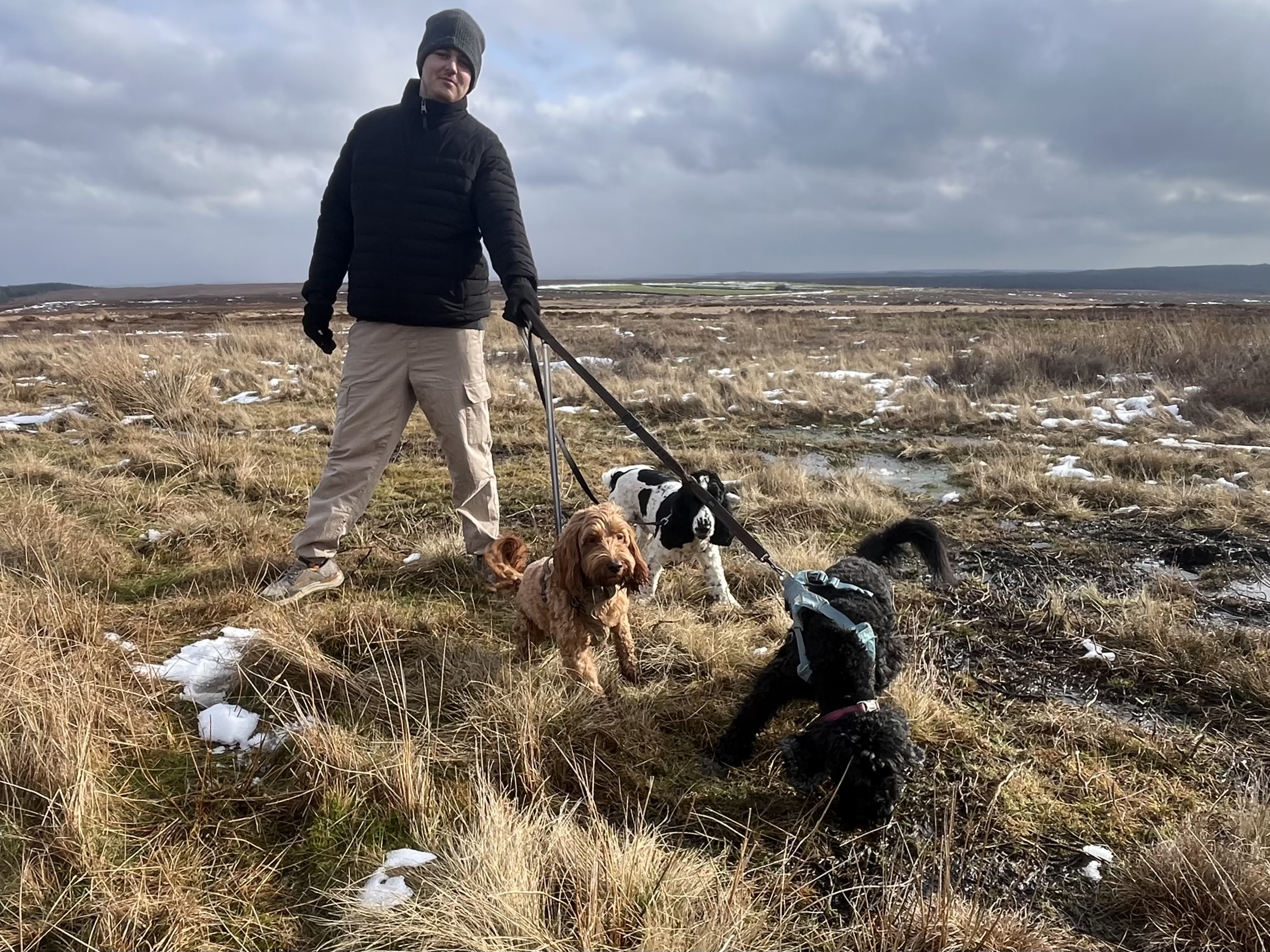
My son Joey and I went to the North York Moors near the site of Hamer Inn to look for the Corkseller’s Grave but were unsuccessful

I’ve had some interesting information about the Corkseller’s Grave that I mentioned a couple of weeks back. If you recall, I quoted a 1990s article written by Paul Grantham in which he explained that our corkseller would have been trekking the moors in the 18th century. Sadly, his threadbare clothes were not enough to protect him one savage winter, and he perished. Hard-up locals would not have been willing to bear the cost of a funeral and so they would have buried him where he was found, which was legal at the time.

My son Joey and I tried to find his grave, but were unsuccessful. I’m thrilled that the writer himself, Paul Grantham, got in touch after reading the column: “I was told, and shown, the Corkseller’s Grave by Dick Bell, the first head ranger of the Moors. He kept the grave marked, and tidied up the stones whenever he passed the site. He told me because he was sure that I would continue to keep it tidy. Sadly, it now appears to be neglected and is in desperate need of some TLC.

“I have records of many unconsecrated graves across the country, some in danger of being lost forever. There is (at least) one other grave on the Moors which beggars belief and will make a wonderful story if written up by someone more skilful than me. There is another story of a missing body which revolves around the little known group of cunning folk called St Mark’s Maidens who operate on the eve of St Mark’s Day. This is April 24th…so it will be here soon.”

I’m looking forward to hearing more from Paul about these mysterious tales, and will of course pass them on to you once I read them for myself.

His comment about St Mark’s Maidens made me want to find out about them, but there was not much that I was able to discover specifically with that name, although there is plenty about St Mark’s Eve.

St Mark the Evangelist was one of Christ’s 12 apostles and is best known for having one of the Bible’s four Gospel books of the New Testament attributed to him. He is the patron saint of many things, including lions, lawyers, opticians, pharmacists, painters, secretaries, interpreters, prisoners and people with insect bites!

I can’t find anything suggesting he is connected with predicting the future or romantic love, which is why it’s a bit odd that the day before his saint’s day is all about ‘divination’, specifically people trying to either find their life partner or determine who is going to die in the coming year.

All sorts of curious practices took place in the hope that at the end, the supplicant would discover the identity of their intended one. Both men and women performed these customs, so would it be that the women were known as St Mark’s Maidens? Would the men then be ‘Masters’?

Rituals included women walking backwards towards a well before circling it three times, also backwards, while wishing to see their future husband. After the second circle, she would peer into the water where the face of her intended would reveal itself. Presumably if she didn’t like the look of him, she’d not complete a third turn!

Another custom was to set the dinner table and leave the front door open. The next person through the door would be your true love. If you didn’t like cooking you could instead visit a church yard at midnight, pluck some grass from a grave and leave it under your pillow. When you awoke, the next person you saw would be THE one.

As for predicting who would pass away, ‘watchers’ would sit in the church porch and at midnight the apparitions of those to die in the coming year would file past. If the watcher at any time fell asleep, then they would be the one to perish. A similar custom was ‘chaff riddling’ where the watcher had to sit by a barn door riddling chaff all night. At midnight the spectres of those who would pass away would parade past. In his book ‘Yorkshire Days’, my dad tells the a story of a female watcher from Malton seeing a coffin being carried by two men.

She was dead within the year.

Do you have opinions, memories or ideas to share with me? Get in touch with me using the ‘Contact’ button on the top right.

This column appeared in the Darlington & Stockton Times on Friday 3rd  and the Ryedale Gazette and Herald on Wednesday 1st April 2026
Hamer Home a family story

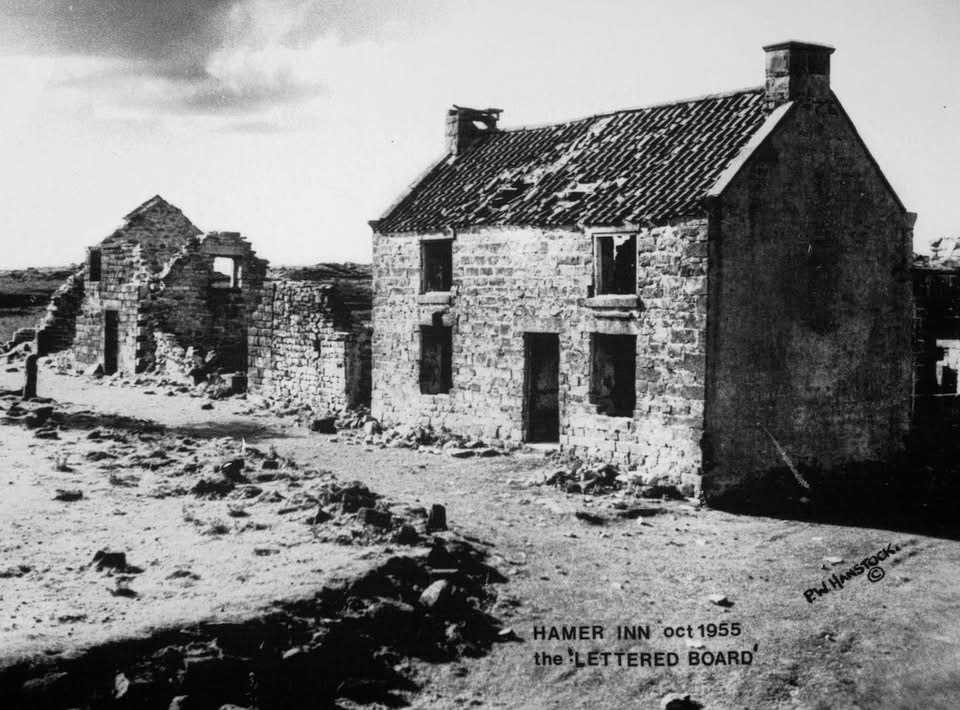
A 1955 photo of the ruins of Hamer Inn, previously known as the Lettered Board. David Ford’s ancestors lived there. Do you have a photo of the inn before it became derelict? Photo: P.W.Hanstock


I received an interesting message from reader David Ford: “I’ve just spotted a picture of the ruins of Hamer House on Facebook…My great grandfather Robert Ford was born there, along with several of his siblings. He emigrated to the USA as a young man seeking a better life, and tried gold mining. However he did not find it any easier over there and returned to Glaisdale. His brother Joseph wrote a book about life and times in Danby Dale…I would like a photo of Hamer when it was open as an inn.”

Although I’d heard of Hamer House, I didn’t know much about it. The first article that came up on Google was a piece written 15 years ago by none other than my dad. It jogged a memory of seeing it in one of his books and sure enough, on my very own bookshelf was a copy of Dad’s ‘Murders & Mysteries From The North York Moors’ with a whole section on Hamer.

Dad wrote: “It is believed the licence of this old inn continued until 1929, although it did survive as a private house into the 1930s. The last family living there was called Boddy, and I recall the old house still standing when I cycled past as a child.”

The building had a colourful past, and no doubt makes David’s family history research intriguing. The reason the inn was featured in the ‘Murders’ book is because there are three separate tales of deaths associated with it.

The inn stood at one of the highest parts of the moors, on the road between Glaisdale and Rosedale Abbey at the point where an old monk’s trod, or path, crossed it (where the Lyke Wake Walk traverses that road now). All that remains is a pile of stones, and yet the inn’s ghostly silhouette can be detected in the form of a wide expanse of smooth grass amongst the rough heather, hinting at what was once there – a busy, thriving coaching inn providing rest, warmth and succour for weary travellers. There were active coal mines nearby which drew men to the moors for work, and Eskdale farmers would send wagons of coal to supply places like Cropton, Hutton-le-Hole and Kirkbymoorside.

Although known by many as Hamer Inn, its previous name was the Lettered Board, and my dad believes it had been there for around three centuries. He talks about David’s ancestors in his book:

‘Hamer’s role as an inn declined after 1870, the year a local writer called Joseph Ford was born at the remote house. His father was landlord and I have a copy of a licensing application dated 1858 in which the liquor licence of the Lettered Board was transferred to Joseph Senior.

‘The younger Joseph Ford, who died in 1944, has left behind some stories of Hamer and they provide a vivid picture of the windswept and snowbound inn. He relates how elderly travelling salesmen would trek onto these moors, even in the height of winter, to sell trinkets.’

One sad story concerns a cork-seller who supplied local inn keepers and farmers, and Joseph Ford’s mother knew him well. He succumbed to the ferocious winter weather, and his skeleton was found much later not far from the Lettered Board Inn, his basket of corks lying nearby enabling his body to be identified.

The three cases of deaths at the inn include that of two apparently healthy guests retiring to bed, only to be found dead the next day with no apparent wounds or obvious cause. They may have been poisoned by noxious fumes resulting from recent replastering of the room, but no-one was ever sure.

The second case was a licensee who killed his wife, and quickly moved elsewhere in the dale. He was never prosecuted or imprisoned. The third story tells of a fight breaking out in the bar, and a man being bludgeoned to death with a poker.

Dad writes: “The only remnant of that tale was a heavy iron poker that was chained to the hearth to ensure this sort of thing never happened again. That poker was still there within the memory of my grandparents, but I never saw it.”

Can any of you reading this help David Ford track down a picture of Hamer Inn before it became derelict?

Do you have opinions, memories or ideas to share with me? Get in touch with me using the ‘Contact’ button on the top right.

This column appeared in the Darlington & Stockton Times on Friday 16th and the Ryedale Gazette and Herald on Wednesday 14th Jan 2026

To name but a few

Dad was very good at coming up with quirky character names in his novels

Back in 2018 I wrote a column about unusual names inspired by an archive piece I’d found by my dad from April 1978 in which he explained that he’d had a schoolfriend called Septimus thanks to the fact he was his family’s seventh son. He was unique because his father was also a seventh son, and so he was in the auspicious position of being the seventh son of a seventh son. These fortunate humans were supposed to have been blessed with supernatural powers, but Dad observed that his friend, whom everyone called Sep, displayed no discernible mystical talents.

Dad was good at coming up with quirky names for the characters in his novels. His best-known was the loveable rogue Claude Jeremiah Greengrass who appeared in many of his Constable books that inspired the TV series Heartbeat. According to Dad, that was a genuine name he had come across as a young bobby and he stored it away in his memory bank until it resurfaced many years later on the pages of the first ‘Heartbeat’ novel (Constable on the Hill, published in 1979). Other fun names he conjured up included Detective Inspector Montague Pluke, Detective Sergeant James Aloyisius Carnaby-King, Sergeant Oscar Blaketon and Constable Alf ‘Volcano’ Ventress.

Brian Reader got in touch via my Countryman’s Daughter web page and informed me: “Two of my grandfather Rocious’s sisters were named Fera and Ellengor! So far I haven’t found the origins.”

I’ve never heard of Rocious, Fera or Ellengor. The only reference I came up with for ‘Rocious’ was in a dictionary of slang where it means ‘amazing’ or ‘cool and trendy’. I wonder if his parents had those traits in mind when naming him? The nearest known name I got to was the Spanish ‘Rocio’, a gender neutral name meaning ‘dew’. The Spanish have used it to refer to the Virgin Mary – ‘La Virgen del Rocio’ (Mary of the Dew).

The next nearest I could get to was ‘Roscius’ which online dictionaries say was a noun first used in Englsih in 1607 to mean ‘actor’. It links back to a famous Roman thespian called Quintus Roscius Gallus, whose reputation in the theatre was legendary, and thus the word ‘Roscian’ became commonplace in the 1600s to refer to someone who had delivered a particularly fine stage performance.

I found a bit more on the name Fera. It is a feminine name derived from the Latin ‘ferus’ which means ‘wild’ or ‘untamed’, and today the Italian word ‘fiero’ means ‘fierce’ or ‘fiery’. ‘Fiera’ as an adjective means ‘proud’ and as a noun means ‘a fete’ or ‘a fair’. In the Calabrian dialect of Italy ‘Fera’ means ‘dolphin’. Fera is also used in Arabic regions and means ‘brave’. It is close to the Irish ‘Feara’ too, which means ‘truth’. I wonder if Brian’s great aunt Fera possessed any of these characteristics?

As for Ellengor, I can find very little in terms of its history as a name or its etymology as a word in any language, never mind English. To me, the name sounds like a character from Arthurian legend, or a queen from Viking mythology. I have found a few mentions of women called ‘Ellengor’, most of whom came from the Northallerton area and one of which might well be Brian’s great aunt. We have Ellengor Barker (1862-1955), Ellengor Bramley (1871-1965), and Ellengor Barker Rollins (1889-1977) all from Northallerton and who might well be related. My guess is that Ellengor Barker Rollins is the daughter of Ellengor Barker.

There are also a couple more: Ellengor Kimberley (b.Boynton) who was born in either 1889, 1899, or 1900 and died in 1961, and her daughter Ellengor Collins (1922-2015). Both of these women came from the Bedale area. I wonder if all the Ellengors are related and named after one original family matriarch?

I’d love to know if any of you have interesting names or do you have a relative who has or had a quirky name? Get in touch with me using the methods below.

(Thanks to Brian inspiring this week’s column, and I hope readers will forgive this public personal message, but it’s the only way I will know that he will see it! Brian just to let you know that I replied to you by email, but have a feeling they may have ended up in your junk folder!).

Do you have opinions, memories or ideas to share with me? Get in touch with me using the ‘Contact’ button on the top right.

This column appeared in the Darlington & Stockton Times on Friday 19th and the Ryedale Gazette and Herald on Wednesday 17th Sept 2025