The secret is out!

Dad at work in his study which is being recreated at the World of James Herriot in Thirsk. It will be opened by Heartbeat star David Lonsdale on Saturday 29th August at 1pm. You are all invited.

I’ve been harbouring a secret for a while now but the time has come to share it…

My dad’s study has been saved!

I’ve written in the past about my concerns as to what is going to happen to it when we have to sell the family home. It’s been a weighty burden because it is tied so closely to Dad and his career. What were we to do with all the stuff that was so important to him?

Dad’s study is THE place where I feel closest to him, THE place where I can still feel his presence, the hub of his creativity. It’s a visual representation of what was going on in his head and how he organised his many ideas and resulting stories. For 35 years he toiled in that small room, producing book after book, column after column, article after article. The shelves are packed with reference books on all manner of topic, the most-important and most-used of them on the shelf just in front of where he sat. There are also filing cabinets stuffed full of 60 years-worth of papers and cuttings he’d collected, stored in an order that made sense to him. He created a card index that sat on top of the cabinets, without which it would be impossible for the rest of us to find anything. Beneath his chair, a hole is worn in the carpet from all his wheeling backwards and forwards to reach for things off the shelves or out of the cabinets.

The walls tell a story themselves, adorned as they are with Heartbeat-related knicknacks, such as an ‘Aidensfield’ village sign, a Claude Jeremiah Greengrass teddy bear, a framed copy of the cover of TV Times magazine from 23rd – 29th June 2007 featuring barmaid Gina Ward and PC Phil Bellamy’s much anticipated wedding. Nestled among the Heartbeat mementoes are more personal items, such as a framed photo his mother, my Nana Walker, taken when she was young woman, while elsewhere are a wooden rosary and a postcard of Pope John Paul II, a reflection of Dad’s Catholic faith. One of his proudest moments was when, as Press Officer for North Yorkshire Police, he was tasked with handling the media aspect of the Pope’s 1982 visit to York and he was able to attend the huge open-air mass held on the city’s Knavesmire.

I’m sure you can imagine how the prospect of it vanishing forever was simply too much to bear. We approached a few places a while back, but were disappointed when no-one was willing or able to take it.

A few months ago, though, I got a phone call from Ian Ashton, the Managing Director of the World of Jame Herriot in Thirsk. We had talked to him a couple of years ago, but at the time, the museum was not in a position to be able to help. However, times have changed!

They are creating a whole new Heartbeat-themed attraction within the museum, and at the centre is a recreation of my dad’s study. Not many people know that Alf Wight (James Herriot) was our local vet and even treated our cat! These two men were at the same time writing humorous tales about the quirky characters of North Yorkshire, both of which would be turned in to hugely successful TV shows. Thanks to them we now have the tourism honey-pots of Herriot Country and Heartbeat Country. What a lucky county we are!

I have (with some able helpers) spent the past couple of weekends packing up boxes while taking photos as I go so that the study can be recreated as accurately as possible. Heartbeat favourite David Lonsdale, who played loveable David Stockwell in the TV show, will unveil the study at 1pm on Saturday 29th August – and you are all invited! Just Google ‘World of James Herriot’ to find it.

Dad was such a humble man that he would have been bewildered by all the fuss.

But if you are the reason behind a TV phenomenon that attracted millions of viewers, that still has millions of fans around the world 16 years after it ended, and who in a large part is responsible for a tourism boom in Goathland and the North York Moors, then the least you deserve is a bit of fuss.

Do you have opinions, memories or ideas to share with me? Get in touch with me using the ‘Contact’ button on the top right.

This column appeared in the Darlington & Stockton Times on Friday 21st and the Ryedale Gazette and Herald on Wednesday 19th August  2026
The heart of the matter


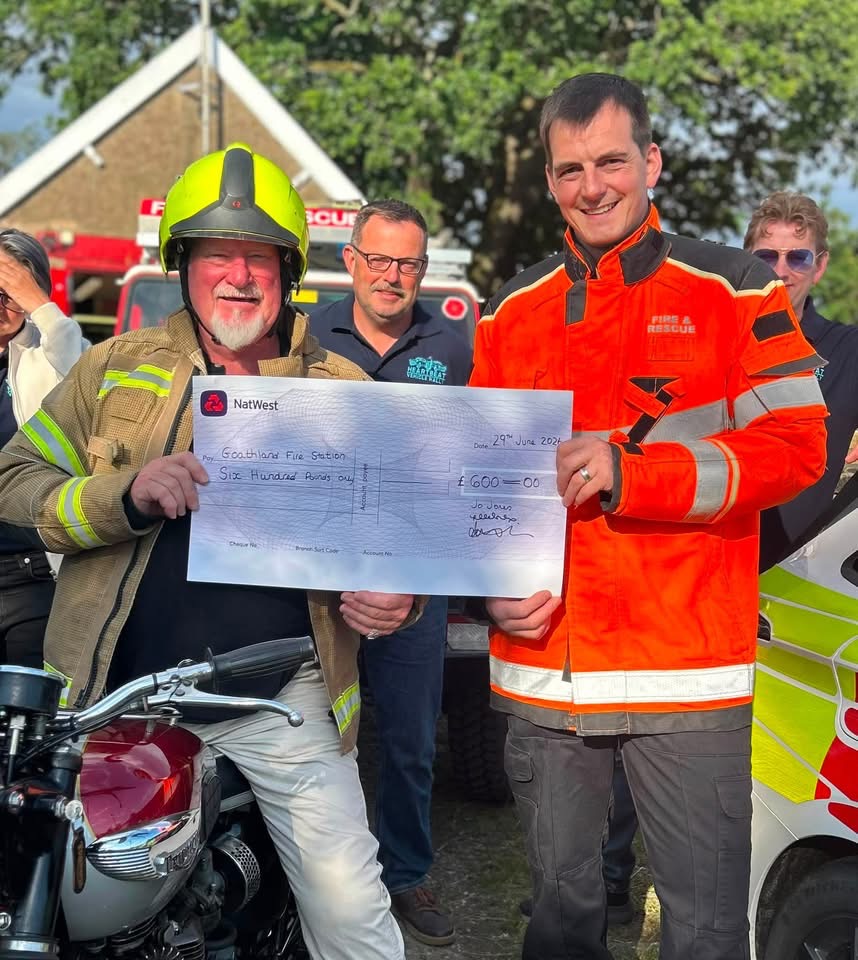
London’s Burning actor Sean Blowers presents a cheque for £600 to Volunteer On-Call Crew Manager Jack Atkinson from Goathland Volunteer Fire Station. Jack and his colleagues were part of the team who tackled the worst fire in North York Moors history last year, centred around Langdale Forest. Picture by Lee Jones.

I am still basking in the glow of another wonderful weekend in Goathland at the annual Heartbeat Vehicle Rally. We were blessed again with lovely weather and we estimate that there were around 6,000 visitors over the two days. Of course, if you read last week’s column, you will already know that my family were reunited with my dad’s old Mark 2 Jaguar, which was an absolute treat.

What I didn’t mention was that as I approached the car for the first time, there was a chap chatting with Richard James, the current owner and the man responsible for the amazing restoration. As the stranger saw me approach, he turned and introduced himself as Keith, saying: “I drove Peter Walker’s daughter Sarah to her wedding in that car!”

So I replied: “I am Sarah!” You should have seen the look on his face! He hadn’t recognised me – which I put down to the fact I was wearing a hat and sunglasses, rather that the 30+ years of aging that have taken place since! Keith was the mechanic who restored it in 1994 and revealed that he was rather stressed in that final week. But he pulled it out of the bag in time, and was thrilled to be my bridal chauffeur.

Considering how many people were gathered in once place, the rally ran very smoothly, with dozens of fans queuing patiently for ages to see the stars and the stars in turn patiently signing hundreds of autographs and posing for hundreds of pictures. This year we had four actors: David Lonsdale, who played bumbling David Stockwell, Vanessa Hehir who played mechanic Rosie Cartright, Ryan Early, who played PC Tom Nicholson and Sean Blowers, who made two memorable guest appearances and was also known for playing John Hallam in London’s Burning, an ITV series about the fire service.

Sean’s appearance was especially fitting because this year, we were delighted that he was able to hand a £600 cheque to Goathland Volunteer Fire Station, while another £600 went to the village primary school.

I was also thrilled to hear from Elsie Smith, trustee of Goathland Village Hall, who sent me a lovely message after the event having seen my family’s emotional reunion with the Jaguar. She reported that the hall did a roaring trade in teas, coffees and cakes, and so benefitted from a nice little windfall too!

Of course, there are drawbacks to hosting such a popular occasion and as ever some selfish drivers were too tight to pay the modest fee for parking (between £2 and £4.50 for a full day). In total there were four separate car parks available with bags of room, and yet a frustrating minority insisted on plonking their cars on the beautiful verges that are such an iconic part of our moorland setting. Despite advance posts on social media showing where to park, plus signage, marshalls and ‘Keep Off’ signs on the day, some people were just too ignorant to pay heed, showing no respect for the historic grazing land nor to the residents who call Goathland home.

When I stand back and look at the event, I do wonder what my dad would think of it all. I’m pretty sure he would be amazed that 16 years after the series came to an end, the fans are still loyal and passionate enough to make the effort to travel all the way to Goathland. One lady I spoke to had come all the way from Boston, USA! She loves Heartbeat, and made the trip for the first time last year. Because she enjoyed it so much, she decided to come back again.

There was one incident that shocked me though. A car went past with the passenger casually hanging her arm out of the window. In her hand was a lit cigarette.

It was one of the most thoughtless and stupidest things I saw all weekend. The moors are tinder dry, and one spark from a cigarette could lead to catastrophe.

If only those fire fighters at Goathland Fire Station – who last year participated in the exhausting battle to control the most devastating blaze in the history of the North York Moors in Langdale Forest and Fylingdales Moors – had had a polite chat with her.

I wonder what they would have said?

Do you have opinions, memories or ideas to share with me? Get in touch with me using the ‘Contact’ button on the top right.

This column appeared in the Darlington & Stockton Times on Friday 17th and the Ryedale Gazette and Herald on Wednesday 15th July 2026

Rallying myself for a special reunion

L-R Me with my niece Eleanor and her baby, Annabelle, my son Joey, my sister Janet  and my mum Rhoda reunited with my dad’s beautiful Mark 2 Jaguar at the Heartbeat Vehicle Rally in Goathland


I’m just home from a very special weekend. We were finally reunited with my dad’s beloved Mark 2 Jaguar.


Dad had always dreamed of owning a Mark 2, and bought one in the early 1970s. However, it failed its MOT in 1979 and languished in the garage for the next 15 years until, following the success of Heartbeat, he was able to get it fixed in time for my wedding in 1994.

As a family, we loved that car, and it stayed with us for more than 40 years until Dad’s death in 2017. We made the heartbreaking decision to sell it then because we feared we could not give it the kind of care it deserved. We thought we’d never see it again.

But, like a knight in shining armour, Jaguar fan Richard James came to the rescue. He’d found the car about a year ago and it had been reduced to a rusty old heap. Only after he bought it did he discover who the previous owner was. He tracked me down through social media, and pledged to bring the car, fully restored, to this year’s Heartbeat Vehicle Rally on the last weekend in June.

The anticipation of seeing it had me in tears even before I’d set eyes on it because it was so tied up with my dad, the treasured memories and the devastating grief at his loss. I know the same goes for the rest of my family too, and so the reunion was made extra special by the fact my mum, my sister, my son, my niece and my six-week-old great-niece – four generations of our family – were at the rally to greet it.


Watching my mum’s face as she saw it come into view is something I’ll never forget – surprise, joy and raw emotion all bundled into one expression. She couldn’t wait to sit in the driving seat and once there, was reluctant to leave it. She recalled that, at five feet tall on a good day, she could barely reach the pedals when she used to drive it to work. She’d perch on the edge of the seat, pushed as far forward as it could possibly go, peeping over the steering wheel and long bonnet, barely able to see out.


She worked at Ampleforth College, and remembered how the schoolboys would gather round the classroom window to watch as she manoeuvred the great thing into a parking spot, bewildered at how a diminutive secretary had such a large fancy car.


What they didn’t know was that the Jaguar guzzled petrol and so it was more economical for Dad to drive our small Ford Anglia the 20 miles to police headquarters in Northallerton while Mum’s journey was just one mile.


Richard had done a remarkable job of the restoration, the paintwork and chrome gleaming as if new. The interior was equally impressive, and the stunning walnut dashboard for which Jaguars are known had been painstakingly crafted back to life. If I am honest, it was in much better condition than when we had it! But then, it was a family car, and with four squirming kids squished into the back on trips out, it perhaps wasn’t given quite the respect it enjoys now.


My dad used to complain about its reliability, or rather, lack of it, and it was renowned for conking out so I was very relieved to hear that it had completed the 350-mile round trip to the rally and back to Richard’s home again without missing a beat.


The best moment was when we got to have a ride in it, with mum in the front passenger seat, and we girls in the back. The familiar low chugging of the engine took me straight back to the last time I had heard that noise, the day it had left us forever. I could quite happily listen to that sound for the rest of my life.


I had a lump in my throat at the end of the day as it sailed off down the road back towards its new home. But Richard has given us a very special memento – Dad’s Jag in miniature mounted on a plaque with a special dedication to honour him.


I don’t think I could have asked for much more.

Do you have opinions, memories or ideas to share with me? Get in touch with me using the ‘Contact’ button on the top right.

This column appeared in the Darlington & Stockton Times on Friday 10th and the Ryedale Gazette and Herald on Wednesday 8th July 2026

Keeping up with the post


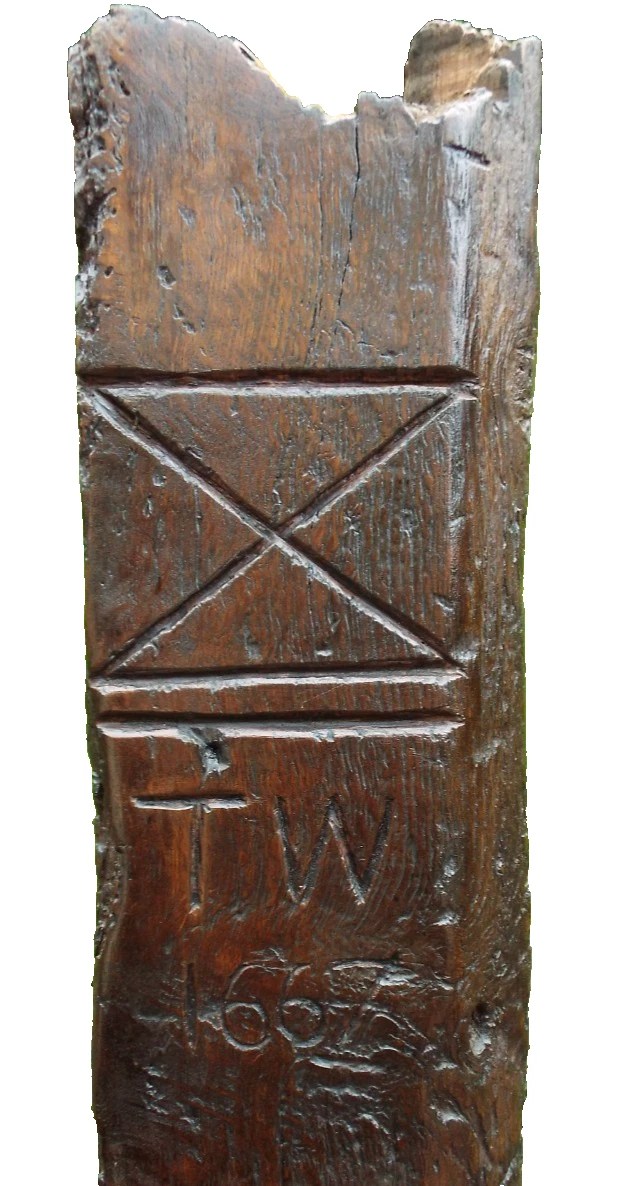
The picture of a witch post sent to me. By Stanislav Stefane


I never know who is going to contact me, nor where they come from, and so I was intrigued when I received the following message from a gentleman called Stanislav Stefane:

“Will you be publishing your father’s papers on the so-called witch posts? There is limited information available online, and I find them fascinating. I am also interested in one that is for sale, dated 1667. Is there perhaps an example with this date mentioned in your father’s papers?”

I replied to him that Dad had composed a whole book about them but sadly died before the final draft made it into print. At the moment there are no plans to publish it, but his extensive historical research is still there in his study. Dad had a very strong Catholic faith and his findings prompted him to believe that many so-called witch posts were not connected to witches at all, but were in fact related to the famous Catholic Martyr of the Moors, Father Nicholas Postgate.

I discovered that Stanislav was based in Slovenia, and asked him what sparked his interest.

“I collect carved oak antiques from the 17th and 18th centuries, mainly pieces that have a carved date and the initials of their owners. By chance, I came across a reference to the so-called ‘witch post,’ which also occasionally bears a carved date. I find the story surrounding them most fascinating. There is one currently for sale, and I thought that perhaps it might have been known to your father. I am not sure whether the post is even original, but if it had been seen by your father, there would be no doubt about its authenticity. I hope you will publish your father’s findings on them. They are probably among the most mysterious and misunderstood of British oak antiques.”

It sounds like Stanislav may have caught the ‘witch post’ bug which affected my dad in the later years of his life, and he would certainly agree with Stanislav’s use of the term ‘misunderstood’. Having started to research them, Dad became more and more fascinated, and began to believe that many of these ‘witch posts’ were not to ward off evil but to indicate ‘safe houses’ for persecuted Catholics.

Even though the full book has not been published Dad did produce an interim pamphlet in 2008, in which he explains why he became so captivated by the topic.

“I began my research more than a year ago but the subject has developed so greatly and produced so many surprises that I have still not completed my investigations…The task is almost complete and it has proved a most enjoyable and enlightening experience.”

Among his files I found a letter to an interested party in which Dad admits that he made mistakes in earlier writings due to the existing information upon which he was relying being incorrect or inaccurate, of which he was unaware at the time. He only realised this once he’d embarked on his own quest to find out more.

“My research into witch posts has revealed quite a lot of errors on my part (and on the part of earlier writers). I hope my recent efforts will rectify some of those – I relied too heavily on earlier works by authors I thought were infallible!”

As yet I have been unable to find Stanislav’s particular post in my dad’s files, but I will keep looking. It has made me think that I ought to do something about all this information that Dad put so much time and effort into researching.

On another note, Katherine Hill has been back in touch after attending a reunion of the Bean family. Katherine contacted me after reading a column where I mentioned Peep o’Day Farm near Husthwaite. She thought her grandfather, Samuel Bean, may have been born there.

A posse of Beans gathered on Sunday March 1st, including her 99-year-old aunt Sylvia, who was a Bean until she married in 1953. “It was a very enjoyable time reminiscing about our childhood at Burton Garth, Knapton.”

Thanks to the endeavours of some very helpful readers, particularly Rex North, I was able to pass on much more information about the Bean family history to her. I wish Katherine all the best with her continuing research and hope there are more Beans yet to be discovered!

Do you have opinions, memories or ideas to share with me? Get in touch with me using the ‘Contact’ button on the top right.

This column appeared in the Darlington & Stockton Times on Friday 20th  and the Ryedale Gazette and Herald on Wednesday 18th March 2026

Mark of respect for lowly corkseller

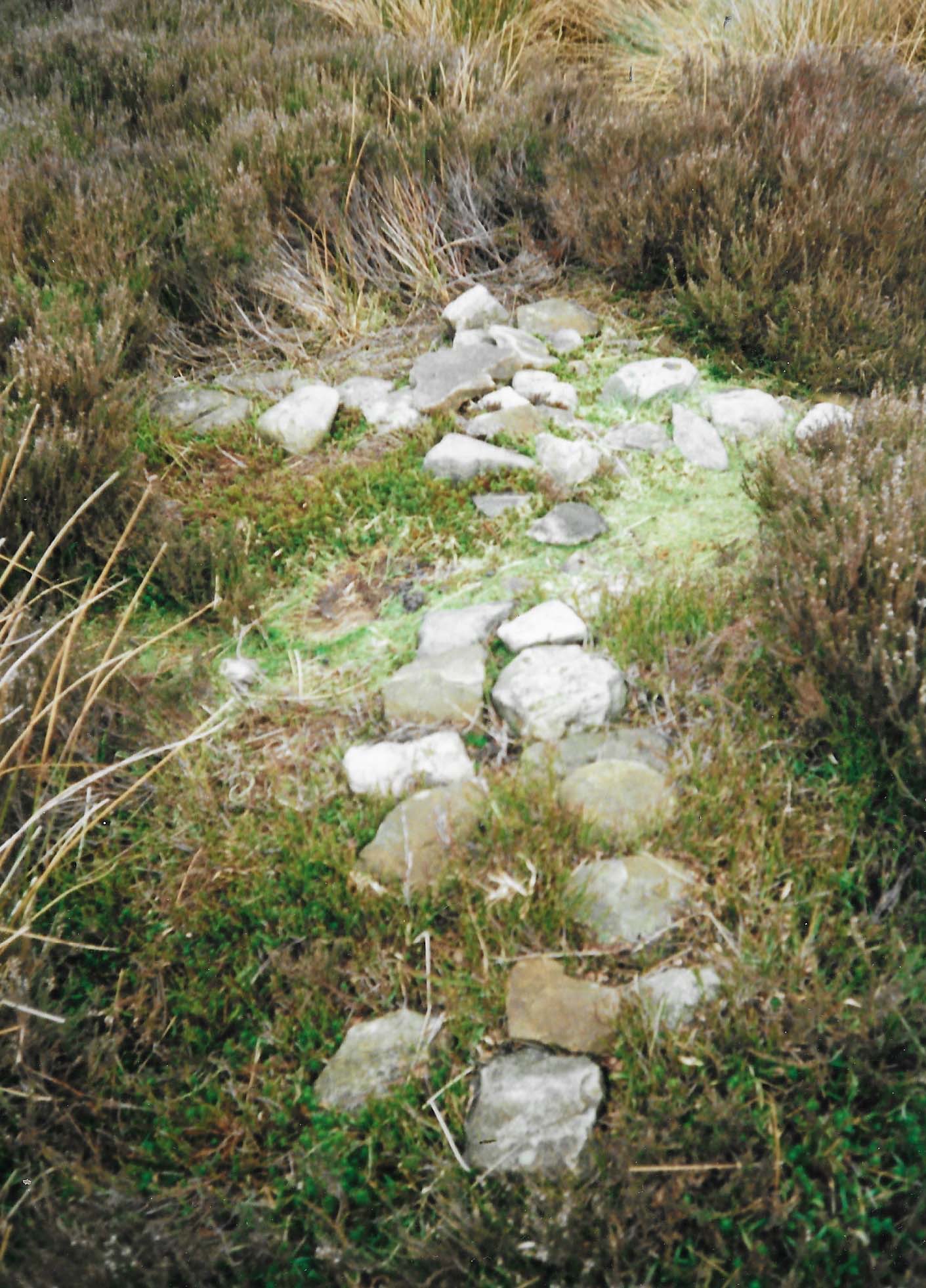
The corkseller’s grave near Bluewath Beck, high on the North York Moors , in a photo taken by reader John Severs in the 1990s.


I’m am getting some wonderful extra information coming in from you brilliant readers on topics I have covered in recent weeks.


If you recall, I’ve been writing about Hamer Inn, which was a thriving coaching stop on the North York Moors on the high road between Glaisdale and Rosedale Abbey. It had a number of previous names including the Lettered Board, and the Wayside Inn, ultimately ending up as Hamer House before it became derelict sometime in the late 1930s we believe. All that remains now are a few stones on a patch of smooth grass.


I first mentioned the inn thanks to reader David Ford, who is trying to trace a picture of it before it became derelict. Sadly we have yet to find one, but his message led me to re-read what my dad had written about it, including three stories of mysterious deaths at the inn. In the first, two apparently healthy guests retired to bed, only to be found dead the next day with no apparent cause. The second was a licensee who killed his wife, and the third involved a fight ending with a man being bludgeoned to death with a poker.


There was another sad story that occurred not inside the inn itself but nearby. A corkseller was a regular visitor, and David Ford’s ancestors, who were licensees, knew him well. One ferocious winter, he succumbed to the elements and his body was found much later not far from the Lettered Board Inn, his basket of corks lying nearby enabling him to be identified.


Reader John Severs got in touch and said: “After reading your article…I rummaged in my documents and photos to find something which may interest you. The photo that I took approximately 30 years ago shows the corkseller’s grave.”


The corkeseller’s grave? I was astounded, because I never imagined that such a thing existed, nor that it is still visible to this day. My dad did not mention it in his book and I don’t recall him talking about it to me, which might explain why I remained in ignorance.


I wonder if you agree with me, that it is quite a moving and remarkable image, showing the full length of the grave, marked out in stones in the unmistakable shape of a human body.


John also sent me a copy of an article written about the same time (1990s) about unconsecrated graves, with a focus on this particular one. The text, written by Paul Grantham, is an extract from the North Moors Association magazine and describes how well received itinerant tradespeople like the corkseller were:


‘As well as plying their trade they would bring news of the outside world, provide an extra pair of hands for heavy jobs and when necessary, act as entertainer and confidante…such was the prevailing attitude that they would generally receive, at the minimum, some sustenance and overnight shelter.’


Grantham believes our corkseller would have been active on the moors in the 18th century, trekking between isolated farms and inns peddling his wares. He would have been a familiar face and his arrival expected by local farmers and licensees.


Sadly, his threadbare clothes were not enough to protect him from one particularly savage winter, and he perished, his body being discovered some time later with his meagre belongings nearby.


At the time, no-one would have wanted to take responsibility for transporting him to the nearest church for burial because of the costs involved and so, as was perfectly legal at the time, they would have buried him where he was found.


Although this tale was passed down by word of mouth, there are no official records revealing the man’s name or anything else about him. But over the years, passers-by would realign the stone markers and someone occasionally placed a wooden cross at its head (the previous ones being ruined by the elements).


I would like to pay my respects next time I am over that way, and if you do too, you will find the grave on the road between Glaisdale and Rosedale Abbey. Stop by the small bridge over Bluewath Beck and walk for 50 yards heading east along the south bank of the stream.


I’m not sure if anyone still places a cross there, but if you know anything at all, do tell!

Do you have opinions, memories or ideas to share with me? Get in touch with me using the ‘Contact’ button on the top right.

This column appeared in the Darlington & Stockton Times on Friday 27th and the Ryedale Gazette and Herald on Wednesday 25th Feb 2026

Homing in on Hamer


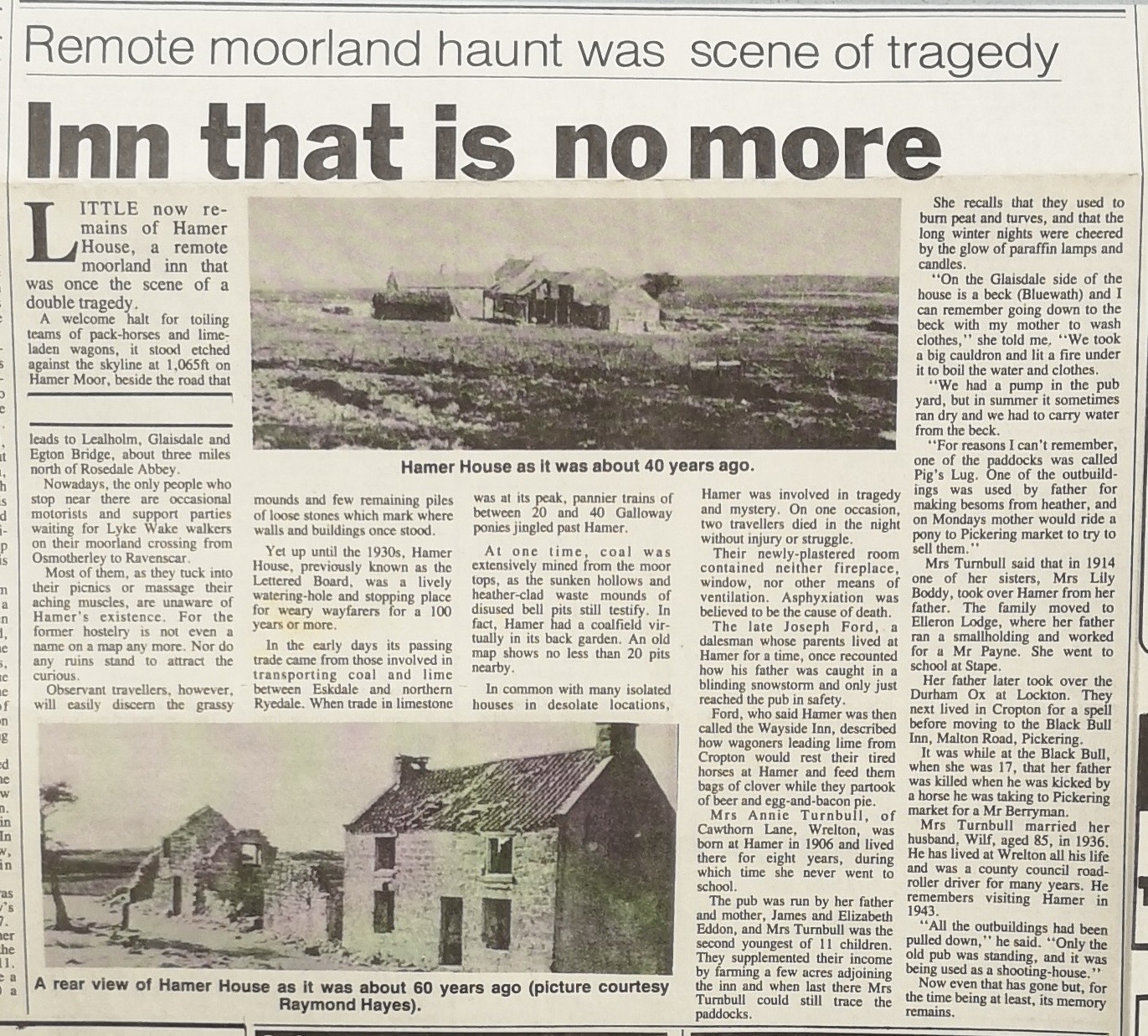
The 1989 Malton Gazette and Herald article about Hamer House sent to me by Howard Campion. Do you know who wrote it?

A couple of weeks ago I mentioned that reader Howard Campion was sending me a copy of a 1989 article that talked about Hamer Inn that once stood on the road between Glaisdale and Rosedale Abbey on the North York Moors. Also known as the Lettered Board, all that now remains is a pile of stones on an expanse of smooth grass surrounded by heather. It used to be a thriving inn providing rest and sustenance for weary travellers and workers from the coal mines operating nearby.


Howard wondered if the article had been written by my dad (there was no writer’s name attached to it) and now that I have had a chance to read it, I think not. The writing style is a little different and because my dad was not an employed ‘reporter’ as such, he rarely conducted interviews like those that are featured. Unless the writer recognises his work and gets in touch, we might never know! I have attached a picture of said article, so that you can see it for yourself. It is a fascinating piece!


The article features first-hand accounts from those who remember it before it became derelict, which is highly useful when putting together a historical record. What I found really interesting is that this inn of many names had yet another, according to writer Joseph Ford, who was born there while his father, also called Joseph, was licensee in the mid to late 1800s. Joseph Ford junior, who died in 1944, was the great great uncle of David Ford, the reader who first contacted me, setting off this whole chain of Hamer-related columns.


The article states: ‘Ford, who said Hamer was then called the Wayside Inn, described how wagoners leading lime from Cropton would rest their tired horses at Hamer and feed them bags of clover while they partook of beer and egg-and-bacon pie.’


A lady called Annie Turnbull was born at Hamer in 1906, after the Ford family had left. ‘The pub was run by her father and mother, James and Elizabeth Eddon, and Mrs Turnbull was the second youngest of 11 children. They supplemented their income by farming a few acres adjoining the inn, and when last there, Mrs Turnbull could still trace the paddocks.’


Annie remembered: “On the Glaisdale side of the house is a beck (Bluewath) and I can remember going down to the beck with my mother to wash clothes. We took a big cauldron and lit a fire under it to boil the water and clothes.


“We had a pump in the pub yard but in summer it ran dry and we had to carry water from the beck. For reasons I can’t remember, one of the paddocks was called Pig’s Lug. One of the outbuildings was used by my father for making besoms from heather, and on Mondays, Mother would ride a pony to Pickering market to try to sell them.”


Annie’s sister, Lily Boddy, took over from her father in 1914, and it remained an inn for some time thereafter. Wilf Turnbull, Annie’s husband, recalled visiting Hamer in 1943: “All the outbuildings had been pulled down. Only the old pub was still standing and it was being used as a shooting house.”


Terry Ashby has also contacted me about Hamer: “At school in the early 1960s I discovered the delights of the one-inch OS maps and having moved to the North York Moors, I bought ‘Sheet 86 Redcar & Whitby’. There was Hamer House clearly marked. I wondered what it was and I probably pestered my dad to drive there to have a look. There wasn’t much left of it even then. I found out later that it had been an inn and later still I found it mentioned in an historical novel. I can’t remember the title or the author. I find these old ruins fascinating and quite poignant as they always pose questions about who lived there and when and why they were abandoned.”


Does anyone know the novel Terry refers to? And don’t forget, David Ford is still  searching for a photo of the inn before it became derelict. Do any of you have one lurking at the back of a drawer somewhere? Maybe it’s time to have a clear out. You never know what you might find!


Do you have opinions, memories or ideas to share with me? Get in touch with me using the ‘Contact’ button on the top right.

This column appeared in the Darlington & Stockton Times on Friday 13th and the Ryedale Gazette and Herald on Wednesday 11th Feb 2026

To name but a few

Dad was very good at coming up with quirky character names in his novels

Back in 2018 I wrote a column about unusual names inspired by an archive piece I’d found by my dad from April 1978 in which he explained that he’d had a schoolfriend called Septimus thanks to the fact he was his family’s seventh son. He was unique because his father was also a seventh son, and so he was in the auspicious position of being the seventh son of a seventh son. These fortunate humans were supposed to have been blessed with supernatural powers, but Dad observed that his friend, whom everyone called Sep, displayed no discernible mystical talents.

Dad was good at coming up with quirky names for the characters in his novels. His best-known was the loveable rogue Claude Jeremiah Greengrass who appeared in many of his Constable books that inspired the TV series Heartbeat. According to Dad, that was a genuine name he had come across as a young bobby and he stored it away in his memory bank until it resurfaced many years later on the pages of the first ‘Heartbeat’ novel (Constable on the Hill, published in 1979). Other fun names he conjured up included Detective Inspector Montague Pluke, Detective Sergeant James Aloyisius Carnaby-King, Sergeant Oscar Blaketon and Constable Alf ‘Volcano’ Ventress.

Brian Reader got in touch via my Countryman’s Daughter web page and informed me: “Two of my grandfather Rocious’s sisters were named Fera and Ellengor! So far I haven’t found the origins.”

I’ve never heard of Rocious, Fera or Ellengor. The only reference I came up with for ‘Rocious’ was in a dictionary of slang where it means ‘amazing’ or ‘cool and trendy’. I wonder if his parents had those traits in mind when naming him? The nearest known name I got to was the Spanish ‘Rocio’, a gender neutral name meaning ‘dew’. The Spanish have used it to refer to the Virgin Mary – ‘La Virgen del Rocio’ (Mary of the Dew).

The next nearest I could get to was ‘Roscius’ which online dictionaries say was a noun first used in Englsih in 1607 to mean ‘actor’. It links back to a famous Roman thespian called Quintus Roscius Gallus, whose reputation in the theatre was legendary, and thus the word ‘Roscian’ became commonplace in the 1600s to refer to someone who had delivered a particularly fine stage performance.

I found a bit more on the name Fera. It is a feminine name derived from the Latin ‘ferus’ which means ‘wild’ or ‘untamed’, and today the Italian word ‘fiero’ means ‘fierce’ or ‘fiery’. ‘Fiera’ as an adjective means ‘proud’ and as a noun means ‘a fete’ or ‘a fair’. In the Calabrian dialect of Italy ‘Fera’ means ‘dolphin’. Fera is also used in Arabic regions and means ‘brave’. It is close to the Irish ‘Feara’ too, which means ‘truth’. I wonder if Brian’s great aunt Fera possessed any of these characteristics?

As for Ellengor, I can find very little in terms of its history as a name or its etymology as a word in any language, never mind English. To me, the name sounds like a character from Arthurian legend, or a queen from Viking mythology. I have found a few mentions of women called ‘Ellengor’, most of whom came from the Northallerton area and one of which might well be Brian’s great aunt. We have Ellengor Barker (1862-1955), Ellengor Bramley (1871-1965), and Ellengor Barker Rollins (1889-1977) all from Northallerton and who might well be related. My guess is that Ellengor Barker Rollins is the daughter of Ellengor Barker.

There are also a couple more: Ellengor Kimberley (b.Boynton) who was born in either 1889, 1899, or 1900 and died in 1961, and her daughter Ellengor Collins (1922-2015). Both of these women came from the Bedale area. I wonder if all the Ellengors are related and named after one original family matriarch?

I’d love to know if any of you have interesting names or do you have a relative who has or had a quirky name? Get in touch with me using the methods below.

(Thanks to Brian inspiring this week’s column, and I hope readers will forgive this public personal message, but it’s the only way I will know that he will see it! Brian just to let you know that I replied to you by email, but have a feeling they may have ended up in your junk folder!).

Do you have opinions, memories or ideas to share with me? Get in touch with me using the ‘Contact’ button on the top right.

This column appeared in the Darlington & Stockton Times on Friday 19th and the Ryedale Gazette and Herald on Wednesday 17th Sept 2025

You can lead a horse to water

A drawing of Sir Ralph Payne-Gallwey from Vanity Fair magazine in 1893. Sir Ralph of Thirkleby Hall, paid for a roadside water trough in the village (Photo: Leslie Ward, public domain via Wikimedia Commons)


A few weeks ago I wrote about how my best friend and I celebrate the longevity of our relationship by having an annual weekend away together.


Gurli Svith from Denmark wrote: “Your column on friendship touched me very much because I have a very good friend I have known since I was 14 and she was 12. She was going to start at my school and came to my home to ask if we could cycle together. That was the beginning and now being 76 and 74 we are still close friends. We do not meet very often but when we do it is as if we saw each other just yesterday. We can talk about everything, and we have helped each other through hard times. For many, many years we have given each other birthday presents, but sometimes we have not seen each other for two or three years so it is like Christmas when we are sitting there drinking tea, eating cakes and unwrapping our presents.”


Is it true that many people are closer to their best friends than their own family? The saying goes, you can choose your friends but you can’t choose your family, so if you could opt out of spending Christmas and Easter with relatives, would you? (I acknowledge that I might be opening a can of worms with that question!)


Let’s get back on safer ground with troughs. Regular reader Clare Powell says: “We do have a couple of stone troughs we bought in a farm sale in Rosedale in the 1980s (Paid more than we should have because my husband kept bidding against himself – much to the locals’ amusement!). We transported them in the back of a Volvo. No idea how old they are, so it was interesting to read your article. Like you, I never really thought about who made them, and how. And you’re right, your dad would have had the answer at his fingertips.”


He sure did, and I now have the space to tell you what I discovered inside his old file. There were a few cuttings, columns, and notes, one of which was in Dad’s handwriting dated 15th May 1993. He had written it during a phone call from a chap called Dick Thompson who lived in our village and whose family had made locally quarried stone troughs for years.


“Each trough was excavated with a pickaxe and drawn down to the road on a sledge,” he’d scribbled. “It took seven or eight days to make one trough – all sizes done. Circular pig troughs also made so pigs could eat together.” He added that the troughs were made on spec, bought mainly by farmers, although parish councils paid for communal troughs situated in villages.


Among other things, the file also contained a newspaper cutting from March 1973 written by the esteemed founder of the original Countryman’s Diary column, Major Jack Fairfax-Blakeborough.


“The wayside water troughs were a real blessing both to parched travellers and to horses,” he wrote, “Especially in the heat of the summer when roads sent up a cloud of dust. Many of the troughs were erected by landowners who knew their value to man and beast. Some of them have inscriptions which tell us of their donor and his consideration for horseflesh.”


He mentions one between Burnsall and Appletreewick in the Dales which has a Latin verse ‘De torrential in via bibet propteren exaltabit caput’ which translated means ‘He will drink at the spring on the way, and thereafter lift his head with joy’, which is the last line of Psalm 110 in the Old Testament. The Major (and my dad when he wrote about it 20 years later) could not shed any light on who had placed the trough there. Can any of our Dales contingent add any more detail about this particular trough?


Dad mentions another placed at Thirkleby near Thirsk, paid for by Sir Ralph Payne-Gallwey (1848-1916), 3rd Baronet of Thirkleby Hall, who was an accomplished engineer, historian and artist. Its inscription, with a bit of poetic license where the rhyme is concerned, reads: ‘Weary traveller bless Sir Ralph, who set for thee this welcome trough.’


I have a feeling we have a lot more to come on these once indispensable features of our countryside highways and byways.


Do you have opinions, memories or ideas to share with me? Get in touch with me using the ‘Contact’ button on the top right.

This column appeared in the Darlington & Stockton Times on Friday 2nd and the Ryedale Gazette and Herald on Wednesday 30th April 2025

Getting it in the neck

Dad wrote more than 2000 Countryman’s Diary columns over 41 years

Will either of these help my cough symptoms?

Would you believe this is my 400th column since I took over from my dad in 2017? I’m pleased that I have made it this far without missing one, despite deaths, illnesses and pandemics trying to throw me off my stride.

Dad was committed to his column-writing duties and made sure he submitted them well before the deadline. Of course, my seven and a bit years pale into insignificance compared to his 41 years of service, which means he compiled more than 2000 of them. If ever I achieve that milestone, I will be 91 years of age, which is quite a thought!

Even then though, I’ll be some way off the record of the man who started this column in the first place, Major Jack Fairfax-Blakeborough. His first ‘Countryman’s Diary’ appeared in the Darlington and Stockton Times in 1922, and his last one at the very end of 1975 when he was aged 93. He died on New Year’s Day 1976, and my dad’s first column (a tribute) appeared on 10th January. That means the Major contributed more than 2750 columns, quite a feat. I’d be interested to know if anyone in this country has (or had) written a weekly column for longer.

We columnists are so attached to our little corners of glory that we are loathe to let anyone else step in, even when we are sick. As I mentioned last week, I was rather below par, and am thankfully much better now, although the nagging cough is hanging on. Everyone I speak to seems to have had it and offer the cheery warning that it will ‘go on for weeks’. I really hope not, and if you’ve been afflicted, then I hope you are not suffering too badly.

The fact it is persisting, even though I can function normally, means that I have ditched the Lemsip. I do not like to take medication for too long if I can help it, but the rattly chest is rather annoying so I have investigated some traditional ‘at home’ remedies that are supposed to help.

I have found plenty, although I am not sure I am going to give all of them a go. I am most tempted to try the first one – drinking hot chocolate. Dark chocolate with a minimum 70% cocoa content contains a good dose of theobromine which is a stimulant similar to caffeine. Recent research suggests it is better at suppressing an annoying cough than codeine, and if you melt it and turn it into hot chocolate by pouring into hot milk, the milk will also help you sleep. But I am a little confused. Does the milk override the stimulating effect of the theobromine? Or is it the other way round? I have yet to find out!

Another tip for a persistent cough is to eat mashed turnip. Not only is the vegetable packed full of vitamins (C, A and B) but it acts as an expectorant, that is, it loosens the mucus that causes you to cough. Spicy foods and curries are also believed to do the same thing, so perhaps if I add chilli powder to my mashed turnip I’ll be on to a winner.

There are some remedies that are more suited to survival experts like Bear Grylls than soft old columnists like me. According to Lady Eveline Camilla Gurdon in a self-help manual published in 1893 by the Folk Lore Society, you must place a large, live, flat fish on your bare chest and keep it there until it dies. It is supposed to help with congestion in the chest and ease coughing. She also advises eating roasted mouse or drinking milk that has already been ‘lapped by a ferret’.

If you are suffering from a sore throat and fever, then you can try basting your throat with lard or chicken fat before wrapping your neck with dirty socks. This is similar to the wartime advice of wrapping your neck with a rope dipped in tar. The fumes from the stinky socks & the toxic tar are supposed to help clear the lungs and a blocked nose. I suppose if you die from inhaling poisonous fumes then you won’t be so bothered about your fever, will you.

I don’t know about you but I will stick to eucalyptus oil soaked into a tissue, thank you!

Do you have any interesting home remedies?

Do you have opinions, memories or ideas to share with me? Get in touch with me via the ‘Contact’ tab at the top right of this page.

This column appeared in the Darlington & Stockton Times on Friday 31st Jan and the Ryedale Gazette and Herald on Wednesday 29th Jan 2025

A past to be Pict apart

20231229_100121
The now disused St Hilary’s Church in Picton near Yarm.

This  Saturday (13th January) was St Hilary’s Day and it is said to be the coldest day of the year. Its chilly reputation came about after a severe frost in 1205 which started on 13th January and lasted until 22nd March.  

Reader Jim Ackrill from Picton near Yarm got in touch with a lovely message connected to St Hilary. He said: “I was doing some research into my local parish church (now closed and sold) and came across an article by someone you may know! A certain Nicholas Rhea published the article in the Darlington and Stockton Times on the 13th of January 2012. It interested me as our local church was dedicated to St. Hilary when it was built in 1911.”

My dad’s article explained that St Hilary was born in 315 in Poitiers, a town in France known for its architecture and hill-top setting. Hilary followed the beliefs of his prominent pagan parents until the age of 35 when he became a Catholic priest and pledged to lead a life of abstinence, despite the fact he was already married with a daughter. He was elected Bishop of Poitiers in 353, and travelled extensively visiting the Middle East, Greece, and Italy.

He was known for being outspoken, and his writings upset Emperor Constantine II, leading to him being banished to Phrygia (now in modern central Turkey) and then back to Poitiers. St Augustine refers to him as an illustrious doctor and, as a progressive thinker, was said to be keen to educate children with learning difficulties. St Hilary died in Poitiers on or around 13th January 368 and is known as St Hilary of Poitiers, Pope Pius IX having named him Doctor of the Church in 1851.

Jim Ackrill wonders more about the connection of St Hilary to his home village: “Now this is the interesting information which I discovered. Poitiers is in western France and was founded by the Celtic Pictones tribe (also known as Pictavi or Picts) and which, after Roman influence, became known as Pictavium. As Christianity was officialised across the Roman Empire during the 3rd and 4th centuries, the first Bishop of Poitiers from 350-367 was St. Hilarius (Hilary). The connection between Picton and the Pictones cannot be a coincidence. I believe some well-read cleric connected the two and suggested St Hilary for the church at Picton.”

It is possible that Jim’s theory about how St Hilary’s in Picton came by its name is correct. It was closed to worship in 2004, and hence St Martin’s Church in neighbouring Kirklevington was rededicated to St Martin and St Hilary in 2011, the centenary of the original St Hilary’s Church. The village name has evolved from Pyketon to Pykton, then Pickton to Picton, and has been said to mean ‘peak town’ which would fit in very well with its hilltop location and as such, echoes its French counterpart.

However, there is a possibility that ‘peak town’ is wrong, if an historical link with Poitiers can be established. Could Picton actually come from ‘Picts town’? As Jim says, Poitiers was called ‘Pictavium’ during St Hilary’s lifetime and is believed to mean ‘painted people’, referencing the Gallic Picts’ habit of painting or tattooing their skin.

It could of course just be a remarkable coincidence that Picton and the Pictones have similar names as well as a link to St Hilary. During the reign of Edward 1st (1272 – 1307), the family that owned the village took the name Picton to symbolise their ownership of it and the surrounding land. It is interesting to note that as a youth, King Edward I was heavily influenced by his relatives from the Poitou region of France (known as Pictavia) of which Poitiers was the capital.

It is also worth mentioning the Scottish Picts, a tribe with a ferocious reputation from the far north and east. Like their Gallic cousins they were named by the invading Romans, thanks to their habit of painting their skin to make them seem more ferocious in battle. Although they have links to the French, I think it is unlikely they have any connection to the village of Picton.

There must be a lot more to be discussed in this story, but it will need someone with a bigger and more knowledgeable brain than mine to get to the bottom of it.

Contact me via my webpage at countrymansdaughter.com, or email gazette@gazetteherald.co.uk or dst@nne.co.uk. 

This column appeared in the Darlington & Stockton Times on Friday 12th and the Ryedale Gazette and Herald on Wednesday 10th Jan 2024.