Slave to history


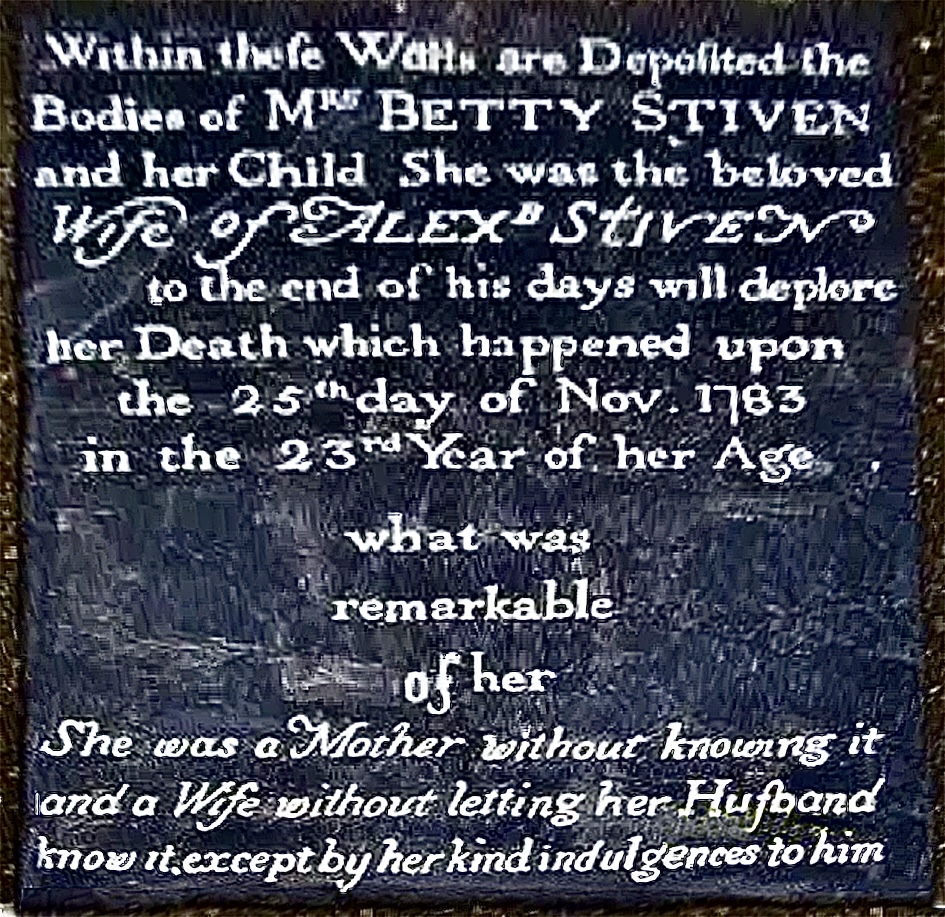
The baffling inscription on Betty Stiven’s grave on the island of Tobago in the Caribbean, spotted by reader Peter Sotheran. Do you know what the last sentence means?

Another family connected to Hamer Inn has been in touch with me following previous columns about Joseph Ford and his descendants, who include readers and cousins, David and Ian Ford.

In one of my columns I mentioned the Eddon family. James and Elizabeth Eddon took over running the inn from the Ford family, and Annie Eddon, later Turnbull, was born at Hamer in 1906. Annie was the second youngest of 11 children.

I previously mentioned a column written in the 1990s in which Annie remembered: “On the Glaisdale side of the house is a beck (Bluewath) and I can remember going down to the beck with my mother to wash clothes. We took a big cauldron and lit a fire under it to boil the water and clothes.

“We had a pump in the pub yard but in summer it ran dry and we had to carry water from the beck…One of the outbuildings was used by my father for making besoms from heather, and on Mondays, Mother would ride a pony to Pickering market to try to sell them.”

It was Annie’s sister, Lily Boddy, who took over from her father in 1914, and you might recall a fabulous photo I shared a few weeks ago showing Lily next to the well with (I presume) her mum Elizabeth Eddon bending over it, bottom in the air!

Following that, I have been contacted by Susan Ellis who wrote: “Further to your piece…my mum has asked me to contact you. My mum is Pauline Elizabeth Ellis (nee Turnbull) one of 6 children, all still alive, and who originate from Wrelton.

“My mum’s grandma and grandad are James and Elizabeth Eddon. One of their daughters, Annie, is my mum’s mum and Annie had some time growing up at Hamer House.

“We would be very interested in any photos you might let us look at, along with any more information.”

I replied to Susan, and sent her some articles and links to the columns about Hamer where I featured photos of the property before it became derelict (which you can find on www.countrymansdaughter.com). Type ‘Hamer’ in the search box and they should come up.

A few days later, Susan wrote to me again: “Thank you Sarah. I’ve just been reading everything out to Mam. It is all fascinating isn’t it? What hardy folk they all were! Mam and I will have a chat and see if any stories surface that can be shared.”

Now to a different, yet equally interesting, query which another reader has brought to my attention, and upon which I am hoping you might be able to shed some light.

Peter Sotheran got in touch because in the past I have written columns discussing the historical resting places of various people. I’ll let Peter explain:

“Many thanks for your columns – always unearthing something fascinating! A while ago, I think you wrote about various gravestones and that stirred in me a memory of a mysterious gravestone that I discovered whilst on holiday on the Caribbean island of Tobago.

“Plymouth on the north-west coast of Tobago is a small coastal community with a population approaching 10,000 residents. English settlers arrived there 400 years ago, hence the prevalence of British place names; Scarborough, Roxborough and Speyside are principal towns on the island.

“One of the island’s greatest curiosities is the inscription on the grave of a local lady, Betty Stiven. After recording the date of her death, the gravestone carries the following message:

‘She was a mother without knowing it and a wife without letting her husband know it, except by her kind indulgences to him.‘

“I wondered if your ever-erudite readers can suggest an explanation?”

I read the inscription (which you can see above) and came up with the conclusion that because her child is interred with her, she died in childbirth, in which case, she would not have experienced motherhood at the age of 23.

I find the last part of the sentence is quite baffling. Perhaps she died soon after getting married? Or was she the unmarried mistress to a plantation slave master? The inscription is quite loving, though, so perhaps it was a genuine marriage? Peter thinks the size and style of her gravestone suggests she was more likely part of the white elite rather than the poorer indigenous community, but is not certain.

I’d love to hear what you think!

This column appeared in the Ryedale Gazette and Herald on 15th and the Darlington and Stockton Times on 17th April 2026

Straight from the horse’s tail

Kath Brammah was fit as a fiddle until she broke her hip playing padel tennis

In my New Year column I featured a number of funny quotes from famous people about diet and exercise, and ended with the following anonymous philosophical quip:

“Eat Right. Exercise. Die Anyway.”

Clare Proctor got in touch to say: “That last quote sums it up for me. An old lady once said to me that her doctor kept telling her to do all sorts of things to help her live to 100, to which she said, ‘Why? My friends are already dying, my family have pretty much gone, so why do I want to live to 100, alone and dribbling in a care home?’ She may have a point…although, the older you get, the younger 100 looks!”

Lucien Smith added: “My mum lived to 94 and by then she had outlived almost all her friends of her own age. She still had lots of younger friends, but it’s not quite the same…That generation see their friends either passing away or confined to a care home. It can’t be easy!”

I’m sure we’d all love to live longer IF we could guarantee not to have to deal with the kinds of physical and mental ailments that we witness our parents’ and grandparents’ generations suffer, but sadly, the older I get, the more I realise that those who do manage to remain spritely are the exceptions rather than the rule.

One such person is my friend’s mum Kath. Until a week ago, 77-year-old Kath was as fit as a fiddle. Sadly, she took a tumble and broke her hip. The thing is, when she took that tumble she was racing like a teenager around a padel tennis court. When the hospital doctor asked how much physical activity she did, she replied that she played tennis and padel twice – sometimes even three times – a day! She also fit golf and countryside walks into her weekly calendar,

I don’t know many 47-year-olds who can manage that level of activity without physical repercussions, let alone 77-year-olds. But as I mentioned, people like Kath are the exception. Thankfully, she is back home and recovering.

I try to keep fit and, like Kath, love playing padel. You may have noticed courts springing up all over, and it seems the nation has become hooked on it. It’s highly addictive, but I am one of the many of a certain age who have been thwarted by their body letting them down.

Just before Christmas my right foot suddenly stopped working normally. I couldn’t lift it upwards, couldn’t wiggle my toes and was getting tingling sensations down that leg.

I was diagnosed with foot drop, something new to me. At first the GP thought it was a compression of the common peroneal nerve which runs off the sciatic nerve, down your leg and wraps around the calf bone. It controls the muscles that operate the ankle, foot and toes.

When I am injured, I turn to my amazing chiropractor to set me right and get me back on court (I’ve lost count how many times I’ve needed his services!). A chiropractor specialises in treating musculoskeletal issues like neck and back pain, and understands the relationship between the nervous system and your bones and muscles. I happened to mention that the tingling sensations had started to appear on the other side of my body too and, alarmingly, he sent me straight to A&E.

There’s a condition called Cauda Equina Syndrome. The cauda equina is a collection of nerves at the base of the spine that fan out like a horse tail, which is what ‘cauda equina’ means in Latin. In rare cases these nerves can become compressed, for example by a slipped disc. It is an emergency situation, and if you arrive in A&E with these symptoms, you will need an immediate MRI scan followed by treatment.

To my utter relief, my scan showed that the compression was further up my spine affecting the a sciatic nerve, and therefore not an emergency. Although I can’t play the sports I love at the moment, the outlook is positive for recovery, as long as I do certain exercises and wear an ankle brace to help with my floppy old foot.

I shall let you if I make it back to the padel court!

This column appeared in the Ryedale Gazette and Herald on 28th and the Darlington and Stockton Times on 30th January 2026

Keeping up with the post


The picture of a witch post sent to me. By Stanislav Stefane


I never know who is going to contact me, nor where they come from, and so I was intrigued when I received the following message from a gentleman called Stanislav Stefane:

“Will you be publishing your father’s papers on the so-called witch posts? There is limited information available online, and I find them fascinating. I am also interested in one that is for sale, dated 1667. Is there perhaps an example with this date mentioned in your father’s papers?”

I replied to him that Dad had composed a whole book about them but sadly died before the final draft made it into print. At the moment there are no plans to publish it, but his extensive historical research is still there in his study. Dad had a very strong Catholic faith and his findings prompted him to believe that many so-called witch posts were not connected to witches at all, but were in fact related to the famous Catholic Martyr of the Moors, Father Nicholas Postgate.

I discovered that Stanislav was based in Slovenia, and asked him what sparked his interest.

“I collect carved oak antiques from the 17th and 18th centuries, mainly pieces that have a carved date and the initials of their owners. By chance, I came across a reference to the so-called ‘witch post,’ which also occasionally bears a carved date. I find the story surrounding them most fascinating. There is one currently for sale, and I thought that perhaps it might have been known to your father. I am not sure whether the post is even original, but if it had been seen by your father, there would be no doubt about its authenticity. I hope you will publish your father’s findings on them. They are probably among the most mysterious and misunderstood of British oak antiques.”

It sounds like Stanislav may have caught the ‘witch post’ bug which affected my dad in the later years of his life, and he would certainly agree with Stanislav’s use of the term ‘misunderstood’. Having started to research them, Dad became more and more fascinated, and began to believe that many of these ‘witch posts’ were not to ward off evil but to indicate ‘safe houses’ for persecuted Catholics.

Even though the full book has not been published Dad did produce an interim pamphlet in 2008, in which he explains why he became so captivated by the topic.

“I began my research more than a year ago but the subject has developed so greatly and produced so many surprises that I have still not completed my investigations…The task is almost complete and it has proved a most enjoyable and enlightening experience.”

Among his files I found a letter to an interested party in which Dad admits that he made mistakes in earlier writings due to the existing information upon which he was relying being incorrect or inaccurate, of which he was unaware at the time. He only realised this once he’d embarked on his own quest to find out more.

“My research into witch posts has revealed quite a lot of errors on my part (and on the part of earlier writers). I hope my recent efforts will rectify some of those – I relied too heavily on earlier works by authors I thought were infallible!”

As yet I have been unable to find Stanislav’s particular post in my dad’s files, but I will keep looking. It has made me think that I ought to do something about all this information that Dad put so much time and effort into researching.

On another note, Katherine Hill has been back in touch after attending a reunion of the Bean family. Katherine contacted me after reading a column where I mentioned Peep o’Day Farm near Husthwaite. She thought her grandfather, Samuel Bean, may have been born there.

A posse of Beans gathered on Sunday March 1st, including her 99-year-old aunt Sylvia, who was a Bean until she married in 1953. “It was a very enjoyable time reminiscing about our childhood at Burton Garth, Knapton.”

Thanks to the endeavours of some very helpful readers, particularly Rex North, I was able to pass on much more information about the Bean family history to her. I wish Katherine all the best with her continuing research and hope there are more Beans yet to be discovered!

Do you have opinions, memories or ideas to share with me? Get in touch with me using the ‘Contact’ button on the top right.

This column appeared in the Darlington & Stockton Times on Friday 20th  and the Ryedale Gazette and Herald on Wednesday 18th March 2026

Homing in on Hamer


The 1989 Malton Gazette and Herald article about Hamer House sent to me by Howard Campion. Do you know who wrote it?

A couple of weeks ago I mentioned that reader Howard Campion was sending me a copy of a 1989 article that talked about Hamer Inn that once stood on the road between Glaisdale and Rosedale Abbey on the North York Moors. Also known as the Lettered Board, all that now remains is a pile of stones on an expanse of smooth grass surrounded by heather. It used to be a thriving inn providing rest and sustenance for weary travellers and workers from the coal mines operating nearby.


Howard wondered if the article had been written by my dad (there was no writer’s name attached to it) and now that I have had a chance to read it, I think not. The writing style is a little different and because my dad was not an employed ‘reporter’ as such, he rarely conducted interviews like those that are featured. Unless the writer recognises his work and gets in touch, we might never know! I have attached a picture of said article, so that you can see it for yourself. It is a fascinating piece!


The article features first-hand accounts from those who remember it before it became derelict, which is highly useful when putting together a historical record. What I found really interesting is that this inn of many names had yet another, according to writer Joseph Ford, who was born there while his father, also called Joseph, was licensee in the mid to late 1800s. Joseph Ford junior, who died in 1944, was the great great uncle of David Ford, the reader who first contacted me, setting off this whole chain of Hamer-related columns.


The article states: ‘Ford, who said Hamer was then called the Wayside Inn, described how wagoners leading lime from Cropton would rest their tired horses at Hamer and feed them bags of clover while they partook of beer and egg-and-bacon pie.’


A lady called Annie Turnbull was born at Hamer in 1906, after the Ford family had left. ‘The pub was run by her father and mother, James and Elizabeth Eddon, and Mrs Turnbull was the second youngest of 11 children. They supplemented their income by farming a few acres adjoining the inn, and when last there, Mrs Turnbull could still trace the paddocks.’


Annie remembered: “On the Glaisdale side of the house is a beck (Bluewath) and I can remember going down to the beck with my mother to wash clothes. We took a big cauldron and lit a fire under it to boil the water and clothes.


“We had a pump in the pub yard but in summer it ran dry and we had to carry water from the beck. For reasons I can’t remember, one of the paddocks was called Pig’s Lug. One of the outbuildings was used by my father for making besoms from heather, and on Mondays, Mother would ride a pony to Pickering market to try to sell them.”


Annie’s sister, Lily Boddy, took over from her father in 1914, and it remained an inn for some time thereafter. Wilf Turnbull, Annie’s husband, recalled visiting Hamer in 1943: “All the outbuildings had been pulled down. Only the old pub was still standing and it was being used as a shooting house.”


Terry Ashby has also contacted me about Hamer: “At school in the early 1960s I discovered the delights of the one-inch OS maps and having moved to the North York Moors, I bought ‘Sheet 86 Redcar & Whitby’. There was Hamer House clearly marked. I wondered what it was and I probably pestered my dad to drive there to have a look. There wasn’t much left of it even then. I found out later that it had been an inn and later still I found it mentioned in an historical novel. I can’t remember the title or the author. I find these old ruins fascinating and quite poignant as they always pose questions about who lived there and when and why they were abandoned.”


Does anyone know the novel Terry refers to? And don’t forget, David Ford is still  searching for a photo of the inn before it became derelict. Do any of you have one lurking at the back of a drawer somewhere? Maybe it’s time to have a clear out. You never know what you might find!


Do you have opinions, memories or ideas to share with me? Get in touch with me using the ‘Contact’ button on the top right.

This column appeared in the Darlington & Stockton Times on Friday 13th and the Ryedale Gazette and Herald on Wednesday 11th Feb 2026

That ol’ chestnut

My son Jasper in an old photo that reappeared on Facebook recently. I have since discovered that disposing of house spiders outisde might not be the most humane thing to do after all!

I’ve had a couple of interesting spider-related experiences this week. The first was in a lofty old house which had vaulted ceilings, beautiful mature oak beams and hanging chandeliers.

The owner was apologising because she had noticed the amount of cobwebs dotted around the high beams and light fittings. She explained that the webs had quickly reappeared thanks to fact she had removed the bowls of chestnuts she usually kept around the house to deter spiders from setting up home.

“Are you sure it works?” I asked. She nodded emphatically and said the cobwebs had been absent while the chestnuts were in situ yet materialised very quickly after they’d gone. She believed the nuts emitted a pungent smell that was repugnant to our arachnid housemates.

I became very excited at the prospect of reducing my household dusting burden by the mere introduction of a few nuts, and checked whether she meant plain chestnuts or horse chestnuts. She used the plain chestnut and I vowed to find out more.

What I discovered was that whole, fresh chestnuts are surprisingly difficult to get from your local supermarket after Christmas. Thankfully, they are available online and I’m sure you could pick some up at a wholefood shop too.

The recommendation to use chestnuts to deter spiders has been around for a long time. The following was published in Nature magazine in May 1874: “Can any of your readers establish the truth of the following assertion? Spiders’ webs are never found upon beams from the Spanish or sweet chestnut tree, even when the timber is several centuries old. The keeper of the ruins of Beaulieu Abbey, in Hampshire, asserts that this is a fact, and the buildings of the Abbey, where beams of Spanish chestnut are used, are free from the invasion of spiders. His attention was drawn to this four years ago, and since then his observations have not thrown any doubt upon its accuracy.”

I could not find the answer to the writer’s question, but I have found several sources that say the claim has never been scientifically proven and is just an old wive’s tale. Some Cornish schoolchildren did their own experiment a few years ago with spiders and conkers which, along with walnuts, are also said to posses spider-repelling properties. However, the critters trotted merrily over the conkers, none the worse for being in contact with the noxious nuts. I will put some chestnuts around my house and see what happens. I’d love to know if you have tried it – or anything else – to keep your home spider and cobweb free.

The second spider-related incident came when I opened up Facebook and at the top of my feed was a picture of my son holding up his mobile phone upon which sat a huge eight-legged monster. It was a photo I had posted 18 months ago after having an unsettling encounter with the beastie. For some reason, a friend had recently commented on it which set off a whole new chain of reactions and comments from friends, some of whom hadn’t realised it was an old post, and that they had already commented when it originally appeared in 2024!

Despite the fact it was old news, it was fun to revisit it and read all the comments of horror, with some people suggesting that an arachnid of such proportions must have hitched a ride from a distant land. Our native house spider can grow surprisingly large and yet is harmless, while being really good at keeping down the population of other annoying pests like flies and mosquitoes.

During my research, I read something that made me quite distraught. We do not kill spiders at home, but capture them and deposit them outside on the assumption that it is the most humane way to deal with them. 

Apparently not. According to what I have read, house spiders cannot live outside for very long, so unless they are able to find somewhere warm and sheltered where they can spin a web to catch food, they will die.

If there is a spider scuttling about my bedroom, I will never be able to sleep, and yet, if I chuck it outside like I have been doing, I might be sentencing it to a lingering death.

So what the heck am I supposed to do now?

Do you have opinions, memories or ideas to share with me? Get in touch with me using the ‘Contact’ button on the top right.

This column appeared in the Darlington & Stockton Times on Friday 23rd and the Ryedale Gazette and Herald on Wednesday 21st Jan 2026

A festive labour of love

For myself and others the marathon task of preparing Christmas dinner is an expression of love for those about to eat it


I’ve had some interesting feedback following my highly controversial column suggesting Yorkshire puddings belonged on the Christmas dinner table, while cauliflower cheese did not.

Reader Mary Raynar says she always makes everything from scratch for Christmas lunch, and adds, startlingly: “And yes to both Yorkshire puddings and cauliflower cheese! It’s a real labour of love and I always joke that next year it’ll be beans on toast, but of course it never is!”

I will forgive Mary’s lapse in judgement on the cauliflower cheese, because, like her, all the hassle and work that I put into that one lunch is my expression of love for those about to eat it. The lengthy preparation is an essential seasonal ritual, capped off by the other ritual of photographing the banquet laid out in all its glory on the festive table.

Yorkshire-born Lynn Catena lives in North America and says: “We didn’t eat Yorkshire puds this Christmas (I wasn’t cooking), but they’re usually on the table. We prefer prime beef rib over turkey because we often celebrate Canadian (October) and US (November) Thanksgiving holidays with turkey.” Lynn didn’t completely miss out on her beloved Yorkshires though: “I did make a few, days before, with beef stew.”

I can understand how Lynn would be all turkey’d out by Christmas after the double Thanksgiving, and some would argue that there are far tastier meats to grace the table than the traditional big bird, which can be quite dry and tasteless, depending on how it is cooked (or who is cooking it!).

Judith Barber is not a fan of roast dinners generally and says: “As someone who hates gravy, I like cauliflower cheese with Christmas dinner. Yorkshire puddings we rarely eat, and I have no preference to their presence at Christmas.”

She adds: “But KFC, I would never, ever eat because of the way their chickens are treated – as a mass commodity – which is why local farmers are so important. And fresh, not fast, food.”

Judith is right about the importance of local farmers and fresh food, and is referring to the Japanese custom of eating Kentucky Fried Chicken (KFC) on Christmas Day, which I also discussed in my column.

The popularity of KFC at Christmas boomed in Japan in the 1970s after branch manager Takeshi Okawara overheard some foreign customers declaring they missed turkey so were ordering a bucket of chicken for Christmas instead. In the blink of an eye Colonel Sanders was dressed in a Santa suit and adverts were being rolled out showing families gathered around a festive bucket of the crispy delicacy. ‘Kentucky at Christmas’ was an instant hit, and 50 years later, four million customers across Japan queue around the block to pick up their Christmas party barrels.

According to KFC’s UK website, the company will only work with suppliers committed to good animal husbandry and welfare standards. They also say they support the global ‘Five Freedoms of Animal Welfare’ which are as follows: 

1. Freedom from hunger or thirst by ready access to fresh water and a diet to maintain full health and vigour.

2. Freedom from discomfort by providing an appropriate environment including shelter and a comfortable resting area.

3. Freedom from pain, injury or disease by prevention or rapid diagnosis and treatment.

4. Freedom to express normal behaviour by providing sufficient space, proper facilities and company of the animal’s own kind.

5. Freedom from fear and distress by ensuring conditions and treatment, which avoids mental stress.

All very noble, and yet a 2022 undercover investigation showed that these standards were not being met at one of KFC’s main suppliers. The chain undertook to investigate and promised to ensure practices improved. I haven’t been able to find out whether that has happened or not.

The thing is, fast food is enjoyed by so many people in this country, including me on occasion, that it is not going anywhere anytime soon, and therefore the best way forward is to keep putting pressure on giants like KFC and other fast food chains to maintain standards and they in turn will put pressure on their suppliers to maintain good animal welfare practices too.  

I think Liz Davidson echoes the thoughts of many a traditionalist Brit when she says simply: “ I don’t really fancy KFC for Christmas lunch.”

Do you have opinions, memories or ideas to share with me? Get in touch with me using the ‘Contact’ button on the top right.

This column appeared in the Darlington & Stockton Times on Friday 9th and the Ryedale Gazette and Herald on Wednesday 7th Jan 2026

Big in Japan

The Japanese KFC Christmas Bucket. Photo KFC Japan
In Japan, people queue for hours to collect their KFC Christmas Bucket of crispy chicken. Photo: KFC Japan


So Christmas is finally here and the TV and radio are crammed with festive programmes, particularly around the food and drink that we will be consuming for Christmas Dinner (I say ‘finally’. It actually approached at breakneck speed and gets speedier with each passing year). I’m a traditionalist and our table will be groaning under the weight of an oversized turkey, piles of roast potatoes, mashed potato, mashed swede, sprouts (just for my mum), various other vegetables, pigs in blankets, oodles of stuffing, bread sauce, cranberry sauce, proper gravy and, of course, Yorkshire puddings.

For those of you who think that Yorkshire puds do not have a place on the festive dinner table, you are wrong. I’m not going to insult your intelligence by providing reasons why, but just know that you are, and always will be, wrong.

Something that definitely does NOT have a place on our table is cauliflower cheese. Anything that is accompanied by a cheese sauce has NO place on the same table as a gravy boat. Cheese sauce next to gravy? Ugh. It’s simply filthy.

Now that is cleared up, I hope your own Christmas lunch was everything you wanted it to be. I have been hearing about some very interesting food traditions in other countries, particularly in Japan where it is common to have Kentucky Fried Chicken on Christmas Day. Yes you read that right. KFC. On Christmas Day.

Sometimes, when I am up to my elbows in a raw turkey, and have not yet peeled the potatoes, carrots, or chopped the veg, and still have seven beds to make up, and the bathrooms to clean, while at the same time realising I have bought two presents for one person, none for another and will have to do some surreptitious present reshuffling, the attraction of nipping out to the nearest fast food place and buying a giant bucket of crispy chicken sounds quite attractive.

But I could go out and buy a giant bucket of crispy chicken any day of the year if I want to. There’s nothing remotely special about it, is there?

To millions of Japanese people, there is. The craze (if it’s fair to call it a craze) began way back in the 1970s. Takeshi Okawara had just opened the first Kentucky Fried Chicken outlet in the in the city of Nagoya, Japan, and according to what could be a myth, he overheard some foreign customers discussing how they missed eating turkey at Christmas and were ordering a bucket of chicken instead. Harvard-educated Okawara, who by 1984 had risen to become the CEO of KFC Japan, spotted a golden marketing opportunity. He started to promote ‘Party Barrels’ to mark Christmas, and the advertising encouraged people to gather and with friends and family to celebrate. The idea took off, and by 1974, Okawara’s idea was adopted nationally with the slogan ‘Kentucky for Christmas’. Knowing what a big deal Christmas was in the USA, Santa-lookalike Colonel Sanders was dressed in a red suit and hat to promote the special festive meal deal.

More people began to flock to the shops to get their seasonal bucket, using it as an opportunity to have a party with loved ones. With only one percent of the population Christian, Christmas it is not a holiday in Japan and purely a secular celebration, similar to the UK marking St Valentine’s Day. Most working families do not have the time to prepare a huge dinner and thus the KFC Christmas Barrel has become the quick and easy meal of choice.

Today, it is by far KFC’s busiest time, with Christmas accounting for a third of the chain’s annual turnover in Japan, and nearly four million people consuming Colonel Sanders’ secret recipe crispy chicken. Customers start ordering their party meals in November, and queue around the block to pick them up, just as we do our turkeys from the local butcher.

KFC Japan’s festive bucket includes pieces of crispy chicken, a ‘meat gratin’ (whatever that is) and a strawberry mousse cake. Here in the UK, we can also buy a similar festive bucket, alongside various other seasonal items, such as the Stuffing Stacker burger.

Next year, if everything gets a bit much, I might be tempted to give it a go. Would you?

However you celebrate, have very Happy Christmas!

Do you have opinions, memories or ideas to share with me? Get in touch with me using the ‘Contact’ button on the top right.

This column appeared in the Darlington & Stockton Times on Friday 26th and the Ryedale Gazette and Herald on Wednesday 24th Dec 2025

Building family foundations

One of the buildings on the Hanging Stones Walk in Rosedale that Nick Harland helped to construct (that’s my friend Dave in the window, looking down at his confused dog Frank).
Andrew Goldsworthy gave Nick Harland this signed book with a hand-drawn picture of the Hanging Stones


I’ve been contacted by readers Ian and Catherine Wilson who had a great titbit about middle names. They wrote: “We would like to add an important advantage to ancestors having maiden names as middle names. When doing family history research the inclusion of a maiden name has often helped to confirm a link.”

I had never thought about that aspect before. They add: “McLaren is an ancestral name that is extremely common in Perthshire not helped by William passing through the generations. Thankfully one generation included Sorley as a middle name and it unlocked our research.”

It makes me think of all the hard work put in by my dad’s brother, Charles Walker, who spent huge amounts of time compiling our family tree. His side of the family had the common name of Walker, and my mum’s side had the even more common Smith. Trying to trace the correct members to create an accurate family tree was extremely tricky, especially when there were first names that were very popular among families of the North York Moors with the same surname. There were dozens of Johns, Henrys and Williams, and Mary’s, Hannahs and Helens too. Uncle Charles’ job was made slightly easier because some of the descendants were given maternal maiden names for middle names. My mum’s eldest brother, was Henry Harland Smith after his paternal grandmother, and her second brother was John Lacy Smith, from his mum’s maiden name. The name Lacy was passed down the next two generations to Henry’s son Richard, and on to his son Charles.

I don’t think this tradition was followed on my dad’s side of the family though, and tracing the Walker line did prove tricky as Uncle Charles wrote back in 2004: “I have a number of possible Walkers living around Lingdale/Skinningrove/Hinderwell. Can Peter remember any names of brothers/sisters of our Grandfather Walker?” He then lists a number of names of possible ancestors. Clearly, trying to sort out who was who was quite the task.

Funnily enough, I was contacted not long ago by Nick Harland, and we discussed whether we might be related through my mum’s side. As mentioned above, her paternal grandmother was a Harland – Edith Richardson Harland. Edith’s parents were William and Ann Harland, and as you might have guessed from Edith’s middle name, Ann’s maiden name was Richardson. Are you keeping up? This is just one tiny segment of our family tree, and I can imagine how mind-boggling it must be when you go down the rabbit hole of trying to piece it all together.

Nick and I didn’t know off the top of our heads if we were related, but that was not the reason he was getting in touch. He wrote: “My father Dennis Harland has often spoken about your dad over the years and I when I first started work, Mary Walker (my dad’s mother) often got me to do little jobs for her as she lived opposite the Glaisdale Institute…my dad’s parents used to live in Brinkburn, the house above where Mary used to live, opposite the institute.”

Nick has a link to the Andrew Goldsworthy ‘Hanging Stones Walk’ in Rosedale about which I wrote a couple of years ago. “All the ten Andy Goldsworthy projects which have been put together have been done with the help of our building firm,” he said.

The Hanging Stones Walk is an amazing feat of creativity, engineering and construction so I am hoping some time to chat more to Nick so he can explain how they did what they did. It is really an art project, rather than simply a walk, and is sponsored by the Ross Foundation (an organisation that supports initiatives related to art, community, sport, music and education) which commissioned sculptor Andrew Goldsworthy, famous for his spectacular pieces of land art. He transformed tumbling down agricultural buildings into amazing pieces that blend seamlessly into their moorland surroundings.

Nick finished by saying: “Another thing you touched on a while ago was about making stone troughs. I make a lot of stone troughs, up to five foot long. There is an easy way and a hard way but it is good fun seeing one completed.”

I think if Nick and I meet, we will have an awful lot to talk about!

Do you have opinions, memories or ideas to share with me? Get in touch with me using the ‘Contact’ button on the top right.

This column appeared in the Darlington & Stockton Times on Friday 19th and the Ryedale Gazette and Herald on Wednesday 17th Dec 2025

For the ones who never came home

Lynne Catena’s uncle, Arthur Pearce, who was killed in WWII during the North Africa campaign in 1941. This picture was taken before the war, in his early 20s, and proudly dressed for a military tattoo.

A few more responses have come in on recent topics. Maxine Gordon contacted me about the convention of incorporating a maiden name into a child’s given name: “Both my sister and I and my best friend from Kirkcaldy have this tradition. We have our grandma’s maiden names as our middle names…I think it was unusual and raised some eyebrows at school etc, so probably dying out even in the 1970s. We might have been a last generation – my mum doesn’t even have a middle name.”

Maxine mentioned something which had not before occurred to me: “As kids you don’t want to stand out, so when they read your name at primary school and people laughed, that wasn’t so nice.” An unusual name certainly could make you a target for mockery among your childhood peers.

Until Fiona White contacted me, I had only come across the maiden name used as a middle name. But her family did something different: “My brother was given my mum’s maiden name as his first name – Innes.” Like Maxine’s family, the name Innes is Scottish. Are there more maiden names given as first names in that part of the world I wonder?

A couple of weeks ago I told the story of Lynn Catena’s Uncle Arthur, who was killed at age 24 while serving in the North Africa campaign in WWII. The war generation are notably reluctant to talk about their experiences. While Clare Proctor was watching the recent Remembrance commemorations, she was particularly captivated by the recollections of a veteran who, like her own father, had served in Burma (now Myanmar). “This veteran was saying that when returning from that war zone they were instructed by their superiors not to go home and talk about their war, because the people of Britain had suffered enough! So, he said, they never talked about it. My father certainly didn’t.”

She adds: “My cousin (30 years older than me) said our family did not celebrate VE Day because her Uncle Allan was still at war in the Far East. Their big day was VJ Day.” It’s satisfying to see that VJ Day is now being suitably commemorated, considering how many of our soldiers fought and died out there.

Robert Carter contacted me after seeing my piece about the Alamein Memorial a couple of weeks ago. Robert visited the Commonwealth, German, and Italian memorials and the Al Alamein Military Museum.

He says: “I was particularly interested to see the number of joint graves which were the last resting places of mainly armoured vehicle crews who presumably could not be separated because of the circumstances of their deaths. As a former soldier I thought it very apt that as they had fought and died together that they should be buried together.”

He adds: “The German and Italian memorials were built in the fifties which involved collecting the bodies from both nations that were widely distributed across the former battlefield and as a result many are listed as ‘Unknown’. The Italian memorial is, as you might expect, a tall very elegant building whereas the German is more sombre and fortress-like. Interestingly, inside the German building is a ring of sarcophagi, each one dedicated to each of the German states, ie Brandenberg, Mecklenburg, and so on, with a list of the servicemen from that state who died during the course of the battle…The museum was an excellent tribute to all of the nations involved with each being given equal status and range of exhibits.”

It is a sombre reminder that ordinary families on both sides of the conflict suffered equally with the loss of their loved ones.

When Lynn told me the story of her Uncle Arthur, I was saddened that I didn’t know what he looked like and assumed that I was unlikely to ever see a picture of him.

But I was wrong. Lynn found a photo and explains: “This is an old photo of Arthur Pearce that I took from my mum’s collection. She told me he wanted to be a career soldier. I believe, in this photo, he’d taken part in a military tattoo. RIP to the uncle I never met.”

Using his picture here is my small tribute to just one of the many young men who never came home.

Do you have opinions, memories or ideas to share with me? Get in touch with me using the ‘Contact’ button on the top right.

This column appeared in the Darlington & Stockton Times on Friday 5th and the Ryedale Gazette and Herald on Wednesday 3rd Dec 2025

Don’t call me Nanny!

My boys with their Dutch grandparents, who were known as Opa (Grandad) and Oma (Grandma). At home, we used Nonny and Grandad to refer to their English grandparents.

A couple of weeks ago I discussed the subject of nominative determinism where a person ends up in a career that reflects their surname. My ballet teacher was called Miss Toes, and my son reminded me that his boss, who was a joiner, was called Mr Stick. Such names sound like characters from Roger Hargreaves’ Mr Men books, with famous examples including Mrs Berry the Baker (Mary), Mr Bolt the Sprinter (Usain), Miss Stepanova the Hurdler (Marina), and Mr Crapper the Sanitary Engineer (Thomas)

Lynn Catena used to know a music teacher called C. Sharp, and Deborah Steed revealed: “My husband worked at a bank with a guy called Nick Money and I used to refer clients in need of a medical to Dr Death.”

I’m not sure how I’d feel being sent to see Dr Death! I am sure there are many more wonderful examples out there, so do get in touch if you have any to share.

I was contacted by Mary Harrison again after she’d read my column featuring her story about a new baby named ‘Mr Harry’ after her husband, who’d raced the expectant parents to hospital in his car.

“Great amusement among my family to see my name in print!” she says. “Since our 55-year-old son was four when we left Kenya, Mr Harry will probably be 51. Sadly, we have no photographs of him; but if he went on to secondary school he would probably have changed his name. Pupils had to confirm their names when filling in the forms for their final exams, and were told they would not be able to change them again afterwards…thank you for all the interesting articles you write!”

I also revealed last week that my sister and husband are due to become grandparents in May next year, and are wondering what they might be called when the time comes.

Alison Davies got in touch to say: “I’m plain old Grandma but love it. I have two beautiful grandsons. I think you refer back to what you called your own grandparents. I’m not a fan of Nanna – just personal preference…My mum as a great grandma is known as GG.”

She is not the only GG I’ve come across. Mary Raynar says: “I’m Granny. My granny was Nanna and my mum was Granny Marie to my children and GG to her great grandson.”

In my own case, we referred to my grandparents as Nana and Grandad Walker and Nana and Grandad Smith, which seems quite formal. By the time my own children were born, Nana Walker was the only remaining great grandparent, and they referred to her less formally as Nana Mary.

Billy Goode states firmly: “It’s Granny and Grandad. If you’re another name you’re the secondary grandparents.” He’s saying that tongue in cheek, of course, and clarifies: “I’m just making the point that everyone thinks what they say is the right one! My mum had a nana not a granny. I’ll ask Dad what he had!”

I wonder if there is competition between the opposing ‘grands’ as to nabbing the preferred term first. For my children, the boxing gloves were not needed because their paternal grandparents were Dutch, and thus Oma and Opa.

Janet Pearce has a lovely name: “I am Bibi, which is Swahili for grandmother because I was born in Tanzania and my daughter suggested it.”

A friend suggested it should be up to the children to decide what they want to call their grandparents (which is how my mum came to be Nonny). But of course, these names only come about once your baby can talk, and so a decision does need to be made before that. Some grandparents can be quite determined, as Clare Proctor discovered: “My maternal grandmother was something of a snob and said she was Grandma, not Nanny, because “Nannies are people you pay to look after the children!” I became a Grammy in April – my daughter suggested it as an alternative to Granny, which I thought I would hate (so aging, darling!) but actually I am so besotted with my beautiful granddaughter that I don’t care what she calls me!”

And that is a sentiment that I am sure I will share if I am ever fortunate enough to experience grandparenthood.

Do you have opinions, memories or ideas to share with me? Get in touch with me using the ‘Contact’ button on the top right.

This column appeared in the Darlington & Stockton Times on Friday 28th and the Ryedale Gazette and Herald on Wednesday 26th Nov 2025