Wood you know this?

Marks on a beam in an old house I visited recently
Marks known as ‘Cats’ paws’ on some kitchen cupboard doors
I wonder if this beam had a previous life?

As the writer of a weekly column, I am always on the lookout for topics, and am often the cause of long delays on walks or trips out as I pause to take pictures and investigate something that has caught my eye.

It could be a flower in the grass, a bird in a bush, a crop at the side of the road or a door in a building –  if the moment takes me, I can be distracted by just about anything!

This week my attention was drawn to the varieties of wood found in a house I was visiting that had beautiful exposed beams and a hand built kitchen. The house was constructed in the 1800s and every piece of timber had its own unique character.

The kitchen was the first to captivate me because it was built from a rich sandy-gold timber with distinctive patches of what I assumed were small knots in the wood. Looking more closely, I could see they were really rather beautiful, each a little cluster with its own distinct patterns, colours and characteristics, the sort you only find in material crafted by nature. Obviously this kitchen was much younger than the house’s supporting beams and struts, but it nevertheless fascinated me.

A bit of net surfing when I got home led me to discover that this particular wood is known as ‘cluster elm’ and the patches that I was looking at are sometimes referred to as ‘cats’ paws’ thanks to their resemblance to a paw print. The clusters are actually dormant buds that have been prevented from growing for some reason, such as an injury to the tree or a disease. Elm is prized for the beautiful patterns created by the swirling nature of the grain which, alongside the cats’ paws, can become a stunning feature on a piece of furniture.

I then spent some time looking closely at the various oak timber beams, A-frames and Y-frames that were holding this lovely old house up. As I mentioned, each piece had its own unique character, with some carved in asymmetrical shapes, and others marked with a series of nicks or puncture marks all over the beam. I wondered why these were created, because it seemed to me that they had been done with purpose, although I was not sure what that purpose was. Were they to allow the wood to breathe, for example? I have since seen other more modern pieces of oak that have also been marked in a similar way. Perhaps a timber expert or someone who works with wood can enlighten me!

I do know that back in the old days, salvaged materials were commonplace, and wood from shipwrecks would be rescued and used in the construction of houses. Some of these beams appeared to have come from one such misfortune, and I could visualise the aged interior of an old sailing ship or the mast upon which the giant sails would be hoisted. I wondered about the tales they could tell and from what kind of ship they had come – was it a trade ship, carrying precious cargo that had perished in a storm, or perhaps a pirate ship, causing havoc on the high seas until karma came a calling, despatching it to a dreadful end on our coastal rocks?

In the 19th century, the North Sea was one of the most perilous stretches of water to sail upon due to frequent storms and scant interest in safety. Shipwrecks were commonplace and if you visit some of the old houses in places like Whitby, Staithes and Robin Hood’s Bay, you’ll see that residents were not shy about reclaiming the timber that had once sailed proud upon the ocean wave.

However it would take an expert to correctly identify where these beams were from, because the house is some way from the coast. Useful timber was also salvaged from buildings that had collapsed or burned down and from what I have read, the style of the markings and the types of joints will tell us more about the original place from which they were salvaged.

I have more photos, but sadly there is not enough room for them all to fit on this page, so if an expert out there is reading this, please get in touch and I will send them on to you!

Do you have opinions, memories or ideas to share with me? Get in touch with me using the ‘Contact’ button on the top right.

This column appeared in the Darlington & Stockton Times on Friday 3rd and the Ryedale Gazette and Herald on Wednesday 1st July 2026
 

Building family foundations

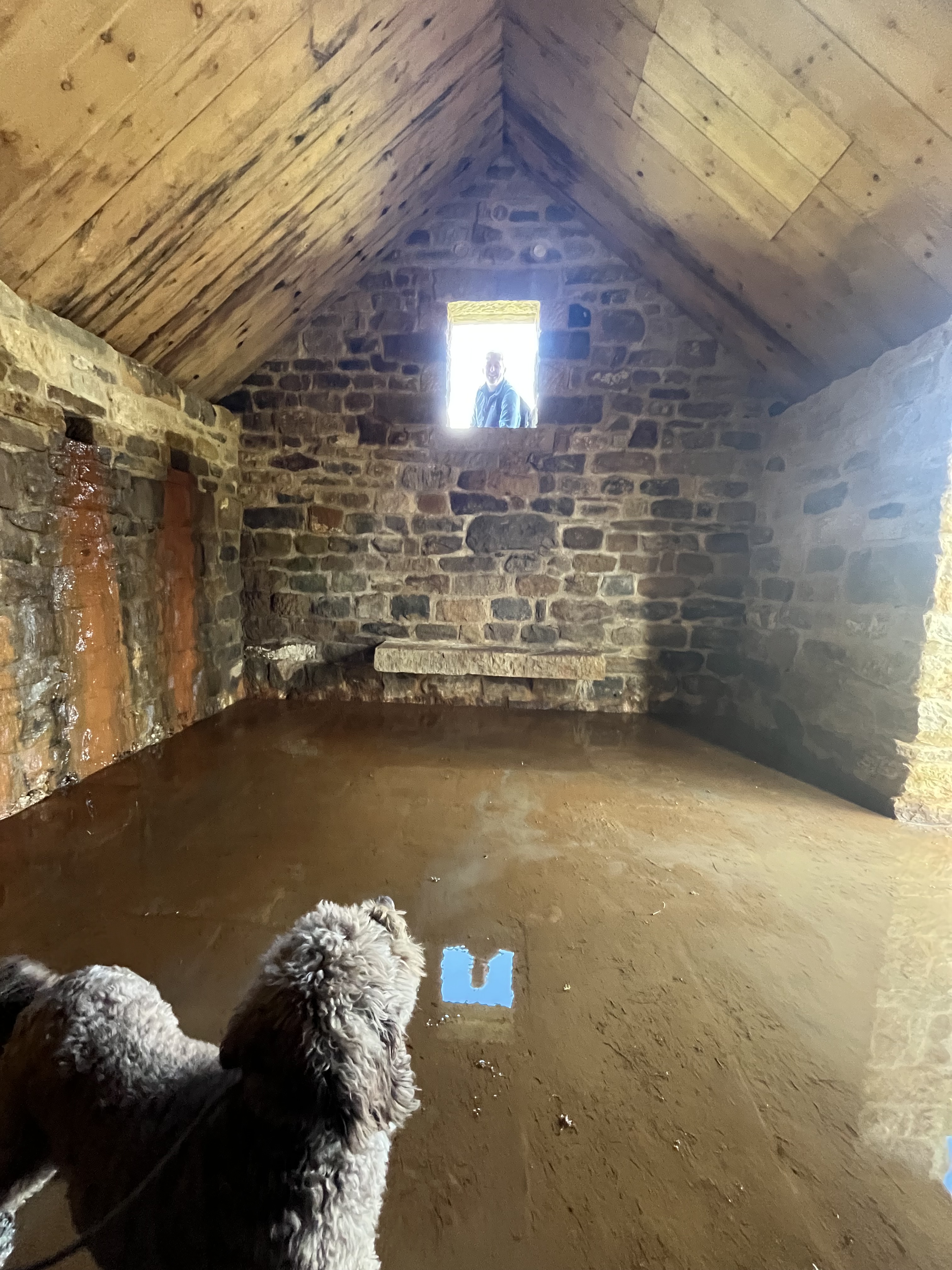
One of the buildings on the Hanging Stones Walk in Rosedale that Nick Harland helped to construct (that’s my friend Dave in the window, looking down at his confused dog Frank).
Andrew Goldsworthy gave Nick Harland this signed book with a hand-drawn picture of the Hanging Stones


I’ve been contacted by readers Ian and Catherine Wilson who had a great titbit about middle names. They wrote: “We would like to add an important advantage to ancestors having maiden names as middle names. When doing family history research the inclusion of a maiden name has often helped to confirm a link.”

I had never thought about that aspect before. They add: “McLaren is an ancestral name that is extremely common in Perthshire not helped by William passing through the generations. Thankfully one generation included Sorley as a middle name and it unlocked our research.”

It makes me think of all the hard work put in by my dad’s brother, Charles Walker, who spent huge amounts of time compiling our family tree. His side of the family had the common name of Walker, and my mum’s side had the even more common Smith. Trying to trace the correct members to create an accurate family tree was extremely tricky, especially when there were first names that were very popular among families of the North York Moors with the same surname. There were dozens of Johns, Henrys and Williams, and Mary’s, Hannahs and Helens too. Uncle Charles’ job was made slightly easier because some of the descendants were given maternal maiden names for middle names. My mum’s eldest brother, was Henry Harland Smith after his paternal grandmother, and her second brother was John Lacy Smith, from his mum’s maiden name. The name Lacy was passed down the next two generations to Henry’s son Richard, and on to his son Charles.

I don’t think this tradition was followed on my dad’s side of the family though, and tracing the Walker line did prove tricky as Uncle Charles wrote back in 2004: “I have a number of possible Walkers living around Lingdale/Skinningrove/Hinderwell. Can Peter remember any names of brothers/sisters of our Grandfather Walker?” He then lists a number of names of possible ancestors. Clearly, trying to sort out who was who was quite the task.

Funnily enough, I was contacted not long ago by Nick Harland, and we discussed whether we might be related through my mum’s side. As mentioned above, her paternal grandmother was a Harland – Edith Richardson Harland. Edith’s parents were William and Ann Harland, and as you might have guessed from Edith’s middle name, Ann’s maiden name was Richardson. Are you keeping up? This is just one tiny segment of our family tree, and I can imagine how mind-boggling it must be when you go down the rabbit hole of trying to piece it all together.

Nick and I didn’t know off the top of our heads if we were related, but that was not the reason he was getting in touch. He wrote: “My father Dennis Harland has often spoken about your dad over the years and I when I first started work, Mary Walker (my dad’s mother) often got me to do little jobs for her as she lived opposite the Glaisdale Institute…my dad’s parents used to live in Brinkburn, the house above where Mary used to live, opposite the institute.”

Nick has a link to the Andrew Goldsworthy ‘Hanging Stones Walk’ in Rosedale about which I wrote a couple of years ago. “All the ten Andy Goldsworthy projects which have been put together have been done with the help of our building firm,” he said.

The Hanging Stones Walk is an amazing feat of creativity, engineering and construction so I am hoping some time to chat more to Nick so he can explain how they did what they did. It is really an art project, rather than simply a walk, and is sponsored by the Ross Foundation (an organisation that supports initiatives related to art, community, sport, music and education) which commissioned sculptor Andrew Goldsworthy, famous for his spectacular pieces of land art. He transformed tumbling down agricultural buildings into amazing pieces that blend seamlessly into their moorland surroundings.

Nick finished by saying: “Another thing you touched on a while ago was about making stone troughs. I make a lot of stone troughs, up to five foot long. There is an easy way and a hard way but it is good fun seeing one completed.”

I think if Nick and I meet, we will have an awful lot to talk about!

Do you have opinions, memories or ideas to share with me? Get in touch with me using the ‘Contact’ button on the top right.

This column appeared in the Darlington & Stockton Times on Friday 19th and the Ryedale Gazette and Herald on Wednesday 17th Dec 2025