Slave to history


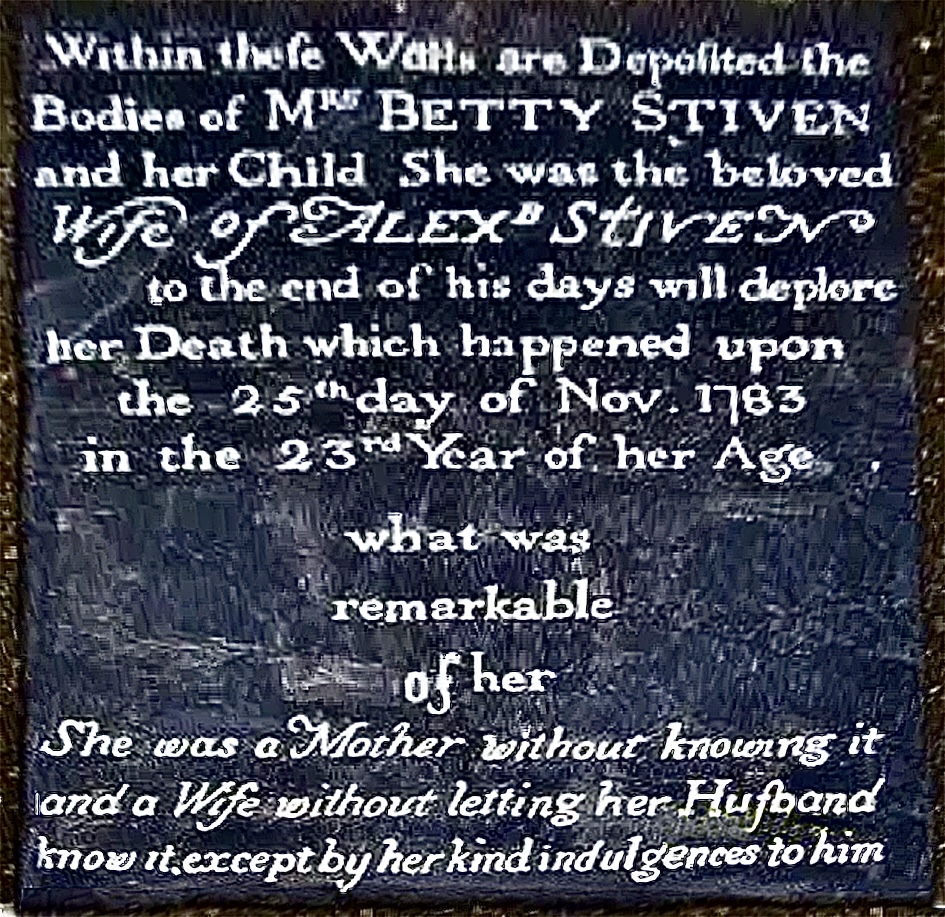
The baffling inscription on Betty Stiven’s grave on the island of Tobago in the Caribbean, spotted by reader Peter Sotheran. Do you know what the last sentence means?

Another family connected to Hamer Inn has been in touch with me following previous columns about Joseph Ford and his descendants, who include readers and cousins, David and Ian Ford.

In one of my columns I mentioned the Eddon family. James and Elizabeth Eddon took over running the inn from the Ford family, and Annie Eddon, later Turnbull, was born at Hamer in 1906. Annie was the second youngest of 11 children.

I previously mentioned a column written in the 1990s in which Annie remembered: “On the Glaisdale side of the house is a beck (Bluewath) and I can remember going down to the beck with my mother to wash clothes. We took a big cauldron and lit a fire under it to boil the water and clothes.

“We had a pump in the pub yard but in summer it ran dry and we had to carry water from the beck…One of the outbuildings was used by my father for making besoms from heather, and on Mondays, Mother would ride a pony to Pickering market to try to sell them.”

It was Annie’s sister, Lily Boddy, who took over from her father in 1914, and you might recall a fabulous photo I shared a few weeks ago showing Lily next to the well with (I presume) her mum Elizabeth Eddon bending over it, bottom in the air!

Following that, I have been contacted by Susan Ellis who wrote: “Further to your piece…my mum has asked me to contact you. My mum is Pauline Elizabeth Ellis (nee Turnbull) one of 6 children, all still alive, and who originate from Wrelton.

“My mum’s grandma and grandad are James and Elizabeth Eddon. One of their daughters, Annie, is my mum’s mum and Annie had some time growing up at Hamer House.

“We would be very interested in any photos you might let us look at, along with any more information.”

I replied to Susan, and sent her some articles and links to the columns about Hamer where I featured photos of the property before it became derelict (which you can find on www.countrymansdaughter.com). Type ‘Hamer’ in the search box and they should come up.

A few days later, Susan wrote to me again: “Thank you Sarah. I’ve just been reading everything out to Mam. It is all fascinating isn’t it? What hardy folk they all were! Mam and I will have a chat and see if any stories surface that can be shared.”

Now to a different, yet equally interesting, query which another reader has brought to my attention, and upon which I am hoping you might be able to shed some light.

Peter Sotheran got in touch because in the past I have written columns discussing the historical resting places of various people. I’ll let Peter explain:

“Many thanks for your columns – always unearthing something fascinating! A while ago, I think you wrote about various gravestones and that stirred in me a memory of a mysterious gravestone that I discovered whilst on holiday on the Caribbean island of Tobago.

“Plymouth on the north-west coast of Tobago is a small coastal community with a population approaching 10,000 residents. English settlers arrived there 400 years ago, hence the prevalence of British place names; Scarborough, Roxborough and Speyside are principal towns on the island.

“One of the island’s greatest curiosities is the inscription on the grave of a local lady, Betty Stiven. After recording the date of her death, the gravestone carries the following message:

‘She was a mother without knowing it and a wife without letting her husband know it, except by her kind indulgences to him.‘

“I wondered if your ever-erudite readers can suggest an explanation?”

I read the inscription (which you can see above) and came up with the conclusion that because her child is interred with her, she died in childbirth, in which case, she would not have experienced motherhood at the age of 23.

I find the last part of the sentence is quite baffling. Perhaps she died soon after getting married? Or was she the unmarried mistress to a plantation slave master? The inscription is quite loving, though, so perhaps it was a genuine marriage? Peter thinks the size and style of her gravestone suggests she was more likely part of the white elite rather than the poorer indigenous community, but is not certain.

I’d love to hear what you think!

This column appeared in the Ryedale Gazette and Herald on 15th and the Darlington and Stockton Times on 17th April 2026

Crossing the Fords to Haymoor


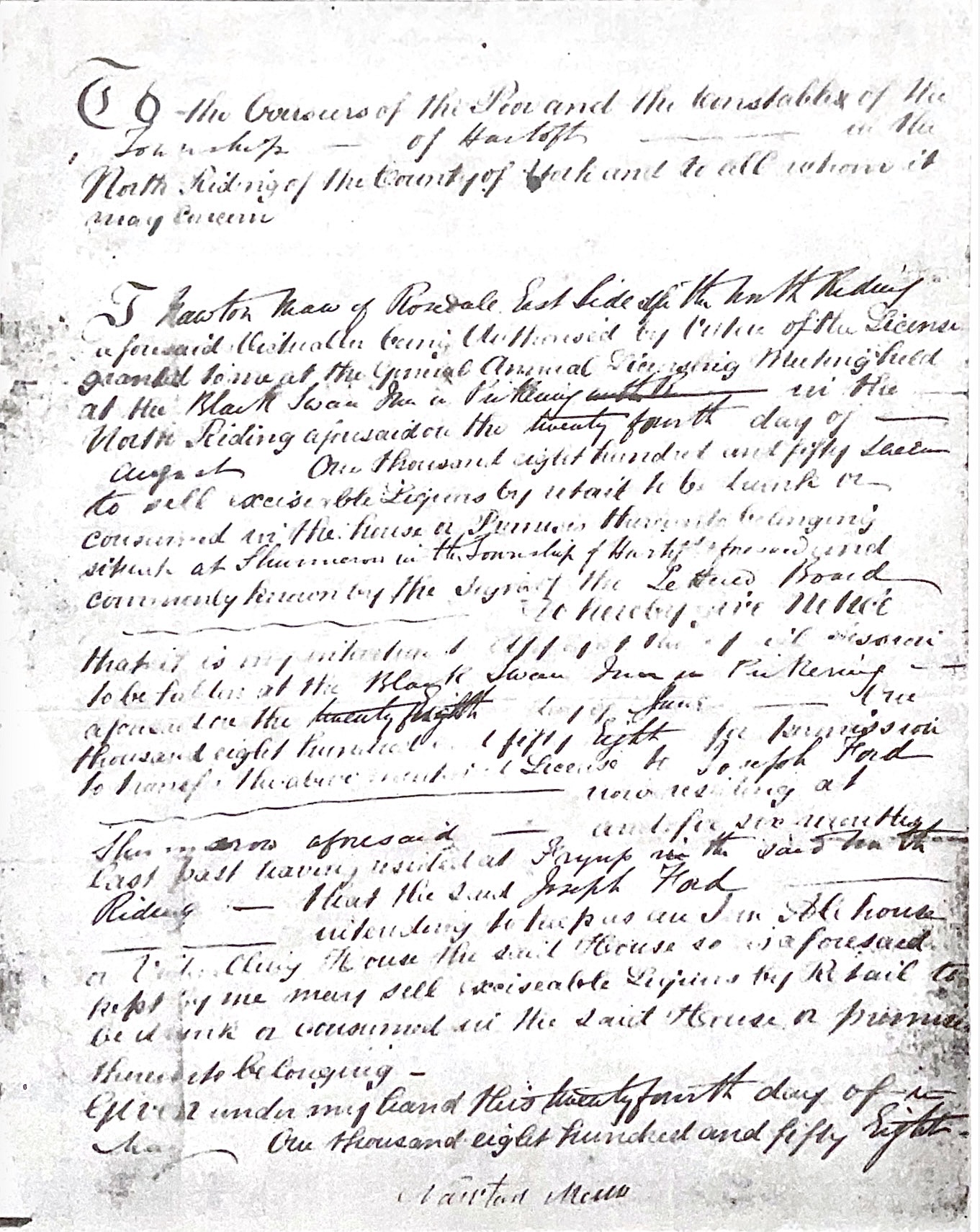
The copy of the liquor licence transferring the lease of the Lettered Board to Joseph Ford, dated ‘fourth day of May One thousand eight hundred and fifty eight’
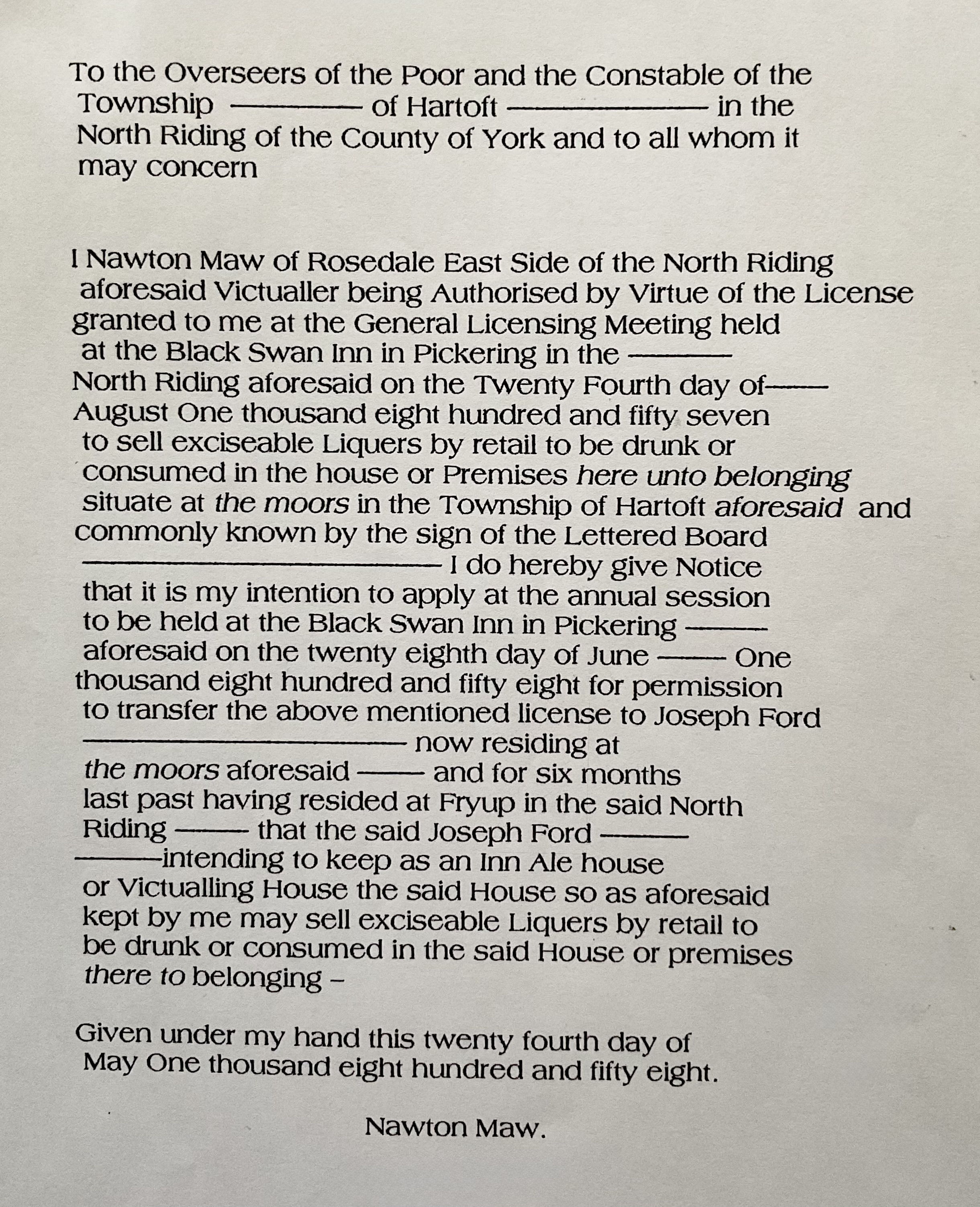
A transcript of the liquor licence
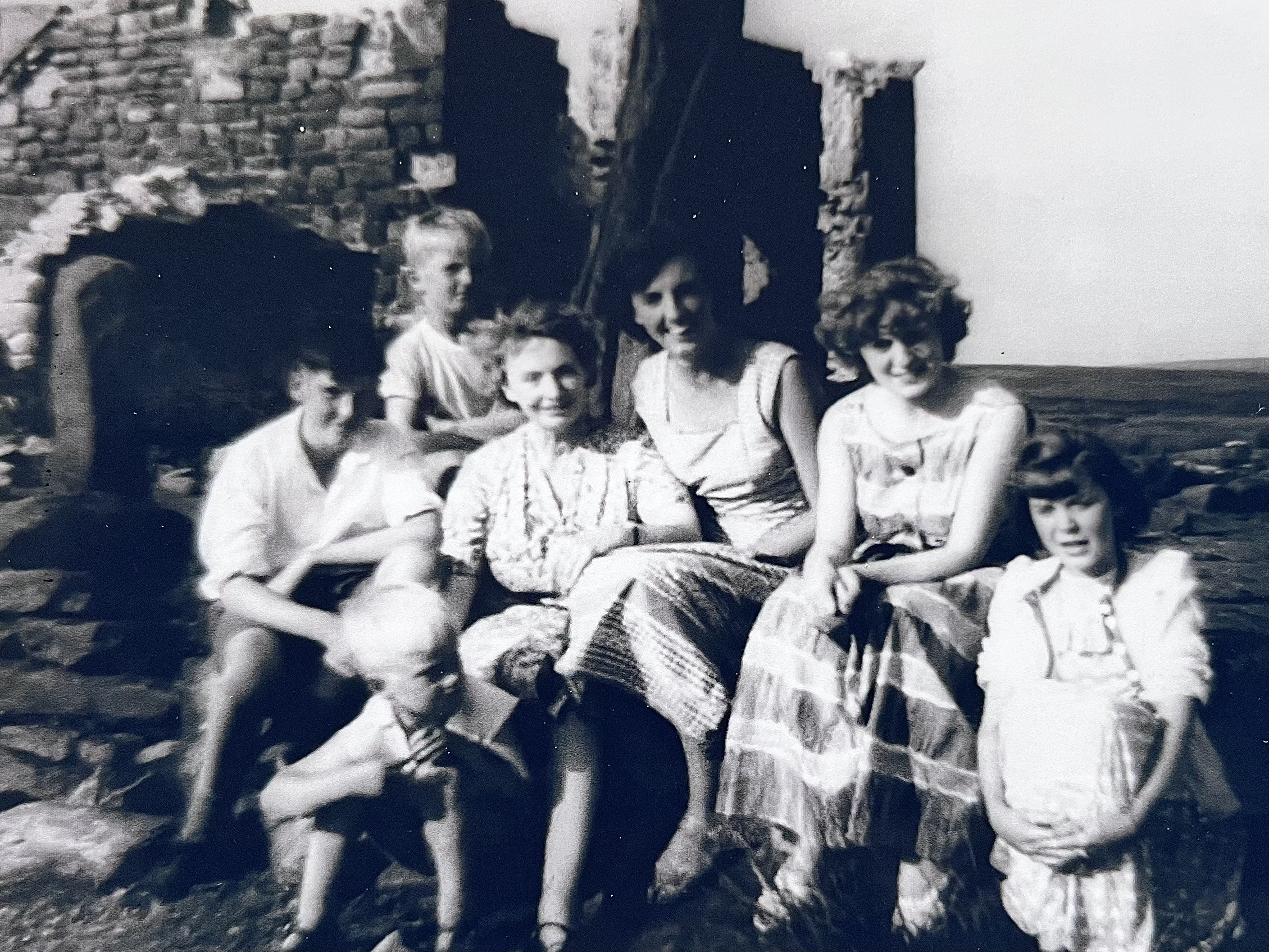
L-R Ian Ford, David Ford (back), Richard Ford (front), Ada Ford, Margaret Ford, Sylvia Ford and Eileen Roe on a family day out in about 1959. The ruins of Hamer House can be seen in the background.

I’m continuing to be surprised by how many memories my columns about Hamer Inn have jogged.

The latest contact came from reader Ian Ford. As his surname suggests, he is related to the Fords who were licensees of the inn in the mid-1800s. Ian is the cousin of David Ford, whose original message to me asking for photos of the inn sparked off this whole chain of columns. Ian is the great great grandson of Robert Ford who was born at Hamer in 1860. Robert was the son of Joseph Ford who took over the licence in 1858 and the brother of Joseph Ford Junior, who wrote a book about life on the North York Moors called ‘Some Reminiscences and Folk Lore of Danby Parish and District.’

Ian sent me copies of correspondence between himself and my dad from 2007 relating to Hamer, including some old family photos taken in the 1950s with the inn in the background, which by then was derelict but still clearly a building of some sort. As you know if you’ve read my previous columns, all that lies there today is a pile of old stones.

I’ve referred to Hamer as a property ‘of many names’ and they include The Lettered Board, The Wayside Inn, Hamer Inn and Hamer House. Ian revealed there was yet another name – Haymoor House. Surely that is its ‘posh’ name, because if you say it in a local accent, you get to Hamer (pronounced Hay-mer).

Ian included a copy of the original licence from when Joseph Ford took it over in 1858. You might recall that I mentioned that my dad had a copy of that licence:

‘Hamer’s role as an inn declined after 1870, the year a local writer called Joseph Ford was born at the remote house. His father was landlord and I have a copy of a licensing application dated 1858 in which the liquor licence of the Lettered Board was transferred to Joseph Senior.’

I searched for the licence in my dad’s files, but was disappointed when I was unsuccessful. What I didn’t know then was that there was a reason I could not find it, and that reason was revealed in the letters that Ian sent me.

Ian had contacted my dad after reading his book ‘Murders and Mysteries From the North York Moors’ in which both Joseph Fords are mentioned. He cites the tales Dad covered in the book, including those about the Lettered Board, and goes on to explain his family connection. He’d asked if he could see a copy of the old liquor licence transferring the lease to from the previous landlord to Joseph Ford.

Dad’s letter of reply states: “So far as the liquor licence for The Lettered Board at Hamer is concerned, I enclose my copy of it. It is dated 1858 and Joseph’s name was quite clear. It is an ancient photocopy – and I can’t remember where I got it from – but I doubt if it would reproduce any better on our modern equipment. As I can’t think I am likely to have any further use for it, please accept it with my compliments.”

So my dad had given it to Ian – no wonder I couldn’t find it! Yet another minor mystery solved thanks to you wonderful readers.

Incidentally, Ian reminded me that he had been in touch with me a couple of years ago regarding Joseph Pilmoor, the illegitimate son of Joseph Foord, the groundbreaking hydro engineer who came up with ways of ensuring remote moorland communities were served with fresh running water. Foord had had a liaison with a lady called Sarah Pilmoor from Fadmoor near Kirkbymoorside, and as a result, he was thrown out of the Quakers. Born in 1739, his son, inspired by founder of Methodism John Wesley, grew up to be one of the most successful preachers who travelled to the USA to recruit followers. Today there are around six million Methodists 30,000+ churches in the USA. He has countless plaques and memorials dedicated to him in many states and is described by them as a ‘pioneer missionary’. A remarkable feat for a lad from North Yorkshire.

Ian thinks both families might be connected, and indeed his branch used to spell their surname ‘Foord’ until the  19th century. Does anyone out there know for sure?

This column appeared in the Ryedale Gazette and Herald on 8th and the Darlington and Stockton Times on 10th April 2026