Is it Written in the Stars?

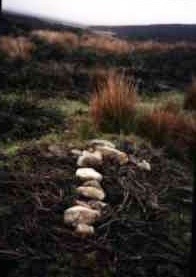
A rather blurry old photo of the Corkseller’s Grave. But the shape of the hills in the background might help us identify the location. Can you recognise it? (Picture: Paul Grantham)

I am constantly surprised by how far and wide my columns are read.

Chris Starfire contacted me with the following: “Hello, I’m far away in Oregon in the USA but fascinated by your story of the Corkseller’s Grave.” Chris, I am fascinated how you found me – and by your surname too! Where does an exotic name like Starfire come from?

Chris read the piece a few weeks ago in which I described trying to find the grave with the help of my son Joey. We were unsuccessful, and Chris got in touch with a couple of helpful ideas: “Poking around online, I noticed that there are two sets of instructions to find the grave and they differ in 30 yards.”

He spotted that in my piece I said ‘…you will find the grave on the road between Glaisdale and Rosedale Abbey. Stop by the small bridge over Bluewath Beck and walk for 50 yards heading east along the south bank of the stream.’

But he found an further piece written by Paul Grantham, other than the 1990s article of his which I had used for my column. He noticed that it said: ‘The isolated grave lies just south of the road junction one mile north of Hamer House, at a point where the road crosses the beck. Park on the bridge and follow the stream east for about 20 yards.’

There was a small photo accompanying the article, and Chris pointed out: “The photo is quite small on the Grantham website, but could be useful for a sight line on the surrounding hills… Best of luck finding the grave if you go looking again!”

I have tried my best to improve the image, which I’ve included with this piece, and it’s not the best quality, but indeed the shape of the background hills can clearly be seen in the distance. Could this be useful for identification? Someone who knows the area better than me might be able to recognise it. If so, please do get in touch!

I have also been contacted by yet another arm of the Eddon family, who you may remember were at one time the licensees of Hamer Inn. James and Elizabeth Eddon took over from the Ford family at the end of the 18th century, and had 11 children. Lily, took over the running of Hamer Inn in 1914 when her parents moved on.

“Following on from your articles about Hamer House, I am David Turnbull grandson of Elizabeth and James Eddon. My mother was Annie Eddon, daughter of Elizabeth and James, and she married Wilfred Turnbull. She was sister to Lily Boddy. Annie was one of 11 children and was born at Hamer Inn. The family moved at some point to run the Black Bull pub on the Pickering/Malton Road where James was unfortunately kicked by a horse and killed. We presume Lily was left behind to run Hamer. My sisters think Lily died quite young but we have no dates. I hope this information is of interest to you.”

It certainly is of interest, David, and I am very grateful to you for getting in touch. I was very sorry to learn about the way James died, which Paul Grantham had mentioned in his 1990s article that I featured. It must have been in 1923 because my research shows that Annie, who was born in 1906, was 17 at the time.

As for David’s question about how long Lily lived, I think she reached a fair age judging by the photos that I published a few weeks back, but I’m not sure how long, or the year that she passed away. Perhaps one of her many relatives out there will be able to tell us?

In the meantime, I have another mystery that has landed in my lap. I was invited on a trip into the Yorkshire Dales last weekend, and on a lovely walk, I spotted a cave in the side of a hill.

I was informed that the legendary Grassington murderer Tom Lee used the cave to hide from his pursuers.

Grassington murderer? Of course that set me off on another quest to find out who the heck Tom Lee was, and what had happened. If you are reading this and know that story, I’d love to hear from you!

Do you have opinions, memories or ideas to share with me? Get in touch with me using the ‘Contact’ button on the top right.

This column appeared in the Darlington & Stockton Times on Friday 24th and the Ryedale Gazette and Herald on Wednesday 22nd April 2026
T’in’t wat thoo ses, t’is t’way thoo ses it


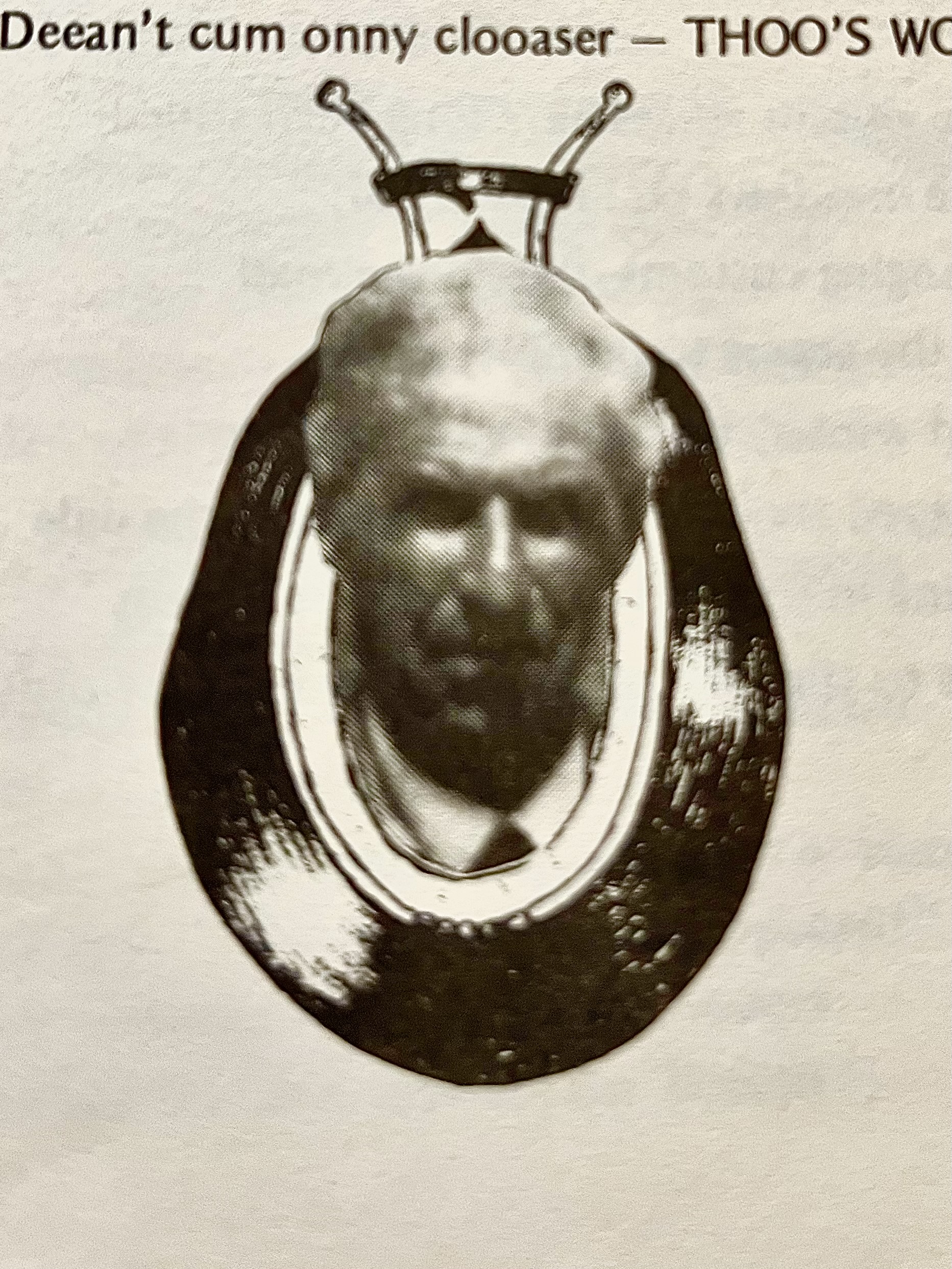
The poem ‘Grandad – through a barfin’ featured this picture of Pam Chester’s grandad George Coverdale. ‘Barfin’ is a dialect word for an oval horse collar.
An old photo from 1978 showing an alternative dialect ‘Beware of the Bull’ sign erected by Danby farmer Ralph Winspear after trouble with walkers straying across his land.

I’ve had some interesting correspondence following my two recent columns about the Danby dialect poet William E Fall who wrote under the name Erimus. If you remember, I was contacted by his great-granddaughter Sophie-Jean Fall who was searching for his books, and my dad happened to have been sent some copies.

Since then, she has revealed the discovery to her family and, following the publication of ‘Part Two’ of the story a couple of weeks ago, said: “Very excited and what an interesting image of Tom Boyes. Also, Gandan – AKA Erimus’ son – was really happy to hear about this all!” Hopefully ‘Gandan’ will also be interested in what the following readers can remember.

Pam Chester recalls: “My parents George and Ella Coverdale, my Grandad George Coverdale and myself lived at Danby Castle when Bill Fall and his wife Ella lived in a cottage at Castle Houses Farm, Danby. Bill would often walk up see my grandad. They would sit and chat about country life, hunting and farming…In the book ‘Poetry for t’Peasantry’ Bill wrote a poem about my grandad.”

I looked the poem up, and sure enough George Coverdale appears in ‘Grandad – through a Barfin’. Bill Fall states that Grandad George ‘Wi’ a dear auld nybour o’ mahn’, and the poem highlights one of Yorkshire’s most elegant of traditions – gurning. This refined skill involves people contorting their faces into gruesome expressions.

The poem describes a competition in which Grandad Coverdale took part. The competitors had to put their heads through a ‘barfin’, a dialect word for the large oval collar worn by cart horses. See if you can decipher the last verse of the poem – the language is bit ripe!

But then ‘e stopped – stood back aghast

Cos Grandad’s snitch was in ‘is gob!

‘Is chin was up – ‘is lugs stuck oot,

Wi’ t’ Judge wishin’ ‘e’d browd ‘is gun;

Freetened ti deeath, ‘e shooted oot,

“Deean’t cum onny clooaser – THOO’S WON!!!”

Pam wasn’t sure if her grandad ever really entered a gurning competition, but revealed that a picture on page 17 of the book is him with his head ‘through a barfin’.

She adds: “Bill and my grandad used to go and dig peats in the 1970s on the moor near the house to use as fuel in the winter months. He also used to follow the Glaisdale Hunt on horseback well into his 80’s. I remember him talking about Tommy Boyes.”

Janet Holt also contacted me: Bill “was our next door neighbour in Danby by our farm. My father had problems with straying walkers and Mr Fall came up with the idea of signs in the Yorkshire dialect. It caught the attention of the local press…He gave my parents a full set of the books.”

Her father was livestock farmer Ralph Winspear, who was fed up with walkers and children straying from the public footpaths across his land, damaging fences and leaving gates open. They ignored the polite signs asking them to keep to the official route and to shut gates. The last straw came in 1978 when two lambs escaped through an open gate and were killed on the nearby railway line. Bill Fall suggested erecting signs in Yorkshire dialect. One read: ‘if t’bull snorts, deean’t linger’, while another was very recognisably from Bill’s pen and entitled ‘Seestha’:

‘Noo, ye’ n’ me beeath need ti eeat

These beeasts’ll mak tasty meat

But not if fooakes gan runnin wild

Seea keep ti t’path n’ hod t’it child. Thankye’

The signs worked, as Ralph explained at the time: “We’ve had no trouble since they were erected because folk appear to be reading them carefully and the message gets home.” I wonder if anyone farming today has similar issues? Perhaps a warning sign in Yorkshire dialect might be worth a try!

I’d also like to thank Bill Filer who put me in touch with Dorothy Jackson from Helmsley, whose family knew Tom Boyes well. If you remember, Bill Fall dedicated a whole volume of poems to Boyes, and I featured a 1927 picture of a wedding at Danby Church in which Boyes could been seen accompanying the grand wedding car in his hunting finery.

But, alas, with me approaching my word count limit, I will have to leave Dorothy’s recollections until next time!


Do you have opinions, memories or ideas to share with me? Get in touch with me using the ‘Contact’ button on the top right.

This column appeared in the Darlington & Stockton Times on Friday 22nd Aug and the Ryedale Gazette and Herald on Wednesday 20th Aug 2025