
Hog your ground for good weather

Burying a sausage is supposed to bring good weather for your wedding. Where did this idea come from?

I am at that stage in my life where I have to admit that I am too old and too lazy to keep myself up to speed with all the new stuff with which my kids’ generation busies itself.

My children are at the age where their peers are getting married and having babies and the trends that were around when I married and started my family are now considered prehistoric. They don’t know how lucky they are not needing to be a contortionist to get a squirming screaming toddler strapped safely into a car seat in the cramped space in the back of the car. Instead of facing towards the seat in front, they are now mounted on a pivot enabling them to be swiftly swivelled to face you at the car door. Why it took so long for us to work out that was a sensible idea baffles me. Having said that, I’m pleased for all the physiotherapists across the world who benefitted from the extra work the old seats created.

It’s coming up to wedding season and I wonder if certain traditions we used to embrace have bitten the dust too, such as not seeing your groom the night before, or making sure you wear something old, new, borrowed and blue. Do Gen Z still do theses things? Gen Z refers to anyone born between 1997 and 2012, the first generation to have had access to the internet, social media, and smart devices for their whole lives.

For those of us startled by that fact, we can be comforted in the knowledge that one thing has remained constant – the unpredictability of our weather. I know that global warming means we experience more severe weather events than we used to, be it days of torrential rain, or days of hot sun. But we still cannot be certain that it won’t pour down when we plan an outdoor occasion.

But fear not. There is a tried and tested method to be sure of fair weather for your nuptials; for brolly-free wedding photos, you have to bury a sausage.

Yes. Bury a sausage.

I’m sure dozens of questions are right now flashing through your head, such as does it matter what kind of sausage? Is it cooked or raw? Does it have to be a particularly big sausage to give yourself a better chance of success? Where are you supposed to bury the sausage? And how long in advance of your wedding should you put it in the ground? Who should bury the sausage? Bride? Groom? Celebrant? And lastly, has anyone measured the success rate of sausage burying?

To find out more, I went straight to an expert, my Gen Z niece, who was married three years ago at a very risky time of year, October, where you’d think the chance of adverse weather put it firmly in sausage-burying territory. But the day was really beautiful, with the golden autumn sunlight providing a stunning backdrop for the photos. Had they concealed a fortuitous frankfurter to achieve it?

She replied: “We did not…I’d actually never heard of it until last week – my friend was at a wedding and they did it.”

Apparently it is the social media platform TikTok that is responsible for the viral trend, and its origins are shrouded in mystery. Google tells me that German-speaking countries, famous for their plethora of porky delights, are responsible, but when I asked my Bavarian friend about it he said he had never heard of such a custom.

As for the dozens of questions you might have, some sources say it has to be a raw sausage, others cooked. Some say bury it at the bride’s home, others at the wedding venue. Some say conceal it the night before, others a week before. As for the kind of sausage, I think you have free rein from chunky bratwurst to skinny chipolata.

I did find one source that suggested it descended from the tradition of Groundhog Day, where the beaver-like mammal comes out of hibernation to predict the weather for the coming months. The connection is that a hog is a kind of pig, which is the source of most sausages, and putting it in the ground means you bury it. Hence groundhog.

Personally, I think everything I’ve just written is a load of old groundhogwash.

Do you have opinions, memories or ideas to share with me? Get in touch with me using the ‘Contact’ button on the top right.

This column appeared in the Darlington & Stockton Times on Friday 5th and the Ryedale Gazette and Herald on Wednesday 3rd June 2026
That ol’ chestnut

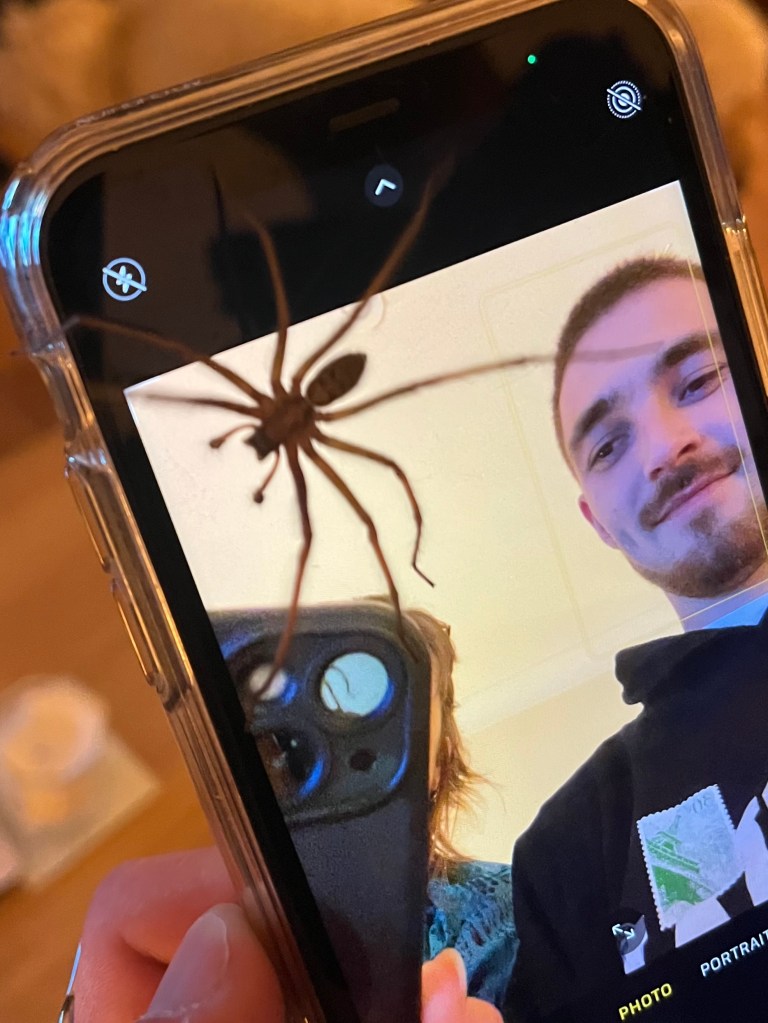
My son Jasper in an old photo that reappeared on Facebook recently. I have since discovered that disposing of house spiders outisde might not be the most humane thing to do after all!

I’ve had a couple of interesting spider-related experiences this week. The first was in a lofty old house which had vaulted ceilings, beautiful mature oak beams and hanging chandeliers.

The owner was apologising because she had noticed the amount of cobwebs dotted around the high beams and light fittings. She explained that the webs had quickly reappeared thanks to fact she had removed the bowls of chestnuts she usually kept around the house to deter spiders from setting up home.

“Are you sure it works?” I asked. She nodded emphatically and said the cobwebs had been absent while the chestnuts were in situ yet materialised very quickly after they’d gone. She believed the nuts emitted a pungent smell that was repugnant to our arachnid housemates.

I became very excited at the prospect of reducing my household dusting burden by the mere introduction of a few nuts, and checked whether she meant plain chestnuts or horse chestnuts. She used the plain chestnut and I vowed to find out more.

What I discovered was that whole, fresh chestnuts are surprisingly difficult to get from your local supermarket after Christmas. Thankfully, they are available online and I’m sure you could pick some up at a wholefood shop too.

The recommendation to use chestnuts to deter spiders has been around for a long time. The following was published in Nature magazine in May 1874: “Can any of your readers establish the truth of the following assertion? Spiders’ webs are never found upon beams from the Spanish or sweet chestnut tree, even when the timber is several centuries old. The keeper of the ruins of Beaulieu Abbey, in Hampshire, asserts that this is a fact, and the buildings of the Abbey, where beams of Spanish chestnut are used, are free from the invasion of spiders. His attention was drawn to this four years ago, and since then his observations have not thrown any doubt upon its accuracy.”

I could not find the answer to the writer’s question, but I have found several sources that say the claim has never been scientifically proven and is just an old wive’s tale. Some Cornish schoolchildren did their own experiment a few years ago with spiders and conkers which, along with walnuts, are also said to posses spider-repelling properties. However, the critters trotted merrily over the conkers, none the worse for being in contact with the noxious nuts. I will put some chestnuts around my house and see what happens. I’d love to know if you have tried it – or anything else – to keep your home spider and cobweb free.

The second spider-related incident came when I opened up Facebook and at the top of my feed was a picture of my son holding up his mobile phone upon which sat a huge eight-legged monster. It was a photo I had posted 18 months ago after having an unsettling encounter with the beastie. For some reason, a friend had recently commented on it which set off a whole new chain of reactions and comments from friends, some of whom hadn’t realised it was an old post, and that they had already commented when it originally appeared in 2024!

Despite the fact it was old news, it was fun to revisit it and read all the comments of horror, with some people suggesting that an arachnid of such proportions must have hitched a ride from a distant land. Our native house spider can grow surprisingly large and yet is harmless, while being really good at keeping down the population of other annoying pests like flies and mosquitoes.

During my research, I read something that made me quite distraught. We do not kill spiders at home, but capture them and deposit them outside on the assumption that it is the most humane way to deal with them. 

Apparently not. According to what I have read, house spiders cannot live outside for very long, so unless they are able to find somewhere warm and sheltered where they can spin a web to catch food, they will die.

If there is a spider scuttling about my bedroom, I will never be able to sleep, and yet, if I chuck it outside like I have been doing, I might be sentencing it to a lingering death.

So what the heck am I supposed to do now?

Do you have opinions, memories or ideas to share with me? Get in touch with me using the ‘Contact’ button on the top right.

This column appeared in the Darlington & Stockton Times on Friday 23rd and the Ryedale Gazette and Herald on Wednesday 21st Jan 2026