Out of the fire

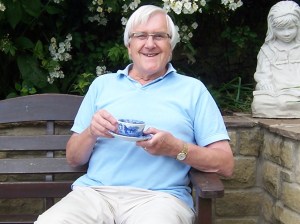
Betty McDonald on holiday in Southern Spain last year. She has kept diaries since she was young

I’ve had some more feedback from readers on the subject of photographs. Betty MacDonald, who will turn 90 this year (I hope you don’t mind me mentioning that, Betty!) writes: “I have many photographs from years gone by, and memories of sending them off to be developed and printed, and especially onto slides…we used to have many an evening watching a slide show.”

She adds: “I’ve kept diaries for decades, which I enjoy writing, and call my ‘reference library’. I can look up what I did 50 years ago on any given date. These are for me only. I have mentioned to my daughter when the time comes to find a spot in the garden and burn them all, although this might not be possible as I fear the fire brigade might have to be in attendance!

“Queen Elizabeth kept a diary and at 6 o’clock every day she sat down to write in it. So I feel as though I have been in good company…I’ve enjoyed my time with all of my collections of stuff over the years, but nothing is forever.”

Betty’s daughter send me a sweet note about her mother too: “She’s a fantastic mam and nana, always has an interesting story to tell and has such a happy outlook on life.” And at the end she added: “P.S. I won’t burn the diaries!”

Do many people still keep daily diaries? My gut tells me not, because everything is so ‘visual’ today that it is rare to find someone who takes the time to sit down and write about their day. I did it when I was a teenager, and when I was away on a gap year in the mid-1980s. I also wrote diaries when I went travelling in South-East Asia because my dad said I would regret it if I didn’t. They came in useful on my return when the newspaper I worked for asked me to do a series of travelogues about each country I visited. It would have been impossible without the diaries, and so I was very grateful for my dad’s advice.

I occasionally look back upon them now with an understanding of why it was so important to keep a contemporaneous record. There is so much detail that I would never have remembered, and they take me back to a time when I was young and carefree. The 1980s don’t seem that long ago, and yet so much has changed since then that they make a fascinating read. They may not mean much to anyone else, but perhaps my children will one day find them interesting.

Alan Graham also got in touch to say: “I always read your piece and was interested in the recent topic of printing photos. Like others I rarely if ever print photos nowadays but I do print and enlarge those that are good, clear and of lasting interest…and mount them in a traditional photo album, the sort with blank pages and a sheet of tracing paper between…Double-sided sellotape is all that’s needed on the back and they never come adrift, even decades later. A short typed label under each photo (who, where, when) adds a permanent memory.

“I’ve got precious pictures of my daughter growing up, my wife, even my cars and motorbikes going back 40 years and these albums are the things I’d save – as they say – in a fire.”

And that prompts me to ask, what would you save from a fire? Would it be something practical like your passport, or something valuable, like your jewellery? Or like Alan, would it be pictures of your loved ones?

For me, the material stuff means nothing, but there are certain things that cannot ever be replaced, such as signed copies of my dad’s books, handwritten letters from loved ones from years ago. I also have a large collection of birthday and Mother’s Day cards that my children have sent me every year since they were able to write and in which they have written very special messages that I never want to lose.

But, as Betty says, we cannot take everything with us, can we. So if you had to choose just one item to save, what would it be and why? Do get in touch via my contact page to let me know.

This column appeared in the Darlington & Stockton Times on Friday 14th March and the Ryedale Gazette and Herald on Wednesday 5th March 2025

Seeing the bigger picture

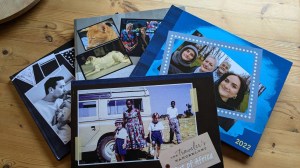
Clare Powell has photo books printed at the end of each year as a legacy for future generations.

My column about family photos a couple of weeks ago sparked quite a discussion. I was concerned that most of us have stopped printing pictures stored on mobile devices like phones and tablets. Would these photos be lost to future generations who don’t have the passwords to access them?

Mary Raynar has a solution to that problem: “I get mine printed every month, otherwise they don’t get looked at. It’s my job in the winter months to put them into albums. It is much more pleasurable than scrolling on the phone.”

I’m impressed that Mary diligently does that every month. I had always planned to get back to sorting the photos on my iPad, but then so many years have passed now that the job has turned into a monster. If you don’t keep on top of it like Mary, that is the problem.

Liz Davidson confesses that she has lots of old family photos that have not been put into albums. “My sons will have no idea who all these people are. We keep saying we will sort them out one day.”

And that is at the heart of the issue. If the physical photos do not have names, places and dates written on the back, those who look at them in the future will have no idea who it is, what they were doing, or where they were taken. Recording these small details is so important for our descendants to piece together their family’s roots.

Clare Powell is one of those ‘old school’ people who still has her photos printed: “My first grandbaby is due in April and I will be printing pictures. I have framed photos all over the house.”

I stropped printing out my photos and putting them into albums in about 2012 and I do regret it. But Clare has a great solution: “My friend said she waited to the end of the year, then selected a few from each month to make a photo book for the year. I made my first one in 2012 and have made one every year since. Waiting to the end of the year focuses your mind and you get good at editing…During Covid I re-did all my old photo albums and as I had over 40 it was quite a task. As I did it I was conscious that this was a legacy and a lot of the pictures would mean nothing to my children…I always label them so they will know who’s who.”

Photo books come with your pictures already printed in the book, which is a lot less effort than physically putting individual snaps into albums. Clare’s have evolved into diaries in which she writes a review of the year, with captions and dates.

Lynn Catena admits: “I haven’t printed any photos off my phone for ages, although I really think I should print some of my grandsons.”

She adds: “During the Covid lockdown I wrote a ‘to do’ list and going through photos was somewhere on it. I did cull many photos and negatives when I downsized my house 7+ years ago although lately I’m just trying to label those I have on my phone…there’s a picture of someone’s baby… now I’m wondering who it is!”

Lynn Catena thinks she should at least have some of the photos of her grandsons she keeps on her phone printed out, including this one of Cal, born just a few weeks ago.

Lucien Smith has another suggestion: “I do at least print out my Facebook posts using Pastbook, which pops up at the end of each year. Other than that, I don’t print them out.”

Caroline Newnham no longer prints them either: “I’ve stopped getting them printed as there are so many. My husband would print them all but where would they go? We already have boxes of photos in the loft…I’ve made a start on a regular yearbook…It concentrates the mind on the big moments of the year. The first was in 2023 and is great to look back over. It wasn’t cheap and took quite a bit of time and effort but is the way forward I think.”

Neil McBride says: “We often discuss the idea. That’s as far as it gets. Great idea printing an annual.”

Whichever way we want to preserve our memories, whether in print or digitally, these comments show that it is clear still that we need plenty of time to do it.

And how many of us have enough of that?

Do you have opinions, memories or ideas to share with me? Get in touch with me via the ‘Contact’ tab at the top right of this page.

This column appeared in the Darlington & Stockton Times on Friday 21st Feb and the Ryedale Gazette and Herald on Wednesday 19th Feb 2025

Picturing the past

I stopped printing photos and putting them in albums in about 2012. Will my great-great grandchildren know what I looked like if they don’t have access to photos of me?

I’ve had a few more comments about the conundrums we face when making decisions about what to do with all the stuff we accumulate over our lifetimes. Should we leave it for our loved ones to deal with after we’ve gone, or should we get rid of it ourselves before we shuffle off this mortal coil? Are those we leave behind interested in the stories behind the things we treasure, or could they not care less?

Lynn Catena, a Brit who now lives in Canada, says: “I doubt my boys are interested in anything I deem sentimental, but I plan on labelling some items. What they decide to do with them after I’m gone is their decision.”

She does have one item of particular significance though, a silver charm bracelet. “My sister gifted it to me when I was her bridesmaid. I have added to the charms (mix of English & Canadian). I have two sons, and three grandsons, so I’ll be gifting it to my nieces, and their daughters.”

Reader Clare Proctor is a self-confessed maximalist, and her house is packed with furniture, antiques and collectibles. She has two daughters with very different attitudes: “Molly said she would get rid of everything, but Lily said she’ll keep it all!”

For Michael Kilmartin, it’s printed photos that he hopes to pass on and points out that few of us print them out anymore. There are devices, like digital photo frames, where you can upload your pictures, and every so often the display rotates so you get to see a variety of your favourite images. But I wonder, 100 years down the line when your great-great-grandchild asks about you, what will their parents show them? Will your future descendants know what you looked like if printed photos no longer exist? Thanks to the photographs that I have inherited, I can see for myself the family likeness in my great-grandparents’ faces and can visualise their lives and contribution to our unique family history.

I stopped putting my photos into albums in about 2012, not intentionally, I just never got round to it as time and technology moved on. I now look through my recent photos via my phone and tablet and have backed them up in ‘cloud’ storage so they never get lost should my devices conk out. But when I’m gone, will my children be able to access them if I forget to give them all my passwords?

Today we don’t have to remember to take a camera to a special event because, thanks to our mobile phones, we have one with us all the time. And we don’t just take one photo, do we, we take lots, and just keep going until we get one we like. I keep promising myself that I will go through and delete all those ‘extras’ and as I write this, I only have 24,893 pictures to go through on my phone (good grief!).

It was not that long ago that we had to be so much more considered about snapping pictures. Firstly, the camera film was expensive to buy, secondly, you only had a limited number of shots you could take before the film ran out, and lastly, they were costly to get developed. As every parent does, once I started a family, I took lots of pictures of the children and religiously had them printed and put into albums. You had to either physically go to a shop or send the films away in an envelope and wait two weeks to get them back.

Do you remember that feeling of eager anticipation as the bulky envelope dropped through the letter box? And that other feeling of abject disappointment when you opened it to find your fingertip in the corner every picture? How would today’s young people cope with having to wait all that time without even knowing if they had taken a decent picture? Too bad if it was taken just as we blinked or sneezed!

Scrolling through photos on a screen is not quite the same as sitting down with a cuppa and turning the pages of the family albums while reading the captions and dates someone has taken the time to write down.

How will the future generations look back on their families’ past, I wonder?

Do you have opinions, memories or ideas to share with me? Get in touch with me via the ‘Contact’ tab at the top right of this page.


This column appeared in the Darlington & Stockton Times on Friday 7th Feb and the Ryedale Gazette and Herald on Wednesday 5th Feb 2025

Time to make decisions

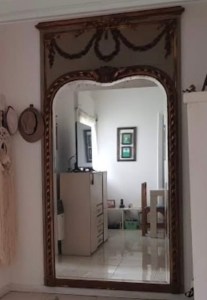
Horacio Romeo’s beloved antique mirror has to stay in Buenos Aires, Argentina, because it is too big to bring to his current home in Brazil.

Following my column about the Hugh Pannell clock owned by Arkansas-resident Sandra Parkerson, David Severs has been in touch. David is a descendant of the 18th century Northallerton clockmaker and was able to provide some useful historical context about it. If you recall, the grandfather clock has been in Sandra’s family for more than 200 years, but she is looking to find it a home because it will be too big to take to a new apartment.

David is compiling a record of Pannell’s work and explains that it is unusual to find ‘CLOCK & WATCH-MAKER’ engraved on the name boss. “This is very rare indeed and to find yet another Pannell example is exciting,” he says.

He explains that Sandra’s walnut case is not original: “I have found well over a hundred Hugh Pannell clocks and not one is in a walnut case.” Most of Pannell’s clocks were in cases of mahogany, oak or pine. David has found only one pine example due to the wood not being durable, and mahogany is also quite rare because he would have had to transport it by cart from west coast ports such as Liverpool, which was far more costly than a readily available oak case. Mahogany cases were the preserve of the wealthy, and housed Pannell’s finest pieces. They became more common once the rail network reached Northallerton in 1841, well after Hugh Pannell’s time. Oak cases with mahogany veneer were known as ‘typical Yorkshire cases’ in 1774 when Pannell was working.

David says about Sandra’s clock: “The decoration on the pediment is not something I have seen over here and the split trunk door is also new to me. It is possible that the clock mechanism alone was sent to the USA and then placed into Sandra’s mahogany case upon arrival.”

David adds: “I have found that some 30% of Hugh’s surviving clocks are now marriages which is perhaps not surprising given that it is 236 years and more since he was making clocks…I am aware of his clocks in California, Florida, New Orleans and San Francisco as well as this one in Arkansas. Clocks by his son Joshua…have found their way to Iowa and California and one of his watches to Florida.”

This brings me on to the subject of what to do with meaningful objects you have collected in your lifetime.

Regular reader Clare Powell says: “I inherited my dad’s grandfather clock…and decided to sell it later on. You get nothing for them at auction, nobody wants or has the room for them, even old ones. But I discovered it was handmade by a company in Somerset and he had paid £3,500 for it. I couldn’t bring myself to sell it for £150, so I am still stuck with it!”

In a previous column I mentioned a small wooden box my grandad gave me which I hope one of my sons will keep. Clare explains that the thought of what to do with all her family heirlooms keeps her awake at night: “I am not sure we should burden the next generation with all our ‘stuff’. If you tell them why everything means so much to you, will they feel ridden with guilt if they are not able to keep it all? Then again, if you don’t tell them, then they may wish they did know the story of certain items, like you and your box.”

Horacio Romeo from Brazil, who contacted me through my web page (countrymansdaughter.com), has a similar problem to Sandra in that he has a beautiful mirror that is too big for his current abode: “I love it and enjoy looking at it when I go to Buenos Aires (Argentina) but bringing it here is out of the question.”

Leni Ella says: “My nana used to say, ‘If you want it, put your Monica on it’, the only way you could bagsy something in her house.” (I am assuming Nana meant ‘moniker’ and ‘Monica’ is a family joke!).

My aunt, Liz Davidson, revealed that she has a family heirloom: “I have a crocheted white bedspread that came from my dad and one of his aunties I think. It’s very heavy when you put it on the bed.”

There is only so much the following generation will want to keep so what, I wonder, will happen to grandad’s bedspread?

Do you have opinions, memories or ideas to share with me? Get in touch with me via the ‘Contact’ tab at the top right of this page.

This column appeared in the Darlington & Stockton Times on Friday 17th Jan and the Ryedale Gazette and Herald on Wednesday 15th Jan 2025

Stop all the clocks

IMG_6278
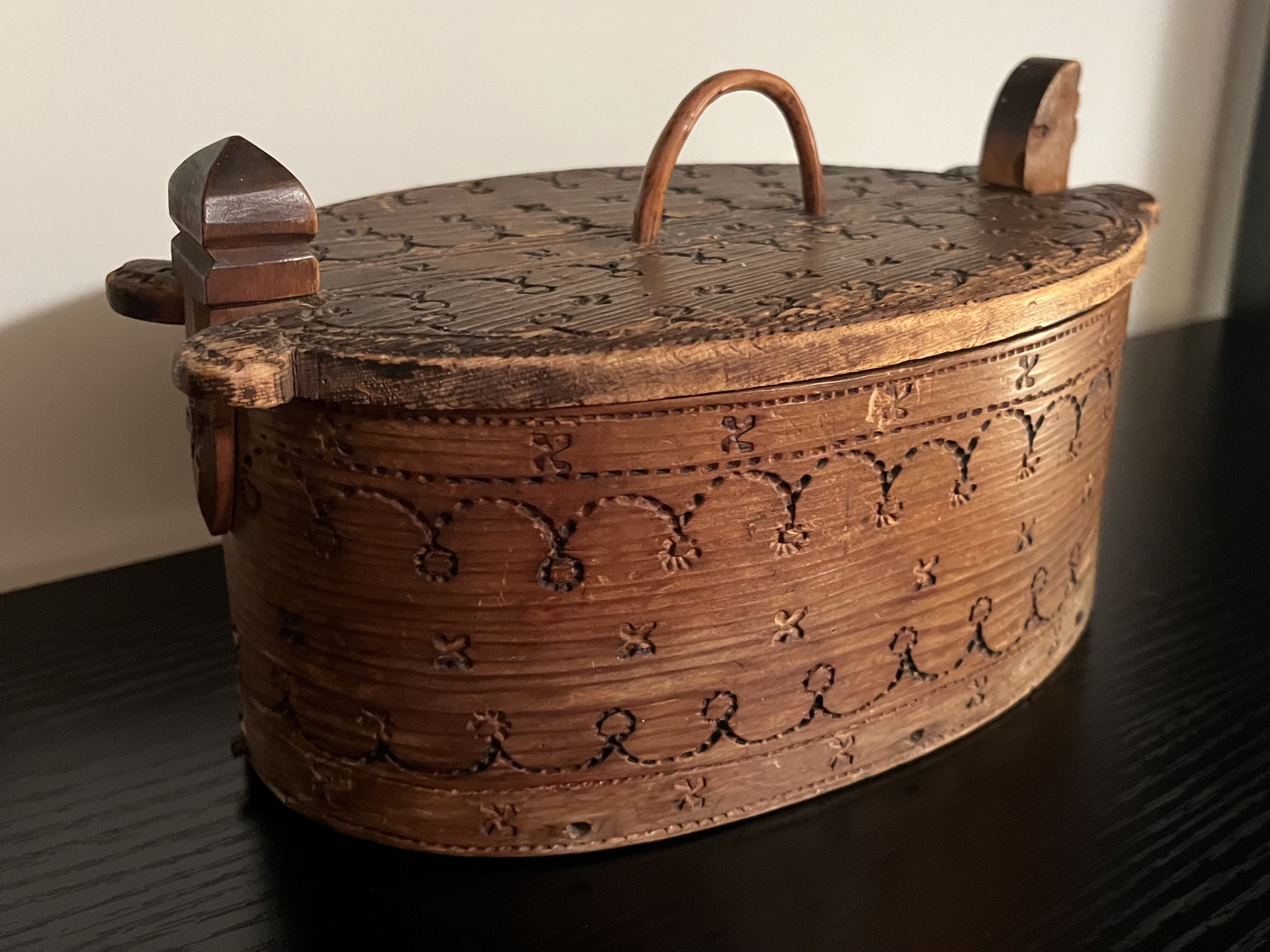
The hand-carved wooden box given to me by my grandad. It is very precious to me.
IMG_9505
Sandra’s 18th century long-case clock made by Northallerton’s Hugh Pannell. Will it find a new home?

IMG_9507

Back in August I wrote about 18th-century Northallerton clockmaker Hugh Pannell after being contacted by one of his descendants, David Severs. I’d been talking about the herringbone pattern that was commonly seen on the stones used to build moorland homes. David informed me that Pannell had used the same herringbone pattern to decorate his clocks and watches.

Following that, reader Sandra Parkerson has been in touch all the way from Arkansas, USA, because she has one of Pannell’s long-case clocks which needs to find a new home. She writes: “I have a grandfather clock that was made by Hugh Pannell. It has been in my family for way over two hundred years. It is in a beautiful walnut case. I am 80 now and want to move into a condominium so probably won’t have room for it…I do hate to part with it.”

She adds: “It is a brass dial with the herringbone pattern…It was running all my life, but when I got it we had carpet and never could get it levelled correctly. So, I assume with a good cleaning, it will work fine.”

I would not normally use this column as an antiques’ marketplace, but with the connection to Hugh Pannell and the herringbone pattern, and the fact that somehow my column has been read by someone all the way over in Arkansas, USA, I thought it appropriate to mention it. It would be lovely to pair up this noble clock with someone who would appreciate it as much as Sandra (Please note: I do not plan to advertise items for sale in future columns and suggest you try Christie’s (for valuable antiques) or eBay (for general tat)).

It does raise the question of what to do with precious family items that the following generation have no inclination to take on. About 25 years ago, my aunt was moving from a large home in North Yorkshire to a smaller one in Ireland. She could not take all her furniture with her and so offered me her beautiful antique mahogany dining table with six upholstered chairs. I willingly accepted it but then found that once it was installed in my pokey dining room, it took up all the space and was really too posh for the likes of us, a working family with young boisterous boys. It was impractical and unappreciated, and I ended up reluctantly selling it for a song when we moved house again. I was told by the auctioneer that large pieces of dark wood furniture had fallen out of favour and they’d struggle to get rid of it. It was heartbreaking to see such a beautifully crafted piece of fine furniture go for so little money.

One thing I treasure greatly is a small oval wooden box that my grandad gave me. He was a skilled wood worker, and I have a number of his beautiful hand-turned bowls. This box is what an antiques expert might call ‘naïve’, in that it is clearly handmade and hand-carved, with a series of little flowers and garlands etched into its surface. Nothing is straight or symmetrical, which is precisely why I love it so much. Someone has taken a lot of time and effort to chisel out all the tiny decorative elements which makes it so unique and personal. They have also coaxed the wood into this oval shape, with tiny little dowel joints holding the base in place. I have no idea of its age, whether my grandad himself made it, or whether it was passed down to him from his own ancestors. I do know he kept bits and bobs for fishing inside it, like hooks and flies, and when I was little I spotted it on a bench in his workshop and said how much I liked it. And so my kind grandad gave it to me. Unfortunately, my youth meant I didn’t ask any pertinent questions about its origin and therefore its history is lost in the mists of time.

Because this is just a small thing, I am fairly confident that one of my boys will happily hang on to it when I take my final leap into the great unknown, but the question is, which one?

If you have more than one child to inherit your precious stuff, how do you decide who gets what?

Do you have opinions, memories or ideas to share with me? Get in touch with me via the ‘Contact’ tab at the top right of this page.

This column appeared in the Darlington & Stockton Times on Friday 27th Dec and the Ryedale Gazette and Herald on Wednesday 18th Dec 2024

Will Satan come down the chimney?


IMG_0901
Will Satan or Santa come down your chimney this Christmas?


I had a message from a reader that made me titter. Jean McKendree said: “Regarding your column on spelling errors that get people’s backs up; mine (though I also have to laugh when I see it) is when people write, “Please bare with me,” to which I reply, “I would really rather not.”

This brings to mind those awkward occasions when you fail to properly proofread an email or text message and send something that has an embarrassing mistake in it. With more and more people switching to messaging rather than speaking on the phone, I’m sure it happens a lot, especially since the dawn of ‘autocorrect’, a function which decides what it thinks you want to say, but which is often some way away from your intentions.

A famous one came from a father who texted his son to say, “Your mum and I are going to Divorce next month”. The shocked son was relieved when he quickly received a follow-up text to say “DISNEY! I meant DISNEY!”

One that I experienced myself came on the first anniversary of the death of my friend Ian’s mum. We were on a walk in beautiful Givendale in the Yorkshire Wolds, her favourite place, when a text came through from a close friend. “Thinking of your dead mum,” it read.

“That’s a bit blunt,” said Ian, puzzled, because this friend was normally so gracious and polite. Before he could react any further, the phone rang, and I could hear her apologising desperately down the phone: “DEAR MUM!” she cried, “I meant your DEAR MUM!” We both found it completely hilarious, and were very grateful to her, because for the rest of what would have been a rather sad day, we kept collapsing into fits of giggles.

Other corkers blamed on autocorrect include: “You have my full condoms” (condolences), “Your dog Dexter is dead” (ready), “Sent with love and fried shrimp” (friendship), “Okay donkey” (okey-dokey).

Thankfully, most messaging services now offer you the opportunity to edit your messages after you have sent them, so you do have a chance to correct them if something erroneous sneaks through (although you have to be really quick to catch them before the receiver reads them).

At the moment, there is a fair amount of debate around the topic of AI (Artificial Intelligence) and whether we should be worried about its power or embrace it. Clearly it is being used in both negative and positive ways, but I did love the story about Daisy, the ‘AI Granny’, who has been tripping up ruthless phone scammers who target the old and vulnerable to steal their money. She is driving them crazy with her daft questions, meandering monologues and delaying tactics. She is a joint enterprise between O2 and YouTube ‘scambaiter’ Jim Browning and is on duty 24/7 intercepting fraudulent calls and taking revenge on people who thoroughly deserve it (give her a Google if you want to see her in action).

On the AI theme, I did see one message that read: “Just tried to type ‘probably’ and autocorrect turned it into ‘peanut uterus’. Don’t think AI is taking over anytime soon.”

It has just dawned on me that this is my last column before Christmas. I love seeing all the lights, decorations, and trees going up to mark the festive season, and when the days are short and the weather is as miserable, it lifts the spirits no end. But it is a time of mixed feelings for many. In 2017 we were bracing ourselves for our first Christmas without my dad, when my sister was unexpectedly diagnosed with cancer. Christmas took second place to hospital visits, and she died in the first week of January 2018. Seven years on, I have found happiness in Christmas once more, but that experience means I am mindful of those who are in hospital, those missing lost loved ones, or those spending Christmas with no-one at all.

So with that in mind, I am sending my thoughts and good wishes to you all at this very special time of year, and will leave you with a festive autocorrect classic:

“Taking the kids to see Satan now.”

“Well, I know they’re not perfect but that’s a bit harsh.”

“SANTA!! I MEAN SANTA!”

Do you have opinions, memories or ideas to share with me? Get in touch with me via the ‘Contact’ tab at the top right of this page.

This column appeared in the Darlington & Stockton Times on Friday 20th Dec and the Ryedale Gazette and Herald on Wednesday 24th Dec 2024

From loss to love

image1
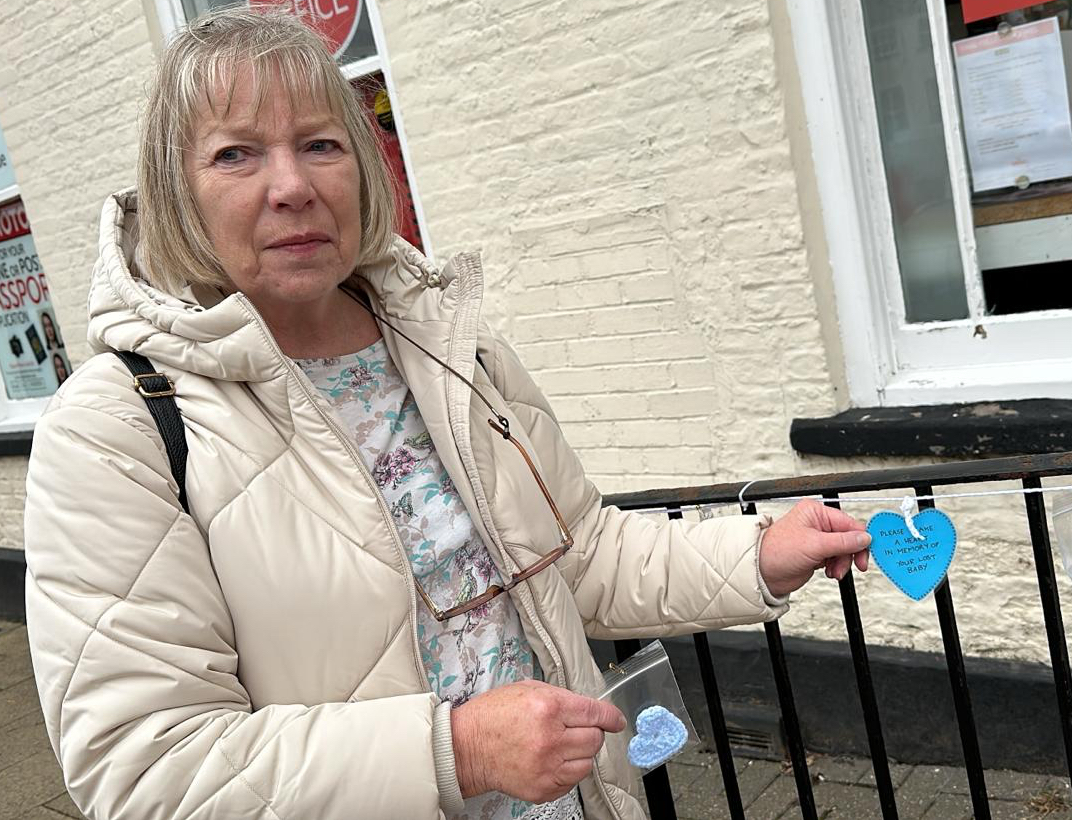
Carol Hepplestone with some hearts of remembrance outside Bedale Post Office during Baby Loss Awareness Week in October


image0
The work of yarnbombers in Bedale during Baby Loss Awareness Week in October
118178277
PC David Haigh, who showed such kindness to Carole Hepplestone after the loss of her baby, Leigh. PC Haigh was murdered by Barry Prudom in 1982.

Occasionally I give talks where I often discuss my dad’s role in the Barry Prudom case. Dad was Press Officer for North Yorkshire Police when Prudom murdered Constable David Haigh near Harrogate in 1982. While on the run, he also killed Sergeant David Winter in Malton and pensioner George Luckett in Nottinghamshire. George’s wife Sylvia was also shot but miraculously survived.

After one such talk, I was approached by Carol Hepplestone who told me a very moving story and, with her permission, I am sharing it with you today.

On 3rd November 1981, Carol gave birth to her second baby, Leigh, at Carlton Lodge Maternity Home in Harrogate. Unfortunately, Leigh passed away very suddenly at six days old on 9th November 1981. What prompted Carol to approach me was the fact that Constable David Haigh played a significant role in her life around that time. “Your talk brought it all back to me,” she said.

Carol explained that after losing Leigh, not only did she have to go through the trauma of a postmortem to find out why he had died, but there was an agonisingly long wait for the results. When they finally did come, the doctor delivering them did a terrible job. “He said they couldn’t find a reason why he had haemorrhaged so they were just going to put it down to a cot death…He said I could go away and have more children. It was quite dismissive and there was no offer of any follow up care.”

The whole experience left Carol bereft and on one particular night she decided she needed some time to herself and headed out without telling anyone where she was going. Her panicked husband phoned the police fearing she was vulnerable and may be in danger. “David Haigh was with my husband when I rang home and the phone was passed to him. In a calm way he asked where I was and told me he would come and collect me, which he did and took me home. He then sat us down and acted as a mediator/councillor/listener between us.”

Afterwards, Constable Haigh visited regularly to see how they were. “He was a father of three small boys at the time and could empathise… He went above and beyond his duties as a police officer.”

It was only a week after his last visit that she learned that he had been killed. It hit her hard, and her heart broke for his wife and boys. Sadly, Carol’s marriage did not survive but as time went on, she grew stronger and reached a stage where she felt she could help other women going though what she had. She joined her local baby bereavement support group, Sands.

“It’s a place where we could talk, listen and support couples,” she says. “We liaised with hospital staff on how to treat bereaved parents. We introduced the idea of memory boxes. We raised funds for a dedicated room for these parents. We also raised funds for a Sands memorial statue which stands in Stonefall Cemetery, Harrogate. I recently visited the cemetery and was astounded to see the volume of graves, plaques and memorials dedicated to our lost babies.”

Carol has two other sons, Jonathan, born in 1979, and Ben, her ‘rainbow’ baby, born in 1983 (a rainbow baby is one who is born following miscarriage, stillbirth or after a sibling has died). On what would have been Leigh’s 40th birthday, Jonathan completed a challenge to raise funds for Sands, running four miles every four hours for 48 hours.

Carol was walking through Bedale last month and was pleasantly surprised to see the town was decorated by yarnbombers to mark Baby Loss Awareness Week (9th -15th October), something that would never have happened back in the 1980s: “How encouraging to see how things have come on over the years, instead of very little being spoken about it like in the past,” she says.

At 71, Carol has now found happiness with a new partner and remains eternally grateful for the kindness shown by David Haigh at a time she most needed it. She hopes that today, with more awareness and organisations offering support after the loss of a baby, no-one will feel let down in the way she was when Leigh died.

“No matter how many years go by, you never forget.”

Do you have opinions, memories or ideas to share with me? Get in touch with me via the ‘Contact’ tab at the top right of this page.

This column appeared in the Darlington & Stockton Times on Friday 29th Nov and the Ryedale Gazette and Herald on Wednesday 27th Nov 2024

Does anyone love a festive birthday?

IMG_1540
Photographer Bella Bradford  and her daughter Heidi, who both have New Year birthdays

My column about festive birthdays sparked some interesting feedback, with most declaring that they don’t like it and would prefer to have a birthday at a different time of year away from Christmas.

Claire Dunston-Elliot was born on 20th December and says: “I hate joint Christmas/birthday cards or presents. Sometimes people forget my birthday because of Christmas, or I get birthday gifts wrapped in Christmas paper.” She also points out that it’s often tricky to find places to eat that do a normal menu not just Christmas food. “I would love a summer birthday,” she says.

Sarah Robinson’s birthday is on 20th December too and she tries to be as organised as possible, making sure that all the Christmas presents are bought and wrapped before the 20th and that ‘Christmas stops for just a day’ so she can enjoy her birthday to the full. She adds: “I did a joint 50th in the summer with my husband and it was much better! I find I am mellowing with this the older I become, and I’m just glad family and friends are around to call by.”

That’s a valid sentiment which is shared by Rob Fawcett, whose birthday falls on 16th December: “I guess it would be nice to have it in July, but I’m getting to that age when I don’t give a monkey’s when it is…just as long as they keep coming!”

Jenny Jagger, who celebrates on 29th December, declares: “It’s rubbish. I made sure I had my babies in the spring!” She also tried celebrating in the summer, but people tended to forget her birthday altogether.

Katie Westmorland says: “I’m a December birthday and I don’t like it. Christmas cards come before birthday cards in the post!”

Clare Proctor adds: “We happily have all our birthdays in the summer, so we can have shared celebrations, but when the girls (both August) were small we made sure to celebrate their individual birthdays so they both got equal attention. I remember a friend’s daughter’s birthday being 2nd January and it often got forgotten because everyone was exhausted from the festive season!”

Michael Kilmartin’s daughter Rose was born on Boxing Day 2014: “For me this is a pain because Christmas has to be finished or put on the back burner. When at home, I used to look forward to a second roast dinner or a visit to a working men’s club for a pint and a bag of crisps. Rose now chooses what she would like to eat and would agree that some of her celebration gets mixed up with Christmas. Presents seem to be smaller too. My wife believes Rose should have a half birthday but this creates issues with her brother and her friends who don’t know what to buy her etc. I will never, however, forget dinner on Boxing Day 2014.” I bet he won’t!

Elise Dawson says: “Our Jack’s is on 16th December. We always put decorations up on the first weekend of December and he doesn’t seem bothered. I’m sure he will as he gets older though.”

I think Elise has a point in thinking that young children don’t mind having a festive birthday, but as they get older they begin to notice things they might be missing out on.

Photographer Bella Bradford has a double whammy, with herself and her five-year-old daughter Heidi both having New Year birthdays. “Having a birthday on the 30th December has always been a weird one. I’ve never truly been able to celebrate with a big group of people on the day itself because people want a quieter day before the New Year’s party after a busy festive period. Luckily Heidi’s birthday is on New Year’s Eve and there is always a party so she will always be around people to celebrate.”

John Walker seems to be the lone adult voice who doesn’t mind having a festive birthday. His falls on New Year’s Eve and he says: “I used to get invited round to the next-door neighbours’ to celebrate. It’s a great time to have a birthday, just about everyone worldwide celebrates it!”

And the obliging neighbour who would always throw a party on New Year’s Eve? Well, that was me!

Are there any of you out there who enjoy having a festive birthday? If so, do get in touch!

Contact me via my webpage at countrymansdaughter.com.

This column appeared in the Darlington & Stockton Times on Friday 16th and the Ryedale Gazette and Herald on Wednesday 14th Feb 2024.

The giving spirit of Christmas

IMG_0888
Even if  Christmas has become too commercial I still want to get a luxurious  present!


I can’t quite believe that this is my last column before Christmas, and as I write, I am wondering what to wear for my annual works night out tonight. We usually end up having a great time, thanks to the free-flowing wine and cocktails, and end the night embarrassing ourselves with some energetic mum/dad dancing in a local bar. It was American stand-up comedian and actress Phyllis Diller who said: “What I hate about office Christmas parties is looking for a job the next day.” I’m hoping I will still have mine in the morning!

I’m sure these sentiments are familiar to many of you, and I’d be interested to hear your cringe-worthy party stories. If you do have any, don’t keep them to yourself but share them with us by getting in touch via the contact details at the bottom of this column (of course, anonymity is guaranteed!).

Good old Les Dawson bemoaned the fact that his family didn’t have much money with which to celebrate: “We were so poor that we couldn’t afford a turkey. We gave the budgie chest expanders. It was five a side to a cracker.”

This time of year can be stressful, especially with having to buy presents for a lot of people, all with different personalities and tastes. There is a stereotype that suggests men are not very good at buying gifts for their other halves. Now I know it is a sweeping generalisation, but stereotypes are stereotypes because they are, on the whole, true. One year, my mum was less than enamoured by the fact that my dad had bought her some pans, and my ex-husband would buy me practical things for the house, like towels, or crockery. It’s not exactly romantic and is an indication of how they see us – as their domestic home helps rather than the love of their lives.

If, until you began to read this, you were considering buying your dearest love pans or crockery, I suggest you take this advice from English comedian Jeff Green: “Women do not consider the following to be gifts: diet books, cooking utensils, cleaning products, petrol for the car, anything from the Pound Shop”. I would add to that that if you want to make sure that you and your partner are still talking to each other once the presents have been unwrapped, then you can’t go far wrong with jewellery (made from precious metals and stones and not from the supermarket), expensive perfume or after shave (not the sort you get from the garage shop), or fancy toiletries (again, not from the supermarket). If you’re struggling, go to your local Boots or department store, follow the waft of perfume to the luxury scent counter and ask the assistant for advice. Believe you me, most of us would prefer one thing of high quality than a whole drawerful of cheap tat. And by high quality, I don’t mean a Dyson vacuum cleaner. Your gift has to leave the recipient with the feeling that they are being spoiled and, more importantly, that you have thought about what they might actually like to receive rather than what you think will make the job of cleaning the house easier.

I’m not the sort of person who will let on how disappointed I am when I get a rubbish present but I think I was justified on what I now call My Worst Christmas Ever. A receipt for a pair of expensive earrings had been carelessly left on the desk in our study weeks before Christmas, and I’d pretended I hadn’t seen it, awaiting the big day with eager anticipation. For once, I thought, I was not getting something useful, but something luxurious and just for me.

Unfortunately, the earrings ended up under another woman’s tree.

Of course, there are those who complain that the true meaning of Christmas has been lost, a victim to commercialism, overindulgence and greed. And I do think it does us good to remember how it all began, and who we should be thinking about at this time of year. With that in mind, I’m going to wish you happiness and joy over the coming festive period, and will give my last words to someone with a great deal more wisdom than me, Bart Simpson:

“Aren’t we forgetting the true meaning of Christmas – the birth of Santa?”

Contact me via my webpage at countrymansdaughter.com, or email gazette@gazetteherald.co.uk.

This column appeared in the Darlington & Stockton Times on Friday 22nd and the Ryedale Gazette and Herald on Wednesday 20th December 2023.

Out on a limb for leeches

242322A0-0D4B-4DD7-ABEA-008FC8E9CF1E
Dad loved his garden pond. Here he is feeding the fish a couple of years ago.

This column appeared in the Darlington & Stockton Times on 2nd February 2018, & the Gazette & Herald on 31st January 2018.

I went through the ‘frogs and snails and puppy dogs tales’ phase with each one of my three boys when they were at primary school. They were fascinated by ‘minibeasts’, which was a new word to me, but referred to what we would have called creepy crawlies. They had no squeamishness about picking up spiders, worms, slugs, snails and wood lice and presenting them to me with great glee.

Even more excitement was to be had whenever we came across a pond, as there were more fascinating minibeasts to found in and around it. When my oldest was a toddler, we lived in house with a pond in the garden and I can’t forget the noise the frogs used to make, and the undulating surface of the water, during mating season. The females are attracted to the males with the loudest croak, hence the cacophony! They also lay up to 2000 eggs, so soon our pond would be teeming with tadpoles, although not all would make it to adulthood, and those that did risked a messy confrontation with the lawnmower if they ventured far from the water.

My brother was also fascinated with such creatures in his youth, and in his February 4th 1978 column, Dad recalls the occasion when he built his own pond. Finding that a hole in the ground lined with polythene was no good, my brother resorted to using an old, Belfast sink, sunk into the rockery outside Dad’s study window. He filled it with with plants and pond life gathered from a local disused swimming pool and nearby lakes. He was very proud that soon his family of great crested newts had started breeding. He wouldn’t have known that 40 years later, if he disturbed the habitat of a great crested newt, he’d face up to six months in prison and an unlimited fine!

Alongside newts, frogs, sticklebacks and minnows, he also unwittingly rehomed a number of freshwater leeches, thankfully a small variety which were harmless to humans.

In medieval times, doctors were called ‘leeches’ due to their custom of treating all manner of ailment by bleeding their patients with the sluglike bloodsuckers. For many centuries, it has been one of the most effective treatments for a number of reasons, and this medical practice continues to this day. There is a farm in Wales which breeds medicinal leeches for this purpose, which is known as hirudotherapy (from the Latin name for these leeches, hirudo medicinalis). As well as supplying the NHS, the company sends them all over the world for use in surgery. The leech, which is about three and half inches long, is particularly effective in treating areas of poor circulation, especially in parts of the body with delicate soft tissue, for example when surgeons are trying to repair or reattach a severely injured limb. They clean up the wound by removing the clotted blood that is inhibiting blood flow, and then encourage circulation to restart.

It is the mechanics of mouth of the leech, a curious biological triumph, which makes it so effective for medical treatment. It has a circular, overlapping lip, and then three jaws, shaped a bit like the Mercedes-Benz logo, each with a row of 100 tiny teeth, perfect for making clean incisions into the skin at exactly the right depth. As they bite, they secrete a local anaesthetic, making the bite painless, alongside another substance, known as a vasodilator, which stimulates blood flow. Once the leech has filled its boots with blood, it then simply drops off to digest it. However, it leaves behind two important chemicals called hirudin and calin, which prevent further clotting and continue to stimulate blood flow for up to 48 hours after the leech has dropped off, which is so important when when it comes to success in treating these kinds of injuries. Although it all sounds a bit gruesome, it is one of nature’s amazing accomplishments, far more effective than many other medicinal treatments, and in fact the leeches only consume a relatively small amount of blood before they become full, around 15ml.

Incidentally, trials have shown that the anti-inflammatory and anaesthetic properties of leech saliva have been shown to be effective in treating pain and tenderness in the joints of people suffering conditions such as osteoarthritis. Vets are also finding them useful during surgical procedures on animals.

Now my question is, how would you feel with a leech let loose on your injured limb?
(Sources: biopharm-leeches.com, guysandstthomas.nhs.uk).