What can’t you live without?

I can’t live without my ear pods. They are the reason I am able to maintain a relatively clean house.

Following my column a couple of weeks ago about personal treasures that are worth more to us than money, Lucien Smith got back in touch to say: “Oh wow, Sarah! My mother would be thrilled not only how much I cherish her painting, but that it made the cover of pic of you post! Thank you.”

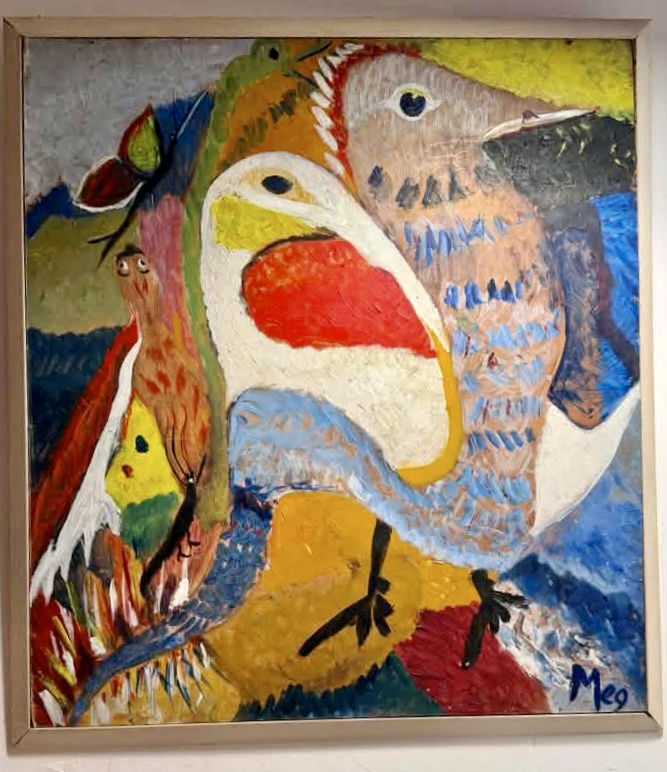
If you remember, Lucien treasured a painting done by his late mother when she was only 22 and called it his ‘save from a burning building’ item. I used a picture of the painting in my column, and then also on a social media post.

It led me to ask what would be your ‘save from a burning building’ item, and self-confessed maximalist Clare Proctor responded: “That is an impossible question! I would want to save my photos, my African treasures from my childhood, my tapestries that I have made over the last 40 years, the copy of Van Gogh’s sunflowers that my dad did, and Howard’s dad’s MBE….no hope of choosing one item!”

She added: “I love Lucien’s mum’s painting. We did that technique at school. We had to take a still life item and interpret it as something else. I chose the jaw bone of a cow and painted a washing line full of clothes! I think it’s in the attic…better add that to my rescue list.”

I’m not sure Clare would make it out of a burning building carrying that lot!

Janet Pearce is slightly more restrained and added: “My late husband’s love letters to me, journals, birthday cards and other jottings of his. They are all together…And my Dachshund!”

Once you start to think about it, your rescue list can get longer and longer. At least Hendrix, Janet’s beloved little dog, made it on to hers!

Sarah Mason agrees with Clare when it comes to pictures, but adds a couple of other items: “The photos and DVDs of my children. And Mum’s jewellery. Oh, and Mum!”

I’m not sure what Sarah’s mum would think about her order of priorities. I still have many photos kept in physical albums and would hate to lose them and the memories they represent. I am of that crossover generation where the first years of my children’s lives are all documented by physical photos, but then, come the advent of tablets and smartphones, I gradually switched to digital pictures only. I diligently printed them and put them into albums up until 2012 and then that’s where the albums stop. I remember feeling guilty at the time that I was letting the pictures mount up, and pledged that I would one day get them printed out. But the albums I had bought in readiness for that task still remain empty nearly 15 years later. Weirdly, I still haven’t got rid of them, despite knowing that it is unlikely they will ever get filled now. What can you do with empty photo albums? I’d love to hear your suggestions.

This subject also led me to wonder if there is anything you use on a daily basis that you didn’t realise you needed until it was invented (internet, computers, smartphones and tablets etc excepted). Clare’s answer to that is as follows: “I’m thrilled with my birthday present from my daughter – an electric throw to wrap around my cold tootsies in the winter.” Here’s another question – can we can rule out foot spas, spiralizers, and the Sinclair C5 as being useful inventions?

My ‘can’t live without’ is my ear pods – small wireless earphones that slot comfortably into the ear and connect via the Bluetooth to my iPad. The reason I can’t live without them is that I hate cleaning; it may be necessary but why does it have to be soooo boring? With these little techy miracles, I can put on a true crime podcast and my mind is magically transported away from the tedium. Because there are no wires, and I am not physically connected to my device, I can wander all over the house and never miss the plot twist of a gripping story. I can still hear it even when I put the vacuum cleaner on, so with no need to crank up the volume, neighbourly harmony is maintained.

Tell me then, what are your ‘burning building’ or ‘can’t live without’ items?

Do you have opinions, memories or ideas to share with me? Get in touch with me using the ‘Contact’ button on the top right.

This column appeared in the Darlington & Stockton Times on Friday 14th and the Ryedale Gazette and Herald on Wednesday 12th August  2026
What would you save?

The painting Lucien Smith’s mother Margaret created in 1952 when she was 22 and called ‘Quirky Birds’. “It’s my ‘run back into a burning building’ item,” says Lucien. What would you save from a burning building?

Following my column about the reunion I had with my dad’s Jaguar, it prompted me to ponder how it is that physical things can mean so much to us.

Reader Lucien Smith got in touch because he has similar feelings about a painting created by his late mother Margaret. I had wondered if anyone still owned an object to which they had an unusually strong attachment.

“Yes I do. This painting by my mum, which she created in 1952 when she was 22. ‘Quirky Birds’ she called it and her teacher at college used a technique where they drew shapes on the canvas, then found the picture within. It’s my ‘run back into a burning building’ item.”

It is a wonderful memento of Lucien’s mother, who died in 2024. Its value to others may be negligible, but to Lucien it is priceless.

Former teacher Lynette Atkinson also got in touch after reading my Jaguar column and said: “What a fabulous story. No wonder it made you emotional. I have kept many items that were made by children I taught and they are treasures to me. A pine cone, a Christmas angel, a trinket box, a bracelet, a painted plate and many more.”

Gurli Smith, who lives in Denmark, contacted me about a different topic: “Reading your column this past Monday (A cheep of faith) made me think of something that happened a few years ago.

“I was sitting in my favourite armchair reading when I heard a loud bang. Something had hit the windowpane and left a big mark on it. I ran outside and saw a young kestrel lying on the ground. I thought it was dead and called my brother.

“By the time he arrived, the kestrel was able to hop around a bit (it had just passed out from the ‘encounter’ with the window!). However, we were afraid that it had broken a wing, so my brother placed it in a safe spot, and a few hours later it was ready to fly again.”

Gurli recalled a second memory prompted by reading my piece about tuberculosis a few weeks back. Her mother had told her this story many years ago.

“In the 1940s Mum trained as a nurse at a small hospital. It was before penicillin and if patients came to the hospital with pneumonia, it meant death for them.

“The specific story was about a young woman (a wife and mother) with pneumonia, and doctors and nurses were sure that she would die. But at a hospital in Aarhus they had penicillin which was driven by ambulance up to my mum’s hospital, and the life of the young woman was saved.

“My mum had tears in her eyes when she told the story and said that the use of penicillin was the greatest thing she had experienced as a nurse.”

We can’t imagine life without antibiotics today, and I have no doubt that they saved the life of my son when he had life-threatening sepsis at the age of three.

It makes me wonder what of life’s inventions that have appeared in your lifetime could you not live without today? Of course there are the obvious things, like the Internet, mobile phones, tablets and the like, but is there anything else you use on a daily basis that you didn’t realise you needed until it was invented?

I have a few personal treasures that will mean nothing to anyone else, but the absolute world to me. I will never forget the moment when I was in my dad’s study not long after he had died. It was the place I would go to feel close to him and on his desk was an A4 diary in which he used to plan out his time for the weeks and months ahead.

I flicked through a few pages and there, written in his distinctive hand, were the words ‘Out for dinner for Sarah’s birthday.’ My heart broke all over again when it dawned on me that he had looked forward to the occasion with no idea he would no longer be alive to enjoy it. Of course, I will never be able to throw that diary away now.

So what is your ‘run back into a burning back into a burning building’ item?

Do you have opinions, memories or ideas to share with me? Get in touch with me using the ‘Contact’ button on the top right.

This column appeared in the Darlington & Stockton Times on Friday 31st and the Ryedale Gazette and Herald on Wednesday 29th July 2026

Out of the fire

Betty McDonald on holiday in Southern Spain last year. She has kept diaries since she was young

I’ve had some more feedback from readers on the subject of photographs. Betty MacDonald, who will turn 90 this year (I hope you don’t mind me mentioning that, Betty!) writes: “I have many photographs from years gone by, and memories of sending them off to be developed and printed, and especially onto slides…we used to have many an evening watching a slide show.”

She adds: “I’ve kept diaries for decades, which I enjoy writing, and call my ‘reference library’. I can look up what I did 50 years ago on any given date. These are for me only. I have mentioned to my daughter when the time comes to find a spot in the garden and burn them all, although this might not be possible as I fear the fire brigade might have to be in attendance!

“Queen Elizabeth kept a diary and at 6 o’clock every day she sat down to write in it. So I feel as though I have been in good company…I’ve enjoyed my time with all of my collections of stuff over the years, but nothing is forever.”

Betty’s daughter send me a sweet note about her mother too: “She’s a fantastic mam and nana, always has an interesting story to tell and has such a happy outlook on life.” And at the end she added: “P.S. I won’t burn the diaries!”

Do many people still keep daily diaries? My gut tells me not, because everything is so ‘visual’ today that it is rare to find someone who takes the time to sit down and write about their day. I did it when I was a teenager, and when I was away on a gap year in the mid-1980s. I also wrote diaries when I went travelling in South-East Asia because my dad said I would regret it if I didn’t. They came in useful on my return when the newspaper I worked for asked me to do a series of travelogues about each country I visited. It would have been impossible without the diaries, and so I was very grateful for my dad’s advice.

I occasionally look back upon them now with an understanding of why it was so important to keep a contemporaneous record. There is so much detail that I would never have remembered, and they take me back to a time when I was young and carefree. The 1980s don’t seem that long ago, and yet so much has changed since then that they make a fascinating read. They may not mean much to anyone else, but perhaps my children will one day find them interesting.

Alan Graham also got in touch to say: “I always read your piece and was interested in the recent topic of printing photos. Like others I rarely if ever print photos nowadays but I do print and enlarge those that are good, clear and of lasting interest…and mount them in a traditional photo album, the sort with blank pages and a sheet of tracing paper between…Double-sided sellotape is all that’s needed on the back and they never come adrift, even decades later. A short typed label under each photo (who, where, when) adds a permanent memory.

“I’ve got precious pictures of my daughter growing up, my wife, even my cars and motorbikes going back 40 years and these albums are the things I’d save – as they say – in a fire.”

And that prompts me to ask, what would you save from a fire? Would it be something practical like your passport, or something valuable, like your jewellery? Or like Alan, would it be pictures of your loved ones?

For me, the material stuff means nothing, but there are certain things that cannot ever be replaced, such as signed copies of my dad’s books, handwritten letters from loved ones from years ago. I also have a large collection of birthday and Mother’s Day cards that my children have sent me every year since they were able to write and in which they have written very special messages that I never want to lose.

But, as Betty says, we cannot take everything with us, can we. So if you had to choose just one item to save, what would it be and why? Do get in touch via my contact page to let me know.

This column appeared in the Darlington & Stockton Times on Friday 14th March and the Ryedale Gazette and Herald on Wednesday 5th March 2025

Picturing the past

I stopped printing photos and putting them in albums in about 2012. Will my great-great grandchildren know what I looked like if they don’t have access to photos of me?

I’ve had a few more comments about the conundrums we face when making decisions about what to do with all the stuff we accumulate over our lifetimes. Should we leave it for our loved ones to deal with after we’ve gone, or should we get rid of it ourselves before we shuffle off this mortal coil? Are those we leave behind interested in the stories behind the things we treasure, or could they not care less?

Lynn Catena, a Brit who now lives in Canada, says: “I doubt my boys are interested in anything I deem sentimental, but I plan on labelling some items. What they decide to do with them after I’m gone is their decision.”

She does have one item of particular significance though, a silver charm bracelet. “My sister gifted it to me when I was her bridesmaid. I have added to the charms (mix of English & Canadian). I have two sons, and three grandsons, so I’ll be gifting it to my nieces, and their daughters.”

Reader Clare Proctor is a self-confessed maximalist, and her house is packed with furniture, antiques and collectibles. She has two daughters with very different attitudes: “Molly said she would get rid of everything, but Lily said she’ll keep it all!”

For Michael Kilmartin, it’s printed photos that he hopes to pass on and points out that few of us print them out anymore. There are devices, like digital photo frames, where you can upload your pictures, and every so often the display rotates so you get to see a variety of your favourite images. But I wonder, 100 years down the line when your great-great-grandchild asks about you, what will their parents show them? Will your future descendants know what you looked like if printed photos no longer exist? Thanks to the photographs that I have inherited, I can see for myself the family likeness in my great-grandparents’ faces and can visualise their lives and contribution to our unique family history.

I stopped putting my photos into albums in about 2012, not intentionally, I just never got round to it as time and technology moved on. I now look through my recent photos via my phone and tablet and have backed them up in ‘cloud’ storage so they never get lost should my devices conk out. But when I’m gone, will my children be able to access them if I forget to give them all my passwords?

Today we don’t have to remember to take a camera to a special event because, thanks to our mobile phones, we have one with us all the time. And we don’t just take one photo, do we, we take lots, and just keep going until we get one we like. I keep promising myself that I will go through and delete all those ‘extras’ and as I write this, I only have 24,893 pictures to go through on my phone (good grief!).

It was not that long ago that we had to be so much more considered about snapping pictures. Firstly, the camera film was expensive to buy, secondly, you only had a limited number of shots you could take before the film ran out, and lastly, they were costly to get developed. As every parent does, once I started a family, I took lots of pictures of the children and religiously had them printed and put into albums. You had to either physically go to a shop or send the films away in an envelope and wait two weeks to get them back.

Do you remember that feeling of eager anticipation as the bulky envelope dropped through the letter box? And that other feeling of abject disappointment when you opened it to find your fingertip in the corner every picture? How would today’s young people cope with having to wait all that time without even knowing if they had taken a decent picture? Too bad if it was taken just as we blinked or sneezed!

Scrolling through photos on a screen is not quite the same as sitting down with a cuppa and turning the pages of the family albums while reading the captions and dates someone has taken the time to write down.

How will the future generations look back on their families’ past, I wonder?

Do you have opinions, memories or ideas to share with me? Get in touch with me via the ‘Contact’ tab at the top right of this page.


This column appeared in the Darlington & Stockton Times on Friday 7th Feb and the Ryedale Gazette and Herald on Wednesday 5th Feb 2025