Theories put through the mill

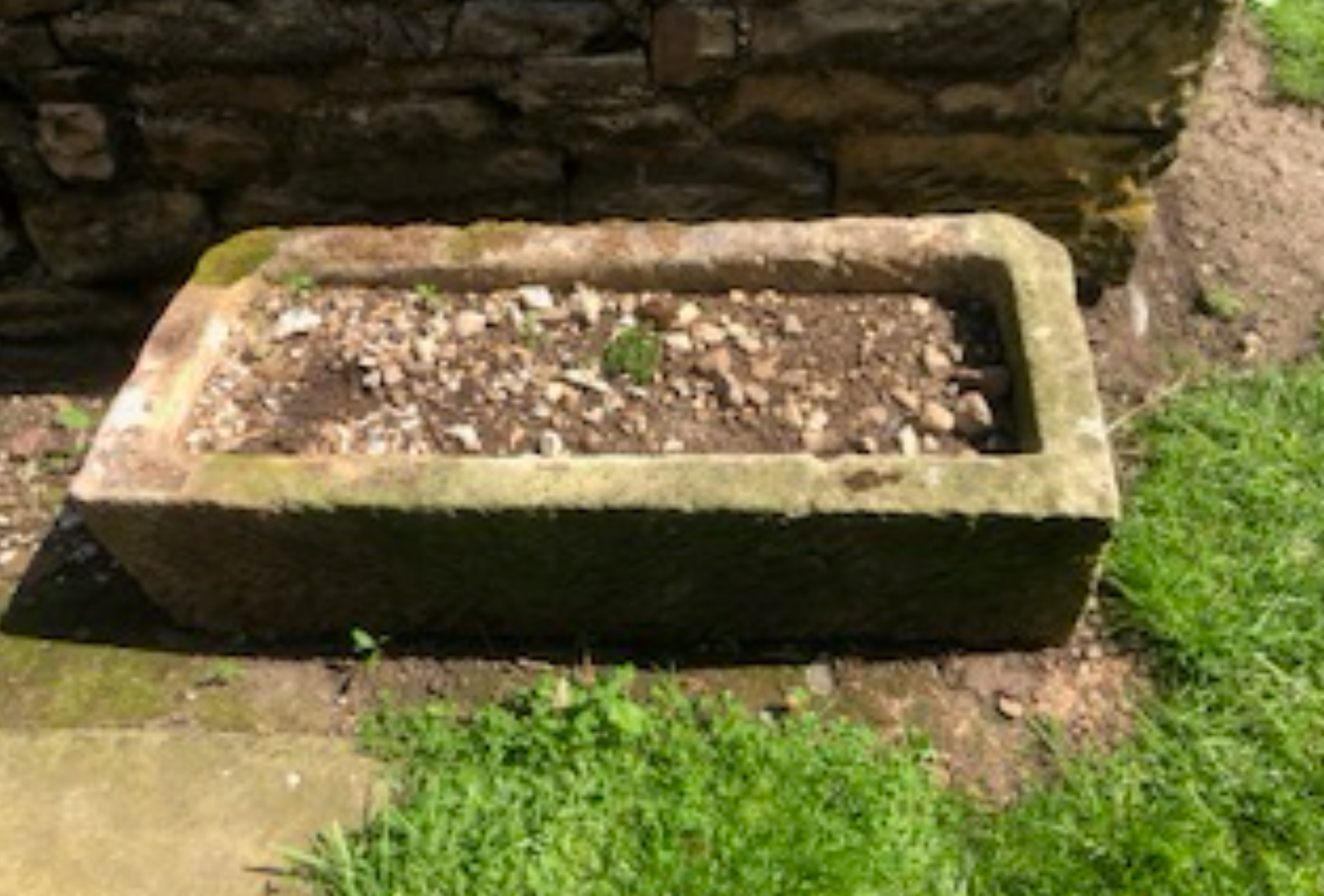
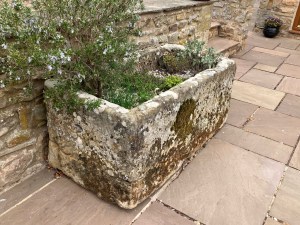
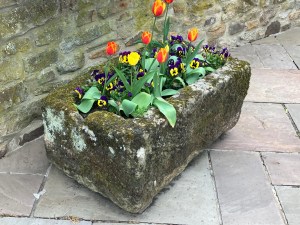
Some beautiful stone troughs that stand in the garden of a reader who lives near Durham

I received some wonderful images of stone troughs from a reader who says: “I enjoyed your article on stone troughs as I have been puzzling over how on earth they were made, by whom, and who paid/got rewarded for making them with no more than manual tools. We have six such troughs of various sizes…We brought one small one from Durham, the rest were on site when we came here, origins unknown.”

As the pictures show, they make super containers for plants, flowers and herbs and nestle naturally into their surroundings, far more at home than a modern equivalent, don’t you think?

I’ve also been contacted about the huge millstone on the moor above Kildale. Reader John Buckworth got in touch a few weeks ago because he had been pondering about the massive, unfinished stone for more than 50 years. It has been chiselled out on one side, but left unfinished on the other, and had been abandoned far from any mill that would have been its ultimate destination. Why was it never finished or moved?

Mick Garratt, who blogs about his travels around the North York Moors, has wondered for years about the baffling millstone. He contacted me to discuss his theories and hopes someone reading this might shed more light upon the mystery.

“I’ve been really curious about that unfinished millstone too! I’ve written about it a few times on my blog and speculated some of my thoughts, but I still have so many questions that haven’t been answered,” he says.

On his blog, Mick mentions that in the 18th century there were two mills in Kildale. The first started life as a fulling mill, a process which thickened and matted together wool fibres, but once the wool industry declined the mill was converted into a bleaching mill to whiten linen cloth. The other mill was ‘the first recorded corn mill in Cleveland’, with the earliest record dating it to 1262, and another stating that it ‘was totally destroyed by a great inundation in 1321’ (A History of the County of York North Riding, Volume 2, ed. William Page, 1923). The corn mill was located near Old Meggison waterfall on the River Leven, north of Kildale village, while the bleaching mill was further down the valley, just below the current ‘Bleach Mill Farm’. On the night of 21st July 1840, the corn mill was wiped out and the bleaching mill severely damaged when, according to Bulmer’s History and Directory of North Yorkshire (1890), ‘Two artificial lakes or fish ponds, which added greatly to the charms of this picturesque vale, unable to bear the pressure of the water which the flood poured into the ponds, were completely swept away, and very considerable damage done by the water.’

Mick suggests: “Maybe the millstone was destined for the corn mill in Kildale but the flood of 1840 caused its manufacture to be abandoned. Purely a guess of course.”

Mick has another suggestion relating to the quality of the stone. “The North York Moors Historic Environment Record dates it to ‘post medieval’, which is any time between 1540 and 1799. The bedrock at this location is recorded as ‘undifferentiated sandstone, siltstone and mudstone’, none of which make particularly good millstones, but probably good enough for grinding proggin (cattle food). At Rievaulx, French burrstone (a sturdy limestone) was used for grinding wheat for flour, and millstone grit from the Derbyshire Peaks for proggin. Our unfinished millstone points then to a poor quality…Perhaps that’s the reason it was abandoned…perhaps a flaw was found.”

Mick also describes the method of carving a stone of sufficient quality to grind fine flour: “Once the millstone is shaped and transported to the mill, it would have to be finally dressed. The miller would ensure the grinding face was flat by proving it with a staff smeared with red rudd (a soft red stone collected from riverbeds and often used to colour front steps of cottages). Next, furrows or grooves would have to be chiselled out using a mill bill or pick. Furrows must be of the correct depth with a straight and sloping side. They act as scissors with those on the top stone during the grinding.”

If any of you have many further suggestions concerning in our mysterious millstone, I’d love you to get in touch via my contact page (above right).

Do you have opinions, memories or ideas to share with me? Get in touch with me using the ‘Contact’ button on the top right.

This column appeared in the Darlington & Stockton Times on Friday 9th and the Ryedale Gazette and Herald on Wednesday 7th May 2025

Solid as a rock

The unfinished millstone near Kildale. You can clearly see the markings made by the mason. But why was it never finished? Picture by John Buckworth

What happens when you suddenly pay attention to something that has not been on your radar before? That thing starts popping up everywhere! A couple of weeks ago I mentioned I’d spotted an old stone trough in the garden of a house near York that piqued my attention. Since then, I have seen them all over the place, in gardens, on roadsides, on footpaths and in fields. Clearly, the stonemasons of North Yorkshire were kept very busy a few centuries ago.

I posed a few questions in the hope that a knowledgeable reader would help me flesh out the history of these troughs. Stan Willis is that knowledgeable reader: “I was fascinated to read your article on stone troughs…The trough would certainly have been cut from a solid piece of rock. To cut a rock that size out of a quarry would have been an achievement in itself. Then it would be to square up before any cutting out was done. It would be dragged to its intended site. The mason wouldn’t risk many weeks of chipping out before transport in case the finished article broke on the final journey. Pickaxes would not be used to cut out the trough…The main cutting would be done with a hammer and cold chisel, a laborious task which probably took several weeks.”

The one pictured with my column was between five and six feet long, about two to three feet wide and almost the same in depth. Stan informed me that such a piece would have been transported on wooden rollers pulled by horses, and that it was likely a drinking trough for large livestock.

He added: “I had the privilege to meet a man from Barnard Castle who probably cut out the last one in the area 50 years ago. He also ran a haulage business; I think is name was Marwood.”

Gurli Svith, who contacted me all the way from Denmark, reads my columns online. She said: “When I saw the picture of a trough, my first thought was ‘The Curse of the Golden Trough’, written by your father.” Gurli was referring to the 5th book in Dad’s Inspector Montague Pluke series, where the eccentric inspector’s hobby, between solving murders, is to seek out and catalogue long forgotten drinking troughs on the North York Moors.

Gurli continued “I do not know much about troughs (we had one at home when I was a child), but since I read your father’s book I notice every trough I see. On some occasions I just take a look at it or into it, and at other times I take photos. But from now on I am sure I will look at the pattern if I see one.”

My column also prompted John Buckworth to contact me on a related subject: “Your article on the stone trough reminded me of the huge millstone in the middle of the moor west of Kildale…I’ve visited it a few times but it is not on a public footpath and difficult to locate when the bracken is up. It is about seven feet in diameter and the top face is finished and ready to flip over and face off the other side. It would take a good team of horses to move it. The nearest water source would be Kildale I assume. I have known about it for 50+ years…I would love to know more about it.” John, like me, imagined that it would have taken the mason many hours of hacking the stone out, and yet the other side remains unfinished. Why, after all that hard work, did he not complete the job?

I wonder if there are any readers out there who know the stone and the history of the area who has any suggestions as to why that is the case? (Please note: I have deliberately not published the exact location due to the fact it is not on a public footpath and there are nesting game birds that should not be disturbed).

Last time I wrote about troughs, I also bet that my dad had a file on them. Sure enough, on my last trip home I found it. But I’ve now run out of space, so I will have to leave what I have discovered for another day.

Do you have opinions, memories or ideas to share with me? Get in touch with me using the ‘Contact’ button on the top right.

This column appeared in the Darlington & Stockton Times on Friday 25th and the Ryedale Gazette and Herald on Wednesday 23rd April 2025

Swanning about at Swinton

The Turret at Swinton Park which was an amazing place to stay


The spectacular circular bathroom in The Turret


The dining room is called ‘Samuel’s’ after textile millionaire Samuel Cunliffe-Lister who bought Swinton in 1888


A few years ago, my best friend and I realised that our relationship was about to pass a significant milestone – that of 50 years. We had met when her mum and my dad, who were both writers living in the same village, arranged a play date for us four-year-old girls.


We got on like a house on fire and have been the best of friends ever since. Our friendship is rather unusual in that we have never attended the same school and always had completely separate social circles. We went to different universities, moved to different cities, and lived and worked miles away from each other. And yet our friendship remained steadfast. Apart from my immediate family, she has known me longer than anyone else on the planet. Because we still live 200 miles apart, we don’t see each other as often as we’d like, so the time we do spend together is very precious.


As the half century anniversary approached, we felt it warranted a weekend break together. We had a wonderful time in a nice hotel, just the two of us pampering ourselves, eating good food and drinking good wine and chatting about everything and nothing. It was brilliant.


As happens with other occasions of such national importance, we decreed that it had to be honoured every year. We are both working mothers who have survived raising three children, who have also miraculously emerged (relatively) unscathed, and so it is only right that we get an annual pass out to indulge ourselves.


I’ve just returned from our latest jolly, the fourth, and it has pitched the bar rather high. We went to the swanky Swinton Park Hotel in Masham and found to our delight that, due to an issue with our original room, we had an upgrade – to a turret. Actually, not A turret, but THE Turret. There is only one at Swinton Park.


We had the whole turret to ourselves – all three floors of it. As you’d imagine, the rooms are round in shape and there are a lot of stairs, but the added bonus is that you can work off all the rich food and wine you consume by running up and down to the bathroom on the top floor and the sitting room on the bottom.


For many years, the house was known as Swinton Castle thanks to the Gothic nature of the architecture, with great towers, imposing gateways, battlements atop the walls, and of course the famous turret that stands proud at the main entrance. The original building was constructed in 1695 by the magnificently-named wool merchant, Sir Abstrupus Danby and then inherited by his son, also called Abstrupus, who continued to extend the grand home. But his son, William Danby, presumably miffed at being given such an ordinary name, just about obliterated the original building constructed by his grandfather and replaced it with an extraordinary ‘castle’.


The castle was sold in 1888 to Samuel Cunliffe-Lister, a multi-millionaire in the Bradford textile industry who decided that the turret simply wasn’t grand enough, so he made it bigger and more castley. And when you own the largest silk mill in the world and employ 11,000 people, I think you have earned the right to build a turret as big as you like.


It’s not just about the turret though. Swinton is a vast estate of 20,000 acres across the Yorkshire Dales, employing more than 200 mainly local people. Swinton Park Hotel covers just 200 of those acres, and the whole lot remains in Cunliffe-Lister hands. There was a major bump in the road in the mid-1970s when the family was forced to sell the house due to the rising costs of running the place, not helped by a whopping inheritance tax bill. However, the family were able to buy it back in 2000, and the current owners, Mark Cunliffe-Lister (the 4th Earl of Swinton) and his wife Felicity have transformed it into a thriving multi-faceted business, combining the historic local traditions of the land with our modern expectations of luxurious getaways.


There was a lot more that we didn’t get to see and do on our stay there, so I’m not sure just one night in a turret is enough. We may have to go back next year.


I do wonder, though, do you have a special friendship?


Do you have opinions, memories or ideas to share with me? Get in touch with me using the ‘Contact’ button on the top right. 

This column appeared in the Darlington & Stockton Times on Friday 4th and the Ryedale Gazette and Herald on Wednesday 2nd April 2025

Romans go underground

IMG_2051
Images of the complete Cawthorne Camp near Pickering which comprises four elements which are (L-R) Fort D, Camp C, Fort A and Annexe B. Photo by Tony Hunt of Yorkshire Archaeological Aerial Mapping

IMG_2050
Fort D (left) whose boundary overlaps Camp C (right) which shows it was built later. Three clavicula gates can clearly be seen to the eastern boundary of Camp C. Pictures by Tony Hunt of Yorkshire Archaeological Aerial Mapping.

I studied Greek and Roman history at university and am fascinated by the ancient world and the remnants of the past that lie beneath the ground we walk upon today.

That’s why I was captivated by some pictures of Cawthorn Roman Camp taken from the air by Tony Hunt of Yorkshire Archaeological Aerial Mapping (YAAM) that popped up on Facebook. The specialist imaging revealed the camp in far more detail than can be seen with the naked eye, bringing it to life in a way I had not yet experienced.

Cawthorn Camp lies atop a rocky escarpment a few miles north of Pickering. I’ve mentioned it before in relation to Wade’s Causeway, sometimes referred to as the Roman Road, which runs across Wheeldale Moor from Goathland. Although only a short section is visible now, some believe it linked Whitby with a settlement at Amotherby near Malton, passing through Cawthorn Camp en route. Some archaeologists suggest it is much later and of mediaeval construction, while others think it dates from even earlier than the Romans, and attribute it to the Neolithic or Bronze ages. My theory is based on logic rather than expertise: perhaps the first moor-dwellers forged what they thought was the easiest route across the landscape, and then the Romans came along and rather than go to the trouble of digging out a whole new road across tricky unfamiliar terrain, used what was already there to create a more formal and recognisable highway. Then in the mediaeval period, more features were added. Thus, this mishmash of eras and styles has led to historians arguing as to which period the road officially belongs.

The camp dates from around AD75, although is believed to have been abandoned, re-inhabited, rebuilt and expanded several times over its lifetime. Although finds such as coins, tools and pots peter out after AD120, the camp would likely have been occupied after this date, possibly as a training ground, especially as the Romans occupied Britain until the start of the 5th century. We don’t really know why there are so few finds later than AD120 though.

There are four distinct elements across two separate plots, referred to as Fort A, Annexe B, Camp C and Fort D with A and B adjacent to each other at the eastern end, while C and D are a slight distance away towards the west. On the ground, although you get an idea of its scale through the deep ditches and mounds it is only through aerial photography that you can truly appreciate it. The forts, as the name suggests, will have been more permanent structures, with a building at their centre and ramparts surrounding them. The temporary camps will have served a more transient population of marching infantry. Similar settlements can be found along the routes of many of our Roman roads lying around 25 miles apart, the distance a cohort of soldiers would be expected to march in a single day.

Three of the plots are shaped like rounded-cornered rectangles, with gates facing every direction. We know Fort D was built later than its immediate neighbour, Camp C, thanks to the fact its boundary overlays that of Camp C, as seen in the accompanying YAAM image. Camp C is a bit of a rarity, shaped as it is like a coffin, and instead of having gates on every side as you’d expect, has three large portals along its eastern boundary. There is also one small opening on the western side, but no entrances to the north and south, which is very unusual.

The canny Romans knew a thing or two about building fortifications, and the three gateways (which are clearly visible in the YAAM image on the right side of Camp C), are known as Claviculae (vine tendrils), their curved shape meaning you cannot see in from the outside. The narrowing entrance would force any attacking enemies to shimmy through, trailing their cumbersome shields behind them as they tried to see where they were going with their sword arms before them, vulnerable and exposed, which allowed the defending Romans to easily disable them.

If space permitted, I could go on and on about Cawthorn Camp but I urge you to go and visit. There is still one question though; how much more lies beneath our feet that has yet to be discovered?

I’d love to hear from you about your stories, memories, opinions and ideas for columns. Use the ‘Contact’ button on the top right of this page to get in touch.

This column appeared in the Darlington & Stockton Times on Friday 11th and the Ryedale Gazette and Herald on Wednesday 9th Oct 2024

A night to remember

I have had a pleasing update following my appeal for help to find out more about King Henry’s Night. I had been contacted about a year ago by Linda Chambers from the Rosedale History Archive asking if could find anything out about it after an elderly gentleman had told her about the custom that centred around young people going out on a particular night and meeting up with likely suitors. Try as I might, I could find no reference to it in my usual trusty sources, such as my dad’s study, his books and the National Newspaper Archive.

However, Linda herself read my piece and got back in touch saying: “I happened to be at Ryedale Folk Museum last week to look at their exhibition ‘Believe It Or Not’ which highlights the folk traditions and witchcraft which were once very much part of moors life. I happened to see a panel which described The Kissing Ring, a charming old tradition where young people gathered outside late on a summer’s evening. It is believed this was last performed in Rudland in the 1930s when 40 young men and women held hands and danced in a ring singing the words which I have attached. The circle gradually diminished as couples broke away with a chosen partner and the young man would walk the girl home. I think we have the answer to King Henry’s Night!”

And having read the words to the ditty, I think Linda must be correct. They are as follows:

‘King Henry was King James’s son

And all the royal races ran

Upon his heart he wears a star

Right away to the ocean far

So choose to the East

And choose to the West

And choose the one that you love the best

If he’s not there to take her part

Choose another with all your heart.’

So it is likely those who took part in The Kissing Ring would have referred to the occasion as ‘King Henry’s Night’ thanks to the words of the song they would sing.

Linda adds: “While I was there, I bought the booklet, published by the Esk Valley News, which adds detail to what is seen in the exhibition – an excellent read, and I recommend the exhibition to anyone interested in our local folklore. It is so easy to lose sight of local traditions and stories, many of which must now be forgotten.”

It’s true that if we did not have places like the Ryedale Folk Museum, or indeed columns like this discussing old traditions and folklore, then such things will be lost. We should all support local museums and local newspapers in a world that seems to be being taken over by technology. Nothing can compete with real people telling us about real memories, because once they are gone it will be too late.

On the subject of preserving local history and traditions, I had the pleasure recently of travelling to a house up near Chop Gate for work. It was a beautiful old farmhouse that commanded glorious views south across the valley towards Bilsdale.

It was built in the early 1800s out of large stones in varying shades of sand and gold. But what caught my eye were the distinctive markings. They looked like they had been carved with a repeating arrow pattern, a little bit like the skeleton of a feather or a fish. Every stone carried this pattern, and it was as if they had been painstakingly hand-sculpted to create a beautiful effect, and one I believe is peculiar to this part of the world.

I know the pattern was not created by some frustrated sculptor working as a bricklayer, but that it is more to do with the way the bricks were made, thanks to friend Linda Harman who explained: “They cut the clay brick shape then take excess clay off with a brush which makes that pattern.” And Irene Sykes, who lives on the North York Moors, adds: “I think local quarries were excavating different types of stone and so they dressed the stone they excavated using different methods.”

Do you know any more about how these stones were made, and the local quarries they came from? Perhaps you had a relative who was a stone mason. Do get in touch as I’d love to know more!

I’d love to hear from you about your opinions, memories and ideas for columns. Use the ‘Contact’ button on the top right of this page to get in touch. This column appeared in the Darlington & Stockton Times on Friday 28th and the Ryedale Gazette and Herald on Wednesday 26th June 2024.

Finding a silver lining

IMG_3690
I now have a Silveroid teapot stand thanks to a clear out at my mum’s house
IMG_3582
The stamp on the bottom reads ‘National Products England’ and ‘National Silveroid’


A couple of challenges for you this week which will hopefully prove that real people can still be more useful for factual information than the seemingly omniscient internet.

Just over a year ago I was invited to give a talk at Rosedale Reading Room and while there Linda Chambers from the Rosedale History Archive asked me if I could find out anything about King Henry’s Night. “I was told about this some years back by an elderly gentleman (now dead) who lived at Thorgill, just along the dale side,” she wrote. “It apparently centred around young people going out on a particular night and meeting up with likely suitors. Not sure what their parents thought but no doubt it was eagerly anticipated!”

I had a look in my dad’s collection of cuttings and files but could not find anything labelled King Henry’s Night. I also looked in a few of his books, Folk Tales from the North York Moors, Folk Stories from the Yorkshire Dales and Yorkshire Days, but again nothing. He did write about occasions where young men and women would go out and perform certain charms and spells in the hope of attracting suitors, but I don’t recall him ever mentioning King Henry’s Night.

I then resorted to that most useful source of miscellaneous information, the British Newspaper Archive, but again, came up empty handed. So, I’m turning to you, dear readers, in the hope that one of you can explain exactly what it is. Perhaps you went out yourself on King Henry’s Night and found your one and only?

The second mystery might be more straightforward to solve. We were having a clear out at my mum’s house when I came across what looked like an old pewter teapot stand that had been abandoned on a windowsill for years. I asked Mum if I could have it. As regular readers know, I drink tea using a proper pot, and a recurring conundrum is how to avoid it scalding whatever surface I place it upon. Now I need worry no more!

Mum couldn’t remember how she came by it, but it was either used at home when she was young or picked up at a jumble sale. There is a stamp on the reverse labelled ‘National Products England’ and ‘National Silveroid’. It brought to mind the war effort and the ‘National Loaf’, but it turns out Silveroid appeared much earlier than that. 

The stand looks a bit like pewter, which is an alloy consisting mostly of tin mixed with small amounts of other metals such as copper, lead or antimony. It has been used for making household items since Roman times and in the 17th and 18th centuries it would have been found in every household in the form of plates, cutlery, cups, jugs, buttons and the like.

Pewter was rather soft and prone to dents, and in the late 19th century, Silveroid started to appear. It was far more durable and yet mimicked the stylish look of pewter along with the shine of silver. It was patented in the USA where it was often used for watch cases. I did find a few references to it in the newspaper archive, the earliest of which appeared in the Daily Gazette in September 1878 and read: ‘Silveroid is the name of a new metal which has just been introduced in America in the manufacture of tableware. It has a fine texture, is susceptible of a high finish, and can be supplied at much less cost than anything heretofore used as a substitute for real silver.’

I also found the exact same paragraph in a number of other newspapers in subsequent years, so I did wonder how long it had to be around for it to be no longer considered ‘new’.

Six years later in 1884, there were adverts extolling the benefits of the product, but they now tell us that Silveroid is ‘the cheapest substitute for silver yet introduced, which being of a uniform white colour throughout, renders Nickel or Silver Plating quite unnecessary. This Metal is specially adapted for Steamship Fittings, Railway Carriage Furniture, and Art Metal Work. Specimens and price on application.’

So what do you know about Silveroid, what happened to it, and what are ‘National Products England’? Do get in touch via the usual channels!

I’d love to hear from you about your opinions, memories and ideas for columns. Use the ‘Contact’ button on the top right of this page to get in touch. This column appeared in the Darlington & Stockton Times on Friday 7th and the Ryedale Gazette and Herald on Wednesday 5th June 2024.

A house with no name

IMG_1631
Clare’s house has been called Ivy House Farm for more than 200 years, even though the farm is long gone

IMG_1630
Ivy House Farm back in the 1940s when it was still in operation.

I had some interesting comments about house names following my column that mentioned the fact that Old Pond House in Newton-on-Rawcliffe had no name until reader Paul Ireson bought it in the mid-1980s. He’d wanted to call it Pond House (the village pond lay not far from their front window) but a neighbouring house had already used that name, hence they called it ‘Old Pond House’.

Reader Andy Long says that when he moved into his house in the late 1990s, although it had a number, there was also a name on the gate. “The gate was rotten so was removed and the name was never replaced or used. Maybe we thought a house name was too posh for us!” Andy isn’t completely sure he’s right but thinks the name was ‘Ingleside’. “The Gaelic origin or link to an open fire possibly went over our heads…or the pending birth of our first child seemed more important!”

And Lynn Catena says her sister’s first house was called Brae Side, but as it also had a number, they never used it. You often see houses on numbered streets that also have their own name, but it used to be seen as rather pretentious, the point being that you don’t need a name if your house already has a number. If such a house does have a name, would you use it when telling someone your address? And if you choose to name a house that already has a number, does it ever become recognised by Royal Mail? Can you ditch your house number altogether and change it to a name?

I grew up in a North Yorkshire village where most of the houses, including ours, had names rather than street numbers. When I was a teenager, we moved to a new house in the same village, and Mum and Dad were able to choose what to call it. They romantically named it after a wood where they would go for walks before they were married. Claire Dunstan-Elliott, who originates from Yorkshire, has spent many years living and working in Wales. She says: “I’ve named every house I’ve owned after the previous place I lived which has worked out quite well.” But she found visiting some small Welsh villages for work quite taxing: “There are no street names, no house numbers, and every house in the village is just named – it is really hard work, especially when they are in Welsh!” Imagine how hard it must be for a new postman or postwoman in these small country villages. Let’s hope they get paid per hour and not per round!

Most people who are going to name a house often, like my parents, have some meaningful reason for the one they choose. Judging by the most popular house names in the UK, though, you can tell that most go with far more practical and obvious choices. At the top of the list is Rose Cottage, and close behind are Orchard House, The Coach House, The Cottage, The Bungalow, The Lodge, The Barn, The Stables, The Gables and The Willows. Hillside and Hillcrest are also up there as are Sunnyside, Woodlands and Meadow View.

Clare Proctor says naming can be a weighty responsibility. “We were hoping to buy a lovely house called Corner Cottage (old house; newish name). I hated the name and was going to change it, but to what? For the few months we were in the running we debated new names. It was worse than trying to choose a baby’s name, or even worse, a pet’s name!” Clare and her husband eventually bought a house called Ivy House Farm, but the farm had long gone, so they pondered changing it, but again, couldn’t think of a suitable moniker. “We eventually decided that as it had held the name for nearly 200 years it was not for us to change it. I just tell people it’s a retired farmhouse!”

Paul Ireson, who lives in Rosedale and whose house-naming sparked this column, might be interested to know that Clare once ran a hotel there: “We used to own the White Horse Farm Hotel. It also was not a farm, but the previous owners bought some sheep and chickens and thought the name would give it a more rustic appeal!”

Have you ever named a house, and if so, what name did you choose and why?

I’d love to hear from you about your opinions, memories and ideas for columns. Use the ‘Contact’ button on the top right of this page to get in touch. This column appeared in the Darlington & Stockton Times on Friday 29th March and the Ryedale Gazette and Herald on Wednesday 22nd March 2024.