Water engineering marvel

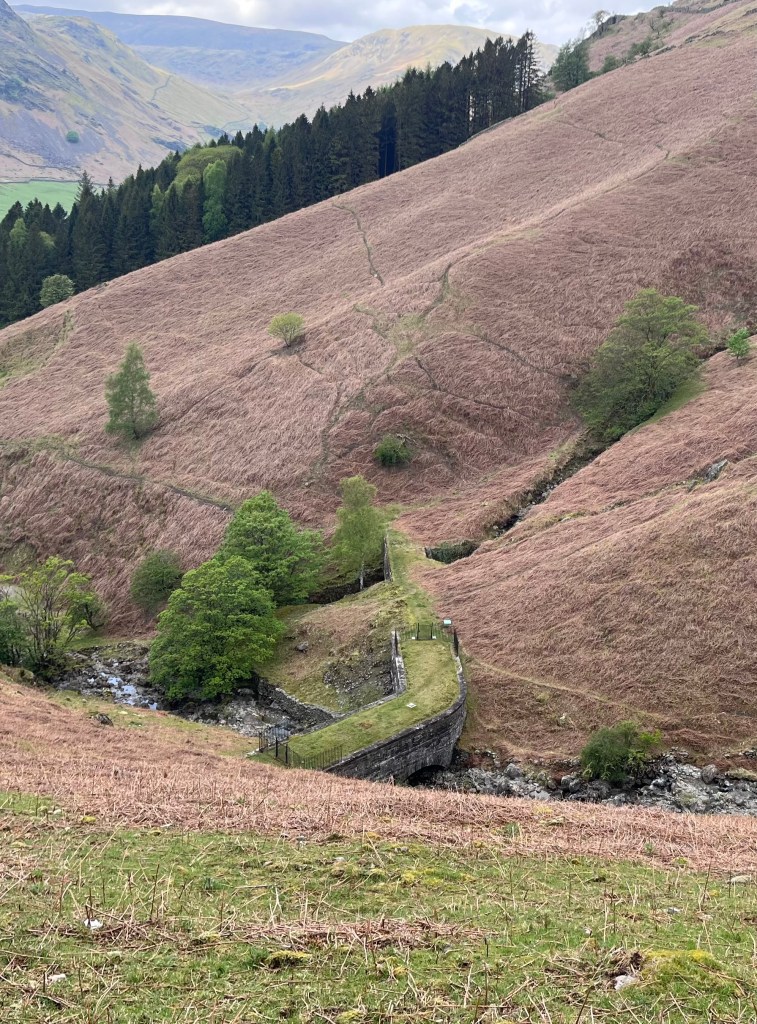
19th century Thirlmere Aqueduct is the longest gravity-fed aqueduct in the country, ending almost 100 miles away in Manchester

I spent a wonderful weekend with friends in the Lake District recently, staying a cottage near the beautiful Grasmere. It’s a lovely, though very small, village and we took time to visit the graves of the famous Wordsworth family found in St Oswald’s churchyard. We walked around the peaceful shores of the lake and also managed a challenging climb up the short but steep Grey Crag to Alcock Tarn.

On the way down the fell, our route guide told us to look out for Thirlmere Aqueduct, a gravity-fed pipeline built in Victorian times that takes fresh water all the way from Thirlmere Reservoir to the city of Manchester. This reminded me of hydro engineer Joseph Foord whom I wrote about in this column a couple of years ago. In the mid-1700s, Foord came up with a groundbreaking system of channels that used gravity to feed fresh water to remote villages high on the North York Moors.

The aqueduct was easy to spot, and took the form of a grass-topped masonry bridge over one of the many streams that tumbled down the hillside. I assumed the stream formed part of the aqueduct, providing plenty of gravity as it raced down the hill, but I was confused about how the system worked. In my head, an aqueduct carries water over or through an obstacle, and upon first sight, this little bridge went over the stream but was not connected to it. Another question was why was it called Thirlmere Aqueduct, when Thirlmere was a good six miles away.

Of course, my column-writing brain kicked immediately into gear, and once I got home, I set about finding out more about this engineering conundrum.

It turns out that what we were looking at was indeed the aqueduct, but the water that was being transported to Manchester was inside the bridge, not running underneath it. The ‘bridge’ was not a bridge at all, but a tunnel.

The aqueduct was the brainchild of engineer John Frederic La Trobe Bateman who was a big name in hydroengineering and established the foundation of today’s British water industry. As the Industrial Revolution took hold, Manchester grew increasingly important as a commercial centre and as a result, the population rapidly grew too. To continue to be successful, the city would need far more water that it was currently getting.

Bateman identified the Lake District as a potential source because it had more far more water than its inhabitants needed, and also plenty of rainfall to ensure a continuous supply. After deliberating over which lake was most suitable, Thirlmere was chosen. There was plenty of opposition from locals understandably wanting to preserve it just as it was. But they were overruled.

I’m a little confused as to the date the ambitious project began, as some online resources suggest it was Queen Victoria who gave the go-ahead in 1890. But I found an obituary published in the year of Bateman’s death (10th June 1889), in which it states work had begun by 1880.

The initial stage involved increasing the size of the lake. Bateman calculated that they had to raise its height by 56 metres to provide the 50 million gallons a day needed, and, which they would achieve by building a dam at one end, and flooding the valley behind it to create a large reservoir.

The next engineering feat was to transport that water across 96 miles and 28 valleys using gravity alone. A series of tunnels totalling around 50 miles were dug out of the rocky hills, some large enough to fit a small car through. The ‘cut and cover’ method was used whereby a ‘D’-shaped trench was dug, lined with brick, and covered with earth. Cast iron pipes were used for the remaining 46 miles and a gentle gradient of 1 in 3000 ensured  a consistent southerly flow of water.

In various places, they had to cross fast-flowing streams tumbling down the fells, some of which ran below the level of the aqueduct. In such cases, the tunnels were constructed within small masonry bridges built over these streams, which is exactly what we saw on our descent from Alcock Tarn.

Thirlmere Aqueduct remains the longest aqueduct in the country, and continues to provide Manchester with its supply using gravity as its main mode of transport.

Those Victorians weren’t half clever.

Do you have opinions, memories or ideas to share with me? Get in touch with me using the ‘Contact’ button on the top right.

This column appeared in the Darlington & Stockton Times on Friday 22nd May and the Ryedale Gazette and Herald on Wednesday 20th May 2026

Solid as a rock

The unfinished millstone near Kildale. You can clearly see the markings made by the mason. But why was it never finished? Picture by John Buckworth

What happens when you suddenly pay attention to something that has not been on your radar before? That thing starts popping up everywhere! A couple of weeks ago I mentioned I’d spotted an old stone trough in the garden of a house near York that piqued my attention. Since then, I have seen them all over the place, in gardens, on roadsides, on footpaths and in fields. Clearly, the stonemasons of North Yorkshire were kept very busy a few centuries ago.

I posed a few questions in the hope that a knowledgeable reader would help me flesh out the history of these troughs. Stan Willis is that knowledgeable reader: “I was fascinated to read your article on stone troughs…The trough would certainly have been cut from a solid piece of rock. To cut a rock that size out of a quarry would have been an achievement in itself. Then it would be to square up before any cutting out was done. It would be dragged to its intended site. The mason wouldn’t risk many weeks of chipping out before transport in case the finished article broke on the final journey. Pickaxes would not be used to cut out the trough…The main cutting would be done with a hammer and cold chisel, a laborious task which probably took several weeks.”

The one pictured with my column was between five and six feet long, about two to three feet wide and almost the same in depth. Stan informed me that such a piece would have been transported on wooden rollers pulled by horses, and that it was likely a drinking trough for large livestock.

He added: “I had the privilege to meet a man from Barnard Castle who probably cut out the last one in the area 50 years ago. He also ran a haulage business; I think is name was Marwood.”

Gurli Svith, who contacted me all the way from Denmark, reads my columns online. She said: “When I saw the picture of a trough, my first thought was ‘The Curse of the Golden Trough’, written by your father.” Gurli was referring to the 5th book in Dad’s Inspector Montague Pluke series, where the eccentric inspector’s hobby, between solving murders, is to seek out and catalogue long forgotten drinking troughs on the North York Moors.

Gurli continued “I do not know much about troughs (we had one at home when I was a child), but since I read your father’s book I notice every trough I see. On some occasions I just take a look at it or into it, and at other times I take photos. But from now on I am sure I will look at the pattern if I see one.”

My column also prompted John Buckworth to contact me on a related subject: “Your article on the stone trough reminded me of the huge millstone in the middle of the moor west of Kildale…I’ve visited it a few times but it is not on a public footpath and difficult to locate when the bracken is up. It is about seven feet in diameter and the top face is finished and ready to flip over and face off the other side. It would take a good team of horses to move it. The nearest water source would be Kildale I assume. I have known about it for 50+ years…I would love to know more about it.” John, like me, imagined that it would have taken the mason many hours of hacking the stone out, and yet the other side remains unfinished. Why, after all that hard work, did he not complete the job?

I wonder if there are any readers out there who know the stone and the history of the area who has any suggestions as to why that is the case? (Please note: I have deliberately not published the exact location due to the fact it is not on a public footpath and there are nesting game birds that should not be disturbed).

Last time I wrote about troughs, I also bet that my dad had a file on them. Sure enough, on my last trip home I found it. But I’ve now run out of space, so I will have to leave what I have discovered for another day.

Do you have opinions, memories or ideas to share with me? Get in touch with me using the ‘Contact’ button on the top right.

This column appeared in the Darlington & Stockton Times on Friday 25th and the Ryedale Gazette and Herald on Wednesday 23rd April 2025

A walk of wonder

IMG_6899
The Hanging Stones Walk in Rosedale is a fantastic celebration of land and art

It may not have escaped your notice that I am rather fond of walking on the North York Moors. I only need half an excuse to head over there for a gallop in the heather. I recently gave a talk to the lovely people of Rosedale WI and someone there mentioned a walk that sounded absolutely fascinating.  

Known as the Hanging Stones Walk, it is much more than just your average bimble. It is an art project sponsored by the Ross Foundation (an organisation that supports initiatives related to art, community, sport, music and education). The foundation commissioned renowned sculptor Andrew Goldsworthy who is famous for his spectacular pieces of land art located in both rural and urban settings.   

The idea of the walk, which starts in Rosedale Abbey, is to create a living and experiential artwork using existing neglected or derelict farm buildings dotted around Northdale. The land belongs to the Rosedale Estate and a series of ancient pathways have been resurrected to link each building. Although the circular walk is not quite finished (there will ultimately be ten buildings to visit), the current series of nine buildings can be visited in four to six hours, depending on how fast you walk and how long you spend in each one. You have to be fairly fit, and able to read a map to locate the buildings. If you do find it a bit strenuous, you have the opportunity to take a breather at each stopping point.   

These old structures have been given a new lease of life, with the original stones being reused as far as possible. They have been constructed in a way that is sympathetic to their original use, and to the land that surrounds them, as if they have always belonged there. They are padlocked shut, so you have to book in advance, and places are limited, but it is well worth the effort. You collect a key and a map, and are let loose to find your way.  

Each installation has its own name, such as ‘Bog’s House’ and ‘Job’s Well’, and as you head towards each one, you begin to wonder what you might find when you arrive, to wonder about its past history and how it was used. What stories would the old building tell if it could speak? The anticipation grows as you put the little key in the lock, because from the outside there are very few visible clues as to what’s going on on the inside. I’m not going to say what is in each, because finding out is part of the enjoyment, but I can say that both of us who went declared ‘Wow’ several times. It was so impressive, and wonderful to just sit by ourselves inside these once neglected buildings to marvel at what they have now become. None of them had any electricity or mains services, and we were often sitting in near darkness with little sound except the calls of birds and the trickling of water. But it gave us some sense of what it must have been like back in the day, back in the times when the residents of these remote dales were not blessed with electric lights, or modern gadgets. It was incredibly peaceful, and a real tonic to be able to switch off from the constant sensual harassment inflicted upon us by everyday life.   

The walk in between each building was a delight in itself too, with expansive views down the valley towards Rosedale, which just served to highlight why it is one of the most beautiful dales in the whole of North Yorkshire.  

It was a privilege to be able to visit, and I marvel at how the creative mind of Andrew Goldsworthy has managed to conceive this amazing, breathtaking art, while at the same time pay homage to the nature and function of the old buildings and the land in which they sit.  

The day we went was overcast, so I plan to go back again on a warm summer’s day and do it all over again. The thing is, if it hadn’t have been for that tip-off resulting from my visit to Rosedale WI I would never have found out about this walk.  

What other wonders are hidden in North Yorkshire that I have yet to find?  

Read more at countrymansdaughter.com. Follow me on Twitter @countrymansdaug  

This column appeared in the Darlington and Stockton Times on 12th and Ryedale Gazette and Herald on 10th May 2023.