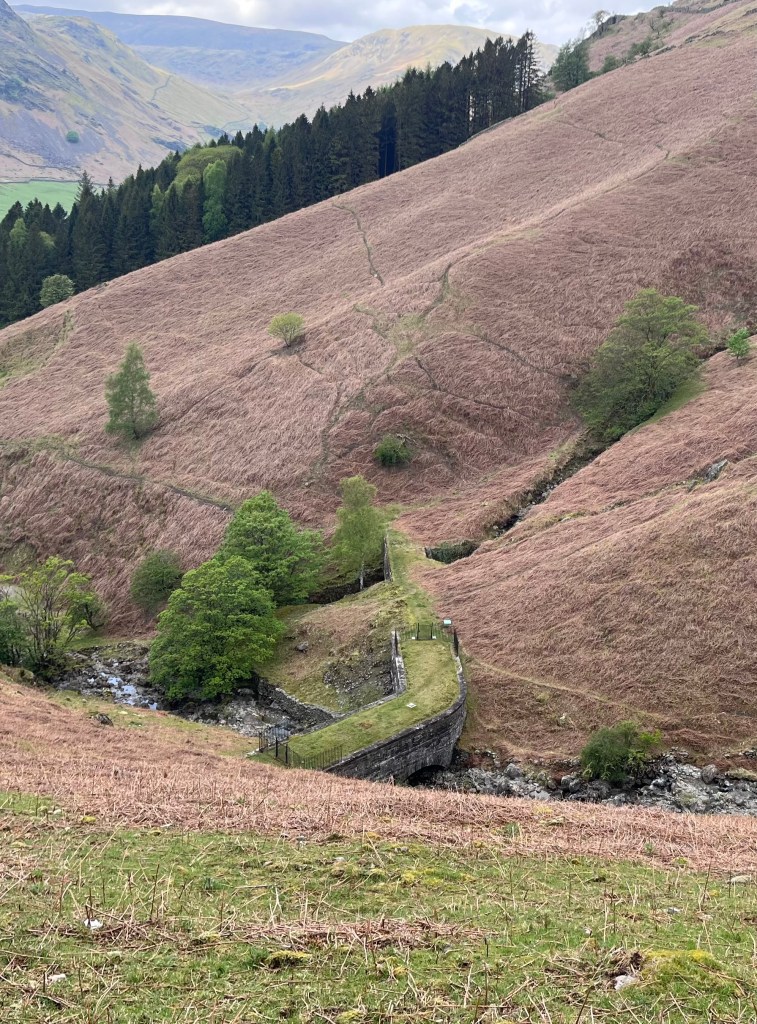
19th century Thirlmere Aqueduct is the longest gravity-fed aqueduct in the country, ending almost 100 miles away in Manchester
I spent a wonderful weekend with friends in the Lake District recently, staying a cottage near the beautiful Grasmere. It’s a lovely, though very small, village and we took time to visit the graves of the famous Wordsworth family found in St Oswald’s churchyard. We walked around the peaceful shores of the lake and also managed a challenging climb up the short but steep Grey Crag to Alcock Tarn.
On the way down the fell, our route guide told us to look out for Thirlmere Aqueduct, a gravity-fed pipeline built in Victorian times that takes fresh water all the way from Thirlmere Reservoir to the city of Manchester. This reminded me of hydro engineer Joseph Foord whom I wrote about in this column a couple of years ago. In the mid-1700s, Foord came up with a groundbreaking system of channels that used gravity to feed fresh water to remote villages high on the North York Moors.
The aqueduct was easy to spot, and took the form of a grass-topped masonry bridge over one of the many streams that tumbled down the hillside. I assumed the stream formed part of the aqueduct, providing plenty of gravity as it raced down the hill, but I was confused about how the system worked. In my head, an aqueduct carries water over or through an obstacle, and upon first sight, this little bridge went over the stream but was not connected to it. Another question was why was it called Thirlmere Aqueduct, when Thirlmere was a good six miles away.
Of course, my column-writing brain kicked immediately into gear, and once I got home, I set about finding out more about this engineering conundrum.
It turns out that what we were looking at was indeed the aqueduct, but the water that was being transported to Manchester was inside the bridge, not running underneath it. The ‘bridge’ was not a bridge at all, but a tunnel.
The aqueduct was the brainchild of engineer John Frederic La Trobe Bateman who was a big name in hydroengineering and established the foundation of today’s British water industry. As the Industrial Revolution took hold, Manchester grew increasingly important as a commercial centre and as a result, the population rapidly grew too. To continue to be successful, the city would need far more water that it was currently getting.
Bateman identified the Lake District as a potential source because it had more far more water than its inhabitants needed, and also plenty of rainfall to ensure a continuous supply. After deliberating over which lake was most suitable, Thirlmere was chosen. There was plenty of opposition from locals understandably wanting to preserve it just as it was. But they were overruled.
I’m a little confused as to the date the ambitious project began, as some online resources suggest it was Queen Victoria who gave the go-ahead in 1890. But I found an obituary published in the year of Bateman’s death (10th June 1889), in which it states work had begun by 1880.
The initial stage involved increasing the size of the lake. Bateman calculated that they had to raise its height by 56 metres to provide the 50 million gallons a day needed, and, which they would achieve by building a dam at one end, and flooding the valley behind it to create a large reservoir.
The next engineering feat was to transport that water across 96 miles and 28 valleys using gravity alone. A series of tunnels totalling around 50 miles were dug out of the rocky hills, some large enough to fit a small car through. The ‘cut and cover’ method was used whereby a ‘D’-shaped trench was dug, lined with brick, and covered with earth. Cast iron pipes were used for the remaining 46 miles and a gentle gradient of 1 in 3000 ensured a consistent southerly flow of water.
In various places, they had to cross fast-flowing streams tumbling down the fells, some of which ran below the level of the aqueduct. In such cases, the tunnels were constructed within small masonry bridges built over these streams, which is exactly what we saw on our descent from Alcock Tarn.
Thirlmere Aqueduct remains the longest aqueduct in the country, and continues to provide Manchester with its supply using gravity as its main mode of transport.
Those Victorians weren’t half clever.
Do you have opinions, memories or ideas to share with me? Get in touch with me using the ‘Contact’ button on the top right.
This column appeared in the Darlington & Stockton Times on Friday 22nd May and the Ryedale Gazette and Herald on Wednesday 20th May 2026

