Growers forcing the issue

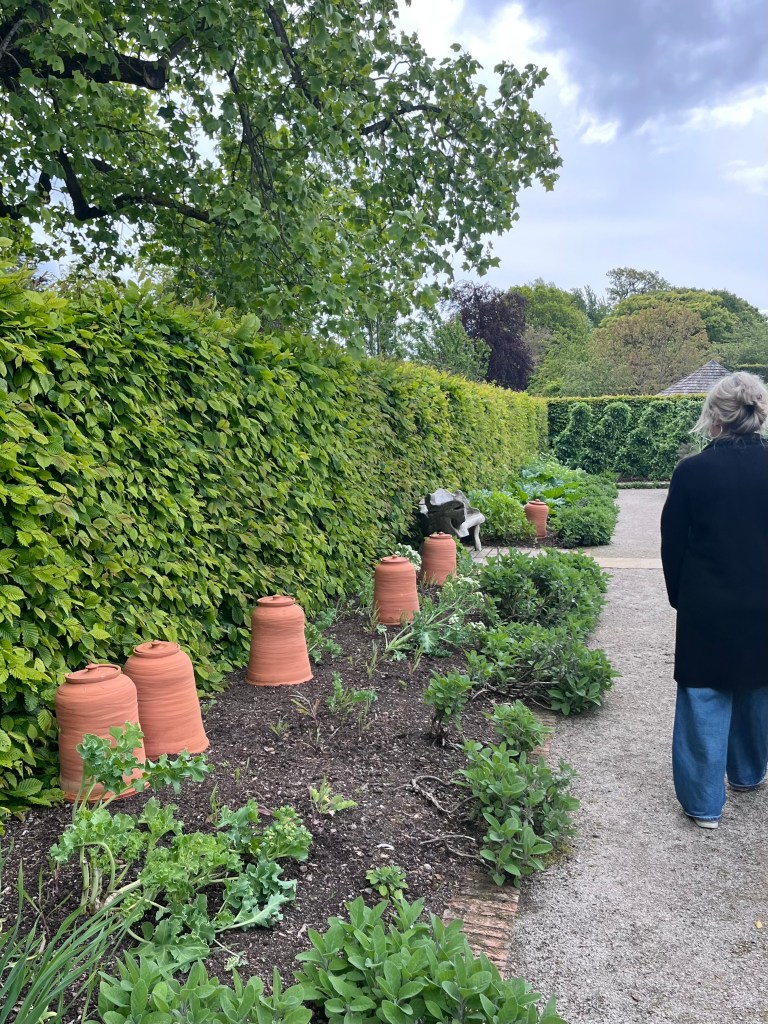
Bell-shaped terracotta pots are used to ‘force’ rhubarb in the kitchen garden at Rudding Park Hotel’s Michelin-starred restaurant ‘Fifty Two’.

I’ve been lucky to have another short trip away, this time to the swanky Rudding Park Hotel near Harrogate for a spa break with my best friend. We started doing this in 2021 when we realised we had been friends for 50 years. We felt that was something worth celebrating, and ever since have made sure just the two of us get away once a year for a weekend of pampering somewhere nice.

We had an afternoon in the spa followed by some relaxing treatments and ended up with a delicious meal in the restaurant. It is a very impressive place, and the staff are clearly well trained, doing everything to make sure your stay is as trouble free and relaxing as possible.

The next morning we were not in any hurry to leave, and decided to have a potter about the grounds. This time of year is hands down my favourite, and we admired the magnificent horse chestnut trees swathed in blossom candles and the rhododendron and azalea shrubs resplendent in their floral frocks of pink, orange, yellow and purple.

There was also a kitchen garden where they grow a huge variety of produce to supply the Michelin-starred restaurant, Fifty Two, which sits just next door. Guests are welcome to wander round and jealously marvel at how healthy and robust the 500 varieties of fruit, veg and herbs look. I’m impressed by people who can grow things. I manage to kill every green specimen that crosses my path, even the herbs that you get from the supermarket. As soon as I put a pot of coriander on my kitchen windowsill, it keels over and dies.

We were intrigued by some strange elongated bell-shaped terracotta pots dotted about the growing beds, and discussed what we thought they might be. In the end we asked one of the gardeners who was busy weeding. Turns out we were speaking to head gardener Emma Pugh, who is extremely knowledgeable about all things horticultural and she explained it was for forcing rhubarb. I’ve heard of ‘forced’ rhubarb and know that in Yorkshire we have the famous Rhubarb Triangle where commercial growers produce rhubarb in huge sheds that do not let in the sunlight. However, I hadn’t before stopped to think about why they might do that.

Emma explained that by restricting the light, the rhubarb is ‘forced’ to grow quicker in a quest to find the sun, and this produces a much sweeter, flavoursome variety than those left to grow au naturel. The stems are longer and thinner, and less stringy too. The lack of sun also means it has a bright pink stalk as opposed to the more bitter red-green ones we associate with the rhubarb from our back gardens. The dark environment also means rhubarb leaves are yellow rather than green.

The terracotta domes were replicating the forced atmosphere so that the chef can create prettier, sweeter and tastier desserts for his diners. The pots are placed over the rhubarb ‘crowns’ in January, and the plant behaves as if it is still underground, forever reaching up towards the daylight. However, a rhubarb plant should only be forced for one season before it is rested, as it really takes it out of the plant having to put so much effort into trying to find something it never will. So the pots are moved around, with the same plant only being forced once every few years.

Emma also explained that the chef had asked her to experiment with forcing other vegetables to see if it improved their taste too. Other commonly forced vegetables include chicory, sea kale and asparagus, and the technique was popularised by the Victorians who wanted to grow produce out of season. Forcing does not just refer to the lack of light, but also to creating warmer temperatures, such as in greenhouses, to encourage plants to grow more quickly, or out of their normal growing period. And it’s worth remembering, for your next pub quiz, that rhubarb is not a fruit, but a vegetable due to its lack of seeds. 

Do you remember a while back I tried ‘wilting’ dandelion leaves in the way you would cook spinach, after reading a column my dad had written suggesting it? It was awful, chewy and bitter.

I wonder if forced dandelion leaves would taste better?

Do you have opinions, memories or ideas to share with me? Get in touch with me using the ‘Contact’ button on the top right.

This column appeared in the Darlington & Stockton Times on Friday 29th May and the Ryedale Gazette and Herald on Wednesday 27th May 2026

Swanning about at Swinton

The Turret at Swinton Park which was an amazing place to stay


The spectacular circular bathroom in The Turret


The dining room is called ‘Samuel’s’ after textile millionaire Samuel Cunliffe-Lister who bought Swinton in 1888


A few years ago, my best friend and I realised that our relationship was about to pass a significant milestone – that of 50 years. We had met when her mum and my dad, who were both writers living in the same village, arranged a play date for us four-year-old girls.


We got on like a house on fire and have been the best of friends ever since. Our friendship is rather unusual in that we have never attended the same school and always had completely separate social circles. We went to different universities, moved to different cities, and lived and worked miles away from each other. And yet our friendship remained steadfast. Apart from my immediate family, she has known me longer than anyone else on the planet. Because we still live 200 miles apart, we don’t see each other as often as we’d like, so the time we do spend together is very precious.


As the half century anniversary approached, we felt it warranted a weekend break together. We had a wonderful time in a nice hotel, just the two of us pampering ourselves, eating good food and drinking good wine and chatting about everything and nothing. It was brilliant.


As happens with other occasions of such national importance, we decreed that it had to be honoured every year. We are both working mothers who have survived raising three children, who have also miraculously emerged (relatively) unscathed, and so it is only right that we get an annual pass out to indulge ourselves.


I’ve just returned from our latest jolly, the fourth, and it has pitched the bar rather high. We went to the swanky Swinton Park Hotel in Masham and found to our delight that, due to an issue with our original room, we had an upgrade – to a turret. Actually, not A turret, but THE Turret. There is only one at Swinton Park.


We had the whole turret to ourselves – all three floors of it. As you’d imagine, the rooms are round in shape and there are a lot of stairs, but the added bonus is that you can work off all the rich food and wine you consume by running up and down to the bathroom on the top floor and the sitting room on the bottom.


For many years, the house was known as Swinton Castle thanks to the Gothic nature of the architecture, with great towers, imposing gateways, battlements atop the walls, and of course the famous turret that stands proud at the main entrance. The original building was constructed in 1695 by the magnificently-named wool merchant, Sir Abstrupus Danby and then inherited by his son, also called Abstrupus, who continued to extend the grand home. But his son, William Danby, presumably miffed at being given such an ordinary name, just about obliterated the original building constructed by his grandfather and replaced it with an extraordinary ‘castle’.


The castle was sold in 1888 to Samuel Cunliffe-Lister, a multi-millionaire in the Bradford textile industry who decided that the turret simply wasn’t grand enough, so he made it bigger and more castley. And when you own the largest silk mill in the world and employ 11,000 people, I think you have earned the right to build a turret as big as you like.


It’s not just about the turret though. Swinton is a vast estate of 20,000 acres across the Yorkshire Dales, employing more than 200 mainly local people. Swinton Park Hotel covers just 200 of those acres, and the whole lot remains in Cunliffe-Lister hands. There was a major bump in the road in the mid-1970s when the family was forced to sell the house due to the rising costs of running the place, not helped by a whopping inheritance tax bill. However, the family were able to buy it back in 2000, and the current owners, Mark Cunliffe-Lister (the 4th Earl of Swinton) and his wife Felicity have transformed it into a thriving multi-faceted business, combining the historic local traditions of the land with our modern expectations of luxurious getaways.


There was a lot more that we didn’t get to see and do on our stay there, so I’m not sure just one night in a turret is enough. We may have to go back next year.


I do wonder, though, do you have a special friendship?


Do you have opinions, memories or ideas to share with me? Get in touch with me using the ‘Contact’ button on the top right. 

This column appeared in the Darlington & Stockton Times on Friday 4th and the Ryedale Gazette and Herald on Wednesday 2nd April 2025