More than a flight of fancy

IMG_1362
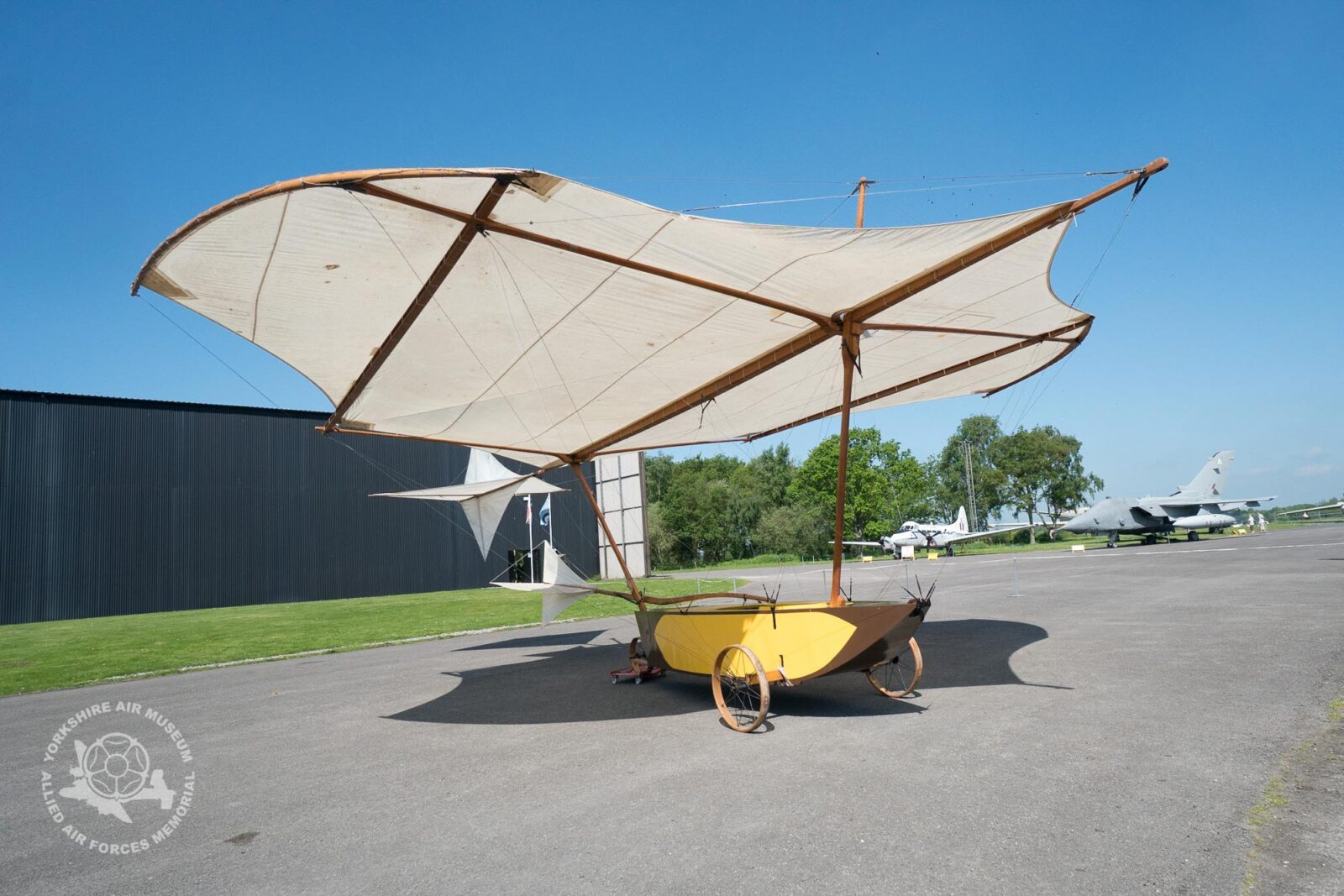
A replica of George Cayley’s Governable Glider housed at the Yorkshire Air Museum at Elvington near York. Picture courtesy of Yorkshire Air Museum.


My column a few weeks ago about the village of Brompton By Sawdon being the ‘birthplace of aviation’ drew some interesting and informative feedback from readers.

If you recall, the village is the birthplace of aeronautical pioneer, Sir George Cayley (1773 – 1857). Cayley is credited with being the first to truly understand the scientific principles of winged ‘heavier than air’ flight. In 1799 he had the idea for a fixed-wing flying machine, but died before he could come up with a suitably light engine to carry humans on a sustained flight. 

But it was Cayley’s theories that contributed to the famous Wright brothers’ success, which they acknowledged when they achieved the first powered flight carrying a human on 17th December 1903. Orville Wright piloted the ‘Wright Flyer’ biplane that he and his brother Wilbur had been developing for four years.

Reader Peter Leek pointed out that Brompton Hall School, a grand building in the centre of the village, was Sir George Cayley’s home. “It is stunning,” he says, “The small octagonal building inside the school grounds, which you can see from the main road, was his workshop. It contains many of his ideas and models…He was a true pioneer in the field of flight and aeronautics.”

Peter goes on: “The plaque on the wall outside says: ‘Scientific Aeronautical Experiment was pioneered from this building. Here the aeroplane was defined for the first time. Circa 1799-1855’. How this is not part of our rich history of explorers, builders and engineers is a mystery to me.”

I quite agree, as does Alan Poxon, who points out that although the Wrights made the first powered flight, Cayley was the first to put a human in a flying machine. “His manned glider flew over Brompton Dale 50 years before the Wright brothers.”

And Garry Mills mentions this too: “The first powered flight was the Wrights, but Cayley had the first human flight. Bit remiss not to include this in the article. From what I’ve read, it’s believed he worked out the principles from watching seagulls in Scarborough.”

Until Cayley came along, most attempts at creating flying machines involved huge flapping wings. But Cayley had spent many hours since childhood studying birds and noticed how seagulls, rather than simply flapping, subtly changed the angle and shape of their wings to remain airborne. It was these observations that inspired him to develop the fixed-wing glider that was launched across Brompton Dale. Known as ‘Cayley’s Governable Parachute’, it had a huge wood-framed canvas canopy with a kite-like tail and, from above, the aircraft resembled a giant stingray. A wooden boat-shaped basket was suspended beneath, complete with a set of oars that the the pilot would use to ‘row’ across the sky. The silhouette of this machine is what you see on the village sign as you enter Brompton. His first attempt came in 1849, using a prototype of the Governable Parachute, when Cayley (who was not reckless enough to attempt to fly his own inventions) hoisted the 10-year-old son of one of his servants aboard his new machine, and it flew for several yards. 

A few years later, in 1853, having made a number of modifications, Cayley enlisted the help of several local youths who pulled the Governable Parachute down a hill while his unwilling coachman, 79-year-old John Appleby, sat anxiously at the helm. The craft launched into the air and flew for 900 yards across Brompton Dale, the first ever manned fixed-wing, ‘heavier than air’ flight. 

Once back on terra firma, the distressed coachman immediately resigned, declaring, “I was hired to drive, not fly!”

Cayley, who was already 80 years old at the time, continued in his quest to create a powered flying machine capable of carrying a human, but died just four years later before he could make his vision a reality. It would be another 46 years before the Wright Brothers accomplished that feat.

Cayley wasn’t just interested in aviation. He was also responsible for inventing a self-righting lifeboat, an artificial hand for amputees, tensioned-spoked wheels for bikes and ferris wheels, caterpillar wheels for heavy vehicles, and various safety features of the railway system including brakes, signals and the cowcatcher. 

If you want to see what Cayley’s Governable Parachute actually looked like, a life-size replica is on display at the Yorkshire Air Museum near York. 

Read more at countrymansdaughter.com. Follow me on Twitter @countrymansdaug (Does anyone call it X?).

This column appeared in the Darlington and Stockton Times on 13th and Ryedale Gazette and Herald on 11th October 2023

Yorkshire pioneer who gave Wright brothers a lift

IMG_8156
The sign at the entrance to a Yorkshire village with a bold claim

P1000539
John Severs’ picture taken in Kirkby Stephen that still shows distances in furlongs

I was contacted back in July by reader John Severs with the following:

“It was another good article you recently published on ploughing strips and the derivation of the furlong measurement, very informative. I’ve attached a photo of a milepost which I took a few years ago in Kirkby Stephen. In addition to the miles, it also indicates furlongs. I suppose that there are some more in the old North Riding area.”

I can’t say I’ve noticed any mileposts that still refer to furlongs, and so this must be a very old one indeed. As I mentioned in my column, a ‘furrow-long’ was considered the length a horse could plough in one day, or a pair of oxen could plough before they needed to rest and was the chosen method of measuring distance when the sport of horse-racing took off in the 1500s. A furlong is an eighth of a mile and they are still marked alongside British racecourses today. The length of any race shorter than a mile, or that is not a round figure in distance, will be described using furlongs.

The black and white signpost in John’s photo shows that it is 12 miles and two furlongs to Appleby from Kirkby Stephen, while Brough is four miles and three furlongs away. It is a very precise measurement, and it reminded me that you rarely see signs showing ‘half’ miles these days. Distances are rounded up or down to the nearest figure and I am guessing it is because it is not essential to know the exact distance when travelling by motorised transport. Perhaps in the days of yore, it was more important to know exactly how far you had left to walk or ride.

On the subject of signs, I was driving through Brompton By Sawdon when the village entry sign caused me to slam on my brakes, stop, and take a picture. Brompton lies about eight miles south-west of Scarborough and what caused me to pull up was the declaration that the village was ‘The Birthplace of Aviation’. What a bold claim, I thought, and immediately determined that I had to delve into it. In my own mind, I expected ‘The Birthplace of Aviation’ to be somewhere far more exotic, like America, where brothers Orville and Wilbur Wright made their groundbreaking first flight.

If you search online for ‘birthplace of aviation’, the Wrights are the first to come up, with Ohio claiming the honour thanks to the fact it was the brothers’ home town. However, I was delighted to see that second on the list is Brompton by Sawdon, and the reason is that it was the birthplace of a pioneering aeronautical engineer, Sir George Cayley (1773 – 1857). Cayley is responsible for many engineering innovations but is credited with being the first to truly understand the scientific principles of winged ‘heavier than air’ flight (as opposed to hot air in balloons, which until then was the only way to get airborne). In 1799 he came up with the idea of a fixed-wing flying machine with separate mechanisms for control, lift and momentum. He developed a model version, which did fly, but soon came to realise that unless someone could come up with an engine that was suitably light, and yet capable of delivering the necessary lift and thrust, then the machine would never be able to carry humans on a sustained flight.

Sadly, he died before he could accomplish that feat, and would not witness how his research and innovation played a huge part in the Wright brothers’ success, which they acknowledged. He would also not have known that his discovery of the four forces that impact on flying aircraft – weight, lift, drag and thrust – would be still used in aviation today.

The first flight carrying a human happened on 17th December 1903 when Orville Wright piloted the ‘Wright Flyer’, the fixed wing, ‘heavier than air’ biplane that he and his brother had been developing for four years. He flew for 12 seconds across 120 feet at Kitty Hawk, North Carolina.

For many years, Kitty Hawk and Ohio disputed with each other as to which of them was the true ‘Birthplace of Aviation’ until, in 2003, Congress came down in favour of Ohio, thanks to the fact the brothers lived and developed their ideas there.

Which place do you think deserves the honour? And have you spotted any noteworthy signs on your travels?

Read more at countrymansdaughter.com. Follow me on Twitter @countrymansdaug

This column appeared in the Darlington and Stockton Times on 22nd and Ryedale Gazette and Herald on 20th September 2023