A cheep of faith

I was at an appointment recently standing at the window waiting for a client.

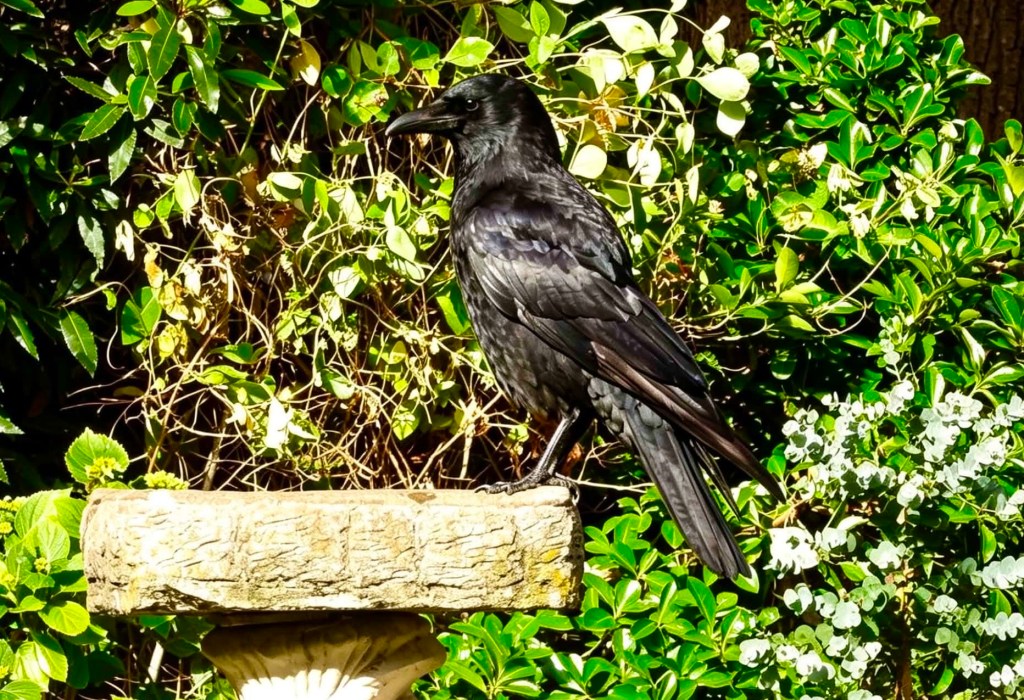
Suddenly, a big glossy crow swooped into view flying at my eye-level across the front of the house before disappearing around the corner. A few seconds later it flew back the way it came with something chunky in its mouth. It looked like a piece of wood, or even a piece of masonry. There was building work going on, so perhaps it had been skip diving? It seemed to know exactly where it was going and what it wanted. But what it would be doing with such a hefty piece of rubbish? It was surely too big for nest building, and definitely not edible, so what would a crow need it for? I welcome suggestions from you bird experts out there.

On the walk there, I’d seen a pigeon fly up off a drive to perch on a roof. It had been standing by something on the ground, and as I drew closer, I realised that sadly it was a deceased baby bird. I wondered how it had ended up there, because it was too young to fly and too far away from any nest to have fallen out. Had it been dropped by an airborne predator perhaps? The pigeon stayed close by, and I have a feeling it may have been its parent, which sparked a pang of sadness. But at this time of year we see a fair amount of avian casualties, such as sickly chicks flung out of nests by parents or siblings. Sometimes fledglings test their wings too soon and end up marooned on the floor.

I’ve mentioned this before, but if you find a young bird on the ground, the RSPB advise to not interfere unless absolutely necessary. Its parents will likely be watching unseen, or off gathering food. To remove a fledgling from its environment has to be a very last resort, and then only if it is injured, in immediate danger, or you have established that it has been abandoned or orphaned.

Another day, I heard a commotion in a nearby fig tree. It was a posse of five or six little black and white birds, all chattering excitedly away. They started off on a low branch, then one hopped to the next branch up, followed by the others, and then seconds later they all hopped up again and so they kept on going up the tree, cheeping away, until they were almost at the top. They stayed there for a few more seconds, before one leapt off, followed by another, and then the rest all at once.

Well, almost the rest. There was one wee chick still left on the tree. It was as if he was plucking up the courage to leap into the unknown, a little afraid of what was to come. Then he did it, jumped off the branch, dropped alarmingly before recovering and following in the direction of his buddies. My guess is that they were fledgling pied wagtails out on the town for the first time.

It reminded me of days in the school playground where there was always a ringleader surrounded by hangers on trying to be cool by association. Then there were those on the periphery trying to fit in but not really managing it, lacking in confidence and battling their demons to try to keep up with the cool kids. If only they realised then that being different and individual is a good thing. Just ask Bill Gates!

The bird’s wobbly flight path also reminded me of the time as a young reporter I had to leap off a cliff for a story. I was strapped to the pilot of a hang glider and needed to gather all my courage to do it. When we took off, I expected to drop like that little chick, but instead, we were lifted upwards on a thermal, which was quite spectacular to experience.

Unfortunately, the thermal soon disappeared, the wind dropped and instead of landing back on the top of the hill as we were meant to, we floated lower and lower down, eventually crash landing at the bottom! Thankfully, we were unhurt. The glider, however, was stuck nose down in the ground.

Let’s hope the brave little chick didn’t end up the same way!

Do you have opinions, memories or ideas to share with me? Get in touch with me using the ‘Contact’ button on the top right.

This column appeared in the Darlington & Stockton Times on Friday 12th and the Ryedale Gazette and Herald on Wednesday 10th June 2026

Yorkshire pioneer who gave Wright brothers a lift

IMG_8156
The sign at the entrance to a Yorkshire village with a bold claim

P1000539
John Severs’ picture taken in Kirkby Stephen that still shows distances in furlongs

I was contacted back in July by reader John Severs with the following:

“It was another good article you recently published on ploughing strips and the derivation of the furlong measurement, very informative. I’ve attached a photo of a milepost which I took a few years ago in Kirkby Stephen. In addition to the miles, it also indicates furlongs. I suppose that there are some more in the old North Riding area.”

I can’t say I’ve noticed any mileposts that still refer to furlongs, and so this must be a very old one indeed. As I mentioned in my column, a ‘furrow-long’ was considered the length a horse could plough in one day, or a pair of oxen could plough before they needed to rest and was the chosen method of measuring distance when the sport of horse-racing took off in the 1500s. A furlong is an eighth of a mile and they are still marked alongside British racecourses today. The length of any race shorter than a mile, or that is not a round figure in distance, will be described using furlongs.

The black and white signpost in John’s photo shows that it is 12 miles and two furlongs to Appleby from Kirkby Stephen, while Brough is four miles and three furlongs away. It is a very precise measurement, and it reminded me that you rarely see signs showing ‘half’ miles these days. Distances are rounded up or down to the nearest figure and I am guessing it is because it is not essential to know the exact distance when travelling by motorised transport. Perhaps in the days of yore, it was more important to know exactly how far you had left to walk or ride.

On the subject of signs, I was driving through Brompton By Sawdon when the village entry sign caused me to slam on my brakes, stop, and take a picture. Brompton lies about eight miles south-west of Scarborough and what caused me to pull up was the declaration that the village was ‘The Birthplace of Aviation’. What a bold claim, I thought, and immediately determined that I had to delve into it. In my own mind, I expected ‘The Birthplace of Aviation’ to be somewhere far more exotic, like America, where brothers Orville and Wilbur Wright made their groundbreaking first flight.

If you search online for ‘birthplace of aviation’, the Wrights are the first to come up, with Ohio claiming the honour thanks to the fact it was the brothers’ home town. However, I was delighted to see that second on the list is Brompton by Sawdon, and the reason is that it was the birthplace of a pioneering aeronautical engineer, Sir George Cayley (1773 – 1857). Cayley is responsible for many engineering innovations but is credited with being the first to truly understand the scientific principles of winged ‘heavier than air’ flight (as opposed to hot air in balloons, which until then was the only way to get airborne). In 1799 he came up with the idea of a fixed-wing flying machine with separate mechanisms for control, lift and momentum. He developed a model version, which did fly, but soon came to realise that unless someone could come up with an engine that was suitably light, and yet capable of delivering the necessary lift and thrust, then the machine would never be able to carry humans on a sustained flight.

Sadly, he died before he could accomplish that feat, and would not witness how his research and innovation played a huge part in the Wright brothers’ success, which they acknowledged. He would also not have known that his discovery of the four forces that impact on flying aircraft – weight, lift, drag and thrust – would be still used in aviation today.

The first flight carrying a human happened on 17th December 1903 when Orville Wright piloted the ‘Wright Flyer’, the fixed wing, ‘heavier than air’ biplane that he and his brother had been developing for four years. He flew for 12 seconds across 120 feet at Kitty Hawk, North Carolina.

For many years, Kitty Hawk and Ohio disputed with each other as to which of them was the true ‘Birthplace of Aviation’ until, in 2003, Congress came down in favour of Ohio, thanks to the fact the brothers lived and developed their ideas there.

Which place do you think deserves the honour? And have you spotted any noteworthy signs on your travels?

Read more at countrymansdaughter.com. Follow me on Twitter @countrymansdaug

This column appeared in the Darlington and Stockton Times on 22nd and Ryedale Gazette and Herald on 20th September 2023