A cheep of faith

I was at an appointment recently standing at the window waiting for a client.

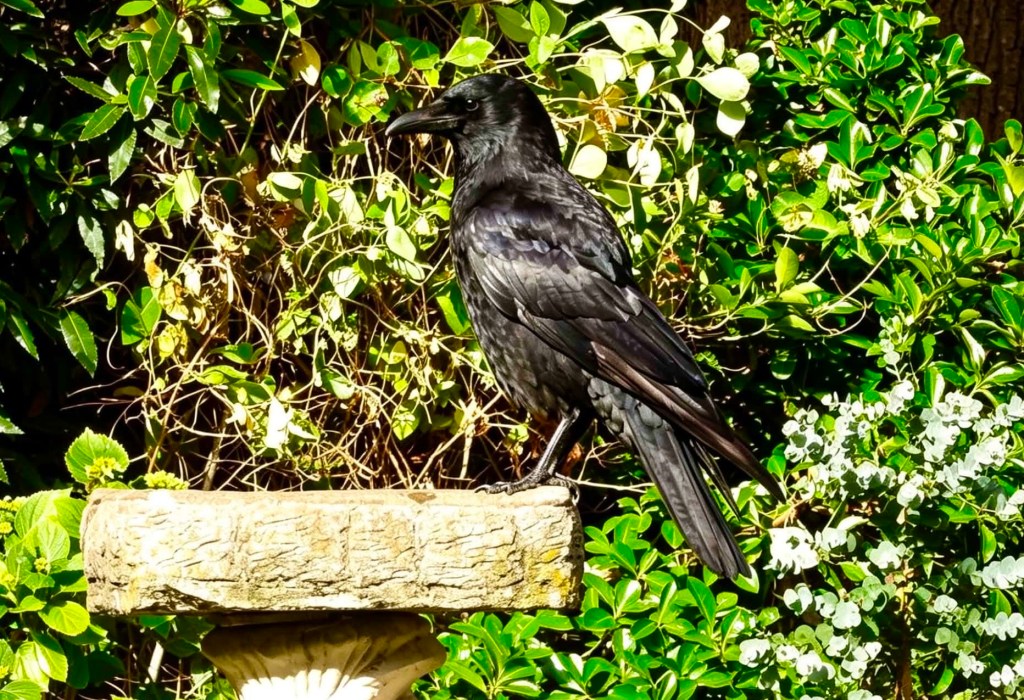
Suddenly, a big glossy crow swooped into view flying at my eye-level across the front of the house before disappearing around the corner. A few seconds later it flew back the way it came with something chunky in its mouth. It looked like a piece of wood, or even a piece of masonry. There was building work going on, so perhaps it had been skip diving? It seemed to know exactly where it was going and what it wanted. But what it would be doing with such a hefty piece of rubbish? It was surely too big for nest building, and definitely not edible, so what would a crow need it for? I welcome suggestions from you bird experts out there.

On the walk there, I’d seen a pigeon fly up off a drive to perch on a roof. It had been standing by something on the ground, and as I drew closer, I realised that sadly it was a deceased baby bird. I wondered how it had ended up there, because it was too young to fly and too far away from any nest to have fallen out. Had it been dropped by an airborne predator perhaps? The pigeon stayed close by, and I have a feeling it may have been its parent, which sparked a pang of sadness. But at this time of year we see a fair amount of avian casualties, such as sickly chicks flung out of nests by parents or siblings. Sometimes fledglings test their wings too soon and end up marooned on the floor.

I’ve mentioned this before, but if you find a young bird on the ground, the RSPB advise to not interfere unless absolutely necessary. Its parents will likely be watching unseen, or off gathering food. To remove a fledgling from its environment has to be a very last resort, and then only if it is injured, in immediate danger, or you have established that it has been abandoned or orphaned.

Another day, I heard a commotion in a nearby fig tree. It was a posse of five or six little black and white birds, all chattering excitedly away. They started off on a low branch, then one hopped to the next branch up, followed by the others, and then seconds later they all hopped up again and so they kept on going up the tree, cheeping away, until they were almost at the top. They stayed there for a few more seconds, before one leapt off, followed by another, and then the rest all at once.

Well, almost the rest. There was one wee chick still left on the tree. It was as if he was plucking up the courage to leap into the unknown, a little afraid of what was to come. Then he did it, jumped off the branch, dropped alarmingly before recovering and following in the direction of his buddies. My guess is that they were fledgling pied wagtails out on the town for the first time.

It reminded me of days in the school playground where there was always a ringleader surrounded by hangers on trying to be cool by association. Then there were those on the periphery trying to fit in but not really managing it, lacking in confidence and battling their demons to try to keep up with the cool kids. If only they realised then that being different and individual is a good thing. Just ask Bill Gates!

The bird’s wobbly flight path also reminded me of the time as a young reporter I had to leap off a cliff for a story. I was strapped to the pilot of a hang glider and needed to gather all my courage to do it. When we took off, I expected to drop like that little chick, but instead, we were lifted upwards on a thermal, which was quite spectacular to experience.

Unfortunately, the thermal soon disappeared, the wind dropped and instead of landing back on the top of the hill as we were meant to, we floated lower and lower down, eventually crash landing at the bottom! Thankfully, we were unhurt. The glider, however, was stuck nose down in the ground.

Let’s hope the brave little chick didn’t end up the same way!

Do you have opinions, memories or ideas to share with me? Get in touch with me using the ‘Contact’ button on the top right.

This column appeared in the Darlington & Stockton Times on Friday 12th and the Ryedale Gazette and Herald on Wednesday 10th June 2026

Very hungry caterpillars

IMG_3715
The box tree caterpillar can decimate a tree within days
IMG_3717
They are very hard to control. These were found in the green waste bin some time after the tree had been chopped up and put in there


I popped in to see my friend Jane the other day and we sat on her terrace overlooking her beautiful garden. She spends hours making sure it is gorgeous, full of healthy-looking shrubs and flowering plants, but she said she had suffered somewhat of a tragedy over recent days. A shrub that she had planted more than 10 years ago seemed to die overnight.

She couldn’t recall its name but said: “It was beautiful with variegated green and yellow leaves, and one day it was fine, and the next it was completely dead!”

Jane had noticed in the days running up to its mysterious demise that it was covered in what looked like cobwebs, and then when it had died and she looked closer, she realised it was infested with caterpillars.

With the help of her husband, they dug up the sad tree, chopped it up and disposed of it in her green waste bin, at the same time as picking off and exterminating as many caterpillars as they could find. They both love animals and nature and weren’t happy at permanently getting rid of the creatures but reasoned that if they can destroy a whole shrub overnight, they cannot be a good thing to have in your garden. Sentimentality went out of the window.

I asked what the caterpillars looked like, and wondered which butterfly or moth they would eventually turn into. Jane showed me her bin with the remains of the brown and withered shrub and there were dozens of the critters still crawling around it. The caterpillars were a couple of inches long with green and black stripes and a black head, and clearly, they hadn’t managed to capture all of them.

Well, this is the kind of murder mystery that the Countryman’s Daughter thrives upon, and as soon as I got back home, I donned my detective hat and set to work. It took me a good minute of eager Googling to crack the case wide open.

Jane’s plant had been slaughtered by the Box Tree Strangler – I mean Caterpillar.

The Box Tree Caterpillar, which is active during spring and summer, is an invasive species that the RHS says is becoming one of the most common problems in British gardens. It predicts that 2024 will be a bumper year, with five times as many cases reported in the first four months of this year than last. This very hungry caterpillar stowed away on plants imported from east Asia in 2007, although the first moth found in a private garden was not reported until 2011. It quickly became a significant problem in the south east, and steadily began to make its way north, unfortunately landing in Jane’s garden this week.

The box tree is a common sight across the land, often being clipped into geometric shapes or animals by those fond of topiary. If you’ve been to places like Castle Howard, Broughton Hall or Beningbrough Hall, then you’ll have seen some fine examples. But if you have some in your own garden, you need to start regularly inspecting it for this particular critter. If you shake your box tree and moths fly out, then that’s a sure indicator they are laying eggs, so you need to get on the case pronto. The moth (Cydalima perspectalis) has white wings with brown borders, or sometimes is brown all over, and lays its eggs on the underside of box leaves. The eggs are flat and yellow and overlay each other, a bit like tiny fish scales. Initially, the problem can look like box blight, a fungal disease, but a tell-tale sign is the web-like substance that can appear all over the tree. The caterpillars weave this over their feeding area, and once you see that, they can decimate a whole tree within days.

Thankfully, they are only interested in the box tree, so a sure way of keeping them away is to not keep any in your garden. Even when a tree or hedge looks dead, though, it can be rescued with effort and persistence and there is lots of advice online. If you discover it, then you should report it (again online is the place to go to find out how).

One last question – if box tree caterpillars destroyed all the box in the land, would they die out or simply change their diet?

I’d love to hear from you about your opinions, memories and ideas for columns. Use the ‘Contact’ button on the top right of this page to get in touch. This column appeared in the Darlington & Stockton Times on Friday 7th and the Ryedale Gazette and Herald on Wednesday 5th June 2024.