A cheep of faith

I was at an appointment recently standing at the window waiting for a client.

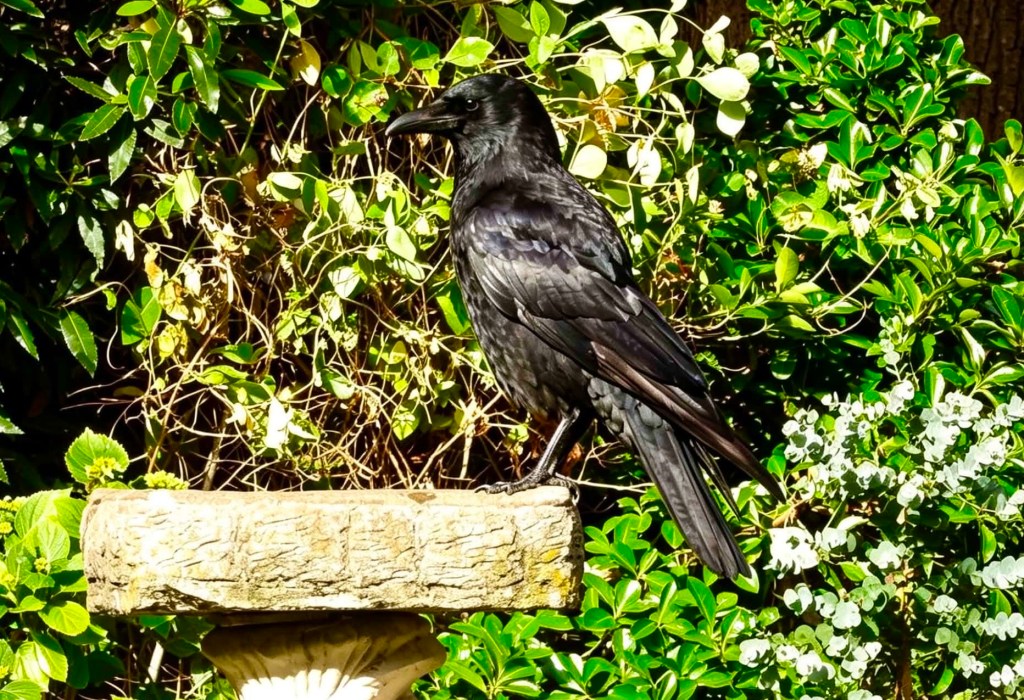
Suddenly, a big glossy crow swooped into view flying at my eye-level across the front of the house before disappearing around the corner. A few seconds later it flew back the way it came with something chunky in its mouth. It looked like a piece of wood, or even a piece of masonry. There was building work going on, so perhaps it had been skip diving? It seemed to know exactly where it was going and what it wanted. But what it would be doing with such a hefty piece of rubbish? It was surely too big for nest building, and definitely not edible, so what would a crow need it for? I welcome suggestions from you bird experts out there.

On the walk there, I’d seen a pigeon fly up off a drive to perch on a roof. It had been standing by something on the ground, and as I drew closer, I realised that sadly it was a deceased baby bird. I wondered how it had ended up there, because it was too young to fly and too far away from any nest to have fallen out. Had it been dropped by an airborne predator perhaps? The pigeon stayed close by, and I have a feeling it may have been its parent, which sparked a pang of sadness. But at this time of year we see a fair amount of avian casualties, such as sickly chicks flung out of nests by parents or siblings. Sometimes fledglings test their wings too soon and end up marooned on the floor.

I’ve mentioned this before, but if you find a young bird on the ground, the RSPB advise to not interfere unless absolutely necessary. Its parents will likely be watching unseen, or off gathering food. To remove a fledgling from its environment has to be a very last resort, and then only if it is injured, in immediate danger, or you have established that it has been abandoned or orphaned.

Another day, I heard a commotion in a nearby fig tree. It was a posse of five or six little black and white birds, all chattering excitedly away. They started off on a low branch, then one hopped to the next branch up, followed by the others, and then seconds later they all hopped up again and so they kept on going up the tree, cheeping away, until they were almost at the top. They stayed there for a few more seconds, before one leapt off, followed by another, and then the rest all at once.

Well, almost the rest. There was one wee chick still left on the tree. It was as if he was plucking up the courage to leap into the unknown, a little afraid of what was to come. Then he did it, jumped off the branch, dropped alarmingly before recovering and following in the direction of his buddies. My guess is that they were fledgling pied wagtails out on the town for the first time.

It reminded me of days in the school playground where there was always a ringleader surrounded by hangers on trying to be cool by association. Then there were those on the periphery trying to fit in but not really managing it, lacking in confidence and battling their demons to try to keep up with the cool kids. If only they realised then that being different and individual is a good thing. Just ask Bill Gates!

The bird’s wobbly flight path also reminded me of the time as a young reporter I had to leap off a cliff for a story. I was strapped to the pilot of a hang glider and needed to gather all my courage to do it. When we took off, I expected to drop like that little chick, but instead, we were lifted upwards on a thermal, which was quite spectacular to experience.

Unfortunately, the thermal soon disappeared, the wind dropped and instead of landing back on the top of the hill as we were meant to, we floated lower and lower down, eventually crash landing at the bottom! Thankfully, we were unhurt. The glider, however, was stuck nose down in the ground.

Let’s hope the brave little chick didn’t end up the same way!

Do you have opinions, memories or ideas to share with me? Get in touch with me using the ‘Contact’ button on the top right.

This column appeared in the Darlington & Stockton Times on Friday 12th and the Ryedale Gazette and Herald on Wednesday 10th June 2026

Difficult fact to swallow

Swallows chatting on overhead lines above me, as if they were scoping out the property’s conservatory to set up home


A swallow feeds its young in a nest under the eaves. Photo by Alastair Smith


I was conducting a house viewing recently where the potential buyers had come for a second look before deciding whether they were going to make an offer or not. It was a lovely stone cottage in the Hambleton Hills with a gorgeous garden and wonderful views at the back.

Because the viewers had been before, I allowed them some privacy and selected a sunny spot outside to sit and wait until they had finished their visit. At the back of the house was a beautiful oak-framed conservatory, and I had opened up the bifold doors to make the most of the wonderful weather.

Not long after I sat down, I noticed a pair of swallows chattering on an overhead power line not far away. I had seen them on an earlier visit, and it had lifted my spirits knowing that the swallows had returned from the southern hemisphere, a portent of the summer soon to follow.

They seemed to be observing the conservatory, nodding to each other and chattering excitedly. It looked as if they were considering it as a suitable place to make a home. To a swallow, it would seem perfect, with sturdy timber y-frame struts and beams offering a selection of nesting sites under the vaulted ceiling, the slate roof providing safety, warmth and shelter.

Soon the birds left their spot on the overhead line, and performed a couple of ‘fly-bys’, sweeping round in wide circles, getting closer to the doors each time, then landing back on the power line to resume their excited chatter.

Moments later, they disappeared into a small shed in the neighbouring garden with a gap at the top of the door. Soon, they were back on the line, resuming their conversation.

Having studied the Swallowish language, I can tell you that the conversation went like this:

“Look at that spot Rita! What a fancy des res. So much light and and space, and with direct access to a bounty of food supplies.”

“Yes, it really is the dream home, isn’t it, Bertie. Imagine bringing up the children here, the garden is to die for. It is so much nicer than that pokey little shed you’ve made us move into. Dark and dingy, and only a wall for a view! The kids will be miserable there, whereas here…”

“I know dear, but then again it is so big, it could be a bit draughty…”

“Draughty? Nonsense! It’s south facing which is exactly what we need – all that sunlight! That grotty shed is north facing, and the roof has holes in it. The kids will be freezing, as will I! I didn’t fly 6000 miles from Johannesburg to spend my summer in a dingy old shed. I need warmth and a view while I bring up the kids, Bertie, and I deserve it after surviving that bloomin’ journey.”

“I suppose you are are right, Rita. I wonder if anyone else is interested in it? I wouldn’t want any dodgy neighbours.”

I kept my beady eye on them the whole time I was there, because anyone who has had swallows resident in their garden knows just how quickly they can dive into an open shed, garage or barn, and then get locked in. We once had to leave our own garage open for a day or so, keeping our eyes on it to see when both swallows had popped out so we could shut the door and prevent them from completing their nest. It felt a bit cruel, but they soon moved on to a more suitable nesting site.

Swallows fly south for the winter because the insects they rely upon for survival are no longer available. Before the 20th century, we didn’t even know they had left the country, and some scientists believed they hibernated, with one bizarre theory suggesting they survived at the bottom of ponds.

It was in 1912, after the introduction of bird ringing, that a swallow was found on a farm in South Africa bearing a ring that had been placed on its leg 18 months earlier by amateur naturalist John Masefield from Staffordshire.

However, more recently, with milder winters becoming commonplace, some swallows have been found to stay in the southern UK all year.

Is it just me, or does news unsettle some of you too?

Do you have opinions, memories or ideas to share with me? Get in touch with me using the ‘Contact’ button on the top right.

This column appeared in the Darlington & Stockton Times on Friday 30th and the Ryedale Gazette and Herald on Wednesday 28th May 2025