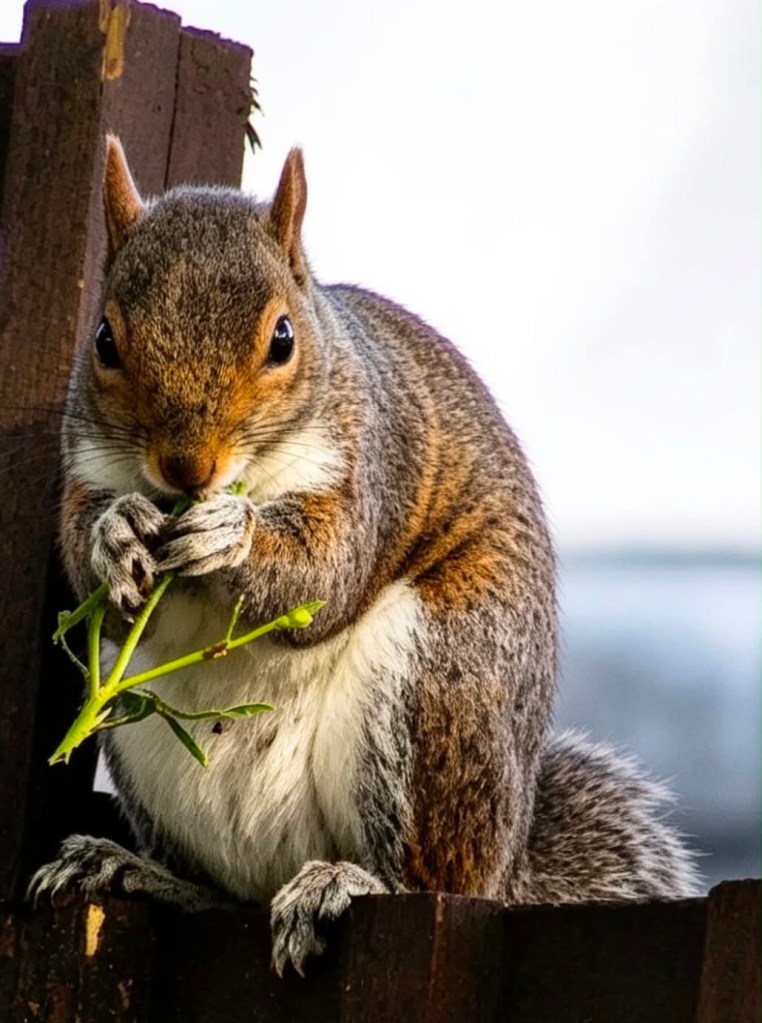
Squirrelling away supplies for winter

Grey squirrel’s stock up in advance of winter by burying acorns. Picture by Mick Gisbourne

Autumn is well and truly established now, and the signs of Nature preparing for winter are all around us. The trees are shrugging off their beautiful cloaks of reds, browns and yellows as the leaves let go of their hosts and tumble to the ground.

I was on one of my regular dog-walking routes the other day when I passed a small enclosed area near an electric substation and was surprised to see no less than four squirrels ferreting around on the ground. When they noticed me they all froze mid-movement, as if the tune had suddenly stopped during a game of musical statues. Seconds later they scattered in unison to the safety of the nearby foliage.

The ground was covered in a carpet of freshly fallen leaves and, as I suspected, the tree they had tumbled from was an oak. The squirrels were of course hunting for acorns.

You may have noticed that squirrels are highly active at the moment. These industrious bushy-tailed rodents have a fair bit of work to do to prepare for the cold weather. Because they do not hibernate, squirrels need to stock up on enough food for the barren days ahead as well as insulate their home with layers of leaves and moss so they survive the chilly months of hardship.

You can spot their nests high up in the trees, at least six metres from the ground, looking like giant scruffy basketballs lodged in the branch forks. They can be mistaken for the nests of big birds like magpies or crows, but to spot the difference (if you have good eyesight or a pair of binoculars) is to look for twigs with leaves woven into the sides of the nest. Birds only use leafless sticks for their home-building projects.

The squirrel is arguably one of our cleverest mammals, as demonstrated by the way it ensures its own survival. When food is plentiful, it will collect the surplus to store for later in a habit known as ‘caching’, which comes from the French word ‘cacher’ meaning ‘to hide’. The grey squirrel digs small shallow holes to conceal such delicacies as acorns, beech nuts, chestnuts and walnuts. Rather than bury them all in the same place, they scatter them around a wide area surrounding their nest, thus ensuring that if one cache is found by a thief, they will not lose all their loot in one fell swoop.

They try not to broadcast to others where they are burying their precious edible treasures either and are known to dig a hole and pretend to bury a nut if they think they are being watched by a rival. Then they scamper off to find a safer place to stash their booty.

At the risk of upsetting fans of their much admired and less prolific relative, the red squirrel, I think the grey was given the bulk of the intelligence genes when they were handed out. Reds have a habit of hiding their winter stash in a single spot (known as a ‘midden’) which means they leave easy pickings for eager competitors like the grey. You’d think they’d learn once their hoard had been stolen a couple of times, but alas not.

If you stay still and watch a squirrel for a while, you might spot another clever trait such as shaking or sniffing an acorn or a nut. By doing this, the squirrel is testing whether it has been invaded by a weevil because its sound and smell will be abnormal. If they detect the grub, these omnivores will consume the food immediately, weevil and all. Had they buried it, it would either have gone rotten, or it would have been consumed by the weevil by the time winter came.

There is some debate as to how accurate the squirrels are in retrieving their own stashes, which often occurs months after they buried them. There is evidence that they use their powers of smell alongside their memories to detect the exact spot where they secreted a particular nut. However they regularly steal supplies hidden by their neighbours too. Whether they think they’ve found their own nuts, or are aware they belong to someone else, is hard to tell.

My guess is that these Artful Dodgers of the natural world know full well but just don’t care.

I’d like to pass on my sincere condolences to the family of Mick Gisbourne who passed away last week and whose wonderful squirrel photo accompanies this week’s piece. It is one of many excellent images he allowed me to use over the years. RIP Mick.

Do you have opinions, memories or ideas to share with me? Get in touch with me using the ‘Contact’ button on the top right.

This column appeared in the Darlington & Stockton Times on Friday 13th and the Ryedale Gazette and Herald on Wednesday 11th Oct 2026

Difficult fact to swallow

Swallows chatting on overhead lines above me, as if they were scoping out the property’s conservatory to set up home


A swallow feeds its young in a nest under the eaves. Photo by Alastair Smith


I was conducting a house viewing recently where the potential buyers had come for a second look before deciding whether they were going to make an offer or not. It was a lovely stone cottage in the Hambleton Hills with a gorgeous garden and wonderful views at the back.

Because the viewers had been before, I allowed them some privacy and selected a sunny spot outside to sit and wait until they had finished their visit. At the back of the house was a beautiful oak-framed conservatory, and I had opened up the bifold doors to make the most of the wonderful weather.

Not long after I sat down, I noticed a pair of swallows chattering on an overhead power line not far away. I had seen them on an earlier visit, and it had lifted my spirits knowing that the swallows had returned from the southern hemisphere, a portent of the summer soon to follow.

They seemed to be observing the conservatory, nodding to each other and chattering excitedly. It looked as if they were considering it as a suitable place to make a home. To a swallow, it would seem perfect, with sturdy timber y-frame struts and beams offering a selection of nesting sites under the vaulted ceiling, the slate roof providing safety, warmth and shelter.

Soon the birds left their spot on the overhead line, and performed a couple of ‘fly-bys’, sweeping round in wide circles, getting closer to the doors each time, then landing back on the power line to resume their excited chatter.

Moments later, they disappeared into a small shed in the neighbouring garden with a gap at the top of the door. Soon, they were back on the line, resuming their conversation.

Having studied the Swallowish language, I can tell you that the conversation went like this:

“Look at that spot Rita! What a fancy des res. So much light and and space, and with direct access to a bounty of food supplies.”

“Yes, it really is the dream home, isn’t it, Bertie. Imagine bringing up the children here, the garden is to die for. It is so much nicer than that pokey little shed you’ve made us move into. Dark and dingy, and only a wall for a view! The kids will be miserable there, whereas here…”

“I know dear, but then again it is so big, it could be a bit draughty…”

“Draughty? Nonsense! It’s south facing which is exactly what we need – all that sunlight! That grotty shed is north facing, and the roof has holes in it. The kids will be freezing, as will I! I didn’t fly 6000 miles from Johannesburg to spend my summer in a dingy old shed. I need warmth and a view while I bring up the kids, Bertie, and I deserve it after surviving that bloomin’ journey.”

“I suppose you are are right, Rita. I wonder if anyone else is interested in it? I wouldn’t want any dodgy neighbours.”

I kept my beady eye on them the whole time I was there, because anyone who has had swallows resident in their garden knows just how quickly they can dive into an open shed, garage or barn, and then get locked in. We once had to leave our own garage open for a day or so, keeping our eyes on it to see when both swallows had popped out so we could shut the door and prevent them from completing their nest. It felt a bit cruel, but they soon moved on to a more suitable nesting site.

Swallows fly south for the winter because the insects they rely upon for survival are no longer available. Before the 20th century, we didn’t even know they had left the country, and some scientists believed they hibernated, with one bizarre theory suggesting they survived at the bottom of ponds.

It was in 1912, after the introduction of bird ringing, that a swallow was found on a farm in South Africa bearing a ring that had been placed on its leg 18 months earlier by amateur naturalist John Masefield from Staffordshire.

However, more recently, with milder winters becoming commonplace, some swallows have been found to stay in the southern UK all year.

Is it just me, or does news unsettle some of you too?

Do you have opinions, memories or ideas to share with me? Get in touch with me using the ‘Contact’ button on the top right.

This column appeared in the Darlington & Stockton Times on Friday 30th and the Ryedale Gazette and Herald on Wednesday 28th May 2025