Pondering on the past

3B2F82BC-3419-46EC-8255-B0DE005F2E98_1_105_c
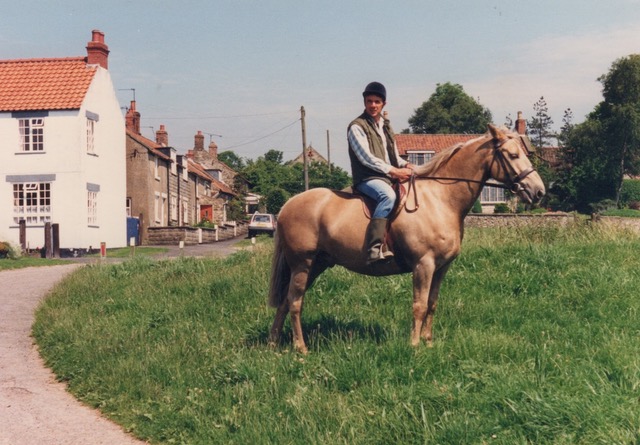
Reader Paul Ireson on one of his horses in Newton-on-Rawcliffe in about 1987. He owned and named Old Pond House which can be seen with the red door near the car behind him. A carved witch post stands still in tact in the sitting room of the house.

Following my columns about festive birthdays, I have been contacted by one of the few people who declares to enjoy them.

Andrea Dandy says: “I was born on Christmas Day in 1941 and have loved every birthday. When I was a child my brother would complain I always got more presents than him. He didn’t realize I never got any presents during the year. When I had three sons, they also always said I got a lot of presents at Christmas. I also have a nephew who was born on my 27th birthday.”

It sounds like Andrea was quite fortunate, with her loved ones making sure she had enough gifts to cover both Christmas and her birthday, contrary to the experiences of other readers who felt hard done by.

I get a bit of a thrill when readers find articles that I wrote a while back and come to me with new information.

Paul Ireson got in touch about a couple of columns I wrote in January 2023 concerning witch posts. If you remember, these carved posts are usually found near fireplaces in very old houses and originally it was thought that the carvings, often featuring crosses, were intended to ward off evil spirits and witches, hence the name. But over the years, my dad came to believe they were in fact associated with the legendary Martyr of the North York Moors, Father Nicholas Postgate, at a time when Catholics were being persecuted. Dad discovered that posts bearing these cross symbols only proliferated during the time of the martyr, and only in areas he is thought to have visited, which is the main reason why he believed they were connected to Postgate. Their purpose, he suggested, was to secretly indicate to fellow Catholics that they were in a safe house. It is possible that the association with witches was a deliberate ploy by Catholics to spread misinformation so that the true meaning behind the symbols would not be discovered. One of these posts can be seen in the Ryedale Folk Museum in Hutton-le-Hole today.

In one of the columns, I mentioned a 17th century cottage called Old Pond House which has a witch post in its living room. Paul revealed: “I bought Old Pond House in Newton-on-Rawcliffe (near Pickering) in 1986 for £38,000 including stables and a three-acre field. We lived there for several years. I had never heard of a witch post and occasionally people would look through the window and enquire about the post. I revisited Newton recently as I now live at Rosedale but didn’t get a chance to visit the house.”

Paul remembered that when he lived in Newton, there was a dairy farm and a post office-cum-shop in the village, but they have been converted into holiday rentals. He added that their house didn’t have a name and they’d wanted to call it ‘Pond House’. Unfortunately, that name had already been taken by a neighbouring property and so, as their cottage was older, they chose ‘Old Pond House’ instead! He said: “The witch post was in original condition and was always a talking point with visitors.

“At the time I was working in a shop and my wife was a receptionist which shows how affordable property was then. Mind you the mortgage rate was about 12%!…We lived there for four years and had two horses…We travelled to York to work every day in an old Volvo estate that did about 20 miles to the gallon. I recall a few bad winters when we would all wait for the snow plough to come up from Pickering before we could get to work.”

It makes me wonder whether people would go to that effort these days. Not only is the road as far as Pickering (where you pick up the main road) single track, and therefore not easy to navigate in wintry conditions, but it is also a good 35 miles into York. I do remember that, living in a village 20 miles from school, we would go to extraordinary lengths to get there, and very rarely did we look out of the window and decide it was too snowy to set out. These days, it seems, a few flakes come down and the whole of Britain grinds to a halt! But then, we were a hardy lot back then, weren’t we.

Or were we just foolhardy?

This column appeared in the Darlington & Stockton Times on Friday 8th March and the Ryedale Gazette and Herald on Wednesday 6th March 2024.
Little book of Mystery

IMG_6638
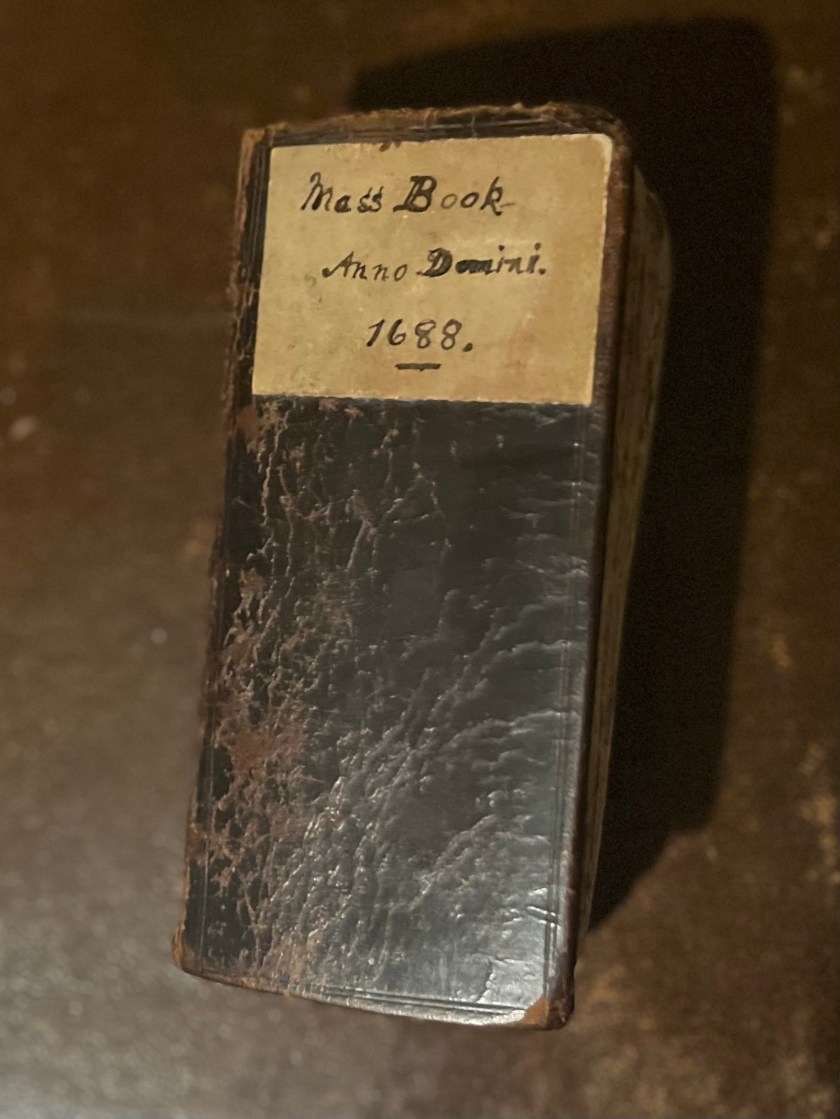
A mass book from 1688 that I found in my dad’s study
IMG_6643
The inside page of the mass book I found in my dad’s study. It was published at the Lamb Inn in Holborn, London, by Matthew Turner in 1688

I have had another letter from Jennie Sanderson, the direct descendant of Hannah Raw’s brother, John. To recap for anyone who has not been following this ever-evolving story, my family had no idea how we came to have Hannah’s sampler, which she embroidered in 1835 when she was nine years old. It was found rolled up in a drawer at my late Nana’s house, along with others done by my ancestors. We are not related to Hannah’s family.

I had sent Jennie a picture of Hannah’s sampler, and of her grave showing the the flowers that I had placed there after tracking it down with the help of readers. Jennie said she was very moved by it: “What a lovely thought to take the time to travel to the grave and lay flowers. On behalf of Great Aunt Hannah, thank you.”

Jennie also has a theory as to how we came to have Hannah’s sampler. She is descended from Hannah’s elder brother John, who was born two years before Hannah. She thinks my great great aunt, Jane Lacy, who made one of the samplers, must have been friends with Hannah, and writes: “I know that my Raw/Sanderson families were Methodists, so maybe the girls attended the chapel in Glaisdale (where John was baptised in 1823) and worked their samplers there. It’s very early for a ‘state’ school, so a Sunday school where the girls could learn their ‘letters and numbers’ seems quite likely.”

She adds: “Strange, isn’t it how the spirits of these little girls from the 1830s have materialised 188 years later via these samplers to rise your curiosity and, thankfully, because they were kept safe by your family, have found their way onto your mum’s kitchen wall, and have brought these little girls back to life.”

This story leads me on to another family mystery – if you can bear yet another one! In my dad’s study I noticed a little book tucked on a shelf, a book that I have been aware of for many years, but which I hadn’t paid much attention to.

It is a small leather bound mass book dating from 1688. I have no idea how it came into our family’s possession, but it belonged to one of my dad’s uncles. I would guess that, with my dad’s writing career and interest in Catholic history, his uncle felt that Dad was a suitable person to pass it on to. We have no idea how my uncle got hold of it, whether it was passed down by generations of our family, or if he simply picked it up in an antiques shop

The front page states that the book is a ‘Collection of Prayers Containing the Mass in Latin and English’ and was printed for a Mr Turner ‘at the Lamb in Holbourn, 1688’. Opposite, pasted to the inside the of the front cover, is a label with an and address (J.Walker, no relation), plus a handwritten note saying ‘page 305’.

When I turned to that page, there was a pencil mark next to a certain verse, which follows instructions on how devout Catholics must receive Holy Communion.

‘Let the tongue touch the inner side of the lip, to receive the Host, and bring it into the mouth, which being reverently held on the tongue, till it be moisten’d, is so to be let down into the Stomach without chewing.’

And the bit that has a pencil mark next to it reads: ‘Then take the Absolution, which is a little wine.’ We are then advised to return to our prayers and refrain from spitting, if we can!

Catholic persecution had begun after Pope Clement VII refused to annul Henry VIII’s marriage to Catherine of Aragon in 1534. Henry declared himself Supreme Head of the Church in England and had all Catholic monasteries destroyed, although it was during his daughter Elizabeth I’s reign (1558-1603) that it actually became illegal to practice Catholicism.

The date of the mass book, 1688, comes right at the end of a brief respite from persecution under King James II (1685-1688), but apart from that, practising Catholicism remained illegal until 1791, and so to carry such a book after 1688 would have been very dangerous. It might explain why it is so small, so that it could easily be hidden.

Can anyone out there shed any more light on this precious family treasure?

Read more at countrymansdaughter.com. Follow me on Twitter @countrymansdaug

This column appeared in the Darlington and Stockton Times on 23rd June and Ryedale Gazette and Herald on 21st June 2023