
A tip-off leads to Guy’s downfall

The dastardly plot by Guy Fawkes and his fellow conspirators led to us celebrating Bonfire Night with fireworks. Picture by Jill Wellington from Pixabay


It’s that time of year again when we hear booms and bangs across consecutive weekends surrounding Bonfire Night. I’ve written before about my opinions on noisy fireworks and don’t understand why the use of silent ones has not yet been enforced so we can simply enjoy the wonderful visual spectacle without terrorising people or pets seriously affected by the noise. It looks like it is on the cards for community displays next year, which will provide relief for some.


Of course what started the whole thing off was the Gunpowder Plot. In the early hours of 5th November 1605, York-born Guy Fawkes was caught in a cellar below the Palace of Westminster, match in hand, next to barrels full of gunpowder. His and his co-conspirators’ plan was to ignite a massive explosion during the State Opening of Parliament the next morning, with the aim of killing Protestant King James I, obliterating his government and sparking a revolution to restore a Catholic to the throne and end years of persecution.


Unfortunately for Guy, an anonymous tip-off led to his discovery and he was imprisoned in the Tower of London. Subjected to relentless torture, he eventually revealed the names of his fellow conspirators and the whole plan unravelled. Just days later on 8th November, plot leaders Robert Catesby and Thomas Percy were killed in a siege at Holbeche House in Staffordshire, while most of the other plotters were rounded up, caught and imprisoned.


On 31st January 1606, the men were subjected to the traditional punishment for treason – public hanging, then ‘drawn’ (taken down just before you are dead and disembowelled) before being ‘quartered’ (having your limbs removed). The separated body parts were then scattered throughout the kingdom, the ultimate humiliation for Catholics for whom being interred in sacred consecrated ground was the only way to enter heaven.


Having gone to school in York, I’m well aware of the oft-repeated claims that St Peter’s School, where Guy Fawkes was educated, never marks Bonfire Night.


However, I was surprised to discover that the story is simply not true. A quick visit to the school website will tell you that they are having a huge fireworks display in the school grounds on Thursday 5th November (and have done in previous years too). And yet, the myth that they do not mark it is perpetuated on almost every other site I visited during the course of my research for this column. Does anyone know where or why the myth originated?


One venue that definitely does not mark 5th November is the Guy Fawkes Inn on York’s High Petergate. It claims to be built on the site of Guy’s birth in 1570 (although York Civic Trust says he was born in Stonegate). The inn is opposite St Michael le Belfrey Church where Fawkes was baptised and a mere skip and a hop from York Minster, both well-established places of worship for the Church of England. So how did Guy end up fighting the Roman Catholic cause?


It may stem from the fact that when he was aged just eight, his father Edward died. A few years later, his mother remarried a chap called Dionis Baynbridgge (or Denis Bainbridge) who was a staunch Catholic. I’m not sure how she ended up with him in such religiously divided times, but nevertheless the family moved to his home in the village of Scotton near Knaresborough when Guy was approaching his impressionable teens. Is it in this village that Guy became radicalised, influenced by prominent local Catholic families such as the Percys, the Pulleyns and of course his stepfather’s family, the Bainbridges?


As an adult, Fawkes left the village to follow a military career in the Netherlands, fighting for Catholic Spain in the Eighty Years War against Dutch Protestants. This is when he developed his military skills and honed his expertise in handling explosives. He also changed his name to the more exotic and Hispanic-sounding ‘Guido’.


Other myths abound including that the plotters used a cottage in Scotton to hatch their radical plan, but there is no evidence to support it. The pub in the village is called the Guy Fawkes, but only adopted that name in the 1970s. The main ‘hub’ of the conspiracy was likely Robert Catesby’s home in Northamptonshire, and it was Thomas Percy who leased the cellar under the Houses of Parliament where the gunpowder was stored.


The remaining question in my head is, though, who was the anonymous tipster?

Do you have opinions, memories or ideas to share with me? Get in touch with me using the ‘Contact’ button on the top right.

This column appeared in the Darlington & Stockton Times on Friday 6th  and the Ryedale Gazette and Herald on Wednesday 4th Oct 2026
Pondering on the past

3B2F82BC-3419-46EC-8255-B0DE005F2E98_1_105_c
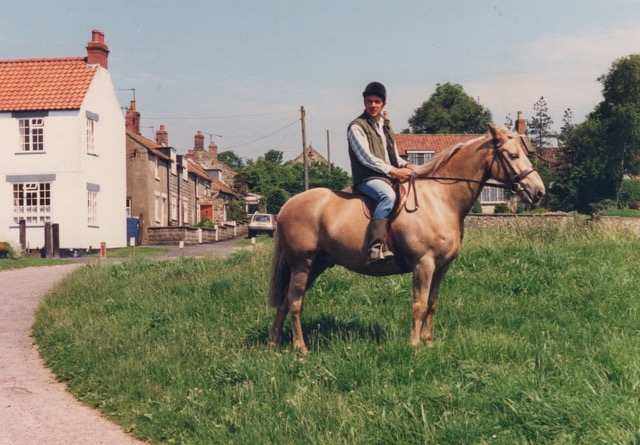
Reader Paul Ireson on one of his horses in Newton-on-Rawcliffe in about 1987. He owned and named Old Pond House which can be seen with the red door near the car behind him. A carved witch post stands still in tact in the sitting room of the house.

Following my columns about festive birthdays, I have been contacted by one of the few people who declares to enjoy them.

Andrea Dandy says: “I was born on Christmas Day in 1941 and have loved every birthday. When I was a child my brother would complain I always got more presents than him. He didn’t realize I never got any presents during the year. When I had three sons, they also always said I got a lot of presents at Christmas. I also have a nephew who was born on my 27th birthday.”

It sounds like Andrea was quite fortunate, with her loved ones making sure she had enough gifts to cover both Christmas and her birthday, contrary to the experiences of other readers who felt hard done by.

I get a bit of a thrill when readers find articles that I wrote a while back and come to me with new information.

Paul Ireson got in touch about a couple of columns I wrote in January 2023 concerning witch posts. If you remember, these carved posts are usually found near fireplaces in very old houses and originally it was thought that the carvings, often featuring crosses, were intended to ward off evil spirits and witches, hence the name. But over the years, my dad came to believe they were in fact associated with the legendary Martyr of the North York Moors, Father Nicholas Postgate, at a time when Catholics were being persecuted. Dad discovered that posts bearing these cross symbols only proliferated during the time of the martyr, and only in areas he is thought to have visited, which is the main reason why he believed they were connected to Postgate. Their purpose, he suggested, was to secretly indicate to fellow Catholics that they were in a safe house. It is possible that the association with witches was a deliberate ploy by Catholics to spread misinformation so that the true meaning behind the symbols would not be discovered. One of these posts can be seen in the Ryedale Folk Museum in Hutton-le-Hole today.

In one of the columns, I mentioned a 17th century cottage called Old Pond House which has a witch post in its living room. Paul revealed: “I bought Old Pond House in Newton-on-Rawcliffe (near Pickering) in 1986 for £38,000 including stables and a three-acre field. We lived there for several years. I had never heard of a witch post and occasionally people would look through the window and enquire about the post. I revisited Newton recently as I now live at Rosedale but didn’t get a chance to visit the house.”

Paul remembered that when he lived in Newton, there was a dairy farm and a post office-cum-shop in the village, but they have been converted into holiday rentals. He added that their house didn’t have a name and they’d wanted to call it ‘Pond House’. Unfortunately, that name had already been taken by a neighbouring property and so, as their cottage was older, they chose ‘Old Pond House’ instead! He said: “The witch post was in original condition and was always a talking point with visitors.

“At the time I was working in a shop and my wife was a receptionist which shows how affordable property was then. Mind you the mortgage rate was about 12%!…We lived there for four years and had two horses…We travelled to York to work every day in an old Volvo estate that did about 20 miles to the gallon. I recall a few bad winters when we would all wait for the snow plough to come up from Pickering before we could get to work.”

It makes me wonder whether people would go to that effort these days. Not only is the road as far as Pickering (where you pick up the main road) single track, and therefore not easy to navigate in wintry conditions, but it is also a good 35 miles into York. I do remember that, living in a village 20 miles from school, we would go to extraordinary lengths to get there, and very rarely did we look out of the window and decide it was too snowy to set out. These days, it seems, a few flakes come down and the whole of Britain grinds to a halt! But then, we were a hardy lot back then, weren’t we.

Or were we just foolhardy?

This column appeared in the Darlington & Stockton Times on Friday 8th March and the Ryedale Gazette and Herald on Wednesday 6th March 2024.