A race to find the answer

IMG_8558
The Gysepy Race is clearly visible in the village of Duggleby on the Yorkshire Wolds
IMG_8565
Travel a little further east of the village, and it is barely visible at all

In one of my columns about the Yorkshire Wolds I wondered where the ancient inhabitants of Thixendale sourced their water. There has been evidence of activity in the area since the Mesolithic and the Neolithic periods (Middle Stone Age, 7,000-10,000 years ago and New Stone Age, 5,000-7,000 years ago) as shown by the discovery of man-made tools found in barrows, or burial mounds, dotted about the landscape. Settlements, for obvious reasons, grew up around sources of water, and yet Thixendale lies in a dry valley.

A reader got in touch to suggest that the Gypsey Race might flow through there. When I heard that, the question that immediately entered my head was ‘What on earth is the Gypsey Race?’

As I now know, the Gypsey Race is a natural watercourse that has its source a little east of Wharram-le-Street on the Yorkshire Wolds, passing through villages such as Duggleby, West Lutton, Foxholes, and Burton Fleming, ending where it enters the North Sea at Bridlington. Thixendale lies west of the source, and therefore the river cannot possibly flow through there.

What is peculiar about this particular river, though, is that it flows both above and below ground, and for much of its journey is quite invisible. The word ‘gypsey’ is an East Yorkshire term that refers to a waterway that comes and goes. If the weather remains dry, then parts of the waterway above ground will remain dry, whereas during a period of wet weather, it fills up and flows above ground. What is happening in reality is that the water table is rising and falling, depending on the level of rainfall, and in dry conditions, it simply falls below the level of the stream bed, rendering it invisible to us land dwellers. However, it will still be held in the aquifer below our feet where we cannot see it. If you watch the river closely, you might see bubbles bobbing up to the surface. These are little pockets of air being pushed out from the chalky layer below.

There are such rivers in other parts of the country, with each region having its own term. In some areas, they are known as ‘winterbourne rivers’, the word ‘winter’ referring to the time of year it is most likely to flow above ground, and the word ‘burna’ being an old term for a stream. Places with ‘Winterbourne’ in their name occur where we find chalky ground, mainly on the eastern side of the country. In Kent, they are known as ‘nailbourne rivers’ and in Hampshire they are called ‘lavants’.

There is some folklore around gypsey rivers, the most common being that when it is in spate, it is a portent of doom. It is only relatively recently that we have begun to understand the scientific reasons behind its quirky behaviour and in previous centuries, it baffled and unsettled many, as described in this 1911 quote from ‘Examples of Printed Folk-lore concerning the East Riding of Yorkshire’, edited by a woman known simply as ‘Mrs Gutch’.

‘To solve the mystery of the “Gypsey Race,” as the strange waters are called, has been the ambition of many modern scientists. Little, however, has yet been discovered to account for its eccentricities. Almost as suddenly as they came, some six weeks ago, the waters will shortly disappear, and may not be seen again for years. Only five or six times during the last twenty-one years has this brook run its eerie course. Its source of origin is a hidden mystery. The strange workings of Nature, however, appeal to the curiosity and imagination of the Yorkshire wold-dweller.

‘Day by day young and old watch the stream running its twenty-mile course of hide and seek among the chalk to the sea at Bridlington. Astonishment is often mingled with awe, for according to tradition dire disasters follow in the wake of the brook, and which in consequence bears the sinister title of ” The waters of woe.” Superstitions die hard, and in these out-of-the-way wolds people are still to be found whom it is difficult to dissuade that the running of a stream fed by an intermittent spring is not in some way associated with the supernatural.’

Advances in science mean we now understand why the Gypsey Race behaves as it does. And yet the question remains – where did the ancient residents of Thixendale get their water?

Read more at countrymansdaughter.com. Follow me on Twitter @countrymansdaug

This column appeared in the Darlington and Stockton Times on 1st Septembrt and Ryedale Gazette and Herald on 30th August 2023
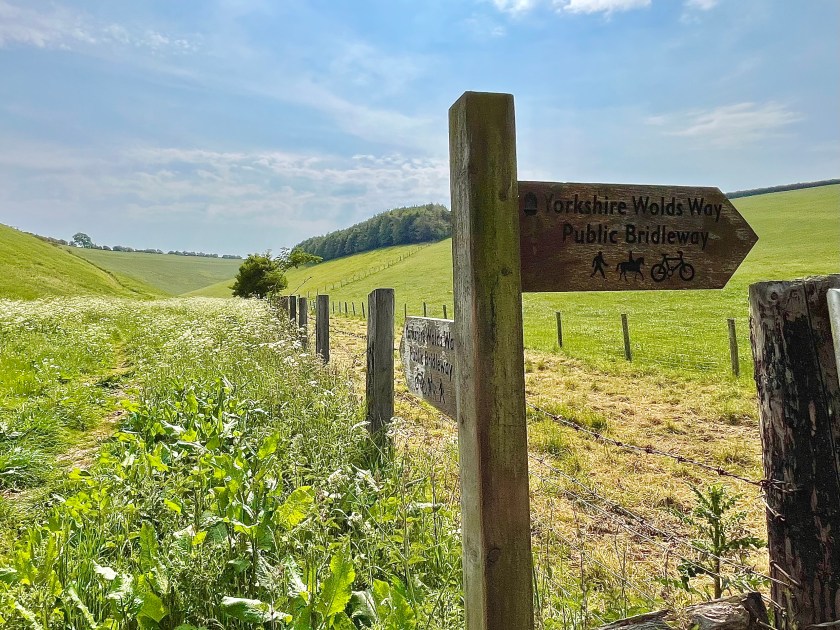
A wold of difference

IMG_7563
The Yorkshire Wolds seem to play bridesmaid to the more popular Moors and Dales.
IMG_7176
The sweeping valleys of the Yorkshire Wolds were created by the run-off from glaciers.
IMG_7558
The dales have smooth steep sides, but are completely dry due to the quick-draining chalky soil

I have said this before, but I’m not going to apologise for repeating that here in North Yorkshire we are blessed to have outstanding countryside on our doorstep. When you hear visitors from more urbanised areas eulogising about it, it does make you grateful to be able to experience it every day.

What is so special is that within our border, we have two national parks in the Yorkshire Dales and the North York Moors, as well as two areas of outstanding natural beauty (AONB) in the Howardian Hills and Nidderdale.

But what I want to know is why do the Yorkshire Wolds seem to play bridesmaid the two brides of the Moors and Dales? I’ve recently been spending a bit more time exploring this part of the world and in my opinion, it is equally as stunning, and yet very different, to other parts of North Yorkshire.

Famously, artist David Hockney has a studio in Bridlington where he has worked on some enormous pieces of Wolds-themed art. He describes painting in the winter near Warter, a village between Pocklington and Driffield:

“There was far more colour than I expected. Occasionally a farmer would come and talk to me. They didn’t think I exaggerated the colour. They thought my paintings were very accurate, and talking to them I noticed that they knew just how beautiful it is here.”

Of course, North Yorkshire cannot lay claim to all of the Wolds, much of which do lie in the East Riding, but the part I was visiting recently was around the gorgeous village of Thixendale and the abandoned mediaeval settlement of Wharram Percy, all of which falls within the border of our county. The landscape is markedly different to the areas with which I am familiar, with no heather or bracken cloaking the gently undulating hills and dales, but rather crops and grazing meadows, which give you a clue to the type of agriculture that prevails.

The word ‘wold’ derives from the old German word ‘wald’, and originally referred to forested land, later coming to mean ‘upland forest’ then, once the forest had disappeared, grew simply to refer to upland areas in general. The Yorkshire Wolds are the most northerly chalk hills in the UK, and stretch from the bank of the River Humber near Hessle, curving north and east in a wide boomerang shape, ending up at the stretch of coast between Filey and Bridlington. The characteristics of the geology can clearly be seen in the sheer white cliffs at places like Flamborough Head and Bempton.

The chalky nature of the ground is evident as you trek among the rolling hills, with white pebbles scattered across the earth like never-melting hailstones. What truly sets this apart from other areas of North Yorkshire is the appearance of the dales. The steep-sided green valleys slice acutely into the landscape, barely visible from the tops of the hills. The sides are so smooth and neat that they look almost man-made, as if they’ve been cut by a giant cake slice. Unusually, the valleys have no rivers or streams running through them. The chalk was formed from marine limestone and deposited during the Upper Cretaceous period between 80 – 100 million years ago, with the dales being formed at the end of the ice age, around 18,000 years ago, when melting glaciers led to fast-flowing streams coursing across frozen ground, ultimately creating deep channels in the surface of the land. The chalky ground meant water easily drained away, and so the resulting valleys that we see today remain dry.

In contrast to the Moors and Dales, the way the land is farmed is topsy-turvy, with crops like oil-seed rape, wheat and barley being grown across the tops of the hills, while sheep and cattle graze the valleys.

There is plenty of evidence that the land has been occupied since prehistoric times, and perhaps one of the most famous and impressive locations is that of Wharram Percy, a settlement that at its peak in the 14th century was home to around 200 people spread across 40 or so dwellings, including a number of Viking-style longhouses, the footprints of which can still be seen on the ground.

There is an application ongoing for the Yorkshire Wolds to be declared an Area of Outstanding Natural Beauty, and I do hope they achieve it. Having walked there a few times now, they surely deserve that accolade.

Read more at countrymansdaughter.com. Follow me on Twitter @countrymansdaug

This column appeared in the Darlington and Stockton Times on 28th July and Ryedale Gazette and Herald on 26th July 2023