Swim the Channel? Fat chance of that!

Bill Burgess slathered in lard before his successful attempt at swimming the English Channel in 1911. (This work is from the George Grantham Bain collection at the Library of Congress. According to the library, there are no known copyright restrictions on the use of this image).

My recent mention of goose fat as a home remedy for a bad chest prompted reader Mike Brown from Stokesley to get in touch. It reminded him of TV personality David Walliams: “He smeared it all over his body before swimming across the English Channel to raise money for the BBC charity Sports Relief. The late Queen mentioned this when she presented him with the OBE for his services to charity and the arts. He replied that the application wasn’t as much fun as it looked. Probably smelt awful too. So as well as a remedy for a persistent cough goose grease is a good insulator as well.”

Walliams completed the 21-mile swim in a very impressive 10 hours and 34 minutes in July 2006, despite confessing that he had never done anything remotely sporty in his life before. Later, in 2008, he swam the Strait of Gibraltar, and then in 2011 completed the ridiculous challenge of swimming the length of the River Thames. He covered 140 miles, starting in Lechlade, which is about 45 miles west of Oxford, and finishing eight days later at Westminster Bridge in London.

For the latter two events, Walliams was wearing a wetsuit, but for his Channel swim, he was only permitted to wear a ‘standard swim costume’ as defined by the Channel Swimming Association for it to be classed as an official swim. The rules state that the costume should not aid buoyancy nor offer thermal protection, and it cannot cover the arms or legs. The same rules apply to the swim hat too, and you are not allowed to use anything that will help you stay afloat or swim faster, so no flippers armbands, rubber rings or lifejackets.

Basically, it’s just you and your Speedos against the elements. Oh – and of course, the goose gunk. Some people smear it all over their body to prevent heat loss, while other more hardy individuals cover just the areas that are likely to chafe, such as armpits, necks, shoulders and thighs. That thought makes me squirm (and if you have ever spent too long in the sea, you will understand the fidgety discomfort of saltwater chafing).

Some people choose not to use fat from a dead animal and instead make their own mixture of roughly 50/50 lanolin and petroleum jelly. Lanolin is what makes a sheep’s fleece waterproof, and is extracted from freshly-shorn wool in a centrifugal process involving hot water. It has dozens of uses, but it does harden when cold, so for the cross-Channel fraternity, it is mixed with petroleum jelly to keep it spreadable.

The first person to ever swim the Channel unaided was 28-year-old Captain Matthew Webb in 1875. He smeared himself with porpoise fat to preserve body heat and avoid the chafing. He earned fame and a small fortune from the achievement, and tried to replicate the financial rewards through other water-related endurance challenges, but none matched that first major accomplishment. He died just eight years later while attempting to swim the Niagara Falls Whirlpool Rapids.

It was another 36 years before anyone else managed to cross the Channel and he happened to be a Yorkshireman. Bill Burgess tried and failed 17 times before succeeding on his 18th attempt in September 1911. Although born in Rotherham, he spent most of his adult life in France, and competed for the country at the 1900 Olympics where he won a bronze medal in water polo. He also coached the first woman to swim the Channel, American Olympian Gertrude Ederle, who was only 20 when she completed the feat in August 1926.

Undertaking a Channel swim sounds, quite frankly, awful. Not only do you have to go to the faff of smearing yourself in gunge before plunging into freezing sea water, you also have to contend with wind, currents, tides, sewage and floating rubbish, never mind the constant traffic surging through the busiest shipping lane in the world. Then there’s the seasickness caused by the incessant motion of the waves, the sore and chapped lips, and the raging thirst thanks to the gallons of polluted salt water you’ll inevitably swallow. Why the heck would you?

Of course, I am facing my own swimming challenge later this year when I compete in my first triathlon. Let’s hope goose fat won’t be needed.

This column appeared in the Darlington & Stockton Times on Friday 7th March and the Ryedale Gazette and Herald on Wednesday 12th March 2025
Beside myself at the seaside

IMG_9910
Will beautiful coastal towns like Scarborough rediscover the status and glory they once enjoyed?

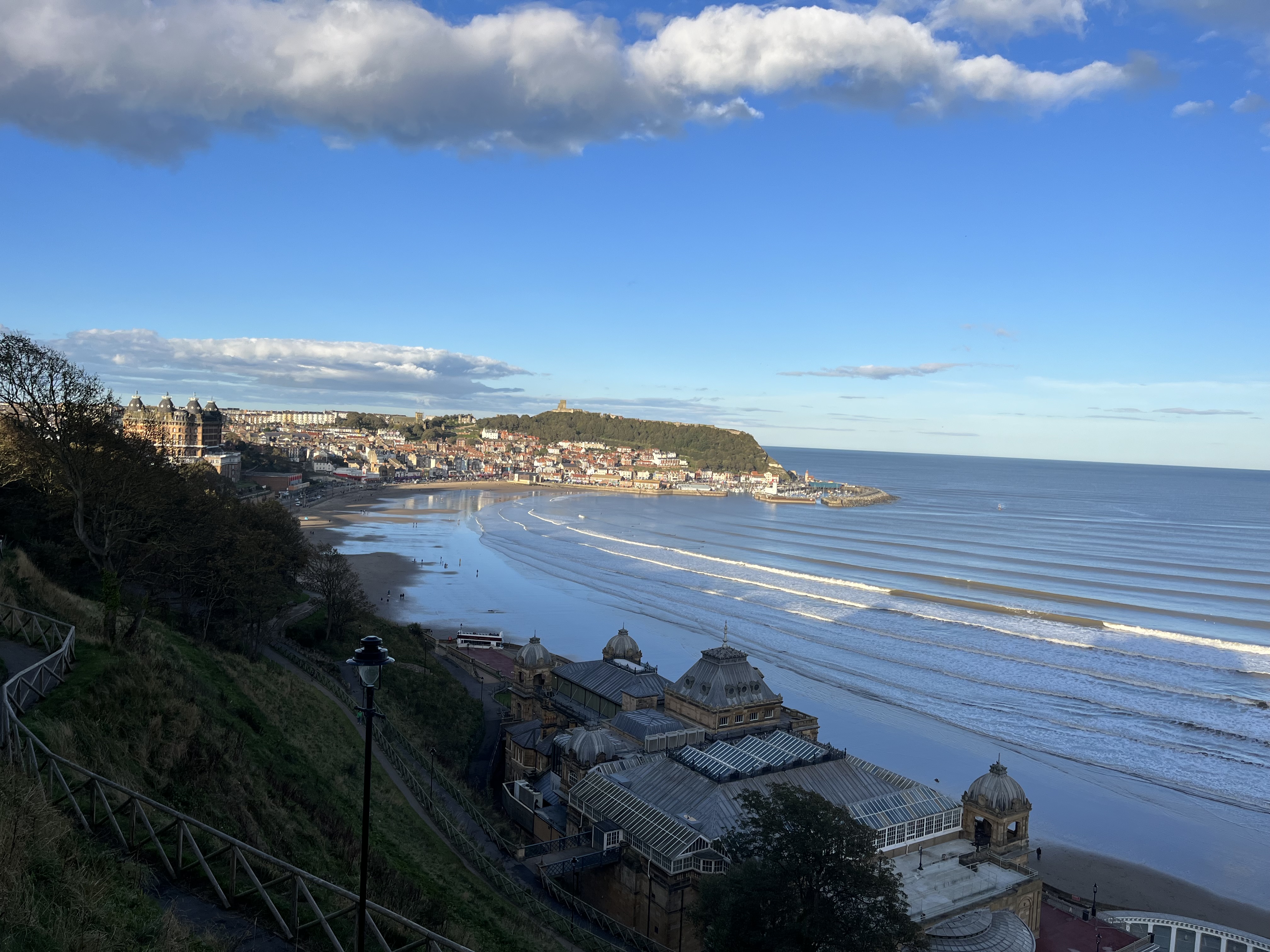
When I visited Scarborough a few weeks ago, I was struck by the size and grandeur of the buildings lining The Esplanade, the main seafront road that spans the South Cliff where I was staying. The properties have spectacular views out to sea and as with most resort towns, some of the houses were well looked after, while others were in need of a fair bit of TLC.

Scarbrough is said to be Britain’s first proper seaside resort, thanks to a woman called Thomasin Farrer who in 1626 discovered a mineral-laden spring trickling down the South Cliff. In 1660, a book written by Dr Robert Wittie extolling the health-giving virtues of this spring led to an influx of people seeking cures for their various ailments. This in turn led to the first ‘Spaw House’, built in the early 1700s on the site of the current Scarborough Spa building, and soon wealthy families from as far away as London were travelling up north to take in the sea air, bathe, and benefit from the medicinal properties of this now famous spring water. Scarbrough became a very fashionable place to be seen and was one of the first to use bathing machines, mini beach huts on wheels that could be rolled into the sea so that the modesty of the well-to-do swimmers could be preserved as they entered the water.

When I trained as a journalist in the early 1990s, I was sent to the south coast town of Hastings in East Sussex on a six-month residential training course. My trip to Scarbrough reminded me of my time there, both towns having that air of shabby elegance about them. I knew nothing about Hastings back then, except that the famous Battle of 1066 was named after it.

I found it unexpectedly beautiful, perched on the edge of the English Channel with glorious ocean views from the wide boulevard that spanned the width of the town. And yet, there was an air of abject neglect that hung around the huge and very beautiful Georgian, Victorian and Edwardian buildings, a contrast which was difficult to reconcile in my young head. The term ‘faded grandeur’ could not have been more apt, and I was genuinely saddened to see these beautiful pieces of architecture lapsing into dereliction.

You could tell that this was once a most fashionable seaside destination. It was the Napoleonic Wars (1803-1815) that were instrumental in bringing to an end the tradition of the ‘Grand Tour’, a ‘coming of age’ trip made by English society’s affluent youth who travelled down through Europe and into Italy. This, along with the expansion of the steam railway network, meant that these bright young things searching for fashionable destinations in which to be seen landed in coastal resorts like Hastings. Hastings, which had been a small fishing town until the early 1800s, expanded rapidly, and imposing town houses, along with assembly rooms, dance halls, coffee shops, shopping arcades, theatres and recreation parks began to be built to cater for this influx of the rich and influential, whose bathing machines began lining up on the beach.

The resort thrived until well into the 20th century, and one of the most striking buildings is where we had our training school, Marine Court, otherwise known as The Ship due to the fact its Art Deco design was based on the recently launched Cunard liner, the Queen Mary. The white building, which at the time of opening in 1938 was the largest residential apartment block in the country, can be seen for miles around, and now, like more than 500 other buildings in Hastings, has Grade II listed status. Our digs were round the corner in Warrior Square, a beautiful green park surrounded on all sides by Georgian and Victorian town houses, most of which were badly run down.

The demise of these once splendid resorts is attributed in the most part to the rise of affordable foreign travel. I haven’t been back to Hastings for years, but a quick look via the trickery that is Street View on Googles Maps shows that most of the buildings are in a much better condition than when I was there. There is evidence of scaffolding on many, suggesting they are being regenerated, which must be a good sign. Will these beautiful coastal towns rediscover the glory and status they once enjoyed?

Contact me via my webpage at countrymansdaughter.com. Follow me on Twitter @countrymansdaug.

This column appeared in the Darlington & Stockton Times on Friday 24th and the Ryedale Gazette and Herald on Wednesday 22nd November 2023.