Do you hike, or saunter?

IMG_1369
John Muir (1838-1914) was the founder of the modern conservation movement 
IMG_9594
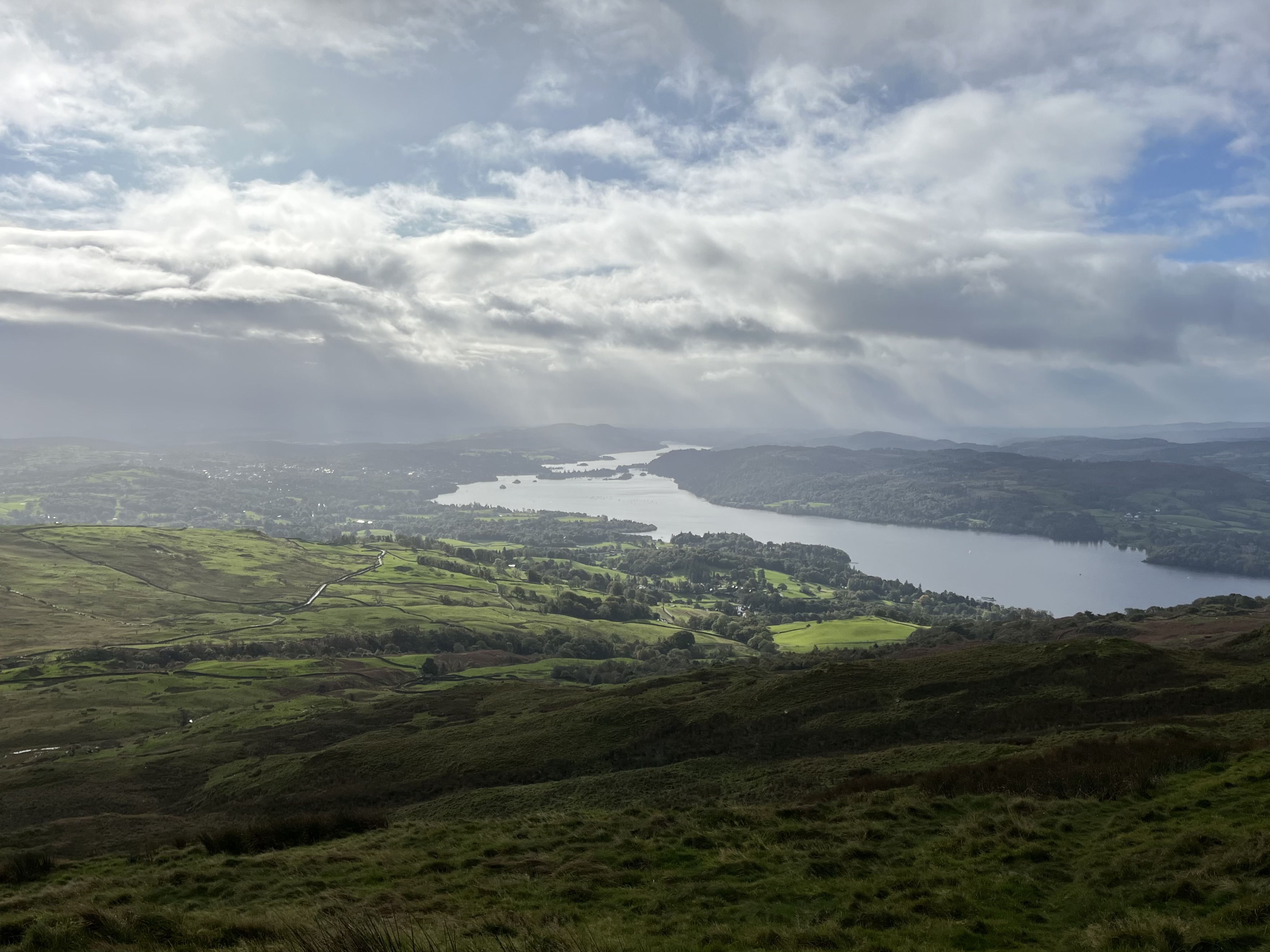
Whether it was a saunter or a hike up Wansfell Pike in the Lake District, the views from the top were worth the climb


Some of you might recall that during the first lockdown in 2020, I set up a Facebook group called ‘Picture That Walk’ where people could dump all those photos they were taking while they ambled about their local area on their permitted daily hour of exercise.

The group now has around 1500 members who continue to share their lovely pictures from all over the world. A regular topic of conversation is the various terms we use to describe a walk. For example, we have had bimble, potter, meander, stroll, ramble, amble and mosey to name just a few.

It was a member of the group who gave me the inspiration for this column after she posted a quote from the legendary John Muir (1838 – 1914) regarding the word ‘saunter’. Muir was objecting to ‘hikes’.

“Do you know the origin of that word ‘saunter?’” he says. “It’s a beautiful word. Away back in the Middle Ages people used to go on pilgrimages to the Holy Land, and when people in the villages through which they passed asked where they were going, they would reply, ‘A la sainte terre,’ ‘To the Holy Land.’ And so they became known as sainte-terre-ers or saunterers. Now these mountains are our Holy Land, and we ought to saunter through them reverently, not ‘hike’ through them.”

Muir was a Scottish-born mountaineer who was passionate about nature and the founder of the modern conservation movement. He was an active campaigner for the preservation of our wild places and wrote extensively about the physical and emotional benefits of immersing oneself in the countryside. His ideas were radical for the time and were based around the premise that the earth was not to be used simply as a resource for humankind but should be looked after, enjoyed and preserved in all its glory. He was instrumental in coming up with concept of national parks, his first being Yosemite in California (Muir’s family had moved to the USA when he was 11).

If you search for his name online and look up some of his more famous quotes, you will find that his words on nature are quite beautiful despite him declaring he wasn’t a particularly good writer. One that struck me was this one, encouraging people to get outside:

“Nature’s peace will flow into you as sunshine flows into trees. The winds will blow their own freshness into you and the storms their energy, while cares will drop off like autumn leaves.”

How lovely is that?

This weekend, I was party to quite a debate about the difference between a walk and a hike. I was spending the weekend in the beautiful Lake District for the ‘hen’ celebrations of my niece, who is due to get married this month. It was superbly organised by her sisters and mum, and on the itinerary for Saturday morning was a walk. ‘It won’t be too intense, don’t worry,’ we were told. It must be noted here that my niece is super fit, and recently completed the Yorkshire Three Peaks Challenge where she climbed Pen-Y-Ghent (2277 ft), Whernside (2415 ft) and Ingleborough (2372 ft) in one day.

Bearing in mind we’d had a rather heavy night the night before, many of the 17-strong-party were slightly jaded on Saturday morning, and the weather was cold, windy and rainy. You can imagine how delighted we were to discover that this ‘not too intense’ walk was a three-and-a-half-hour circuit starting at Troutbeck and climbing up and over the not inconsiderable 1600-foot Wansfell Pike.

There were a fair few mutterings about the description of this as a ‘walk’, when for some it was most definitely a hike. Despite the grumbles, the groans, the breathlessness, the cold, the wet, and the general pain, once we’d struggled to the top of the fell, we were handsomely rewarded. The views of Lake Windermere, Ambleside and the mountains beyond were absolutely stunning. By the time we got to the end a couple of hours later, the sun had come out, our hangovers had gone, our grumbles had stopped, and we were ready for a good old pub lunch.

I must confess, on the way up Wansfell Pike, I was definitely in ‘hike’ territory. But once I got to the top, and took in the fantastic view, I took a deep breath and gave the landscape the due reverence that John Muir declared it deserved.

Read more at countrymansdaughter.com. Follow me on Twitter @countrymansdaug.

This column appeared in the Darlington & Stockton Times on Friday 3rd and the Ryedale Gazette and Herald on Wednesday 1st November 2023.

What comes to pass

27F58347-F7D4-48EA-8AA8-7B5EB5A239ED
My son taking a picture looking down Kirkstone Pass towards Brotherswater
33B15F9B-1419-4F8B-B187-A20EDDB80F01
The route up to Kirkstone Pass from Ambleside is known as The Struggle due to the steep gradients


I took a week off work recently and spent some precious time with my boys in the Lake District. It was one of my dad’s favourite parts of the world and I have many fond memories of holidays there as child, so was keen to share it with my own children.

It is impossible, in a single column, to cover all the wonderful sights we saw, so I am going to focus on one must-see – Kirkstone Pass.

I can’t remember the last time I went, but I reckon it was more than 20 years ago, so I’d forgotten just what an amazing route it is. Rising almost 1500 feet above sea level, the A592 road links Windermere and Ullswater. It used to be a drovers’ road busy with farmers driving their livestock southwards and it made me shudder to think how hard it must have been having to climb what is in parts a 1 in 4 gradient in all weathers without the aid of motorised transport. There is another route from Ambleside up to the top that is known locally as ‘The Struggle’ due to its punishing gradients.

I was accompanied by my 23-year-old son who isn’t the most outwardly expressive of souls, but I knew he was impressed, because whenever we stopped he took out his fancy DLSR camera and spent several minutes taking shots of the spectacular views.

The pass is named Kirkstone thanks to a huge boulder near the peak whose silhouette resembles a church (‘kirk’ is the Scottish and old English word for church). At the peak, there is an old inn which purportedly dates from around 1496, and is considered one of the most haunted in England. That claim intrigued me, as I love an old ghost story (I wonder where I inherited that from?).

We stopped at a car park nearby, and as I looked down the snakelike route towards Brotherswater, watching the steady stream of vehicles making their timid ascent, I did wonder about days gone by, when travellers had to rely on real horsepower to get around, and when cars were not as sophisticated and powerful as they are now. How did they cope with such a long and hazardous climb and descent?

Back home I delved into the online British Newspaper Archives, looking for the earliest stories I could find about Kirkstone Pass. Sure enough, there was tale after tale from decades past of mishaps, blunders and accidents involving coaches and horses, bicycles, motor cars and wagons, a good number of which resulted in fatalities (is that why the inn is so crowded with ghosts?).

I was captivated by the oldest which dated from the late 19th century, and what struck me were the overtly salacious headlines. There were no photographs to grab the attention back then, just swathes of grey type swimming before the eyes. So editors relied on man’s insatiable desire for tragedy and bloodshed to draw readers in (things haven’t changed there, then, have they!).

From the Penrith observer in 1890, we have ‘Shocking Coaching Disaster – Two Lives Lost’, and in 1893, the Maryport Advertiser declares ‘Alarming Carriage Accident – A Lady’s Leg Broken’, while in 1912, the Lakes Herald declares ‘Terrible Motor Smash on Kirkstone Pass – 1 Killed, 4 Injured. Car Turned Bodily Over’. In terms of horse-drawn carriages, it seems a common cause of accidents was either a wheel coming off, or part of the mechanism failing as the carriages tried to navigate the steep descent. For motor vehicles, it was generally the brakes that were unable to tolerate the momentum of vehicles gathering speed as they hit the steepest points.

The news stories back then were written in a much more flowery way that would likely be ridiculed today. As a preamble to the point of the story – the accident – we learn all about the victims’ holidays, how they had spent the previous days, what hotels they’d stayed in, how jolly they were when they set out that day, and how captivated they were by the fabulous scenery as they traveled towards their doom. It is a bit like an episode of Casualty. When we see a character having too good a time, we know that a disaster awaits them just around the corner.

Thankfully, despite the fact we had a good time, my son and I made it to the bottom all in one piece.

Read more at countrymansdaughter.com. Follow me on Twitter @countrymansdaug

This column appeared in the Darlington and Stockton Times on 22nd July and Ryedale Gazette and Herald on 20th July 2022