Permission to be curmudgeonly

IMG_1996
Reader Deborah Steed went to school with my late sister Tricia, whose anniversary it is this week (8th January)


I have received some interesting feedback following my pre-Christmas columns about the annoying misuse of certain words, as well as ‘autocorrect’ changing words into something you don’t mean at all.

A reader I only know as ‘vibrant50770a0070’, who contacted me through my countrymansdaughter.com webpage, stated: “One of my annoyances is the use by weather forecasters (and others) of ‘A month’s worth of rain fell.’ What is a month’s worth of rain? Surely the correct use of the English language would be to say ‘The equivalent of a month’s rain fell’. The spelling and use of words in the English language is now appalling, as can be found in such places as Facebook, etc. I am a retired police officer, now in my nineties, so I think I can be permitted to be a curmudgeonly old codger, but I think that the decline of the English language over the years is very sad.”

Having achieved that significant age milestone ‘vibrant50770a0070’ has the right to be as curmudgeonly as he wants. Having said that, what some see as a ‘decline’ in the English language, others see as ‘evolution’. I’m still not sure upon which side of the fence I fall.

Monica Gantz, a writer and blogger who lives in the USA, also contacted me through my webpage saying: “Autocorrect has gotten out of control. It used to be spot on with its correction. I admit to typing and almost hitting ‘send’ when I decide to re-read my post and in horror, similar to your examples, find that autocorrect substituted a terrible word in my sentence. It’s a great reminder to RE-READ before pressing ‘send’. 

I read my copy countless times before sending it, only to discover that when it is printed, a silly typo has slipped through. It drives me nuts but happens because my brain tricks me into seeing what I want, rather than what is actually on the page. A regular one is ‘their’ when I mean ‘there’. I know which is right of course, but sometimes in the speed of typing, I pop the wrong one in. I will have read over it  lots of times without spotting the error, only to see it once the final version is out in public. It makes me so cross with myself!

You might recall that in my Christmas column I brought up the fact that a common festive ‘autocorrect’ error is spelling ‘Santa’ as ‘Satan’ and it jogged a couple of regular readers’ memories about taking children to see the big man in the red suit.

Clare Proctor, who works at various properties owned by the National Trust, said: “Having observed my colleagues grapple with children (and, even worse, parents) whilst corralling them to visit the Santa’s grotto we used to do at work, Satan might not have always been a mistake!”

And on a similar theme Janet Pearce added that she had a bad experience sitting on an elderly priest’s lap as a child. “I did not want my children sitting on old strangers’ laps! Satan seems quite appropriate.” I can relate to that because as a very young child similar was done to me on a number of occasions by an elderly neighbour. It was only as an adult that I realised that what he had done was wrong. It is such a shame that something that should be a magical experience for our children has been tainted by a few disgusting men taking advantage of innocence.

Before Christmas I also wrote about the fact that on the first anniversary of my friend Ian’s mum’s death, we thought it hilarious when he’d received a message from a close friend. She had been crushed with embarrassment when she realised she’d written ‘Thinking about your dead mum’ instead of ‘dear mum’.

Deborah Steed said the story made her giggle because it reminded her of an occasion where she had met up with some old classmates. Her friend was grieving the recent loss of her pet dog and said to Deborah: “Now I understand why you didn’t feel like coming to the last school reunion after your dog had just died.”

She was mortified when Deborah said: “No, that was my dad. The dog is still alive and kicking.”  

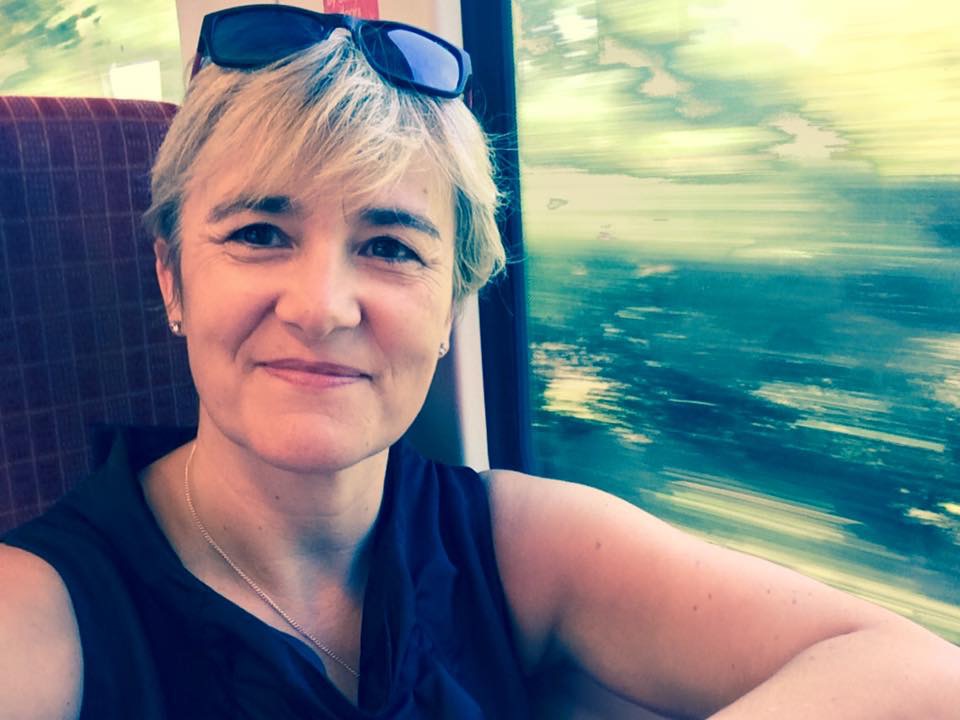
Coincidentally, Deborah went to school with my sister Tricia, who died seven years ago this week, which is a great excuse to use the picture accompanying this column. I’ll leave the closing words to Deborah:

“Thinking of Tricia as I read this. She was a lovely girl.”

Do you have opinions, memories or ideas to share with me? Get in touch with me via the ‘Contact’ tab at the top right of this page.

This column appeared in the Darlington & Stockton Times on Friday 10th Jan and the Ryedale Gazette and Herald on Wednesday 8th Jan 2025

Lend me your ear

IMG_6104
Listening to audiobooks in the car allows me to indulge in those I do not have the time to read. Audio versions are also useful for people living with impaired vision

I’ve had some interesting comments from readers following my recent mentions of listening to audiobooks. I spend a lot of time driving and use that time to catch up on books that I otherwise would not get to read. One book led me to anger (about serial killers that was so awful that I stopped after the first chapter) but I have thoroughly enjoyed most of the others, including Bill Bryson’s Road to Little Dribbling. However, I did notice a few errors here and there, most notably Bryson’s narrator’s mispronunciation of the word ‘Minoan’ when referring to that famous ancient Greek civilisation. The reader kept saying ‘MinoNan’.

Leni Ella writes: “I listen to books in the car as so much driving is involved with the job. Some people read audiobooks like it’s the first thing they’ve ever read. Having said that I’ve listened to some absolute beauties too.”

She adds: “The Dutch House read by Tom Hanks was like being read to by a friend because his voice is so singular and familiar. Both the Obama books were excellent and inspiring listens and I also enjoy Sara Cox reading her own stuff.”

I do find that when writers narrate their own work, it is much more meaningful because it adds an extra dimension that you do not get through written words on a page. Through their voice, you hear their emotions and feelings as they read the sentences they have composed. It particularly comes across in autobiographies, where the writers are revisiting experiences and memories they have actually lived through. I first realised this when listening to Dave Grohl’s autobiography, The Storyteller (Grohl is the lead singer of the Foo Fighters, a band on my bucket list to see which I achieved earlier this year). Hearing him recall certain events in his life in his own voice where his tone, speed and volume would change depending on what he was reading, made the whole book burst with life. You could hear his emotion at the birth of his children, the shock and grief when Kurt Kobain died, the unbridled thrill of doing his first stadium concert,

Clare Powell, a self-confessed ‘ranter’, says: “I am new to audiobooks. I’m enjoying David Mitchell (the comedian) ranting in ‘Thinking About It Only Makes It Worse’ (having listened to his ‘Unruly’ first). He is a magnificent ranter but also an amusing historian. I highly recommend it.”

In the same column I referred to Bill Bryson’s condemnation of grammatical errors made by people who should know better.

Clare went on: “My guilty failure when writing is the excessive use of the exclamation mark!! However, my English teacher told us that creative writing allowed for certain grammatical ‘hiccups’. The rule is not to start a sentence with ‘and’, ‘but’ etc., but sometimes it is acceptable. He then quoted from a very famous piece of literature which, over 40 years later, I have no hope of remembering! I do remember his words of wisdom though.”

Lynne Wheatley confesses: “I am one of those people who just can’t enjoy audiobooks.” But my column did bring to mind her 1940s school days: “Our English teacher in 1947 was a demon. You did it her way, no deviation, spelling mistakes written out 100 times. I was an avid reader so soon got the hang of correct English. My first job was proof reading, and I loved it. My ‘driving nuts’ is spelling mistakes, especially on social media. I remember way back, with my small grandchildren, when they would write in schoolbooks with spelling mistakes. I used to point out the odd error, but was told, “Oh it doesn’t matter as it’s not an English lesson.” WHAT? I could see my English teacher turning in her grave. I must say, you’ve whetted my appetite, I might yet try the audio.”

It has occurred to me that audiobooks are a clever way for people who have problems with their eyesight to enjoy books they can’t see. Not everyone who has impaired vision knows how to read Braille, and I’m sure many of you who used to see perfectly well but no longer can, will miss being able to indulge in a good book.

My last paragraph then obviously begs the question, how are you reading this column? Maybe it’s time that I did an audio version.

Do you have opinions, memories or ideas to share with me? Get in touch with me via the ‘Contact’ tab at the top right of this page.

This column appeared in the Darlington & Stockton Times on Friday 6th Dec and the Ryedale Gazette and Herald on Wednesday 4th Dec 2024