All set for spring

Sunrise over Runswick Bay, North Yorkshire. Picture by Alastair Smith

This week might just my favourite week of the whole year. The reason is because it contains my favourite day of the whole year.

“And which day is that?” I hear you ask. It is not my birthday, although that is also a pretty good one, if only for the excuse to eat and drink whatever I want as I contemplate the widening chasm between my age and my date of birth.

No, my favourite day is the Spring Equinox which falls on Thursday this week. After what seems like an interminably long winter, for the next six months the days are going to get longer and the nights are going to get shorter. That thought makes me very, very happy.

‘Equinox’ comes from the Latin ‘equi’ (equal) and ‘nox’ (night). It refers to the fact that we will have as many daytime hours as nighttime thanks to the sun’s position directly above the Equator as it trundles on its journey northwards towards our summertime. This year the actual moment of ‘equinox’ in the UK is at 9.01am on 20th March. Of course in the Southern Hemisphere, the opposite is happening, and they are welcoming Autumn as their daylight hours reduce in length.

The astronomical boffins among you will know that the date upon which we have true equal day and night does not actually fall upon the equinox, but rather on the lesser-known equilux (‘lux’ is the Latin for ‘light’). Interestingly, my spellchecker proves it is lesser-known because it refuses to recognise ‘equilux’ as a bona-fide word, underlining it with that bossy red squiggle. It wants me to change it to ‘equinox’. Sorry spellchecker, but this time I know better than you!.

The explanation is a bit complicated, but I will give it a go. There are two ways of measuring the times when daylight and nighttime officially start and finish. There’s the way for regular humans who don’t care about the scientific facts but just like to take pictures of pretty sunrises and sunsets, and then there’s the clever people who know what is actually happening from an astronomical perspective. So depending on which one you prefer, the equal 12 hours of daylight and 12 hours of nighttime fall on different dates.

This might help you understand what is happening (or it might not): imagine the sun as a flat circle with a point at its centre. The period of equilux is measured from when the very top of the circle first peeps above the horizon until the last moment just before it dips below it. The Spring and Autumn equinoxes are measured from when the circle’s centrepoint first appears above the horizon and ends when it dips below it at sunset. Therefore, there’s a bit of a discrepancy in timing, and so by the time the equinox occurs on 20th March, the equilux will have already occurred about three days before. For the same reason, the Autumn Equilux is about three days after September’s equinox.

I’m also a bit mind-blown to discover that we don’t ever achieve real night/day equality. The nearest we get is about 12 hours and 10 minutes of daylight, and 11 hours and 50 minutes of nighttime. So the equinox isn’t actually ‘equi’ at all!

But that’s not quite the full picture, because of course the earth is not flat but a sphere encased in its own atmosphere. This means the sun’s rays are refracted from below the horizon before it actually rises, so it tricks our mortal eyes into thinking that it has started its rise before it physically has. The same applies to sunset. In other words, it brings the time of sunrise forwards and puts back the time of the sunset (or what appears to us to be sunrise and sunset). It’s all a bit mind boggling.

Then we have the summer and winter solstices, which occur when the sun is at its furthermost points north and south of the equator. For us in the Northern Hemisphere, the Summer Solstice occurs in mid June, and the winter one in mid December (of course, the opposite is true in the Southern Hemisphere). I think that’s all I need to say about those for now.

Right, after all that, I need a lie down while I watch the sun set.

Do you have opinions, memories or ideas to share with me? Get in touch with me using the ‘Contact’ button on the top right. 

This column appeared in the Darlington & Stockton Times on Friday 21st March and the Ryedale Gazette and Herald on Wednesday 19th March 2025

Hard as snails

IMG_3022
A cluster of garden snails found under a rock in my back yard
IMG_3035
A snail needs to consume lots of calcium-rich food as contained in green vegetables like spinach and broccoli to keep its shell strong
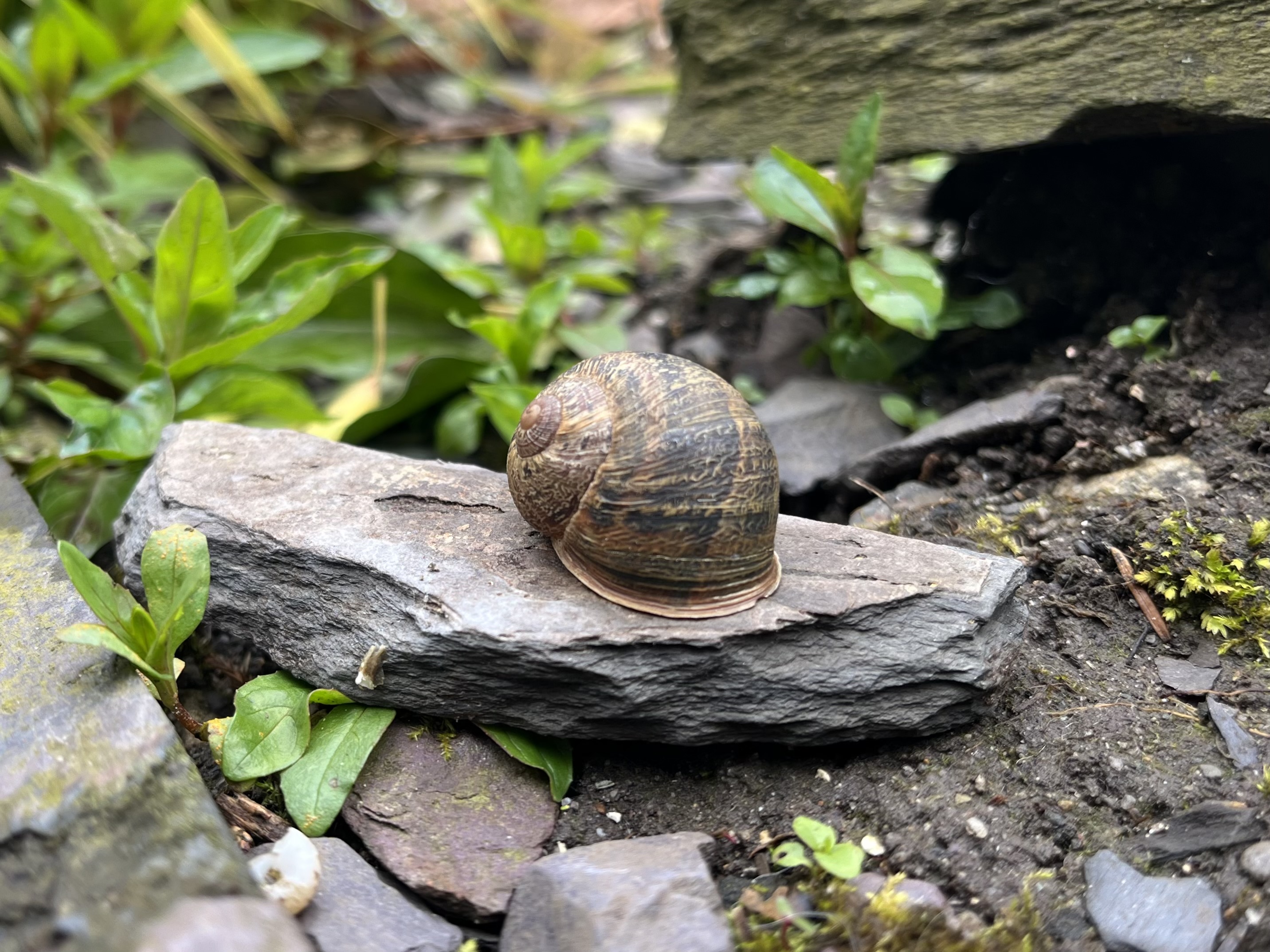
I love it when an idea for a column comes from something that I see every day and yet have not paid much attention to before. It was on a dog walk that I spotted a snail on the path on front of me and thought what an amazing pattern and colour its shell was. It struck me that I had no idea how these shells were formed, nor how they gained their colours and patterns.

I do know that snails are the bane of most horticulturists’ lives who will go to many lengths to deter or prevent these stubborn gastropods from ruining their much toiled over gardens. But you see, I am to gardening what Rab C Nesbit is to personal hygiene (willingly neglectful) and therefore I do not see snails as the enemy but instead am rather fascinated by them.

There are upwards of 120 different varieties of snail in this country, and the average British garden is home to several thousand at any given time. You probably know that they are hermaphrodites (i.e. have both male and female reproductive organs), but they need to mate and exchange sperm to have babies, which they do around February and March. They lay their fertilised eggs in dark moist places, often underground, and it takes around 15 to 21 days for them to hatch, depending on the species.

Initially, the baby snailettes, which are born with a wafer-thin flimsy shell, eat the calcium-rich eggshell from which they hatched to see them through the first five days or so. But after that, they have to go in search of more fodder to continue to thrive. As they emerge into the open air they are extremely vulnerable to an array of hungry predators which is the reason their average lifespan is a mere nine to 12 months, even though they can live longer. Their first and urgent mission is to find sources of calcium to grow and nourish their hardening protective shell.

Their distinctive shells are formed thanks to an organ called the ‘mantle’ which secretes layer upon layer of calcium carbonate to build size and thickness. Green vegetables such as broccoli, spinach, cabbage, and lettuce are particular delicacies, as are flowers like hosta, marigold and rudbeckia. The swirly shape is thanks to the way in which the calcium carbonate is secreted, and in almost every case flows in a right-handed, or clockwise, direction, otherwise known as dextral. There is the odd species that has a left-hand swirl which is referred to as ‘sinistral’, but they are pretty rare.

You can use pesticides to control the snail population in your garden, but there is a trend towards more environmentally friendly methods. There are a surprising number of snail-repellent flowers, vegetables and herbs (a quick Google search will tell you what they are) and you can take steps to make your patch an attractive des res for natural predators like birds and hedgehogs. Again, Google is your friend if you want tips on how to draw them in.

Incidentally, if you spot a rock that is surrounded by cracked snail shells, this is likely to be a bird’s anvil stone. Garden birds like the songthrush love eating snails, and cleverly use the rock to bash it and crack open the shell. If a snail is ever separated from its shell, it cannot survive.

Snails love to hide in the daytime in warm, moist places, so another suggestion is to lay planks within your flower borders before nightfall, and then first thing the next day, lift them up and collect any snails you find hiding underneath. They will graze an area of no more than about 20 metes around the spot where they were born and get very disorientated if they are moved further away so if you take them out into the countryside and set them free in a woodland, for example, they won’t be able to find their way back.

Of course, with thousands at a time dwelling in your garden, you might need to make a lot of trips. But perhaps, if you embrace all of these deterrent methods, alongside a healthy dose of persistence, you might just end up with a full crop of lettuce this year.

I’d love to hear from you about your opinions, memories and ideas for columns. Use the ‘Contact’ button on the top right of this page to get in touch. This column appeared in the Darlington & Stockton Times on Friday 3rd and the Ryedale Gazette and Herald on Wednesday 1st May 2024.