Find your nesting instinct

Our fake wasp nest made from a brown paper bag hung on the gazebo to deter the buzzy pests

As I write this, I have just come back from a weekend away where one of my closest friends got married. It was a super occasion, small and informal, in which we celebrated the official union of two lovely people.

The day after they held a garden party where we could gather again to mull over the celebration. Several of us chose to sit in a spot under a gazebo while we chatted and enjoyed our drinks.

No sooner had we sat down than we began to be pestered by wasps. There were lots of them hovering around, determined to steal a sip of whatever we were drinking, or to take a closer look at our faces, our hairstyles or our clothes. It was extremely annoying and put a bit of a dampener on our enjoyment.

Some people are not troubled by wasps, calmly ignoring them or batting them away, while others shriek, leap from their chairs and flee as if pursued by wolves. I’m on the calmer end of the wasp-fear spectrum and my favourite dispersal method is waiting until they are close and then blowing at them as hard as I can so they are tossed away in a mini hurricane. This method is fine if they appear just once or twice, but if they are a persistent nuisance then the constant blowing makes it appear that my lung has collapsed.

Although wasps are more likely to sting than bees, they are still only supposed to do that when they feel threatened. However they are extremely territorial about their nests, and if they deem anyone or anything to be a danger to it, they will attack. I used to think it was an old wive’s tale that if you kill a wasp, its mates will come to take revenge, but in fact it is sort of true. A squished wasp emits a pheromone that alerts its comrades nearby who rush to the scene to leap into defensive action.

There are those who will defend this polarising insect. A few years ago I got talking to a country gentleman about wasps and mentioned my natural dislike of them. He insisted they got a bad press and went on to explain why they behave like they do in late summer, which I must admit, made me sympathise a bit with their irritating behaviour around this time of year. Although I have mentioned this tale before, it is worth repeating.

He explained that the wasps that annoy us are usually worker wasps and they are a bit Jekyll and Hyde. For the first half of the year, they are the benign Dr Jekyll, their job being to maintain the nest and provide food for the growing colony. In these early days of summer, insects and grubs are plentiful, and the busy wasp is too preoccupied finding enough protein to feed the ever-hungry brood so have no need to bother us humans. Once the colony is established, however, they are no longer of use and are cast out like a layer of surplus middle management. Suddenly they are homeless, and food supplies run thin. Competition with other redundant hungry wasps is fierce and in a desperate bid to survive, they will take whatever they need wherever they can find it. At this time of year, they crave sugar, and our penchant for al-fresco dining provides them with an oasis of sweetness in an otherwise barren landscape.

On the positive side, wasps are excellent pollinators for our fruits, flowers and crops, and also extremely efficient at pest control. Some sources I’ve read say that if it wasn’t for the wasp, we would be overrun with destructive insects that would make our lives misery.

Back to my garden party. One of the guests suggested a tactic to inflate a brown paper bag and hang it up nearby, shaping it to look like a nest. This then fools the wasps into thinking that they have infiltrated another colony’s territory, and so they buzz off in fear of being attacked to bother someone else.

So we did exactly that. We found a paper bag and hung it up. Sure enough, within a few minutes, the wasp botherers had vanished. Try it out for yourself and let me know your results!

What pest-deterring tactics do you recommend?

Do you have opinions, memories or ideas to share with me? Get in touch with me using the ‘Contact’ button on the top right.

This column appeared in the Darlington & Stockton Times on Friday 18th and the Ryedale Gazette and Herald on Wednesday 16th July  2025

Stings in the tales

IMG_0646
Steve D does not recommend disturbing a wasps nest with a ride-on mower
IMG_8218
Wasps are polarising insects

My last couple of columns have struck a chord with readers keen to tell me of their own experiences, which I absolutely love to hear, so thank you to all of you who have taken the trouble to get in touch.

Last week it was all about dimpled pint pots, and this week, it is all about that annoying critter that harasses those of us who enjoy drinking from our pint pots outdoors – the wasp.

I mentioned that in spring and early summer they like to eat protein in the form of other bugs and insects, which is true, but I have since learned that they also feed on the sweet liquid secreted by the wasp larvae that are still growing in the nest. By the end of the summer the larvae have matured into fertile male and female wasps, then leave the nest to mate. So the worker wasps have to find their sugary fixes elsewhere, and thus are drawn to the sweet stashes provided by their human suppliers.

I also posed the question of whether you consider the wasp to be a pest or a friend, and it seems, for the poor wasp, that the majority come down on the side of pest, with the odd person sticking their neck out to fight its corner. Usually, as in my case when a wasp stung my toddler son for no apparent reason other than grumpiness, the bad experiences colour our opinion of them for ever more. Such is the case of a friend of reader Lynn C: “Last night we were just talking about sipping out of cans. One fellow got stung that way and refuses to drink out of cans now. He’s scarred for life!” she says.

Michael K was stung on the way home from his holiday: “I was in the back of a taxi in Corfu travelling to the airport when one came in at speed landing down my shirt. I screamed out making the driver jump.” He adds that he was also attacked last year trying to tackle a nest himself. “Not a good idea,” he admits, and now employs the services of a ‘Wasp Man’ who charges £80 a visit. “Not bad for five minutes’ work,” he says. I think I’d charge double for performing such a risky operation, Michael!

Talking of nests, Steve D had a rather terrifying experience and advises: “Wasps do not like it if you go over their nest on the mower!” He was on a ride-on cutting his grass last year when he unknowingly ran over one. “Little b*****s went directly for my face,” he says. “I’ll never forget the moment I looked up and one of the little sods was making a beeline (see what I did there!) for the spot directly between my eyes. Hit me like a bullet. A painful week!”

Joanne C also had an alarming experience. “I was stung few weeks ago IN MY MOUTH!’ she cries. “The wasp had left its sting on my food and I ate it and it stung my lip and it really hurt…it swelled up and eventually eased…I’m not even afraid of them either. Can’t say the same for spiders though!” This tale intrigued me, because I know that bees lose their spike when they sting, but wasps don’t. Could it really have been a wasp sting, or perhaps a bee sting that had come away from its host to lurk with intent among the salad leaves?

Some of us acknowledge that our fear of them is perhaps unwarranted. Angela B admits: “I am so ridiculously and irrationally scared of the little @&*#s much to the amusement of my friends. I cannot remain still and grab the nearest person and literally shake! I don’t understand others’ fear of spiders as they don’t come looking for you like the evil wasp. Even saying the word makes me shudder. Spoils my summers!”

The lone voice that spoke up for the much-maligned wasp was Gareth C who points out: “Wasps are excellent pollinators, they hunt and eat aphids, and they will eat mosquitoes if they find them.”

Knowing that, then, I need to train one to sort out that irritating mosquito that loves to dive-bomb my ear in the dead of night. If you know how to train a wasp, do get in touch via the usual channels.

Read more at countrymansdaughter.com. Follow me on Twitter @countrymansdaug

This column appeared in the Darlington and Stockton Times on 15th and Ryedale Gazette and Herald on 13th September 2023

Is the wasp really a pest?

IMG_8240

I have mentioned my dislike of wasps before, and it is about now that they can become extra annoying when you are eating or drinking outside. They just love to buzz about your burger, land on your ice cream, or take a dip in your pint.

Some people aren’t too bothered, and calmly bat them away, while others scream, throw their chairs back and flee as if pursued by hungry lions. Although wasps are more likely to sting than bees, they are still only supposed to do that when they feel threatened.

They are extremely territorial about their nests, and if they deem anyone or anything to be a danger to it, they will attack, so it’s best to steer well clear if you come across one. I used to think it was an old wive’s tale that if you kill a wasp, its mates will come to take revenge, but in fact it is sort of true. A squished wasp emits a pheromone that alerts its comrades nearby who rush to the scene to leap into defensive action.

One summer years ago we were staying at a holiday cottage where wasps had made a nest under the roof. My youngest son was playing in the garden when I noticed one flying around him. It was not in a good mood, even though my son, a toddler then, was well away from its nest and oblivious to it. The wasp was circling him like a predator and before I could intervene, it swooped in at lightning speed to sting him. My poor boy was shocked and distressed at the sudden piercing pain in his arm.

So that is why I don’t like wasps. They sting, sometimes for unforeseen reasons, sometimes multiple times, and it really hurts! Why this irritated wee beastie thought my little boy was dangerous still baffles me. Thankfully, though, my now 21-year-old has no memory of it.

There are those who will defend this polarising insect though. I was visiting a house in the country and got talking to a gentleman about wasps and my natural dislike of them. He insisted they got a bad press and went on to explain why they behave like they do in late summer.

The wasps that annoy us, he said, are often worker wasps and they are a bit Jekyll and Hyde. For the first half of the year, they are the benign Dr Jekyll, their job being to maintain the nest and provide food for the growing colony. In these early days of summer, insects and grubs are plentiful, and the busy wasp is too preoccupied finding enough protein to feed the ever-hungry brood. They give us humans and our food a wide berth because they can easily find what they need elsewhere. Once the colony is established, however, they are no longer of use and are cast out like a layer of surplus middle management. Suddenly they are homeless, and food supplies are running thin. Competition with other redundant hungry wasps is fierce and in a desperate bid to survive, they will take whatever they need wherever they can find it. At this time of year, they crave sugar, and our penchant for al-fresco dining provides them with an oasis of sweetness in an otherwise barren landscape.

On the positive side, wasps are excellent pollinators for our fruits, flowers and crops, and also extremely efficient at pest control. Some sources I’ve read say that if it wasn’t for the wasp, we would be overrun with destructive insects that would make our lives misery.

Knowing this did make me sympathise a little with their plight. But I can’t say it makes me like them much more.

Read more at countrymansdaughter.com. Follow me on Twitter @countrymansdaug

This column appeared in the Darlington and Stockton Times on 25th and Ryedale Gazette and Herald on 23rd August 2023

Feeling rather waspish

51A63B3B-372A-4D8F-895A-8E2FF784A21D
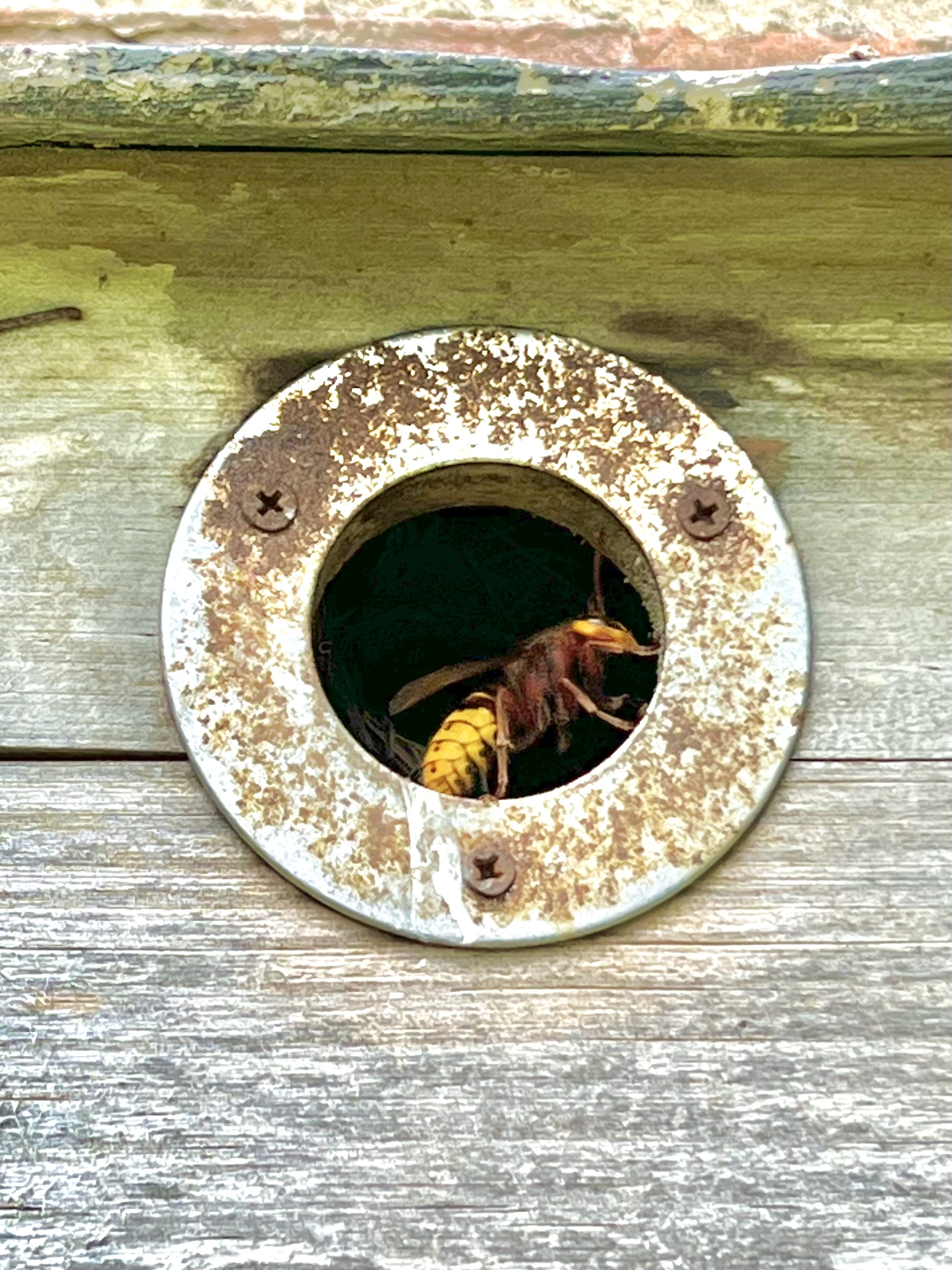
This wood wasp in the entrance to a bird box gives you an idea of how big they are

DDACEBBD-A667-4B21-8950-D19D41A146E3
Wood wasps had made their nest in a bird box attached to the house

I was at a lovely country cottage that’s for sale in Ryedale recently, just doing some final checks before the potential buyers arrived, when I heard what sounded like the low hum of a Lancaster bomber.

I glanced towards the closed patio doors from where it was coming and, to my horror, saw that a giant wasp had found its way inside. The huge creature, which I concluded had escaped from Jurassic Park, was hovering and swooping ominously about.

Its considerable size convinced me it was a hornet, for what other buzzing yellow and black thing was that big? I knew hornets were not common up north, but couldn’t fathom what else it might be. I bravely managed to dodge past it to open the patio doors and, much to my relief, it lumbered out into the open air just as the viewers arrived.

I’ve always been afraid of wasps, and have had an even greater fear of hornets since I went to France as a teenager. The farmhouse I stayed in was plagued with terrifying striped buzzing beasts, which dwarfed anything I had ever seen back home in England. I was never stung by one, but the way the family insisted on the windows being shut before it got dark and the way they left a big bright light on outside the barn to divert them away from the house, made me think there must have been some reason to fear them. I assumed they must be hornets, and determined to stay as far away from them as humanly possible.

As I showed the couple around the cottage, I extolled the charms of the spacious kitchen and delightful sitting room, and then suggested we go and see the first floor. As we climbed the stairs, I froze. There, gliding round the landing light like a flock of hungry pterodactyls, were three or four more of the dreaded things.

Like the consummate professional that I am, I yelped, “Argghh!” before scuttling on up the rest of the steps, sashaying around them at the top, then hurrying into the nearest bedroom. The viewers, bizarrely, paid little attention to them (although I may have seen them raise an eyebrow or two towards me).

After the viewing, the owner of the house, a self-confessed nature lover, came back and when I suggested that she might need to get pest control in, she laughed. She explained that they were not hornets at all, but wood wasps and they were absolutely harmless. She led me to the side of the house to a set of bird boxes on the wall. The wasps had made a nest inside one of them and were peacefully coming and going, minding their own business. It is likely that the viewers, who were used to living in the countryside, knew exactly what they were. 

How did I not know about the wood wasp before? I grew up in the country too, but don’t recall coming across it. I’m sure if I had, my dad would have explained what it was. I have a feeling that those I saw in France were probably wood wasps too.

The wood wasp, also known as the giant horntail, does look terrifying, but its merely its armour against predators. It has a similar black and yellow striped body to the common wasp, but is more than double the size. Its spiked tail can be mistaken for a stinger, and the female has an extra long black spike at the end of her body, which looks lethal, but is in fact an ovipositor, a tube that enables her to penetrate wood and lay her eggs inside. These wasps are very docile, do not sting and, unlike their carnivorous doppelgängers, don’t eat other insects, preferring to dine on wood, especially pine.

Hornets are still rarely seen here in the north, and are distinguishable from the common wasp by their large size and chunkier body which, unlike wasps, is not pinched at the waist. While wasps generally have a black head, upper body and yellow legs, a hornet has lighter copper brown head, upper body and legs. Another little-known fact is that they are not likely to be aggressive unless their nest is being threatened.

So now, if ever I do come across one, I’ll just calmly walk on by. Or maybe I’ll run.

Yes, I’ll definitely still run.

Read more at countrymansdaughter.com. Follow me on Twitter @countrymansdaughter

This column appeared in the Darlington and Stockton Times on 24th and Ryedale Gazette and Herald on 22nd August 2022