Ancestor with an honourable roll

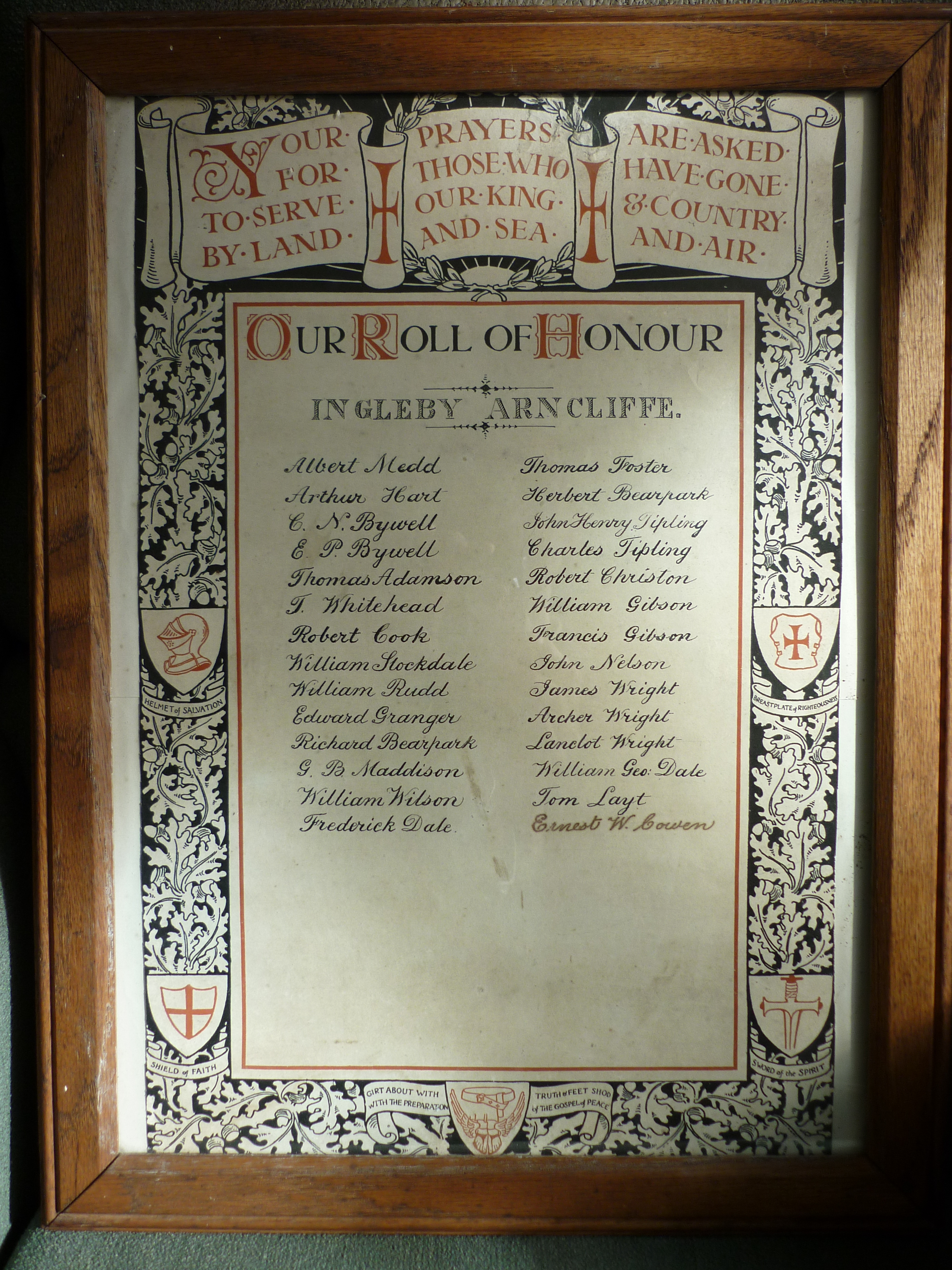
P1050375 - Roll of Honour IA
The Ingleby Arncliffe Roll of Honour

Following my column a few weeks ago when I mentioned the roll of honour on the wall of Lealholm Church, Tim Roy got in touch with some observations on the one in his own church, All Saints in Ingleby Arncliffe, which lies just off the A19 north of Northallerton.

Although I’ve seen many rolls of honours in churches all over the place, I must shamefully confess that I haven’t paid much attention to them apart from a quick glance as I walked past. But since I wrote about my ancestor with the unusual name (Neural Lacy, a cousin of my mum’s mum who was killed in Word War I), they have become much more than simply a list of names. These were real people, often young sons of mothers and fathers who must have been desperately worried when they went to war, not knowing if they would ever see them again. And as we know, many of them didn’t including Neural Lacy’s mother who (according to my own mum) never recovered from the 19-year-old’s loss. So what Tim has to reveal about these rolls takes on much more significance now that I know I have a direct link to one.

Tim explains that rolls of honour are contemporaneous records of those who went to fight in the Great War. The men who enlisted before the war are named first, not in alphabetical order but, where appropriate, in familial groups. Other names were added as men joined up on an ongoing basis.

Although communities chose their own designs and methods of honouring those who served and those who died, it seems that a variety of blank roll of honour templates were mass-produced from which they could choose a design they liked. This explains why Tim found at least one other church (at Daresbury in Cheshire) that has the identical roll of honour template to the one in Ingleby Arncliffe. There are many other designs that appear elsewhere, such as the one in Lealholm.

Tim writes that in Ingleby Arncliffe “The heading states: ‘Your prayers are asked for those who have gone to serve for our King and country by land and sea and air’ which suggests that names were added as men joined one of the armed services.” If you compare your local roll of honour to your nearest war memorial you can probably work out which men survived the conflict. In Ingleby Arncliffe, there are 24 men who appear on the roll, but not on the memorial, which means they were the ones who returned home to their families.

On the Lealholm Roll of Honour, a red star is placed next to the name of the men who died, and their names can be found at the front of the war memorial which was erected just outside the church. The other men who served but came back are included on the memorial, but on either side rather than front and centre. According to family history enthusiast Gillian Hunt, it is unusual to see the names of those who survived the war on these memorials. “Middleton-in-Teesdale war memorial, for example, has an inscription which remembers all those who served, but only lists the names of the fallen,” she says.

She also makes the sobering point that many soldiers were incredibly young: “The Ley brothers and Claude Wood (named on the Lealholm memorial) were leading men into battle when they were barely out of school themselves. Being privately educated, and Maurice attending Sandhurst, they would quickly obtain a commission. It is hard to think of any of them leaving the peace of the North York Moors for the horror of the Western Front.”

In terms of my own relatives, three Lacys are on the Lealholm roll of honour and the memorial, but it’s only the unusually-named Neural, who lost this life, whose name appears on the front. Gillian did some research on this name and discovered that Neural Ernest William George Lacy was born on January 1st 1898 to George William Lacy and his wife, Mary (nee Jimmison). She adds: “But the name is down as Nuhral. Never heard it before and has been put down as Neural on military records etc as that’s how it sounded.” She tried finding others with that name or similar, but he was the only one.

So the mystery remains, where does that name come from?

Read more at countrymansdaughter.com. Follow me on Twitter @countrymansdaug

This column appeared in the Darlington and Stockton Times on 19th and Ryedale Gazette and Herald on 17th May 2023

A walk of wonder

IMG_6899
The Hanging Stones Walk in Rosedale is a fantastic celebration of land and art

It may not have escaped your notice that I am rather fond of walking on the North York Moors. I only need half an excuse to head over there for a gallop in the heather. I recently gave a talk to the lovely people of Rosedale WI and someone there mentioned a walk that sounded absolutely fascinating.  

Known as the Hanging Stones Walk, it is much more than just your average bimble. It is an art project sponsored by the Ross Foundation (an organisation that supports initiatives related to art, community, sport, music and education). The foundation commissioned renowned sculptor Andrew Goldsworthy who is famous for his spectacular pieces of land art located in both rural and urban settings.   

The idea of the walk, which starts in Rosedale Abbey, is to create a living and experiential artwork using existing neglected or derelict farm buildings dotted around Northdale. The land belongs to the Rosedale Estate and a series of ancient pathways have been resurrected to link each building. Although the circular walk is not quite finished (there will ultimately be ten buildings to visit), the current series of nine buildings can be visited in four to six hours, depending on how fast you walk and how long you spend in each one. You have to be fairly fit, and able to read a map to locate the buildings. If you do find it a bit strenuous, you have the opportunity to take a breather at each stopping point.   

These old structures have been given a new lease of life, with the original stones being reused as far as possible. They have been constructed in a way that is sympathetic to their original use, and to the land that surrounds them, as if they have always belonged there. They are padlocked shut, so you have to book in advance, and places are limited, but it is well worth the effort. You collect a key and a map, and are let loose to find your way.  

Each installation has its own name, such as ‘Bog’s House’ and ‘Job’s Well’, and as you head towards each one, you begin to wonder what you might find when you arrive, to wonder about its past history and how it was used. What stories would the old building tell if it could speak? The anticipation grows as you put the little key in the lock, because from the outside there are very few visible clues as to what’s going on on the inside. I’m not going to say what is in each, because finding out is part of the enjoyment, but I can say that both of us who went declared ‘Wow’ several times. It was so impressive, and wonderful to just sit by ourselves inside these once neglected buildings to marvel at what they have now become. None of them had any electricity or mains services, and we were often sitting in near darkness with little sound except the calls of birds and the trickling of water. But it gave us some sense of what it must have been like back in the day, back in the times when the residents of these remote dales were not blessed with electric lights, or modern gadgets. It was incredibly peaceful, and a real tonic to be able to switch off from the constant sensual harassment inflicted upon us by everyday life.   

The walk in between each building was a delight in itself too, with expansive views down the valley towards Rosedale, which just served to highlight why it is one of the most beautiful dales in the whole of North Yorkshire.  

It was a privilege to be able to visit, and I marvel at how the creative mind of Andrew Goldsworthy has managed to conceive this amazing, breathtaking art, while at the same time pay homage to the nature and function of the old buildings and the land in which they sit.  

The day we went was overcast, so I plan to go back again on a warm summer’s day and do it all over again. The thing is, if it hadn’t have been for that tip-off resulting from my visit to Rosedale WI I would never have found out about this walk.  

What other wonders are hidden in North Yorkshire that I have yet to find?  

Read more at countrymansdaughter.com. Follow me on Twitter @countrymansdaug  

This column appeared in the Darlington and Stockton Times on 12th and Ryedale Gazette and Herald on 10th May 2023.

Beacon of light

IMG_3884
For obvious reasons, beacons were placed in locations with expansive views in all directions, just like at Beacon Bank in my home village.

You might recall that last week I mentioned that reader Linda Chambers used to live in my home village and would see my dad most mornings climbing a nearby hill in his trademark white, cable-knit sweater. By coincidence, this week I came across an article Dad wrote 14 years ago which talked about what he saw going up that very hill.

“I’ve seen a huge dog fox walking along the top of a fence like a tightrope walker and watched a pair of fox cubs at play,” Dad says, “I’ve rescued a baby tawny owl with an anxious mother watching me, noted badgers lumbering over the road, had grey squirrels gambolling in hedges to accompany me and enjoyed precision-timed aerial displays by a flock of wintering golden plovers. I can add to this the sight of cuckoos and kestrels, soaring buzzards, new-born lambs, shy deer, charms of goldfinches, of fieldfares, moles digging in the verges, black rabbits, white pheasants and a bewildering array of wild plants with hedgerows containing gooseberries, elderberries and sloes.”

We villagers have always referred to this hill as simply ‘The Beacon’, although I think its official name is ‘Beacon Bank’. Dad’s reward for the hard work of the climb was that once at the top, he was blessed with spectacular views in all directions – the North York Moors to the North and East, his home valley and Vale of York to the South, and then the Yorkshire Dales to the West.

It is this uninterrupted vista for miles around which meant our forbears chose it as the perfect location for a beacon, a fire that would be lit as an urgent signal to other settlements nearby warning that enemies were approaching, or that help was needed. Neighbouring villages would light their own beacons, demonstrating that they had received the message and were passing it on, and so the chain of fire would make its way quickly across the land.

Beacons are believed to date as far back as Anglo-Saxon and Viking times (9th – 11th centuries), although possibly the most famous example of their efficiency was when they were used to alert Queen Elizabeth I to the threat from King Phillip II’s approaching Spanish Armada. On 19th July 1588, a fleet of invading ships was spotted off Lizard in Cornwall, and the warning beacon was lit, sparking a trail of signals that led right up to the capital. It is said that once the message reached Sussex, it took just another 30 minutes to get to London, and the attack was ultimately thwarted.

Beacons were not simply fires though. As many of us know, trying to light a fire in the open air with ordinary wood is not that easy. To ensure the blaze took off quickly, large ropes would be doused in pitch, which of course would set alight immediately and keep burning for a long time, even in rainy weather. Not only that, they gave off a thick plume of black smoke which, during daylight hours, could be seen much more readily than flames, mighty useful if you’ve just spotted a fleet of enemy ships on the horizon.

Once the Spaniards were defeated, the beacons were used again as way of celebrating the victory and that festive sentiment continued on down the centuries. In 1897, beacons were lit to mark Queen Victoria’s Diamond Jubilee, and then again in 1977, 2002, 2012 and 2022 to honour Queen Elizabeth II’s various jubilees.

This weekend, we are celebrating the coronation of King Charles III, and I wondered if there would be any beacon-lighting going on. Although some communities will be lighting their own fires, there is no official beacon event. However, perhaps to reflect a change of monarch in an ever-changing world, there will be a ‘Lighting Up the Nation’ ceremony on 7th May during the celebratory concert at Windsor Castle. Landmark buildings across the country will be lit up using ‘projectors, lasers, drone displays and illuminations’. I tried to find out which buildings were taking part but, at the time of writing, could not put my hands on any information about them. I suppose we will just have to wait to find out.

If you are celebrating this special weekend, I hope you have a wonderful time, and do let me know how you marked the arrival of a new king, and the dawn of a new age.

Read more at countrymansdaughter.com. Follow me on Twitter @countrymansdaug

This column appeared in the Darlington and Stockton Times on 5th and Ryedale Gazette and Herald on 3rd May 2023.

Writing and rewards

IMG_1507
My nana aged about three (seated) with her family outside the Thee Blast Furnaces pub, Glaisdale, in about 1919. Her mum, Sarah Jane Williamson, was the sister of reader Jeremy Williamson’s great-grandfather George Williamson.

One of the things I most enjoy about writing a weekly column is that fact that you lovely readers get in touch with comments, observations, recollections and feedback. Firstly, it gives me enormous satisfaction to know that my efforts to entertain are not in vain, and secondly, your messages often result in new opportunities to research topics which provide material for future columns.

This week I was showered with an embarrassment of riches on the ‘readers getting in touch’ front. No less than five people contacted me, all talking about different subjects.

Gillian Hunt (who was featured last week) furnished me with more fascinating details relating to aspects of sampler embroidery, which I may come back to at a later date, while Jeremy Williamson wrote to me revealing that we are related. My great-grandfather Thomas Rhea, who was licensee of the Three Blast Furnaces Inn (later the Anglers’ Rest) in Glaisdale, was married to Sarah Jane Williamson, Jeremy’s great aunt. Sarah Jane was sister to his grandfather George Henry Williamson, and George was landlord of the Robin Hood and Little John pub in Castleton from 1939 until the 1960s. Sadly, that pub went a similar way to the Angler’s Rest, and has been converted into a house. Jeremy has only recently found out that George Henry was one of nine children, and went on to father ten children. We have a wonderful picture of my nana’s family outside the Three Blast Furnaces when she was around three alongside her parents and five siblings (she did have two more, an elder brother who died when he was just two, and another younger brother yet to be born). Imagine buying Christmas presents for that lot. It makes me think my family of three children barely qualifies me to call myself a parent.

Terry Ashby got in touch after reading my column about pathways a few weeks back. Terry is a staunch advocate for the protection of historical footpaths, bridleways and boundaries and has written extensively on the subject. He laments the fact that many routes either disappear, or their original use becomes lost when not protected, observing: “There are many instances of, for example, bridleways which reach boundaries or other dividing obstacles and become footpaths on the other side. Some tracks or paths end for no apparent reason.” I wonder if any of you have encountered that problem? I imagine it must be very annoying if you’re out enjoying a leisurely hack when the bridleway you’re following suddenly disappears.

Peter Allen emailed me following my article about poltergeists, correcting me about ‘Lady Nunnington’. In fact there never was a Lady Nunnington – the ghost was actually known as ‘The Proud Lady of Nunnington’.

And lastly, Linda Chambers, in an old-school 20th century manner, wrote me an actual letter. She used to live in my home village, and recalled (as do many long-term residents), the sight of my dad climbing the local hill every day in his trademark white, cable-knit sweater. She came up with a question that I couldn’t answer, asking if I had heard of ‘King Henry’s Night’.

“I was told about this some years back by an elderly gentleman (now dead) who lived at Thorgill,” she says. “It apparently centred around young people going out on a particular night and meeting up with likely suitors. Not sure what their parents thought but no doubt it was eagerly anticipated.”

Naturally, I was straight into my dad’s vast collection of cuttings, files and books gathered over the sixty years of his writing career, but came up empty-handed. I also tried a few searches online, but they were pretty fruitless. So this is where you come in. Have you heard of it, and if so what can you tell us? Recent requests for help on all sorts of subjects have come up trumps, so I am hopeful that at least one of you reading this will either know, or has the means to find out.

Then I can write about it and take all the glory.

Read more at countrymansdaughter.com. Follow me on Twitter @countrymansdaug

This column appeared in the Darlington and Stockton Times on 28th and Ryedale Gazette and Herald on 26th April 2023

A very grave quest

IMG_6753
The World War I Roll of Honour, with Neural Lacy’s name second to bottom on the far left column, above ‘Houlsyke’. His mother never got over his death


IMG_6759
St James the Greater Church, Lealholm, where my great grandparents lie in unmarked graves.


You might remember a few weeks ago I wrote about the fact that my mum’s family could not afford headstones when the grandparents on her mother’s side died. It was a source of great sorrow to my nana that her parents were laid to rest in unmarked graves.

Although my mum knows which graveyard they are in (St James the Greater Church, Lealholm, on the North York Moors), she does not know where exactly they are, and I have made it my mission to find out so that we can go and lay some flowers and pay our respects on her and my nana’s behalves.

Although I have found some clues, my first trip to the churchyard this weekend didn’t throw up much more insight, apart from the fact there were quite a number of unmarked plots. But all is not lost as I have a couple of leads to follow up which I will do in the coming weeks. I will let you know how I get on.

The graves we are talking about are those of John and Mary Lacy, and Mary, as you might recall, is the person who created one of the three samplers on our kitchen wall. Her birth name was Atkinson, and everyone called her ‘Polly’ rather than Mary.

After I returned from the Moors, I found an email in my inbox from Gillian Hunt, who was so helpful in the quest to find out more information about the samplers, and about the life story of Hannah Raw, whose creation we have on our wall but about whom we knew nothing (she was not a relative as far as we know). Gillian is a family history enthusiast and, happily for me, is also very knowledgable about samplers. She promised to find out more about Mary Atkinson’s, and has come up trumps once again.

She writes: “If you look at the cat motif and the building you can see how much more detailed and 3D they are than the simple figures on Hannah’s sampler. This indicates it is later in date and is influenced by the Berlin wool-work craze. This was effectively the needlework equivalent of paint by numbers. Hand-painted charts of coloured squares were bought or given away in needlework magazines and the stitches recreated the design on canvas using brightly coloured wools. The cat motif appears on a number of samplers I have seen. Mary’s sampler also has initials and alphabets but, unlike Hannah’s, it has an ‘improving’ verse. These were often quite morbid for young girls to be stitching.’

The verse Gillian is referring to reads ‘Prepare to meet thy God’ which cheerfully  means, ‘Death might not be far away, so always say your prayers just in case you pop your clogs tomorrow’.  I know from my own research for another topic that picture books written to entertain children back then were a far cry from the sweet, uplifting stories we might see now. They were full of death and damnation, illustrating quite graphically what would befall a child that skipped church on a Sunday. Down into the flaming pits of hell they would tumble!

Like me, Gillan has a fascination with headstones and epitaphs. She writes: “Gravestones are very interesting and an indicator of social history. I have a terrible reputation among my friends for always being in churchyards because I am interested in the 1918 Spanish flu epidemic…Unlike most influenza outbreaks (or Covid) which were more likely to take the very young and very old, Spanish flu killed those between mid-teens to late 30s.”

Incidentally, while I was in Lealholm, I ventured inside St James’ Church, and on the wall was a handwritten list of all the local soldiers who had perished during World War I, and there were three Lacys included. I mentioned this to Mum when I returned home, and she told me the story of my nana’s cousin, who was killed when he was only 19, and his poor mother never got over it.

“He had an unusual name that began with ‘N’, and I can’t remember it apart from the fact that I had never heard of it,” she explained.

I went back to the picture I had taken of this memorial, and sure enough there near the bottom was Private Neural Lacy. Has anyone heard that used as a first name before?

Read more at countrymansdaughter.com. Follow me on Twitter @countrymansdaug

This column appeared in the Darlington and Stockton Times on 21st and Ryedale Gazette and Herald on 19th April 2023

Restless spirits throw in the towel

IMG_1059
Nunnington Hall near Helmsley, where it is said you can hear the swishing of the Proud Lady’s skirts going up the stairs (Picture from The National Trust)

As I have mentioned before, as well as being a writer, I conduct house viewings for an estate agency and am sometimes asked whether it bothers me going alone to empty houses to meet complete strangers. Over hundreds of viewings I’ve never been in any situation that has made me fear for my safety. Today we are very diligent about vetting the people we allow to view properties, and of course we have mobile phones, so calling for help and tracking our whereabouts is somewhat easier.

Having said that, I was at a property the other day, and some strange and inexplicable goings on have been giving me pause for thought. The Victorian house has been occupied by the same family for many years and is full of dark wood furniture, knick-knacks and collectibles and still maintains many period features. It really is a beautiful house. I conducted viewings with two couples, after which I checked all the rooms to make sure everything was in order, that the lights were turned off and all windows and doors were locked. And then I went home.

A few days later, I had a call from the office. The owner’s daughter was asking if I had any idea why the towels, which had been neatly folded on the beds, were messed up and thrown on the floor. I replied that when I left there was nothing out of place. However, when she had returned to the property, the towels had been tossed on to the floor, and a chair had mysteriously been moved. Neither of us had any idea how this had happened, or who might be responsible. We are the only people who hold keys.

She then explained that there was a family tale that the house was inhabited by a poltergeist. She also said that a family friend was so concerned about the spooky happenings that she refused to go upstairs.

Here in Yorkshire, we have a plethora of tales about hauntings, some of which I have written about before, as did my dad on many occasions, and our county capital is described as the one of the most haunted cities in the world. But a poltergeist is different to your average ghost in as much as they are supposed to be able to cause physical and audible disturbances. The word comes from the German meaning ‘noisy spirit’ and they are reputed to be able to throw objects, move chairs, slam doors, talk, scream and turn lights on and off. Most are deemed to be mischievous rather than dangerous, although there are tales of particularly malevolent spirits.

Yorkshire’s most infamous poltergeist is believed to inhabit 30 East Drive, Pontefract. The family that occupied the nondescript council house in the 1970s suffered what they described as ‘non-stop’ happenings. The last straw came when their 12-year-old daughter was witnessed being dragged upstairs. The family moved out, and the house was left empty, yet despite this, to this day neighbours report hearing noises and bangs coming from it.

Other notorious Yorkshire poltergeists include the Proud Lady of Nunnington Hall near Helmsley, whose full dress skirts can be heard swishing up the stairs and she is said to have been responsible for books flying off shelves. Mary Ingram, who died at Temple Newsham House near Leeds after being attacked by highwaymen, is blamed for inexplicable noises and carpets rippling up of their own accord. Ripley Castle’s Henry and Mary Ingilby, who both died of childhood leukaemia in the 19th century, have been blamed for moving furniture, turning paintings back to front and for stealing candlesticks, only to replace them several years later. Cinemas and theatres are a hotbed for poltergeist activity, and in Darlington, both the Hippodrome (former Civic Theatre) and the now closed Odeon cinema had numerous reports of noises, voices, flickering lights, flapping curtains and even bottom-pinching.

I wonder if you have ever experienced poltergeist activity? I’d love to hear your stories (Contact me by emailing this paper, or through my contact age at countrymansdaughter.com).

I’m due back at the spooky house next week, which I will enter with a bit more trepidation this time. And if I witness any ghostly goings on, I will certainly let you know.

Read more at countrymansdaughter.com. Follow me on Twitter @countrymansdaug

This column appeared in the Darlington and Stockton Times on 14th and Ryedale Gazette and Herald on 12th April 2023

A path to inspiration

A0C69DB8-C839-42D4-B3FF-1BCB902E0992
Public footpaths have often existed for thousands of years

5F1EB9C6-750F-4799-B14D-F171AD5D722F
The familiar fat yellow arrows show which way to go after crossing the stile

As a follow-up to my last column about the tragic case of William Winter who lost his wife and three young children to Scarlet Fever in May 1889, I was planning this week to discuss the havoc the disease wreaked on England in the nineteenth century. But as I wrote, it dawned on me that the subject matter was thoroughly miserable. I questioned whether I, as a columnist for this esteemed paper, was serving you readers by showering you in melancholy and thus making you as miserable as I felt. Let’s face it, over recent weeks I’ve bombarded you with tales of disease, death and graveyards.

So I did what I always do when I’m faced with such a quandary; I stopped writing. As a writer, you have to trust that inspiration will come, and you learn not to struggle on when your ideas don’t work. By the next morning, I still had very little notion as to what misery-free topic I would write about and once I had exhausted all the usual procrastination-induced tasks (like hanging out washing, making pots of tea, watching Netflix), I did the next best thing. I went for a walk.

I’m lucky to have instant access to the beautiful North Yorkshire countryside outside my front door and, thanks to the kindness of a local farmer, am allowed to wander across his land up to the top of a hill where I can take in the glorious views over my home valley. It helps me clear my mind just a little bit.

The route through his field joins a public footpath across the top of the hills and I soon came to a stile where the way ahead was signposted by familiar fat yellow arrows put in place by the North York Moors National Park Authority. I didn’t need them though as the direction was clearly visible thanks to the many thousands of feet that had trodden it before me.

And that, dear people, is when the inspiration for this particular column finally arrived. How did this footpath get here, and how old was it?

A path across land can become an official right of way if it has been used continuously by the public for at least 20 years and, once approved, it is a classification bound by law. In many cases, these routes have existed for generations, and in the days before instant communication and motorised transport many were packhorse trails, used for delivering messages and shifting goods between settlements.

Different paths would be forged for different reasons, and there are clues as to their age and purpose. For example, if a path runs directly between two villages (and especially if those villages appear in the Doomsday Book), it is likely to have existed for thousands of years, originally linking tribal settlements to one another. Later on, from the first century AD until the fifth, we were occupied by the Romans who took highways and byways to a whole new level, being the first civilisation to construct formal paved roads, forging their way for many miles right across the landscape. It made it easier to move armies, weapons and supplies from one part of the country to another. Many Roman roads form the basis of our transport network today, while others have become public footpaths and bridleways, and the rest have been swallowed up by agricultural land or development, although their imprint can sometimes still be seen from the air.

Other public footpaths trace their roots back to specific purposes. A ‘monk’s trod’ ran between monasteries and religious sites, a ‘corpse trail’ was a path to church along which coffins would be borne, ‘miners’ tracks’ were formed in remote parts of the Dales and Moors when the land was exploited for tin and lead, and ‘drove roads’ were created to drive livestock to markets, sometimes stretching for hundreds of miles (much of the Cleveland Way is an old drove road).

These networks of paths provide insight into how our forbears went about their everyday lives. The one I was using led to a local historical monument, thought to be a late Bronze Age animal enclosure, which means I was following a route that was created around 3,000 years ago.

So next time you walk one of your local public footpaths, I wonder if you can work out its age, and how it came to be?

Read more at countrymansdaughter.com. Follow me on Twitter @countrymansdaug

This column appeared in the Darlington and Stockton Times on 7th and Ryedale Gazette and Herald on 5th April 2023

A sad Winter’s tale

BD615127-C25E-4DA4-893F-BB4ADD4ED9D0
Glaisdale Graveyard where the tragic Winter family are buried

F67D5C27-53F3-4016-8ABA-455D2C0346C9
The news story from 1889 telling us what happened to the Winter family

Since I started investigating the embroidered samplers owned by my mum, I’ve developed a fascination with graveyards and headstones, especially those in the moorland villages where my ancestors are buried. You might recall a couple of weeks ago I mentioned that I was contacted by Carol McLee, Chairman of the Cleveland, North Yorkshire and South Durham Family History Society. Her team have transcribed the headstones of hundreds of graves, including those at the Church of St Thomas in Glaisdale where Hannah Hall (nee Raw) is buried.

I got hold of a list of the transcriptions of some of the older graves, and started to read them. While some were quite straightforward, with little information other than names, dates and a good old god-fearing exclamation, others gave hints as to how the deceased had met their maker.

One inscription noted that William Abbot, a master mariner, died aged 62 in December 1879. On the same grave, it is noted that his youngest son, also called William, ‘drowned at Wvburg, Finland, 26 July 1880, aged 20 years.’ The writer in me knows there is a story to tell there. Did Mr Abbot senior die at sea? After all, the 19th century was a perilous time to be a sailor. But maybe he didn’t, as the inscription states he died ‘in Glaisdale’ which is away from the coast. I don’t think it is unreasonable to surmise that his young son followed in his father’s footsteps with a career at sea, and met his misfortune on the ocean waves. It also means that poor Mrs Abbot, who is buried in the same plot and died eight years later, lost both her son and husband within a few months.

One inscription that particularly moved me was the following (you might need tissues for this): ‘In remembrance of Sarah, wife of William Winter of Lealholme, who died 6 May 1889 aged 34 years. Same year three of their children, Edith Ellen, 5 May aged 6 years. Hannah Mary, 6 May aged 11 years. Joseph William, 9 May aged 4 years.’

It means William Winter lost his wife and three of this children in less than a week. How could this be, and why was William not buried in the same plot with his family, even if he died later? My appetite – some might call it an addiction – for true crime was awakened and I began to wonder if there was a sinister explanation. Was William a killer? Was that why he wasn’t laid to rest with his family? I discussed the possibility with my mum and she, less sensationally but more rationally, suggested it was likely to be a crime-free case of scarlet fever, which was prevalent back in the 19th century.

I had to find out though. If William had murdered his family then it would a news story, wouldn’t it? So off I went to my trusty resource, the British Newspaper Archive, and sure enough, after a few searches, I found exactly what I was looking for. I could recount the story, but the North-Eastern Daily Gazette from 10th August 1889 does the best job of telling us what happened:

‘Scarlet fever has broken out at Lealholm…and in one poor family has played havoc. Within the week a child of William Winter, a labourer, was seized with the fever and died. The mother, who nursed the child, then took the fever and succumbed. A second daughter, aged eleven years also died, so that there were three persons lying dead in the cottage at one time. They were all – mother and two daughters – buried on the same evening in Glaisdale Churchyard. There are two other children in the same house who are stricken down with the fever, and they are not expected to recover.’

What an awful tragedy, and sadly I found the third child Joseph’s death notice in the paper a couple of days later. However, I could find no mention of the fourth, and they are not mentioned on the grave inscription either, so I am hoping, for poor William Winter’s sake, that they survived. William escaped the disease and lived for another 40 years, passing away in 1929 at the age of 76. He is buried in a separate plot elsewhere in the graveyard.

So absolutely no sinister explanation whatsoever. Is it true that your mother is always right?

Read more at countrymansdaughter.com. Follow me on Twitter @countrymansdaug

This column appeared in the Darlington and Stockton Times on 31st and Ryedale Gazette and Herald on 29th March 2023

A great murmur in the sky

13EBFB1B-5DEC-4E43-AAF3-B3C5D99D3F17
Up to 250,000 starlings gathered at Ripon City Wetlands Nature Reserve

F89A4B6B-CB05-4240-BCD2-139C7A6A4980
Towards the end, they grouped so close together they looked like a giant slithering anaconda

I was fortunate recently to go and watch the incredible starling murmuration that has been happening most days over the past few months at the Ripon City Wetlands, a nature reserve managed by the Yorkshire Wildlife Trust.

Because this one was causing quite the stir, I decided it was worth the effort of travelling the hour or so to see it. There’s no guarantee that our feathered friends will put on a performance, and the weather can be a factor (rain puts them off), but I was very lucky to witness an incredible spectacle, the like of which I have never experienced before. It was proper bucket list stuff.

The show started just after 5pm with a warm up of just a few posses of birds flying and swooping around the lakes and trees. Gradually, these groups grew larger as they merged together, and more groups flew in, until the sky was filled with a colossal mass of around a quarter of a million starlings. From a distance it looked like the biggest swarm of bees you’ll ever see, the whole lot at times seeming to move as one, swirling and swooping in unison as if performing some highly choreographed dance where every participant knew their role and their moves. Every now and then a few would break away to create huge floating, liquid shapes in the sky.

What surprised me was the relative quiet. Starlings are known for their animated chatter, but during the murmuration they were completely mute, and as the grey cloud of birds drew closer to where I was standing, all I could hear was a constant whooshing sound generated by thousands and thousands of fluttering wings. As the massive flock flew directly over my head, it felt like an enormous ceiling in fan whirring above me.

As the sun started to set and the sky grew darker, the flock grew denser, the birds grouping closer and closer together, so that they resembled a brooding storm cloud, churning above the earth. The spectacle was building to a crescendo and the cloud of birds appeared to morph into a huge black anaconda, slithering at speed much closer to the water and reed beds of the wetlands. If you’ve ever watched a Harry Potter film and seen the flying dementors, you have some idea of what it looked like. It was simply mesmerising. Then all of a sudden, this great big snake swooped up and slithered round until, suddenly, it merged into the vegetation and was gone. The whole display lasted a good forty minutes, and was possibly one of the best natural shows I have ever had the privilege to see.

Only once they had roosted did the starlings begin to chatter, and with so many in such close quarters, it was quite the racket! But why do starlings murmurate? And why so many in one place? A gathering of 100,000 starlings is considered a large murmuration, but at Ripon the estimates range from 150,000 to 250,000 birds.

It is thought that the reason they flock together like this is because there is more safety in numbers. If you are flying in a large group, then it is much more difficult for a predator, like the peregrine falcon, to single you out. And once you roost, huddling together in large groups is a very effective way of keeping warm. Being very social creatures, starlings take the opportunity share information about the best places to source food too.

One of the reasons that so many have gathered in Ripon is that over the past few years the City Wetlands have worked hard to improve the quality of their lakes and reed beds, making them a very attractive habitat. News among the starling community has obviously spread, and now smaller murmurations that would occur at neighbouring sites, such as Staveley and Nosterfield nature reserves, have moved over to Ripon.

One thing that occurred to me while I looked to the heavens as the thousands of birds flew over was that those of us on the ground were sitting targets for their – how shall I put it – mucky missiles! No sooner had that thought crossed my mind that I looked down to the phone in my hand and a slimy deposit landed slap bang in the middle of the screen.

Does that make me lucky or unlucky I wonder?

Read more at countrymansdaughter.com. Follow me on Twitter @countrymansdaug

This column appeared in the Darlington and Stockton Times on 24th and Ryedale Gazette and Herald on 22nd March 2023

Another quest I wonder?

77DFAEA6-1EC0-4F3F-AA1B-9E97ABBECB6D
The sampler made by Mary ‘Polly’ Atkinson, my mum’s mum’s mother.

8A52B561-93F3-40C0-9D09-A490CD1E99C9
Polly and her daughter Mary, my mum’s mum. It was a great source of sorrow that Polly was buried without a headstone to mark her resting place.

I’ve been bowled over by the way my recent columns about the search for descendants of Hannah Raw have resulted in a mini-band of internet sleuths forming to help me in my quest. All I had at the beginning was a sampler on a wall with her name, age (nine) and the date she made it (1835).

It was found rolled up with another sampler belonging to my great great aunt on my mother’s side, Jane Lacy, who was aged 10 at the time she created her sampler in 1837. It now hangs on our kitchen wall alongside Jane’s and another by my mum’s grandmother, Mary ‘Polly’ Lacy (nee Atkinson). As far as we know, we are not related to the Raw family, so I wondered how it came to be in our possession.

As those of you who follow this column know, since then we have managed to flesh out much of Hannah’s story, thanks to you lovely lot getting in touch. We know that she married, had two daughters, and went on to become a grandmother to eight children. She died in 1880 at the age of 64, and is buried in Glaisdale with her husband John Hall, who died 23 years later aged 87.

Well, dear readers, the story doesn’t end there. Carol McLee has been in touch, and she is the Chairman of the Cleveland, North Yorkshire and South Durham Family History Society. She revealed that her team have transcribed the headstones of hundreds of graves, including those at the Church of St Thomas in Glaisdale where Hannah is buried. All these, along with historical parish records of births, deaths and marriages are available from the society’s website.

Carol added another layer to Hannah’s ever-expanding story. Hannah’s daughter Ellis, if you recall, married a joiner named William Hodgson in 1878. The couple’s first child was a daughter, named Hannah Margaret (after ‘our’ Hannah) but, as was not unusual at the time, she only lived a very short life, dying at the age of six in February 1885. As we know, though, the couple went on to have seven more children, and I am hopeful as a result, there are living descendants out there.

We also know that ‘our’ Hannah’s other daughter, Sarah Hall, never married, but lived with her parents in a three-bedroomed house at Lealholm Bridge. She was a dressmaker and took care of her father John until his death in 1903. Thanks to Carol, we now know that Sarah died in October 1926 at the age of 77. Unfortunately, Carol was unable to find a record for the burial of Hannah’s other daughter Ellis Hodgson (occasionally spelled Ellice). Did they move away I wonder?

She did, however, reveal that Hannah’s parents-in-law were Matthew and Sarah Hall, and that Matthew owned a joinery business that was passed on to Hannah’s husband John and his younger brother Thomas Hall after Matthew’s death in 1851. My cousin, who lives in Egton, knows a few Raw’s and Hall’s, so is going to have a chat with them to see if he can dig up anything of use. I feel it in my bones that we are not far away from tracking down the elusive living descendants of Hannah Raw!

I was discussing all this with my mum, and she revealed that her maternal grandparents are buried in separate plots in the graveyard of St James’ Church, Lealholm, but at the time of their deaths, the family did not have enough money to buy headstones. It was a source of great sorrow to my nana that her parents’ graves were unmarked, and my mum does not know where in the graveyard they are. Unfortunately, her two elder brothers may have known, but they are no longer with us and without a headstone, they may be difficult to pinpoint. As you may have already worked out, one of these is the grave of the above-mentioned Mary ‘Polly’ Atkinson, who embroidered one of the three samplers on our kitchen wall, next to Hannah Raw’s.

I wonder if you are thinking what I am thinking – that this might be start of another quest? I am going to find out where the resting places of my great grandparents are, and I will go lay some flowers there on behalf of my nana and my mum. And one day, perhaps, we can give them the headstones that they deserve.

Read more at countrymansdaughter.com. Follow me on Twitter @countrymansdaug

This column appeared in the Darlington and Stockton Times on 17th and Ryedale Gazette and Herald on 15th March 2023