What shall be shall be


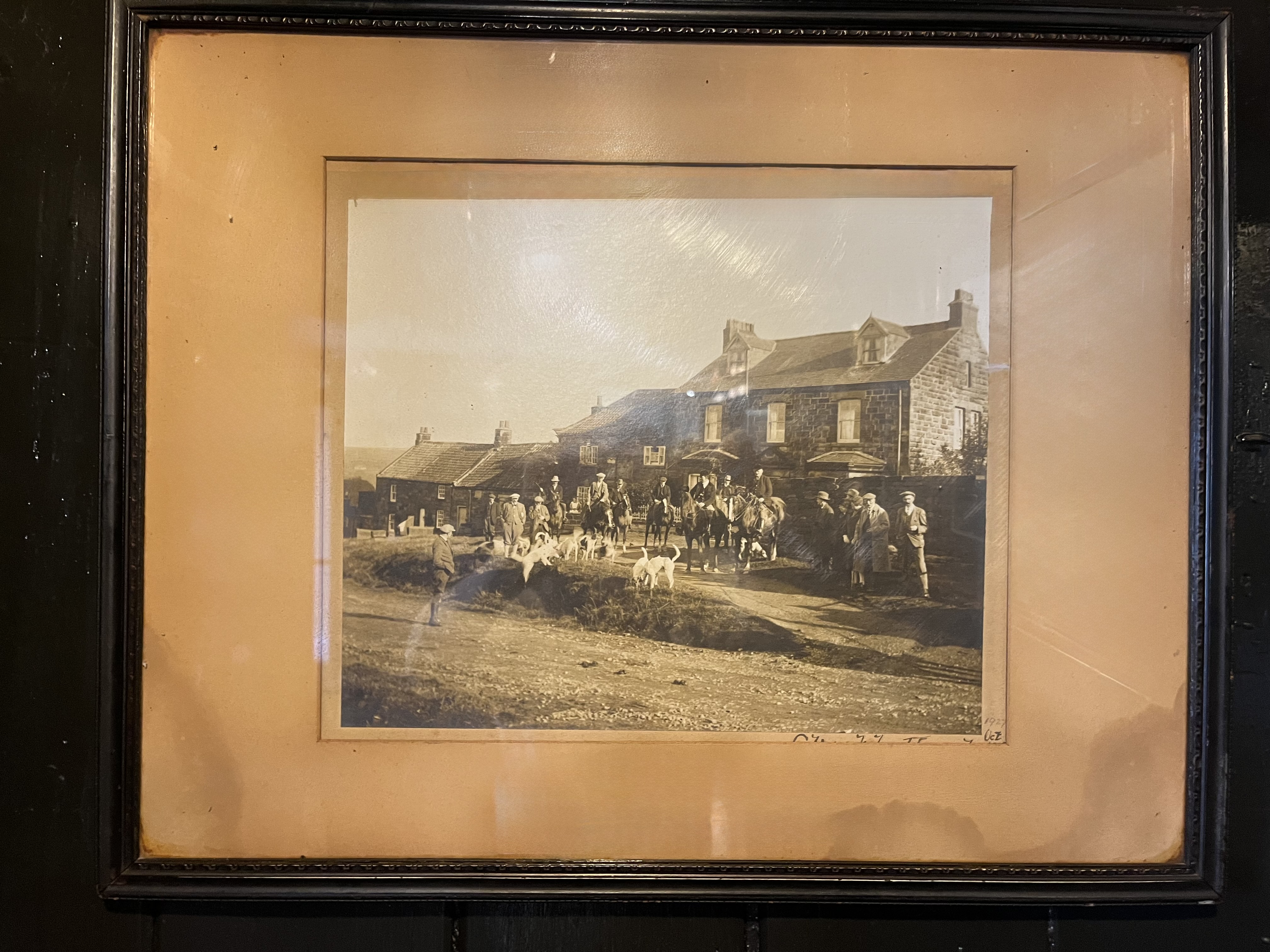
The picture hanging on the walls of the Fox and Hounds pub at Ainthorpe taken in October 1927. Does it feature Tom Boyes? And what does the hidden inscription on the bottom left say?
A close-up of the hidden inscription. Does anyone know what it says?


The links to Yorkshire dialect poet William E Fall keep on coming. Known as Bill, Fall wrote several volumes under the pen name Erimus which centred around his home turf of Danby on the North York Moors. Many of his works feature the characters that he encountered during his lifetime, such as horse breeder Tom Boyes, and farmers Ralph Winspear and ‘Grandad’ George Coverdale.

Fall lived and wrote at Danby Castle Houses, which I discovered from looking inside his books. Danby Castle Houses sit just below Danby Castle, and by a happy/spooky coincidence, last weekend I attended a wedding at that very location.

We stayed at the Fox and Hounds pub at nearby Ainthorpe, and at breakfast the following morning, I noticed a couple of pictures of the local hunt hanging on the walls. One was taken in Newholm, which is 13 miles east of Ainthorpe. It showed a pack of beagles clustering around a lead horse and rider, while a few other horses follow him, their riders dressed in their smart jodhpurs, jackets and black riding hats. It is undated.

The second showed a group of huntsmen outside the Fox and Hounds with some beagles too, but this time they were more casually dressed, most in flat caps and woollen suits. It was dated to October 1927, the same year of the wedding at Danby Church that I featured in my column a few weeks ago.

The frustrating thing was that there was an inscription at the bottom of the photograph, but it was partially obscured by the mount surrounding it meaning I was unable to read what it said. My guess is that it could have said ‘Glaisdale Hunt’ written in a curling ink script, but I can’t be certain (it is pictured here in case anyone can shed light on it). I do wonder if one of the gentlemen in the picture is our friend Tom Boyes? In October 1927, he would have been nearly 45, and because he was such a known character in the area, perhaps he is the chap on horseback in the centre of the picture looking to the left? Maybe one of you will recognise the photograph and be able to enlighten me on the inscription and the characters featured.

I have also heard back from Sophie-Jean Fall, whose email to me sparked this whole series of columns. She has recently returned from a holiday and is only just catching up. She says: “It’s like reading an in-detail history book. The amount of memories adds so much soul. My Aunty Ann actually called up my father in excitement because she was also really happy about these columns and how I’d contacted you! Really good writing again.”

Sophie-Jean was also fascinated by Dorothy Jackson’s recollections about Tom Boyes: “Dorothy and the word ‘sackless’ is just priceless! These all really set the poems and hidden stories to life; it is good that with your work the recollections are to be remembered further.”

Sophie-Jean also informed me: “I did forget to say, but Erimus’ childhood home is in a museum. I forget which now, but you can actually go visit it which is so interesting!”

I did a quick Google hunt to see if I could locate the museum Sophie-Jean refers to, and discovered that there are many references to ‘Erimus’ in and around Middlesbrough. There is Erimus House, an organisation helping vulnerable young people, the Erimus Practice health centre, Erimus Quoit and Rifle Club, Erimus Engines, Erimus Social Club and Erimus Cleaners. I found out that the reason this unusual Latin word proliferates in the town is because it is featured on its coat of arms which was adopted in 1853, the year of incorporation. It means ‘We shall be’, and contrasts with the motto of the ancient de Brus family, who used to own the land upon which Middlesbrough sits. Their motto was ‘Fuimus’ which means ‘We have been’.

I’d love to know which museum holds Erimus’ childhood home, and go and pay it a visit. It particularly intrigues me because I’d like to preserve my dad’s study in the same way, if only I could find someone or somewhere willing to house it!

And lastly, I wonder why Bill Fall chose to write under the name ‘Erimus’?

Do you have opinions, memories or ideas to share with me? Get in touch with me using the ‘Contact’ button on the top right.

This column appeared in the Darlington & Stockton Times on Friday 12th and the Ryedale Gazette and Herald on Wednesday 10th Sept 2025
T’in’t wat thoo ses, t’is t’way thoo ses it


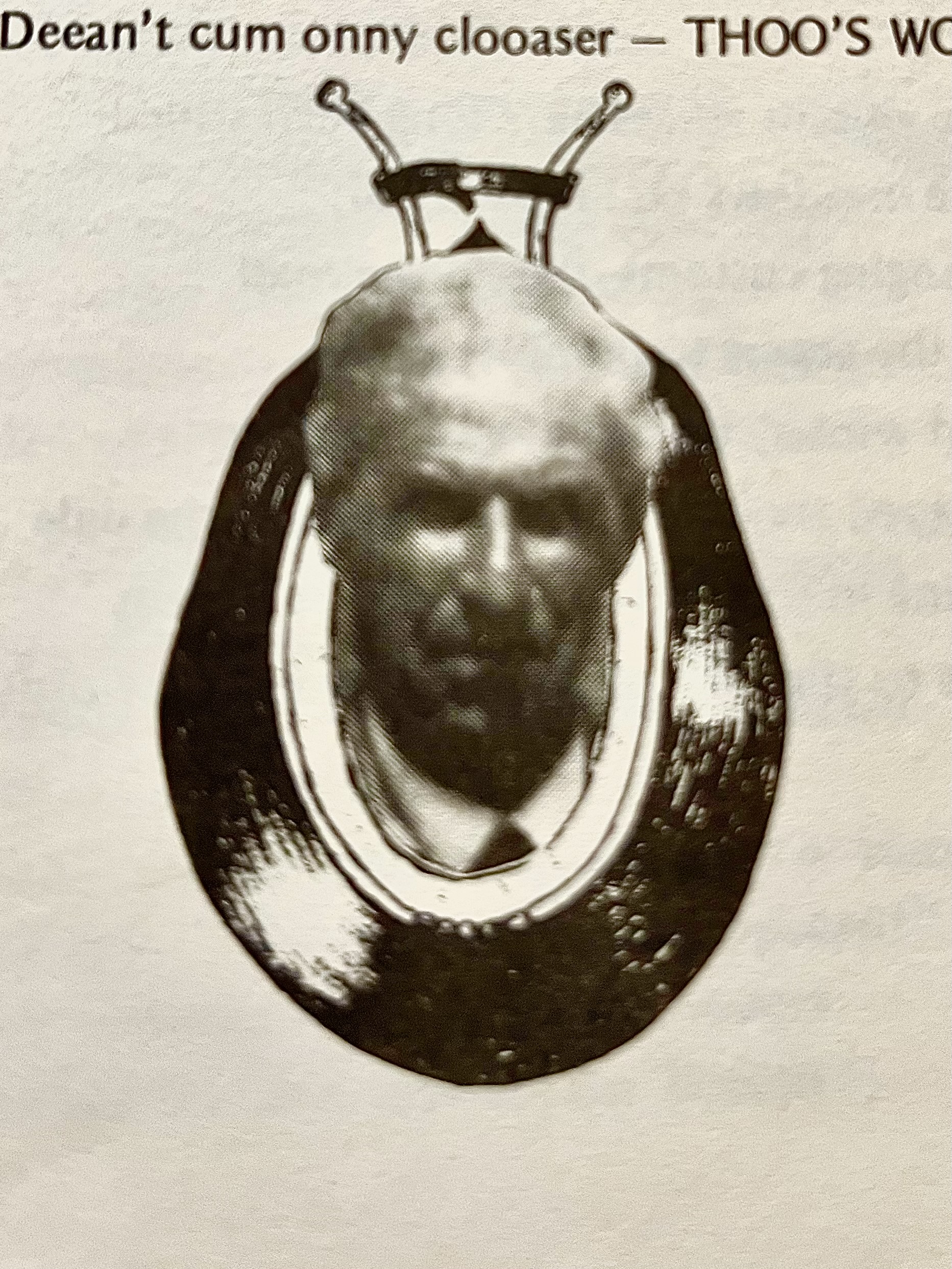
The poem ‘Grandad – through a barfin’ featured this picture of Pam Chester’s grandad George Coverdale. ‘Barfin’ is a dialect word for an oval horse collar.

An old photo from 1978 showing an alternative dialect ‘Beware of the Bull’ sign erected by Danby farmer Ralph Winspear after trouble with walkers straying across his land.

I’ve had some interesting correspondence following my two recent columns about the Danby dialect poet William E Fall who wrote under the name Erimus. If you remember, I was contacted by his great-granddaughter Sophie-Jean Fall who was searching for his books, and my dad happened to have been sent some copies.

Since then, she has revealed the discovery to her family and, following the publication of ‘Part Two’ of the story a couple of weeks ago, said: “Very excited and what an interesting image of Tom Boyes. Also, Gandan – AKA Erimus’ son – was really happy to hear about this all!” Hopefully ‘Gandan’ will also be interested in what the following readers can remember.

Pam Chester recalls: “My parents George and Ella Coverdale, my Grandad George Coverdale and myself lived at Danby Castle when Bill Fall and his wife Ella lived in a cottage at Castle Houses Farm, Danby. Bill would often walk up see my grandad. They would sit and chat about country life, hunting and farming…In the book ‘Poetry for t’Peasantry’ Bill wrote a poem about my grandad.”

I looked the poem up, and sure enough George Coverdale appears in ‘Grandad – through a Barfin’. Bill Fall states that Grandad George ‘Wi’ a dear auld nybour o’ mahn’, and the poem highlights one of Yorkshire’s most elegant of traditions – gurning. This refined skill involves people contorting their faces into gruesome expressions.

The poem describes a competition in which Grandad Coverdale took part. The competitors had to put their heads through a ‘barfin’, a dialect word for the large oval collar worn by cart horses. See if you can decipher the last verse of the poem – the language is bit ripe!

But then ‘e stopped – stood back aghast

Cos Grandad’s snitch was in ‘is gob!

‘Is chin was up – ‘is lugs stuck oot,

Wi’ t’ Judge wishin’ ‘e’d browd ‘is gun;

Freetened ti deeath, ‘e shooted oot,

“Deean’t cum onny clooaser – THOO’S WON!!!”

Pam wasn’t sure if her grandad ever really entered a gurning competition, but revealed that a picture on page 17 of the book is him with his head ‘through a barfin’.

She adds: “Bill and my grandad used to go and dig peats in the 1970s on the moor near the house to use as fuel in the winter months. He also used to follow the Glaisdale Hunt on horseback well into his 80’s. I remember him talking about Tommy Boyes.”

Janet Holt also contacted me: Bill “was our next door neighbour in Danby by our farm. My father had problems with straying walkers and Mr Fall came up with the idea of signs in the Yorkshire dialect. It caught the attention of the local press…He gave my parents a full set of the books.”

Her father was livestock farmer Ralph Winspear, who was fed up with walkers and children straying from the public footpaths across his land, damaging fences and leaving gates open. They ignored the polite signs asking them to keep to the official route and to shut gates. The last straw came in 1978 when two lambs escaped through an open gate and were killed on the nearby railway line. Bill Fall suggested erecting signs in Yorkshire dialect. One read: ‘if t’bull snorts, deean’t linger’, while another was very recognisably from Bill’s pen and entitled ‘Seestha’:

‘Noo, ye’ n’ me beeath need ti eeat

These beeasts’ll mak tasty meat

But not if fooakes gan runnin wild

Seea keep ti t’path n’ hod t’it child. Thankye’

The signs worked, as Ralph explained at the time: “We’ve had no trouble since they were erected because folk appear to be reading them carefully and the message gets home.” I wonder if anyone farming today has similar issues? Perhaps a warning sign in Yorkshire dialect might be worth a try!

I’d also like to thank Bill Filer who put me in touch with Dorothy Jackson from Helmsley, whose family knew Tom Boyes well. If you remember, Bill Fall dedicated a whole volume of poems to Boyes, and I featured a 1927 picture of a wedding at Danby Church in which Boyes could been seen accompanying the grand wedding car in his hunting finery.

But, alas, with me approaching my word count limit, I will have to leave Dorothy’s recollections until next time!


Do you have opinions, memories or ideas to share with me? Get in touch with me using the ‘Contact’ button on the top right.

This column appeared in the Darlington & Stockton Times on Friday 22nd Aug and the Ryedale Gazette and Herald on Wednesday 20th Aug 2025