Stop all the clocks

IMG_6278
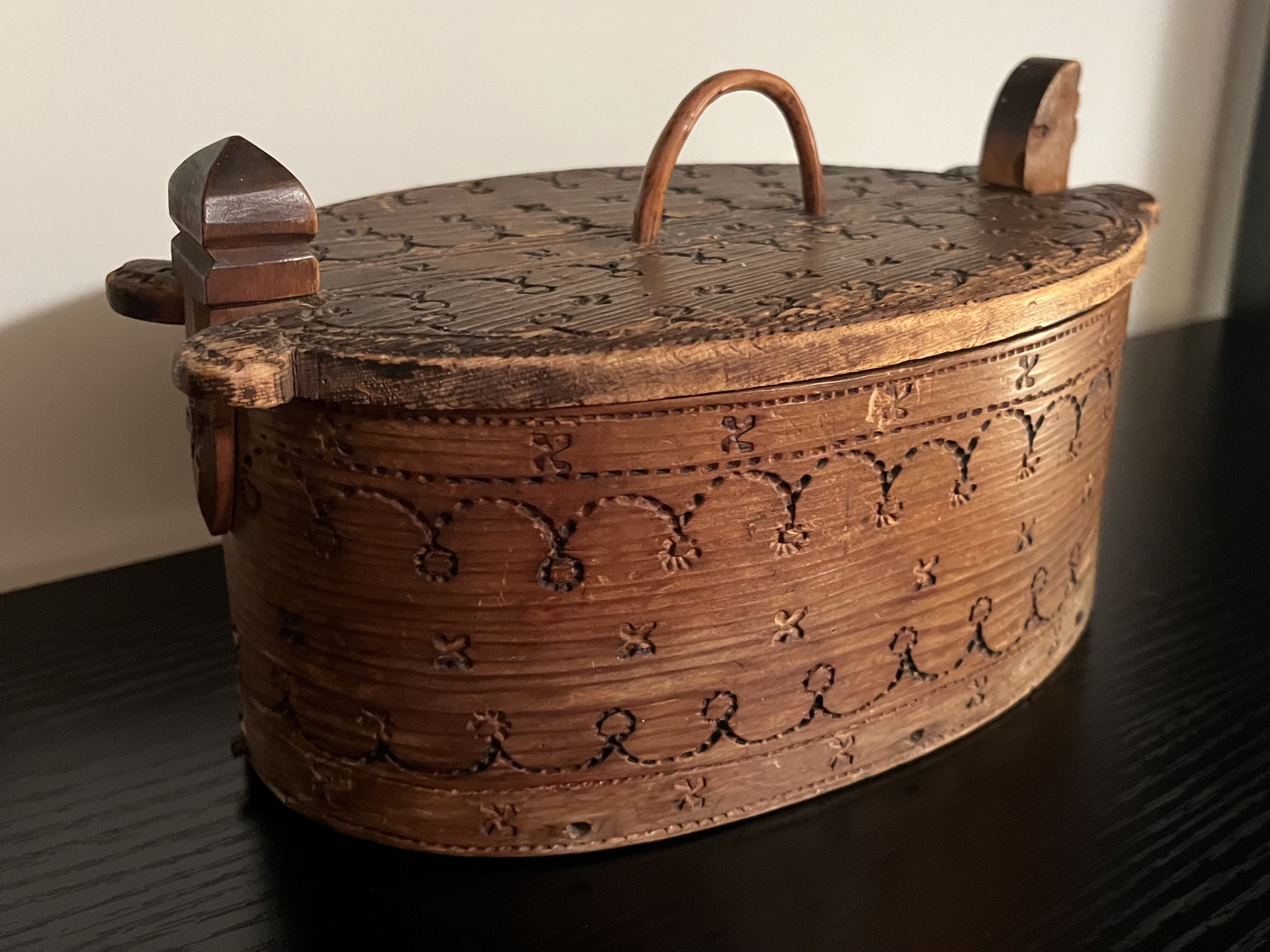
The hand-carved wooden box given to me by my grandad. It is very precious to me.
IMG_9505
Sandra’s 18th century long-case clock made by Northallerton’s Hugh Pannell. Will it find a new home?

IMG_9507

Back in August I wrote about 18th-century Northallerton clockmaker Hugh Pannell after being contacted by one of his descendants, David Severs. I’d been talking about the herringbone pattern that was commonly seen on the stones used to build moorland homes. David informed me that Pannell had used the same herringbone pattern to decorate his clocks and watches.

Following that, reader Sandra Parkerson has been in touch all the way from Arkansas, USA, because she has one of Pannell’s long-case clocks which needs to find a new home. She writes: “I have a grandfather clock that was made by Hugh Pannell. It has been in my family for way over two hundred years. It is in a beautiful walnut case. I am 80 now and want to move into a condominium so probably won’t have room for it…I do hate to part with it.”

She adds: “It is a brass dial with the herringbone pattern…It was running all my life, but when I got it we had carpet and never could get it levelled correctly. So, I assume with a good cleaning, it will work fine.”

I would not normally use this column as an antiques’ marketplace, but with the connection to Hugh Pannell and the herringbone pattern, and the fact that somehow my column has been read by someone all the way over in Arkansas, USA, I thought it appropriate to mention it. It would be lovely to pair up this noble clock with someone who would appreciate it as much as Sandra (Please note: I do not plan to advertise items for sale in future columns and suggest you try Christie’s (for valuable antiques) or eBay (for general tat)).

It does raise the question of what to do with precious family items that the following generation have no inclination to take on. About 25 years ago, my aunt was moving from a large home in North Yorkshire to a smaller one in Ireland. She could not take all her furniture with her and so offered me her beautiful antique mahogany dining table with six upholstered chairs. I willingly accepted it but then found that once it was installed in my pokey dining room, it took up all the space and was really too posh for the likes of us, a working family with young boisterous boys. It was impractical and unappreciated, and I ended up reluctantly selling it for a song when we moved house again. I was told by the auctioneer that large pieces of dark wood furniture had fallen out of favour and they’d struggle to get rid of it. It was heartbreaking to see such a beautifully crafted piece of fine furniture go for so little money.

One thing I treasure greatly is a small oval wooden box that my grandad gave me. He was a skilled wood worker, and I have a number of his beautiful hand-turned bowls. This box is what an antiques expert might call ‘naïve’, in that it is clearly handmade and hand-carved, with a series of little flowers and garlands etched into its surface. Nothing is straight or symmetrical, which is precisely why I love it so much. Someone has taken a lot of time and effort to chisel out all the tiny decorative elements which makes it so unique and personal. They have also coaxed the wood into this oval shape, with tiny little dowel joints holding the base in place. I have no idea of its age, whether my grandad himself made it, or whether it was passed down to him from his own ancestors. I do know he kept bits and bobs for fishing inside it, like hooks and flies, and when I was little I spotted it on a bench in his workshop and said how much I liked it. And so my kind grandad gave it to me. Unfortunately, my youth meant I didn’t ask any pertinent questions about its origin and therefore its history is lost in the mists of time.

Because this is just a small thing, I am fairly confident that one of my boys will happily hang on to it when I take my final leap into the great unknown, but the question is, which one?

If you have more than one child to inherit your precious stuff, how do you decide who gets what?

Do you have opinions, memories or ideas to share with me? Get in touch with me via the ‘Contact’ tab at the top right of this page.

This column appeared in the Darlington & Stockton Times on Friday 27th Dec and the Ryedale Gazette and Herald on Wednesday 18th Dec 2024

The legacy of lost things

1-100_0612
A clock face made by reader David Severs’ ancestor Hugh Pannell with the herringbone pattern around the outer edge of the dial and around the name boss, along with the rare ‘Clock & Watchmaker’ inscription.

I’ve had some more feedback from readers following the column I wrote about the stones marked with the herringbone pattern typically used in the construction of traditional North Yorkshire moorland homes. Reader John Severs had referred me to a book entitled ‘Life in the Moorlands of North-East Yorkshire’ written in 1972 by Marie Hartley and Joan Ingilby. There was a section on this specific type of masonry along with some photographs featuring a well-known local family, the Weatherills.

Another reader, John Buckworth, has emailed to say: “Good to read your article re. Mr G. Weatherill. We were a customer of his some years ago and a great admirer of his craftsmanship. I pass his stone yard at Ainthorpe quite frequently and still see the antiquated home-made crane to lift the headstones. Also there’s a piece of carved stone on his wall depicting a fox’s mask, brush and hunting horn. Most country people followed the hunt and I find this a great tribute to the past way of life. Being now in my 80s I am a great admirer of country life and your father’s writings.”

He added: “I think the old crane was built by his grandfather…There are some very fancy and OTT headstones. However when my wife’s father died, he was a man of the soil and we walked into the stone yard at Ainthorpe and there was a piece of rough Yorkshire sandstone which fitted the man admirably.”

My editor at the Darlington and Stockton Times, Hannah Chapman, spotted something relevant on a weekend walk: “I was walking on the Cleveland Way yesterday (north from Lordstones café) and I’m sure I spotted a stone in the path with the grooved diagonal pattern you wrote about in the Chop Gate area. Could the old stones from houses in the area have been used to build paths?”

I think Hannah probably has a point – why not reuse stones from the tumbled down moorland buildings in the construction and repairs of our public walkways?

I also received a couple more stories about ‘lost things’ and how difficult it is to discard a lone earring. Monica Ganz contacted me all the way from America about a bracelet her mother had given her: “It had a daisy as a charm. I loved it, because the daisy was painted yellow and white…I was delivering newspapers on my bike and somehow the Daisy fell off, never to be found again. When I was older in my 20s, I was water skiing. I wore these cute little gold huggy earrings that had small diamond on them. Of course…the earring popped off…I still have the bracelet and the one earring…Why do we lose treasured items? Hard to know why, right? And it’s hard to part with them.”

I wonder if it is more the memories and feelings that are held within the precious item that makes it hard to let go?

David Severs from Northallerton had his own fascinating story too: “You might be interested to know that in Saywell’s ‘History and Annals of Northallerton’ he recounts how a gardener’s newlywed wife had lost her wedding ring in their garden and 14 years later, in 1796, it was found when a customer cut into a turnip and found the ring inside.”

David also mentioned how the herringbone pattern was used in the decoration of clocks and watches: “Herringbone engraving was used on the brass dials of long-case clocks in the early years of the 18th-century in London … said to be a sign of quality. Some clockmakers used it until about 1740. My ancestor Hugh Pannell, the Northallerton clockmaker, was in business until he died in 1788. I have traced well over 100 of the clocks he made and many of them have herringbone engraving. Most clockmakers decorated the spandrels on their brass dials (the corners) with cast-brass decoration; a few engraved the spandrels; and even fewer left them undecorated: Hugh did all three…Most of his dials have herringbone engraving somewhere. Incidentally on the photograph (seen here) he described himself as ‘Clock & Watchmaker’ and this is very rare indeed. In very many years I have found only one example by one other clockmaker whereas I have found five examples by Hugh Pannell, three of these dials now being in the USA.”

I’d love to hear from you about your stories, memories, opinions and ideas for columns. Use the ‘Contact’ button on the top right of this page to get in touch.

This column appeared in the Darlington & Stockton Times on Friday 9th  and the Ryedale Gazette and Herald on Wednesday 7th August 2024.