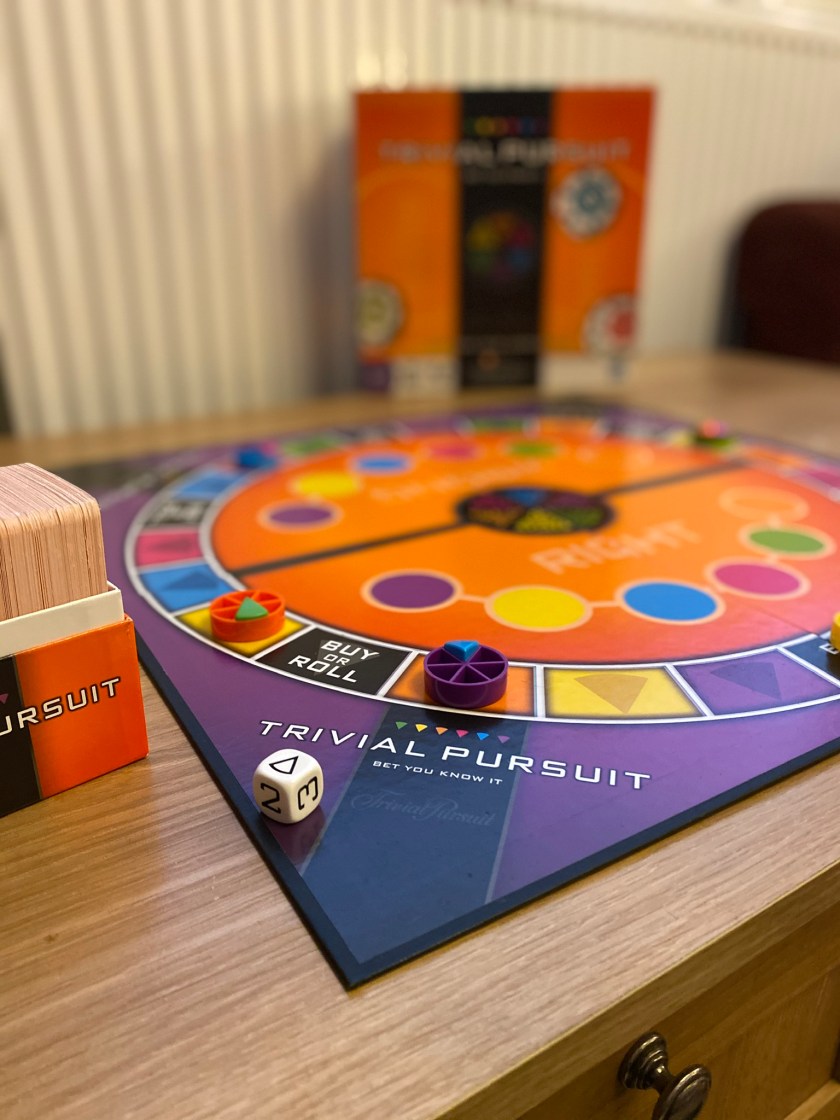

Something that saddens me is the decline in traditional games played as a family. Growing up I was a big fan of board games like Frustration, Buckaroo, Draughts, Cluedo, and Backgammon.
My love of games continued into adulthood, and then on into parenthood, and when my children were very little, we played a number of board games alongside Hide and Seek, Blind Man’s Buff and treasure hunts. But as they grew older, the lure of technology beckoned and the old games were played less and less, eventually becoming solely a Christmas activity forced upon them by a mother desperate to cling on to the past. I would subject the family to rounds of Pictionary, or Trivial Pursuit, or to ‘parlour’ games like charades, or ‘The Name Game’ (where you all write down 20 names of famous people on pieces of paper that are folded and thrown into a bowl. Then, playing in teams, you get 30 seconds to describe as many as you can while your team guesses). It’s one of those games that the whole family, from youngsters to grandparents, are supposed to enjoy, although it baffled me that not everyone was as enthusiastic about it as me.
This sentiment is echoed by my dad in his column from 29th November 1980 when the fear of advancing technology was already taking hold. A friend had asked him if he knew of any suitable games for children to play indoors. He wrote: ‘In a modern society, this is not easy because there are so many intriguing games which can be bought and which today operate with the help of miniature computers and electronic gadgetry.’
He was referring to things like ‘Pong’, a 1970s electronic game that mimicked table tennis with two people ‘batting’ a ‘ball’ backwards and forwards across a screen. It was one of the first consoles that you could plug into the TV to play. My best friend had one and I coveted it, begging to have a go whenever I visited her. By 1980, more sophisticated video games had begun to appear, the most famous being Pac-Man, where the object was to eat as many dots in a maze as you could without crashing into the coloured ghosts along the route. It started out as something you could only play when visiting a town centre arcade, but soon, home-based consoles were developed and were instantly popular. Other electronic games soon followed, such as Donkey Kong and Space Invaders, which although extremely simple by today’s standards, were nevertheless incredibly popular with a young generation ready to embrace the age of the computer.
‘Playing games’ evolved into ‘gaming’, and a whole new era of internet-based entertainment for the youth dawned. I wonder what our forebears would make of the idea of young people sitting alone in their bedrooms playing games with their peers miles away, often living on different continents and in different time zones. It would have blown their minds! The sad thing is that these are not games that many play together as a family.