Time to make decisions

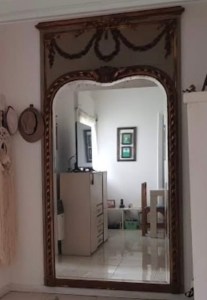
Horacio Romeo’s beloved antique mirror has to stay in Buenos Aires, Argentina, because it is too big to bring to his current home in Brazil.

Following my column about the Hugh Pannell clock owned by Arkansas-resident Sandra Parkerson, David Severs has been in touch. David is a descendant of the 18th century Northallerton clockmaker and was able to provide some useful historical context about it. If you recall, the grandfather clock has been in Sandra’s family for more than 200 years, but she is looking to find it a home because it will be too big to take to a new apartment.

David is compiling a record of Pannell’s work and explains that it is unusual to find ‘CLOCK & WATCH-MAKER’ engraved on the name boss. “This is very rare indeed and to find yet another Pannell example is exciting,” he says.

He explains that Sandra’s walnut case is not original: “I have found well over a hundred Hugh Pannell clocks and not one is in a walnut case.” Most of Pannell’s clocks were in cases of mahogany, oak or pine. David has found only one pine example due to the wood not being durable, and mahogany is also quite rare because he would have had to transport it by cart from west coast ports such as Liverpool, which was far more costly than a readily available oak case. Mahogany cases were the preserve of the wealthy, and housed Pannell’s finest pieces. They became more common once the rail network reached Northallerton in 1841, well after Hugh Pannell’s time. Oak cases with mahogany veneer were known as ‘typical Yorkshire cases’ in 1774 when Pannell was working.

David says about Sandra’s clock: “The decoration on the pediment is not something I have seen over here and the split trunk door is also new to me. It is possible that the clock mechanism alone was sent to the USA and then placed into Sandra’s mahogany case upon arrival.”

David adds: “I have found that some 30% of Hugh’s surviving clocks are now marriages which is perhaps not surprising given that it is 236 years and more since he was making clocks…I am aware of his clocks in California, Florida, New Orleans and San Francisco as well as this one in Arkansas. Clocks by his son Joshua…have found their way to Iowa and California and one of his watches to Florida.”

This brings me on to the subject of what to do with meaningful objects you have collected in your lifetime.

Regular reader Clare Powell says: “I inherited my dad’s grandfather clock…and decided to sell it later on. You get nothing for them at auction, nobody wants or has the room for them, even old ones. But I discovered it was handmade by a company in Somerset and he had paid £3,500 for it. I couldn’t bring myself to sell it for £150, so I am still stuck with it!”

In a previous column I mentioned a small wooden box my grandad gave me which I hope one of my sons will keep. Clare explains that the thought of what to do with all her family heirlooms keeps her awake at night: “I am not sure we should burden the next generation with all our ‘stuff’. If you tell them why everything means so much to you, will they feel ridden with guilt if they are not able to keep it all? Then again, if you don’t tell them, then they may wish they did know the story of certain items, like you and your box.”

Horacio Romeo from Brazil, who contacted me through my web page (countrymansdaughter.com), has a similar problem to Sandra in that he has a beautiful mirror that is too big for his current abode: “I love it and enjoy looking at it when I go to Buenos Aires (Argentina) but bringing it here is out of the question.”

Leni Ella says: “My nana used to say, ‘If you want it, put your Monica on it’, the only way you could bagsy something in her house.” (I am assuming Nana meant ‘moniker’ and ‘Monica’ is a family joke!).

My aunt, Liz Davidson, revealed that she has a family heirloom: “I have a crocheted white bedspread that came from my dad and one of his aunties I think. It’s very heavy when you put it on the bed.”

There is only so much the following generation will want to keep so what, I wonder, will happen to grandad’s bedspread?

Do you have opinions, memories or ideas to share with me? Get in touch with me via the ‘Contact’ tab at the top right of this page.

This column appeared in the Darlington & Stockton Times on Friday 17th Jan and the Ryedale Gazette and Herald on Wednesday 15th Jan 2025
Stop all the clocks

IMG_6278
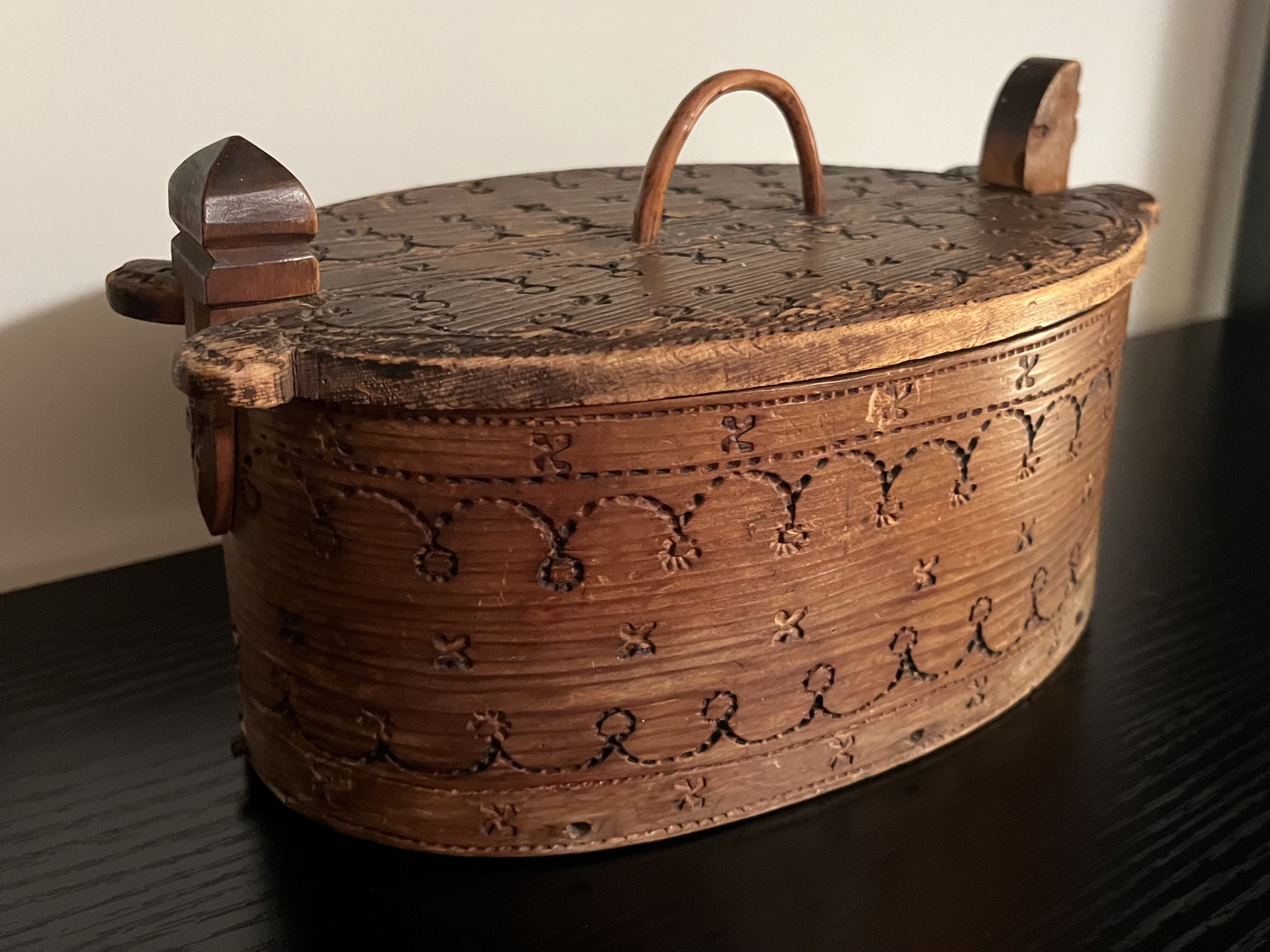
The hand-carved wooden box given to me by my grandad. It is very precious to me.
IMG_9505
Sandra’s 18th century long-case clock made by Northallerton’s Hugh Pannell. Will it find a new home?

IMG_9507

Back in August I wrote about 18th-century Northallerton clockmaker Hugh Pannell after being contacted by one of his descendants, David Severs. I’d been talking about the herringbone pattern that was commonly seen on the stones used to build moorland homes. David informed me that Pannell had used the same herringbone pattern to decorate his clocks and watches.

Following that, reader Sandra Parkerson has been in touch all the way from Arkansas, USA, because she has one of Pannell’s long-case clocks which needs to find a new home. She writes: “I have a grandfather clock that was made by Hugh Pannell. It has been in my family for way over two hundred years. It is in a beautiful walnut case. I am 80 now and want to move into a condominium so probably won’t have room for it…I do hate to part with it.”

She adds: “It is a brass dial with the herringbone pattern…It was running all my life, but when I got it we had carpet and never could get it levelled correctly. So, I assume with a good cleaning, it will work fine.”

I would not normally use this column as an antiques’ marketplace, but with the connection to Hugh Pannell and the herringbone pattern, and the fact that somehow my column has been read by someone all the way over in Arkansas, USA, I thought it appropriate to mention it. It would be lovely to pair up this noble clock with someone who would appreciate it as much as Sandra (Please note: I do not plan to advertise items for sale in future columns and suggest you try Christie’s (for valuable antiques) or eBay (for general tat)).

It does raise the question of what to do with precious family items that the following generation have no inclination to take on. About 25 years ago, my aunt was moving from a large home in North Yorkshire to a smaller one in Ireland. She could not take all her furniture with her and so offered me her beautiful antique mahogany dining table with six upholstered chairs. I willingly accepted it but then found that once it was installed in my pokey dining room, it took up all the space and was really too posh for the likes of us, a working family with young boisterous boys. It was impractical and unappreciated, and I ended up reluctantly selling it for a song when we moved house again. I was told by the auctioneer that large pieces of dark wood furniture had fallen out of favour and they’d struggle to get rid of it. It was heartbreaking to see such a beautifully crafted piece of fine furniture go for so little money.

One thing I treasure greatly is a small oval wooden box that my grandad gave me. He was a skilled wood worker, and I have a number of his beautiful hand-turned bowls. This box is what an antiques expert might call ‘naïve’, in that it is clearly handmade and hand-carved, with a series of little flowers and garlands etched into its surface. Nothing is straight or symmetrical, which is precisely why I love it so much. Someone has taken a lot of time and effort to chisel out all the tiny decorative elements which makes it so unique and personal. They have also coaxed the wood into this oval shape, with tiny little dowel joints holding the base in place. I have no idea of its age, whether my grandad himself made it, or whether it was passed down to him from his own ancestors. I do know he kept bits and bobs for fishing inside it, like hooks and flies, and when I was little I spotted it on a bench in his workshop and said how much I liked it. And so my kind grandad gave it to me. Unfortunately, my youth meant I didn’t ask any pertinent questions about its origin and therefore its history is lost in the mists of time.

Because this is just a small thing, I am fairly confident that one of my boys will happily hang on to it when I take my final leap into the great unknown, but the question is, which one?

If you have more than one child to inherit your precious stuff, how do you decide who gets what?

Do you have opinions, memories or ideas to share with me? Get in touch with me via the ‘Contact’ tab at the top right of this page.

This column appeared in the Darlington & Stockton Times on Friday 27th Dec and the Ryedale Gazette and Herald on Wednesday 18th Dec 2024