What shall be shall be


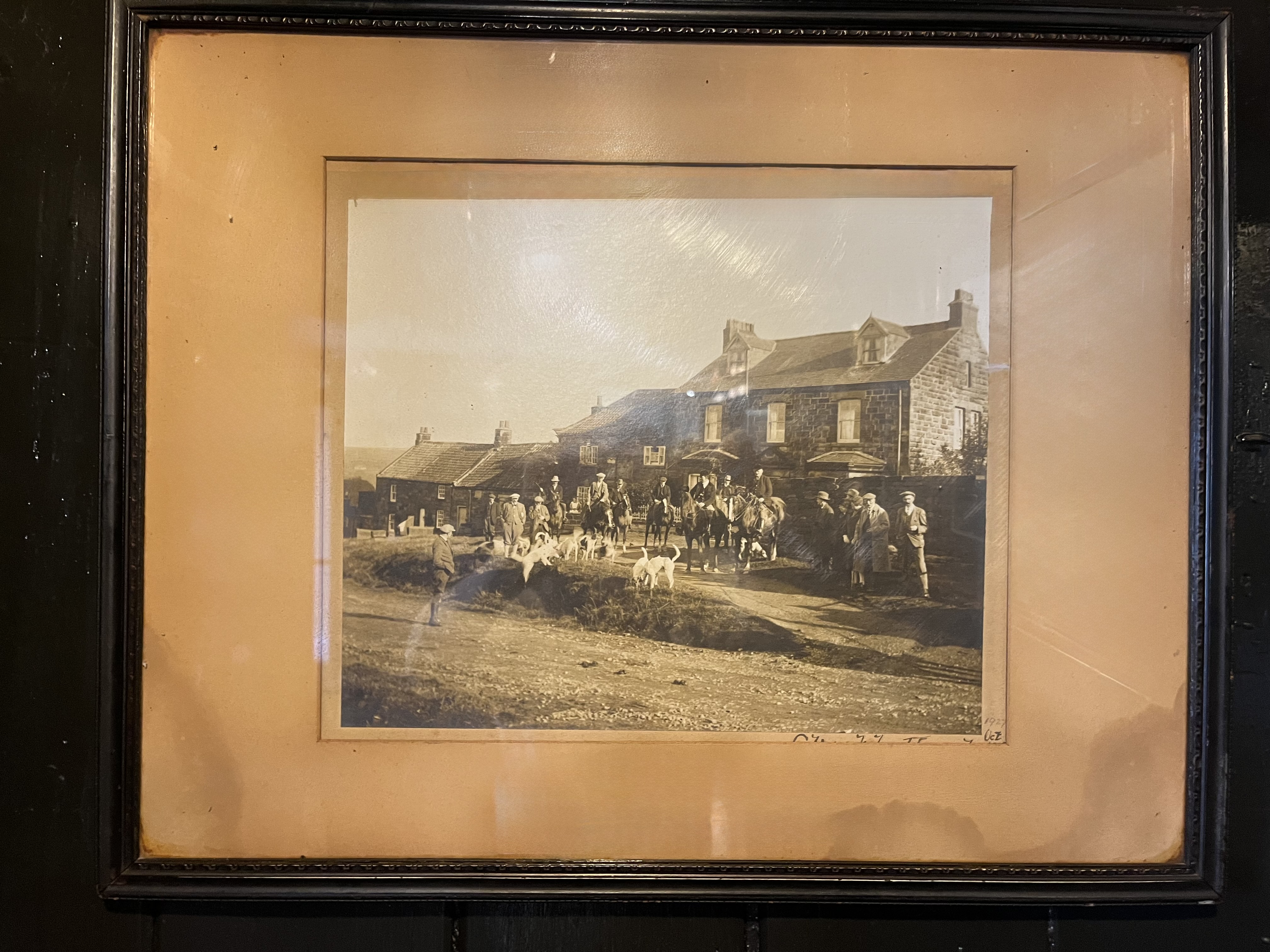
The picture hanging on the walls of the Fox and Hounds pub at Ainthorpe taken in October 1927. Does it feature Tom Boyes? And what does the hidden inscription on the bottom left say?
A close-up of the hidden inscription. Does anyone know what it says?


The links to Yorkshire dialect poet William E Fall keep on coming. Known as Bill, Fall wrote several volumes under the pen name Erimus which centred around his home turf of Danby on the North York Moors. Many of his works feature the characters that he encountered during his lifetime, such as horse breeder Tom Boyes, and farmers Ralph Winspear and ‘Grandad’ George Coverdale.

Fall lived and wrote at Danby Castle Houses, which I discovered from looking inside his books. Danby Castle Houses sit just below Danby Castle, and by a happy/spooky coincidence, last weekend I attended a wedding at that very location.

We stayed at the Fox and Hounds pub at nearby Ainthorpe, and at breakfast the following morning, I noticed a couple of pictures of the local hunt hanging on the walls. One was taken in Newholm, which is 13 miles east of Ainthorpe. It showed a pack of beagles clustering around a lead horse and rider, while a few other horses follow him, their riders dressed in their smart jodhpurs, jackets and black riding hats. It is undated.

The second showed a group of huntsmen outside the Fox and Hounds with some beagles too, but this time they were more casually dressed, most in flat caps and woollen suits. It was dated to October 1927, the same year of the wedding at Danby Church that I featured in my column a few weeks ago.

The frustrating thing was that there was an inscription at the bottom of the photograph, but it was partially obscured by the mount surrounding it meaning I was unable to read what it said. My guess is that it could have said ‘Glaisdale Hunt’ written in a curling ink script, but I can’t be certain (it is pictured here in case anyone can shed light on it). I do wonder if one of the gentlemen in the picture is our friend Tom Boyes? In October 1927, he would have been nearly 45, and because he was such a known character in the area, perhaps he is the chap on horseback in the centre of the picture looking to the left? Maybe one of you will recognise the photograph and be able to enlighten me on the inscription and the characters featured.

I have also heard back from Sophie-Jean Fall, whose email to me sparked this whole series of columns. She has recently returned from a holiday and is only just catching up. She says: “It’s like reading an in-detail history book. The amount of memories adds so much soul. My Aunty Ann actually called up my father in excitement because she was also really happy about these columns and how I’d contacted you! Really good writing again.”

Sophie-Jean was also fascinated by Dorothy Jackson’s recollections about Tom Boyes: “Dorothy and the word ‘sackless’ is just priceless! These all really set the poems and hidden stories to life; it is good that with your work the recollections are to be remembered further.”

Sophie-Jean also informed me: “I did forget to say, but Erimus’ childhood home is in a museum. I forget which now, but you can actually go visit it which is so interesting!”

I did a quick Google hunt to see if I could locate the museum Sophie-Jean refers to, and discovered that there are many references to ‘Erimus’ in and around Middlesbrough. There is Erimus House, an organisation helping vulnerable young people, the Erimus Practice health centre, Erimus Quoit and Rifle Club, Erimus Engines, Erimus Social Club and Erimus Cleaners. I found out that the reason this unusual Latin word proliferates in the town is because it is featured on its coat of arms which was adopted in 1853, the year of incorporation. It means ‘We shall be’, and contrasts with the motto of the ancient de Brus family, who used to own the land upon which Middlesbrough sits. Their motto was ‘Fuimus’ which means ‘We have been’.

I’d love to know which museum holds Erimus’ childhood home, and go and pay it a visit. It particularly intrigues me because I’d like to preserve my dad’s study in the same way, if only I could find someone or somewhere willing to house it!

And lastly, I wonder why Bill Fall chose to write under the name ‘Erimus’?

Do you have opinions, memories or ideas to share with me? Get in touch with me using the ‘Contact’ button on the top right.

This column appeared in the Darlington & Stockton Times on Friday 12th and the Ryedale Gazette and Herald on Wednesday 10th Sept 2025
The tale of the fox kicking the Bucket

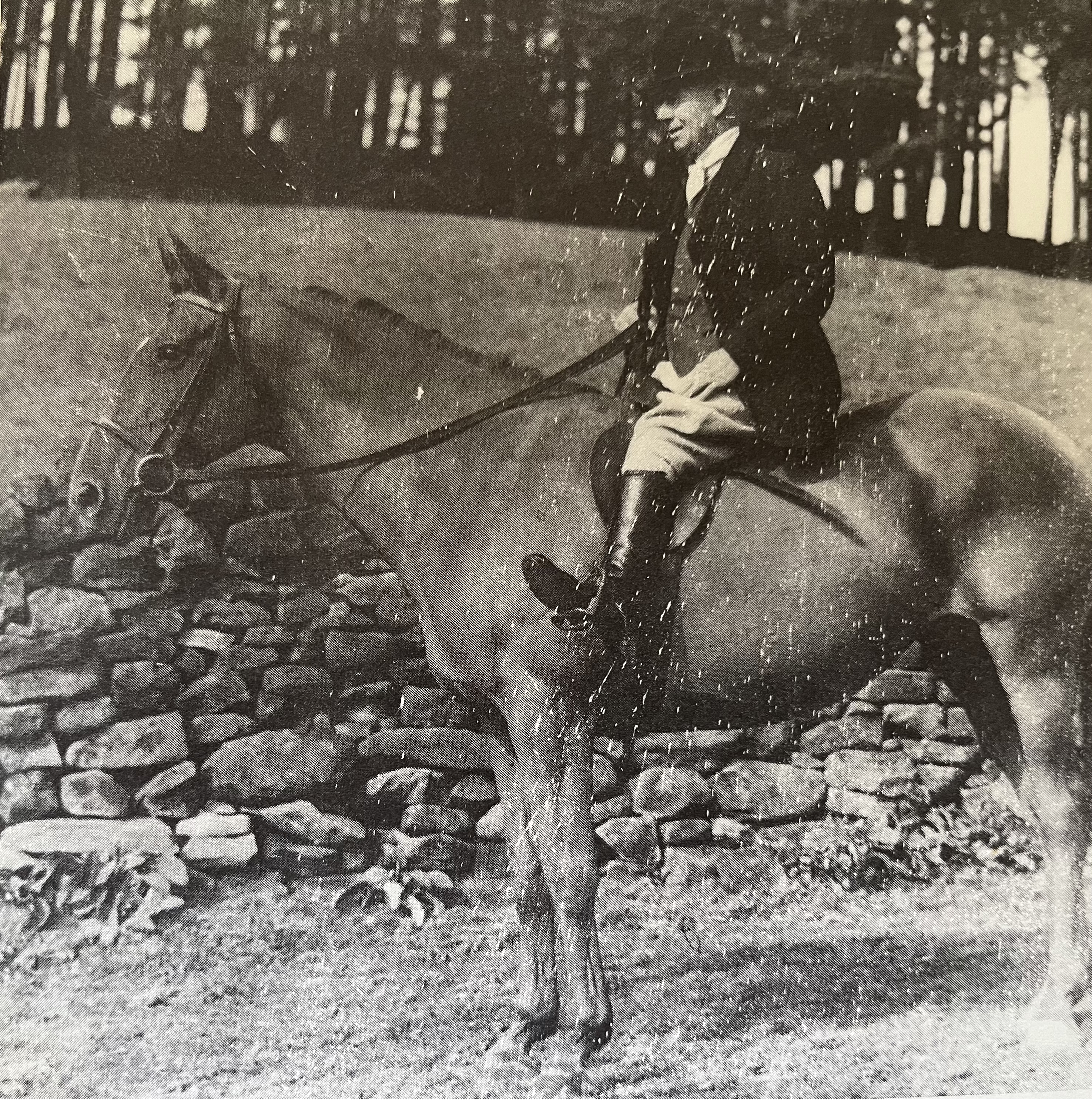
A picture of Tom Boyes whom reader Dorothy Jackson knew well, taken from one of poet Bill Fall’s books

One of Tom Boyes’ greyhounds, sketched by Bill Fall. Is this Bucket?

Last week, I thanked reader Bill Filer who put me in touch with Dorothy Jackson from Helmsley, whose family knew Tom Boyes. Boyes, born in Castleton in 1882, was well-known as a horse breeder and dealer and member of the Farndale Hunt, as well as being a good friend of the Danby poet William E Fall (Bill) who wrote dialect verses under the name Erimus. His poems highlighted the quirky characters he came across and several readers have already been in touch with recollections about Bill and his family.

Dorothy revealed she had seen the photo of the 1927 Danby wedding in my previous column and it jogged her memory of having one of Bill Fall’s books, ‘Tom Boyes, Deealsman’. Dorothy has a lovely old moors accent, and explained: “When I saw your column I wondered if I still had that book…I went to the cupboard and it was the first thing that came out, so I hadn’t to look very long for it!” Considering she’s had the book for many years, that was some bit of luck.

She was given it by the Bonas family, who were good friends with Tom Boyes. Dorothy is still in touch with their daughter, now 97 years old. “We’ve always kept in touch and so I was interested to know if she remembered Tom Boyes. I talked to her and straight away she said, ‘Oh yes, Tom Boyes came to our place time and time again!’ He dealt with horses and ponies and her father was the same…At 97 she remembered him straight away!” It is clear Tom Boyes was a memorable character.

Dorothy revealed that during the 1939-1945 war years her family was friendly with the Palmers who owned Grinkle Hall Estate near Danby (now the Grinkle Park Hotel). They got to know them through the Glaisdale Hunt and Dorothy’s father, John Bell Sokell (known as Jack), was on the hunt’s committee.

Mark Palmer, heir to the estate, had gone to fight in WWII as an army captain, and Myrtle Palmer was his sister. Although from a well-to-do family, Myrtle wanted do her bit and registered to support the Home Front.

Dorothy explained: “They came to an arrangement where she would go to Tom Boyes. He had a smallholding and she would work there through the day and return to Grinkle Hall at night time. That went on all through the war years…She was a very hard-working person and very particular with horses,” Dorothy remembered. She also recalled that the Grinkle Hall horses were always very well kept and turned out and that they still had a beautiful old coach in one of the stalls, left behind from the days before motor vehicles.

Dorothy explained that Myrtle had some wonderful scrap books full of photographs documenting her life and the people she had met along the way, including a lot of Tom Boyes. “Myrtle passed away some years ago and I’ve often wondered what happened to those scrap books,” she said.

Mark Palmer married after the war, never returning to the estate, and it was sold to a hospitality group in 1946 which turned it into a hotel, and that is how it has remained ever since. The tenants living in estate properties were offered the chance to buy their homes, which many took up, although Dorothy’s family had already bought a freehold farm at Borrowby, near Staithes, in 1943.

Dorothy remembered a funny story about Boyes that Myrtle had told her: “He always had a greyhound and called it ‘Bucket’ and in one of Bill Fall’s poems, Bucket comes into it.

“One day Tom Boyes was sat on his shooting stick and his terrier went down this fox hole, and the fox came out and knocked Bucket over!” Dorothy chuckled at the memory. “Bucket was just sat there so sackless just looking around and it knocked him over!” Sadly I could not find the poem she refers to in the three books I have.

It was lovely to hear Dorothy use the old northern adjective ‘sackless’ which I’ve not heard for a long time. It has fallen out of common use, but means ‘innocent’ or ‘guiltless’.

I adore hearing first-hand memories like these of times gone by, and am now wondering where Myrtle Palmer’s scrapbooks ended up. Perhaps someone reading this might know?

Do you have opinions, memories or ideas to share with me? Get in touch with me using the ‘Contact’ button on the top right.

This column appeared in the Darlington & Stockton Times on Friday 29th Aug and the Ryedale Gazette and Herald on Wednesday 27th Aug 2025