In my New Year column I featured a number of funny quotes from famous people about diet and exercise, and ended with the following anonymous philosophical quip:
“Eat Right. Exercise. Die Anyway.”
Clare Proctor got in touch to say: “That last quote sums it up for me. An old lady once said to me that her doctor kept telling her to do all sorts of things to help her live to 100, to which she said, ‘Why? My friends are already dying, my family have pretty much gone, so why do I want to live to 100, alone and dribbling in a care home?’ She may have a point…although, the older you get, the younger 100 looks!”
Lucien Smith added: “My mum lived to 94 and by then she had outlived almost all her friends of her own age. She still had lots of younger friends, but it’s not quite the same…That generation see their friends either passing away or confined to a care home. It can’t be easy!”
I’m sure we’d all love to live longer IF we could guarantee not to have to deal with the kinds of physical and mental ailments that we witness our parents’ and grandparents’ generations suffer, but sadly, the older I get, the more I realise that those who do manage to remain spritely are the exceptions rather than the rule.
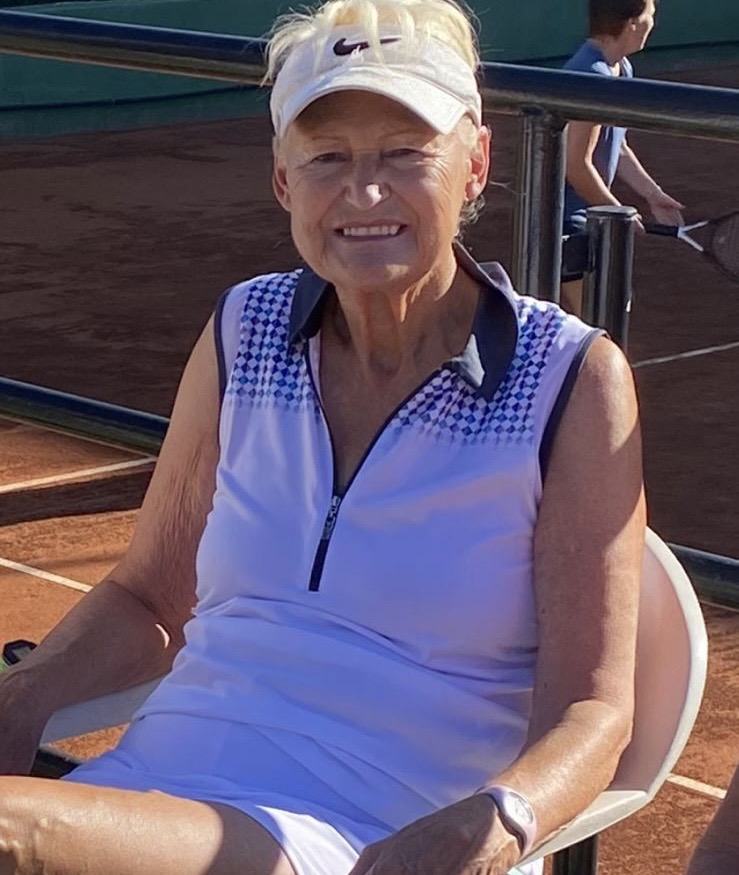
One such person is my friend’s mum Kath. Until a week ago, 77-year-old Kath was as fit as a fiddle. Sadly, she took a tumble and broke her hip. The thing is, when she took that tumble she was racing like a teenager around a padel tennis court. When the hospital doctor asked how much physical activity she did, she replied that she played tennis and padel twice – sometimes even three times – a day! She also fit golf and countryside walks into her weekly calendar,
I don’t know many 47-year-olds who can manage that level of activity without physical repercussions, let alone 77-year-olds. But as I mentioned, people like Kath are the exception. Thankfully, she is back home and recovering.
I try to keep fit and, like Kath, love playing padel. You may have noticed courts springing up all over, and it seems the nation has become hooked on it. It’s highly addictive, but I am one of the many of a certain age who have been thwarted by their body letting them down.
Just before Christmas my right foot suddenly stopped working normally. I couldn’t lift it upwards, couldn’t wiggle my toes and was getting tingling sensations down that leg.
I was diagnosed with foot drop, something new to me. At first the GP thought it was a compression of the common peroneal nerve which runs off the sciatic nerve, down your leg and wraps around the calf bone. It controls the muscles that operate the ankle, foot and toes.
When I am injured, I turn to my amazing chiropractor to set me right and get me back on court (I’ve lost count how many times I’ve needed his services!). A chiropractor specialises in treating musculoskeletal issues like neck and back pain, and understands the relationship between the nervous system and your bones and muscles. I happened to mention that the tingling sensations had started to appear on the other side of my body too and, alarmingly, he sent me straight to A&E.
There’s a condition called Cauda Equina Syndrome. The cauda equina is a collection of nerves at the base of the spine that fan out like a horse tail, which is what ‘cauda equina’ means in Latin. In rare cases these nerves can become compressed, for example by a slipped disc. It is an emergency situation, and if you arrive in A&E with these symptoms, you will need an immediate MRI scan followed by treatment.
To my utter relief, my scan showed that the compression was further up my spine affecting the a sciatic nerve, and therefore not an emergency. Although I can’t play the sports I love at the moment, the outlook is positive for recovery, as long as I do certain exercises and wear an ankle brace to help with my floppy old foot.
I shall let you if I make it back to the padel court!
This column appeared in the Ryedale Gazette and Herald on 28th and the Darlington and Stockton Times on 30th January 2026
 The Countryman's Daughter