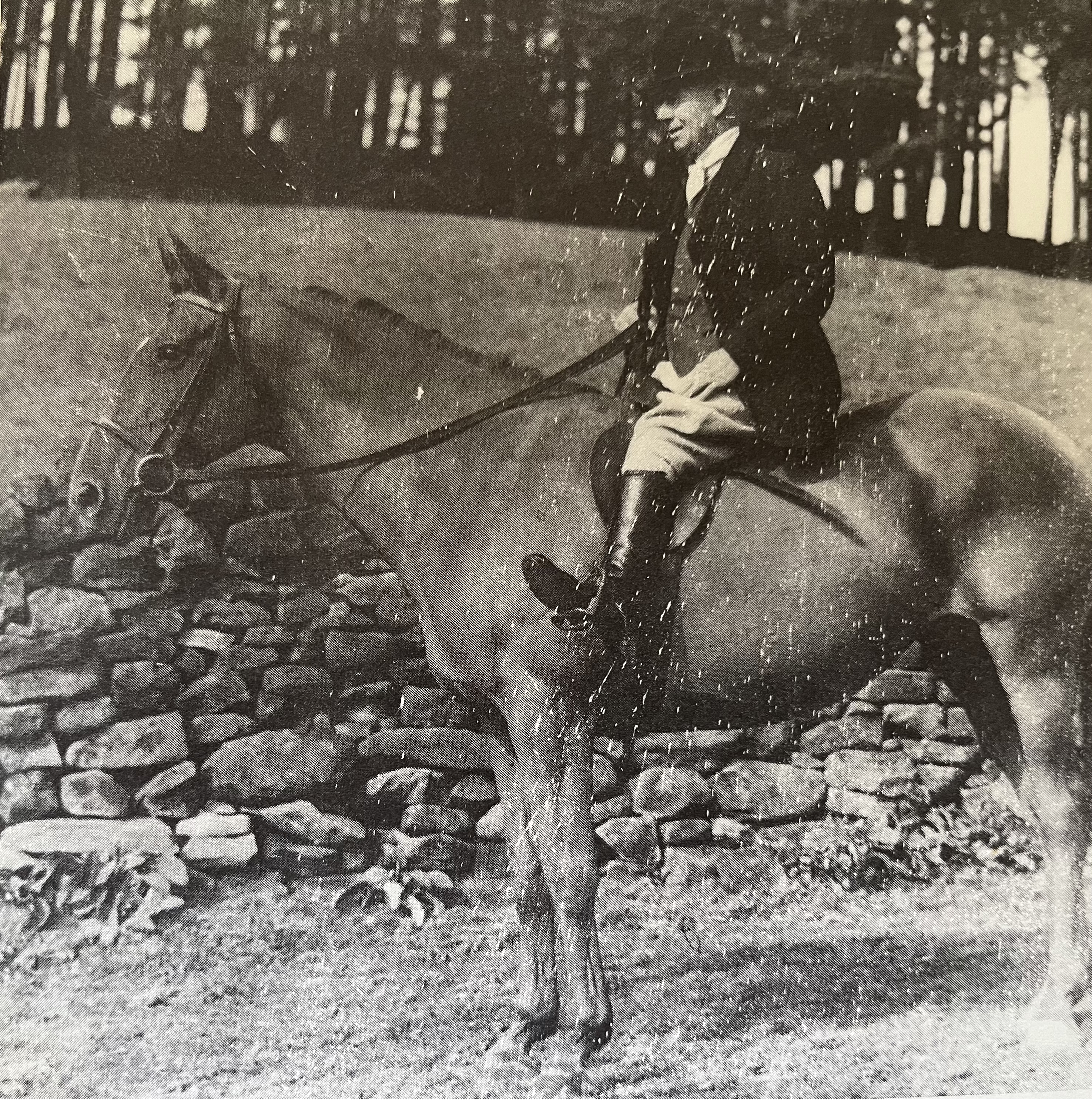
The tale of the fox kicking the Bucket

A picture of Tom Boyes whom reader Dorothy Jackson knew well, taken from one of poet Bill Fall’s books
One of Tom Boyes’ greyhounds, sketched by Bill Fall. Is this Bucket?

Last week, I thanked reader Bill Filer who put me in touch with Dorothy Jackson from Helmsley, whose family knew Tom Boyes. Boyes, born in Castleton in 1882, was well-known as a horse breeder and dealer and member of the Farndale Hunt, as well as being a good friend of the Danby poet William E Fall (Bill) who wrote dialect verses under the name Erimus. His poems highlighted the quirky characters he came across and several readers have already been in touch with recollections about Bill and his family.

Dorothy revealed she had seen the photo of the 1927 Danby wedding in my previous column and it jogged her memory of having one of Bill Fall’s books, ‘Tom Boyes, Deealsman’. Dorothy has a lovely old moors accent, and explained: “When I saw your column I wondered if I still had that book…I went to the cupboard and it was the first thing that came out, so I hadn’t to look very long for it!” Considering she’s had the book for many years, that was some bit of luck.

She was given it by the Bonas family, who were good friends with Tom Boyes. Dorothy is still in touch with their daughter, now 97 years old. “We’ve always kept in touch and so I was interested to know if she remembered Tom Boyes. I talked to her and straight away she said, ‘Oh yes, Tom Boyes came to our place time and time again!’ He dealt with horses and ponies and her father was the same…At 97 she remembered him straight away!” It is clear Tom Boyes was a memorable character.

Dorothy revealed that during the 1939-1945 war years her family was friendly with the Palmers who owned Grinkle Hall Estate near Danby (now the Grinkle Park Hotel). They got to know them through the Glaisdale Hunt and Dorothy’s father, John Bell Sokell (known as Jack), was on the hunt’s committee.

Mark Palmer, heir to the estate, had gone to fight in WWII as an army captain, and Myrtle Palmer was his sister. Although from a well-to-do family, Myrtle wanted do her bit and registered to support the Home Front.

Dorothy explained: “They came to an arrangement where she would go to Tom Boyes. He had a smallholding and she would work there through the day and return to Grinkle Hall at night time. That went on all through the war years…She was a very hard-working person and very particular with horses,” Dorothy remembered. She also recalled that the Grinkle Hall horses were always very well kept and turned out and that they still had a beautiful old coach in one of the stalls, left behind from the days before motor vehicles.

Dorothy explained that Myrtle had some wonderful scrap books full of photographs documenting her life and the people she had met along the way, including a lot of Tom Boyes. “Myrtle passed away some years ago and I’ve often wondered what happened to those scrap books,” she said.

Mark Palmer married after the war, never returning to the estate, and it was sold to a hospitality group in 1946 which turned it into a hotel, and that is how it has remained ever since. The tenants living in estate properties were offered the chance to buy their homes, which many took up, although Dorothy’s family had already bought a freehold farm at Borrowby, near Staithes, in 1943.

Dorothy remembered a funny story about Boyes that Myrtle had told her: “He always had a greyhound and called it ‘Bucket’ and in one of Bill Fall’s poems, Bucket comes into it.

“One day Tom Boyes was sat on his shooting stick and his terrier went down this fox hole, and the fox came out and knocked Bucket over!” Dorothy chuckled at the memory. “Bucket was just sat there so sackless just looking around and it knocked him over!” Sadly I could not find the poem she refers to in the three books I have.

It was lovely to hear Dorothy use the old northern adjective ‘sackless’ which I’ve not heard for a long time. It has fallen out of common use, but means ‘innocent’ or ‘guiltless’.

I adore hearing first-hand memories like these of times gone by, and am now wondering where Myrtle Palmer’s scrapbooks ended up. Perhaps someone reading this might know?

Do you have opinions, memories or ideas to share with me? Get in touch with me using the ‘Contact’ button on the top right.

This column appeared in the Darlington & Stockton Times on Friday 29th Aug and the Ryedale Gazette and Herald on Wednesday 27th Aug 2025

Mic drop for a windbag

IMG_6162
Have you heard people drop their ‘N’s’, for example when they ask for ‘a apple’? Do you do it?

I do enjoy hearing from you in response to my columns as it proves to me that for one, you read them and for two, the topics spark thought and comment. I do not mind if you get in touch to praise, correct or criticise, I welcome everything!

I received a lovely email from reader Rosemary Scott who said: “I wanted you to know how much I enjoy your columns, and I look forward to them every week. I was particularly taken by your ‘Perverse Experience’ of October 23rd  25th  because I have been waging a silent war against all those people who misspell the word ‘faze’. This word I have always taken to mean to ‘daunt’ or to ‘challenge’ someone. I keep seeing it spelled as ‘phase’, and this annoys me very much. I finally checked my 1972 Chambers dictionary, which is possibly past its ‘use by’ date, and was shocked to find that they spell ‘faze’ as ‘feeze’ and it means to ‘worry, perturb or discompose’, which more or less agrees with my thinking. However, to my dismay, I saw that the American spelling can be ‘phase’, which means I can no longer silently shout at those I believed to be sinners. I can’t tell you how chagrined and disappointed I was.”

I empathise because I felt just the same when I discovered that ‘perverse’ can mean the same as ‘perverted’, despite thinking that they were two very different things. For no justifiable reason, I had wasted years’-worth of hot air maligning people who mixed them up.

It heartens me to know I am not alone in my little irritations over the usage of certain words. I looked up faze/phase in my 2004 Oxford English Dictionary (OED) and in that edition there are two distinct definitions. ‘Phase’ (both verb and noun) refers to a set period of time, and ‘faze’ (which only appears as a verb) means ‘disconcert’, although it does say it is of US origin from the 19th century. My 2004 OED does not show ‘phase’ to mean ‘disconcert’ at all and it is only defined in the way Rosemary describes, so she is in fact right (even though she wasn’t back in 1972, according to her own Collins dictionary). I also consulted a few online dictionaries which are as up-to-date as you can get and I could not find ‘phase’ used to mean ‘disconcert’ anywhere. Hurrah for Rosemary after all!

Rosemary has a second irritation: “Another pet annoyance is that ‘an’ no longer seems to exist in spoken vocabulary. The efforts people go to to say ‘ay apple’, for example, instead of the much easier to pronounce ‘an apple’.”

That is not something that I have noticed in my everyday interactions, so I’d be interested to know if any of you have spotted this gradual erosion of ‘an’. If you try to say nouns and adjectives beginning with a vowel without using ‘an’ it does feel cumbersome: ‘Ay aeroplane’, ‘a elephant’, ‘ay orange, ‘a exceptionally gifted columnist’. No, it just doesn’t sit right, does it.

But, as we know, language evolves over time, and things that we think are wrong now might very well become right once they worm their way into everyday speech. If they are then repeated many times they evolve into an acceptable part of written English too, eventually ending up on the hallowed pages of the Oxford English Dictionary (OED), the definitive record of the English language.

I was surprised to learn that the OED is revised four times a year in March, June, September and December, which demonstrates just how quickly our language evolves. The latest (at the time of writing) was September 2024 and new words and phrases that were added this time include ‘boop’ (to tap someone on the nose in a friendly way), ‘to cheap out’ (buy something of inferior quality), ‘cyberstalk’ (harass a person online), ‘mic drop’ (to drop, or mimic dropping, a microphone after a success), ‘prags’ (financial or material aid given to a person in need) and ‘sheisty’ (shifty behaviour). These are just a few of no less than 600 words and phrases added in the latest quarter.

I hope you don’t accuse me of my favourite though, which is ‘windbagging’ (talking or writing at length without saying anything of interest).

Do you have opinions, memories or ideas to share with me? Get in touch with me via the ‘Contact’ tab at the top right of this page.

This column appeared in the Darlington & Stockton Times on Friday 13th Dec and the Ryedale Gazette and Herald on Wednesday 11th Dec 2024