For the ones who never came home

Lynne Catena’s uncle, Arthur Pearce, who was killed in WWII during the North Africa campaign in 1941. This picture was taken before the war, in his early 20s, and proudly dressed for a military tattoo.

A few more responses have come in on recent topics. Maxine Gordon contacted me about the convention of incorporating a maiden name into a child’s given name: “Both my sister and I and my best friend from Kirkcaldy have this tradition. We have our grandma’s maiden names as our middle names…I think it was unusual and raised some eyebrows at school etc, so probably dying out even in the 1970s. We might have been a last generation – my mum doesn’t even have a middle name.”

Maxine mentioned something which had not before occurred to me: “As kids you don’t want to stand out, so when they read your name at primary school and people laughed, that wasn’t so nice.” An unusual name certainly could make you a target for mockery among your childhood peers.

Until Fiona White contacted me, I had only come across the maiden name used as a middle name. But her family did something different: “My brother was given my mum’s maiden name as his first name – Innes.” Like Maxine’s family, the name Innes is Scottish. Are there more maiden names given as first names in that part of the world I wonder?

A couple of weeks ago I told the story of Lynn Catena’s Uncle Arthur, who was killed at age 24 while serving in the North Africa campaign in WWII. The war generation are notably reluctant to talk about their experiences. While Clare Proctor was watching the recent Remembrance commemorations, she was particularly captivated by the recollections of a veteran who, like her own father, had served in Burma (now Myanmar). “This veteran was saying that when returning from that war zone they were instructed by their superiors not to go home and talk about their war, because the people of Britain had suffered enough! So, he said, they never talked about it. My father certainly didn’t.”

She adds: “My cousin (30 years older than me) said our family did not celebrate VE Day because her Uncle Allan was still at war in the Far East. Their big day was VJ Day.” It’s satisfying to see that VJ Day is now being suitably commemorated, considering how many of our soldiers fought and died out there.

Robert Carter contacted me after seeing my piece about the Alamein Memorial a couple of weeks ago. Robert visited the Commonwealth, German, and Italian memorials and the Al Alamein Military Museum.

He says: “I was particularly interested to see the number of joint graves which were the last resting places of mainly armoured vehicle crews who presumably could not be separated because of the circumstances of their deaths. As a former soldier I thought it very apt that as they had fought and died together that they should be buried together.”

He adds: “The German and Italian memorials were built in the fifties which involved collecting the bodies from both nations that were widely distributed across the former battlefield and as a result many are listed as ‘Unknown’. The Italian memorial is, as you might expect, a tall very elegant building whereas the German is more sombre and fortress-like. Interestingly, inside the German building is a ring of sarcophagi, each one dedicated to each of the German states, ie Brandenberg, Mecklenburg, and so on, with a list of the servicemen from that state who died during the course of the battle…The museum was an excellent tribute to all of the nations involved with each being given equal status and range of exhibits.”

It is a sombre reminder that ordinary families on both sides of the conflict suffered equally with the loss of their loved ones.

When Lynn told me the story of her Uncle Arthur, I was saddened that I didn’t know what he looked like and assumed that I was unlikely to ever see a picture of him.

But I was wrong. Lynn found a photo and explains: “This is an old photo of Arthur Pearce that I took from my mum’s collection. She told me he wanted to be a career soldier. I believe, in this photo, he’d taken part in a military tattoo. RIP to the uncle I never met.”

Using his picture here is my small tribute to just one of the many young men who never came home.

Do you have opinions, memories or ideas to share with me? Get in touch with me using the ‘Contact’ button on the top right.

This column appeared in the Darlington & Stockton Times on Friday 5th and the Ryedale Gazette and Herald on Wednesday 3rd Dec 2025

A battle to be remembered


A June 1961 image of Roye New British Cemetery at Somme in France showing the conifer tree to the right of the stone cross memorial (Photo Commonwealth War Graves Commission copyright).

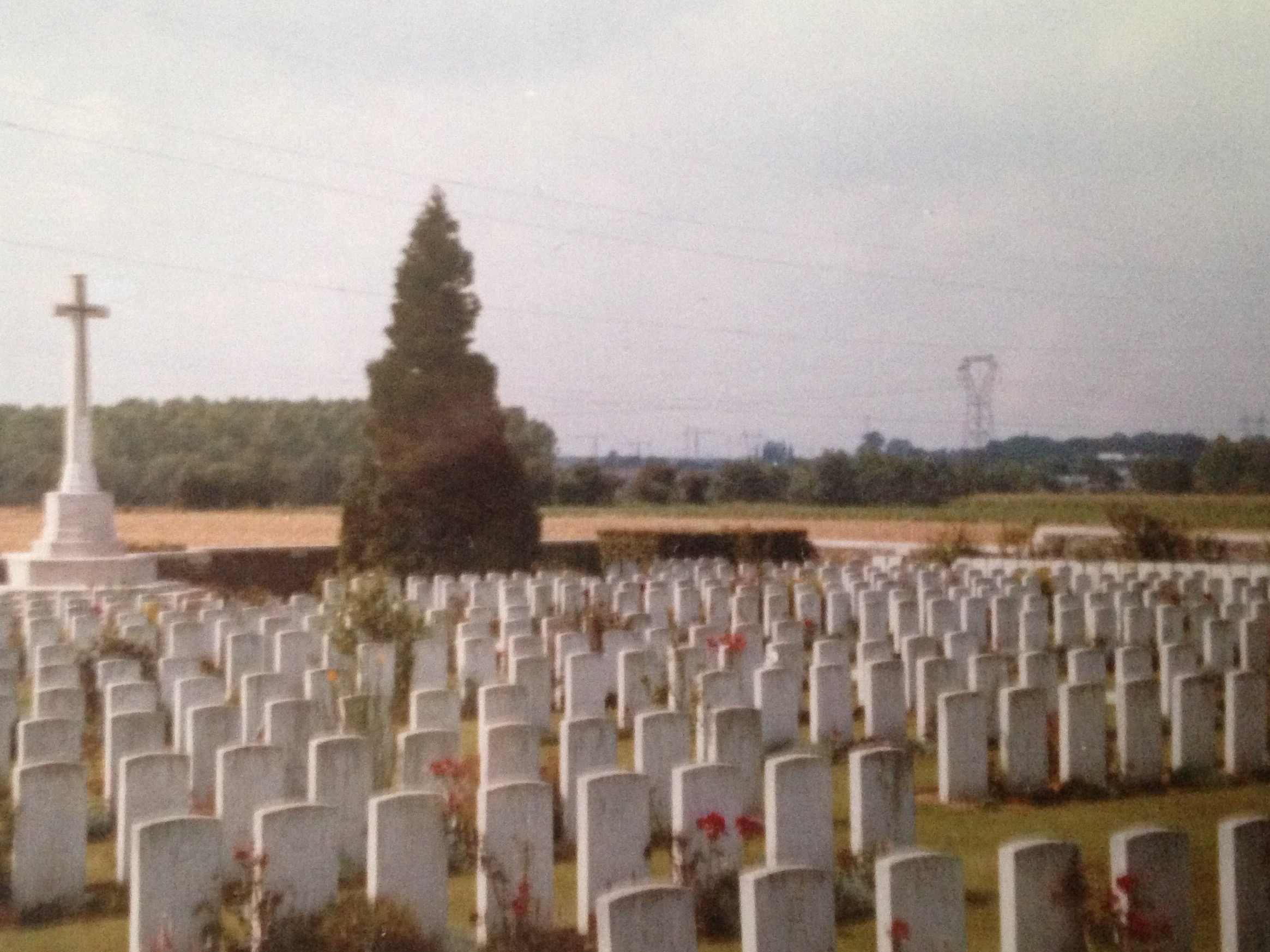
My dad’s 1979 photo taken from a similar spot. The conifer has grown somewhat.

A couple of weeks ago, I featured an old photo of a graveyard on one of the Somme battlefields and asked for your help to identify which one.

As usual, you have come up trumps! Reader Andrew Jackson says: “I think the photograph was taken in Roye New British Cemetery.”

Andrew directed me to a website documenting World War I cemeteries and commemorating the men interred there. It has recent pictures of Roye New British Cemetery, but it was difficult to work out if it was the same place. It was only when I came across some older photos that I began to recognise it. There was one in particular taken in June 1961 from the same vantage point as mine. The fir tree to the right of the stone cross memorial gives it away – although by the time my 1979 image was taken, it had grown somewhat! In the more recent photos, the tree has gone which is why it was harder to identify.

What makes the website so moving is that they have tracked down photos of some of the men interred there, putting faces to the names on the rows and rows of silent headstones. It brings home the stark reality of the massive sacrifice made by the soldiers and the families that had to continue to live without them. Interestingly, there are no special places for the higher-ranked men, no separating the rank and file from the captains and majors. As reader Tony Eaton from Northallerton pointed out, in death, everyone is equal.

Tony, a self-confessed World War I ‘buff’, enlightened me on a few things. I had wondered if the army had stopped recruiting members of the same families into the same regiment as a result of the disastrous ‘pals’ initiative, where the army canvassed groups from the same locality, enticing them with the promise that they could serve alongside people they knew (in other words, their ‘pals’), rather than randomly being assigned to regiments. Unfortunately, because they served side by side, so they died side by side, leaving gaping holes in communities and families. The strategy was abandoned after the Battle of The Somme in July 1916.

Tony explained: “You mentioned family brothers joining up which was common in the early part of the war and many households lost several of their sons during that conflict, but far as I know there was no embargo on family groups joining up until 1915, when the Conscription Act was passed, becoming law in 1916.

“The Somme showed the folly of the Pals Battalions. Conscription was the way of recruitment due to high numbers of highly qualified specialist personnel being taken out of the industrial and scientific side of prosecuting the war. This act may have precluded brothers being called up until the desperate times of 1918.”

Tony also mentioned a friend of his, Stanley Bewsher from Ripon, who went ‘over the top’ on that fateful day in July 1916. Despite his comrades being gunned down around him, Stanley bravely forged on, picking up a discarded machine gun and advancing towards the enemy.

“He was then struck in the helmet by a shell fragment that indented it into his head. He was taken from the battlefield back to England and after lengthy treatment and rehabilitation stayed in the army acting as a driver…he was awarded the Military Medal,” says Tony.

Tony also explains that the casualties of the Somme battle, although high, were not quite as high as I mentioned. “It is generally accepted that the Allies suffered c900,000 to 1,000,000 casualties…I highly recommend a book by Gordon Corrigan entitled ‘Mud, Blood and Poppycock’ where Corrigan states that 74% of all British and Empire troops that fought on the Somme came out without the proverbial scratch. It is true that on 1st July only six miles of ground was captured, but by the end of the battle, the Germans began withdrawing behind the Hindenburg Line some ten miles eastward.

“The Battle of Arras campaign in the spring of 1917 had a higher rate of attrition, dead and wounded than did the Battle of the Somme.”

Whatever the true number, we must never forget the sacrifice of every singe person whose life was lost during that terrible time of war.

Do you have opinions, memories or ideas to share with me? Get in touch with me using the ‘Contact’ button on the top right.

This column appeared in the Darlington & Stockton Times on Friday 10th and the Ryedale Gazette and Herald on Wednesday 8th Oct 2025

Pals for all eternity

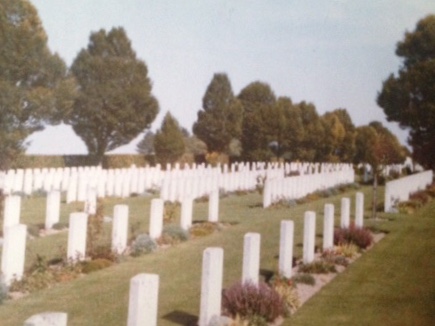
A photo taken by my dad in 1979 on our visit to the Somme battlefields. I’m not sure which cemetery it is, but it is possibly that of the Yorkshire Regiment. Please feel free to tell me if you recognise it.

Another photo taken on the same visit. Again not sure which cemetery but perhaps one of you know? Do get in touch if so.

When Brian reader contacted me about his quirkily-named relatives Rocious, Fera and Ellengor last week, he also posed a question about his family’s history of serving during World War I.

He explained how his forebears had joined up: “Albert and his brother John Elliott were both in the Northallerton Borough Band and in the 4th Battalion Yorkshire Regiment band. Rocious and two of his brothers were also in the Yorkshire Regiment, John Jackson and James Edward (killed in action in France in 1918).”

Brian posed the question: “What was the maximum number of people from the same family serving in the same regiment?”

I’m not sure if Brian meant what was the ‘permitted’ maximum of soldiers from the same family serving in the same regiment (if there was a limit), or whether he meant what is the ‘record’ for the most people from the same family serving in the same regiment. Large families were common in the early 20th century, so it was possible that the number could have been a pretty high.

However, my guess is that large families serving in the same regiment would only have been recruited before 1916. You might remember that back in 2019 I wrote a piece about my family’s 1979 visit to the battlefileds of the Somme in France when I was 12 years old. My young self failed to understand the significance of the ground upon which I walked.

When they launched their River Somme offensive on July 1st 1916, the British Army expected little German resistance after a sustained artillery bombardment the week before. They couldn’t have been more wrong, and within the first hour, almost 20,000 of the 120,000 allied troops lay dead, while 37,000 were wounded. The Battle of the Somme lasted 141 days and resulted in around 1.5 million casualties on both sides, yet enabled our troops to advance a mere six miles.

The awful death toll led to the military abandoning their recruitment strategy known as the ‘pals’ battalions. To encourage men to join up, the army had canvassed potential soldiers in groups from the same locality, from workplaces, towns, villages, sports clubs and practically any community with a common interest. They promised them that they could serve alongside their family, friends, neighbours and work colleagues (in other words, their ‘pals’), rather than the usual method of being assigned randomly to regiments. Entering the unknown with familiar faces next to you was far more attractive than being thrust into a war alongside total strangers. The drive was highly successful, with ‘pals’ battalions being established all over the country.

It’s worth remembering that most of the soldiers recruited from places like the North York Moors would be farmers and labourers who would never before have ventured far from their own homes. National Service didn’t come in until after the Second World War and so the training would have been extremely limited and the men would have little concept of the atrocities they were about to confront. Entering this scary and unfamiliar world would be easier if you had family and friends coming along with you.

Sadly, as men from the same places served side by side, so it meant they were killed side by side. It left gaping holes in the communities to which they belonged, and devastated families who had sent fathers, sons and cousins to fight. Certain areas suffered far higher losses than they otherwise would had they been assigned randomly to regiments. One of the worst affected was the East Lancashire Regiment, better known as the Accrington Pals. Of the 700 members who all came from in and around that Lancashire town, 235 were killed and 350 were wounded in the space of 20 minutes on the first day of the Battle of the Somme.

Following the carnage, the army reverted to more traditional methods of recruitment to avoid anything like it happening again. Therefore it is unlikely that a high number of people from the same family would have been enlisted to serve in the same regiment after that date.

I wonder if Brian’s ancestors were recruited through the ‘pals’ scheme to fight in WWI? And do you have relatives who joined up through the ‘pals’ scheme? I’d be interested to hear any interesting war stories, so do get in touch.

Do you have opinions, memories or ideas to share with me? Get in touch with me using the ‘Contact’ button on the top right.

This column appeared in the Darlington & Stockton Times on Friday 26th and the Ryedale Gazette and Herald on Wednesday 24th Sept 2025