For the ones who never came home

Lynne Catena’s uncle, Arthur Pearce, who was killed in WWII during the North Africa campaign in 1941. This picture was taken before the war, in his early 20s, and proudly dressed for a military tattoo.

A few more responses have come in on recent topics. Maxine Gordon contacted me about the convention of incorporating a maiden name into a child’s given name: “Both my sister and I and my best friend from Kirkcaldy have this tradition. We have our grandma’s maiden names as our middle names…I think it was unusual and raised some eyebrows at school etc, so probably dying out even in the 1970s. We might have been a last generation – my mum doesn’t even have a middle name.”

Maxine mentioned something which had not before occurred to me: “As kids you don’t want to stand out, so when they read your name at primary school and people laughed, that wasn’t so nice.” An unusual name certainly could make you a target for mockery among your childhood peers.

Until Fiona White contacted me, I had only come across the maiden name used as a middle name. But her family did something different: “My brother was given my mum’s maiden name as his first name – Innes.” Like Maxine’s family, the name Innes is Scottish. Are there more maiden names given as first names in that part of the world I wonder?

A couple of weeks ago I told the story of Lynn Catena’s Uncle Arthur, who was killed at age 24 while serving in the North Africa campaign in WWII. The war generation are notably reluctant to talk about their experiences. While Clare Proctor was watching the recent Remembrance commemorations, she was particularly captivated by the recollections of a veteran who, like her own father, had served in Burma (now Myanmar). “This veteran was saying that when returning from that war zone they were instructed by their superiors not to go home and talk about their war, because the people of Britain had suffered enough! So, he said, they never talked about it. My father certainly didn’t.”

She adds: “My cousin (30 years older than me) said our family did not celebrate VE Day because her Uncle Allan was still at war in the Far East. Their big day was VJ Day.” It’s satisfying to see that VJ Day is now being suitably commemorated, considering how many of our soldiers fought and died out there.

Robert Carter contacted me after seeing my piece about the Alamein Memorial a couple of weeks ago. Robert visited the Commonwealth, German, and Italian memorials and the Al Alamein Military Museum.

He says: “I was particularly interested to see the number of joint graves which were the last resting places of mainly armoured vehicle crews who presumably could not be separated because of the circumstances of their deaths. As a former soldier I thought it very apt that as they had fought and died together that they should be buried together.”

He adds: “The German and Italian memorials were built in the fifties which involved collecting the bodies from both nations that were widely distributed across the former battlefield and as a result many are listed as ‘Unknown’. The Italian memorial is, as you might expect, a tall very elegant building whereas the German is more sombre and fortress-like. Interestingly, inside the German building is a ring of sarcophagi, each one dedicated to each of the German states, ie Brandenberg, Mecklenburg, and so on, with a list of the servicemen from that state who died during the course of the battle…The museum was an excellent tribute to all of the nations involved with each being given equal status and range of exhibits.”

It is a sombre reminder that ordinary families on both sides of the conflict suffered equally with the loss of their loved ones.

When Lynn told me the story of her Uncle Arthur, I was saddened that I didn’t know what he looked like and assumed that I was unlikely to ever see a picture of him.

But I was wrong. Lynn found a photo and explains: “This is an old photo of Arthur Pearce that I took from my mum’s collection. She told me he wanted to be a career soldier. I believe, in this photo, he’d taken part in a military tattoo. RIP to the uncle I never met.”

Using his picture here is my small tribute to just one of the many young men who never came home.

Do you have opinions, memories or ideas to share with me? Get in touch with me using the ‘Contact’ button on the top right.

This column appeared in the Darlington & Stockton Times on Friday 5th and the Ryedale Gazette and Herald on Wednesday 3rd Dec 2025

A war to remember

The Alamein Memorial at the entrance to the El Alamein War Cemetery in Egypt which commemorates WW2 fallen servicemen who fought in the North Africa campaign and whose remains have never been found. Lynn Catena’s uncle, Arthur Pearce, can be found on Column 32 (Picture CWGC)
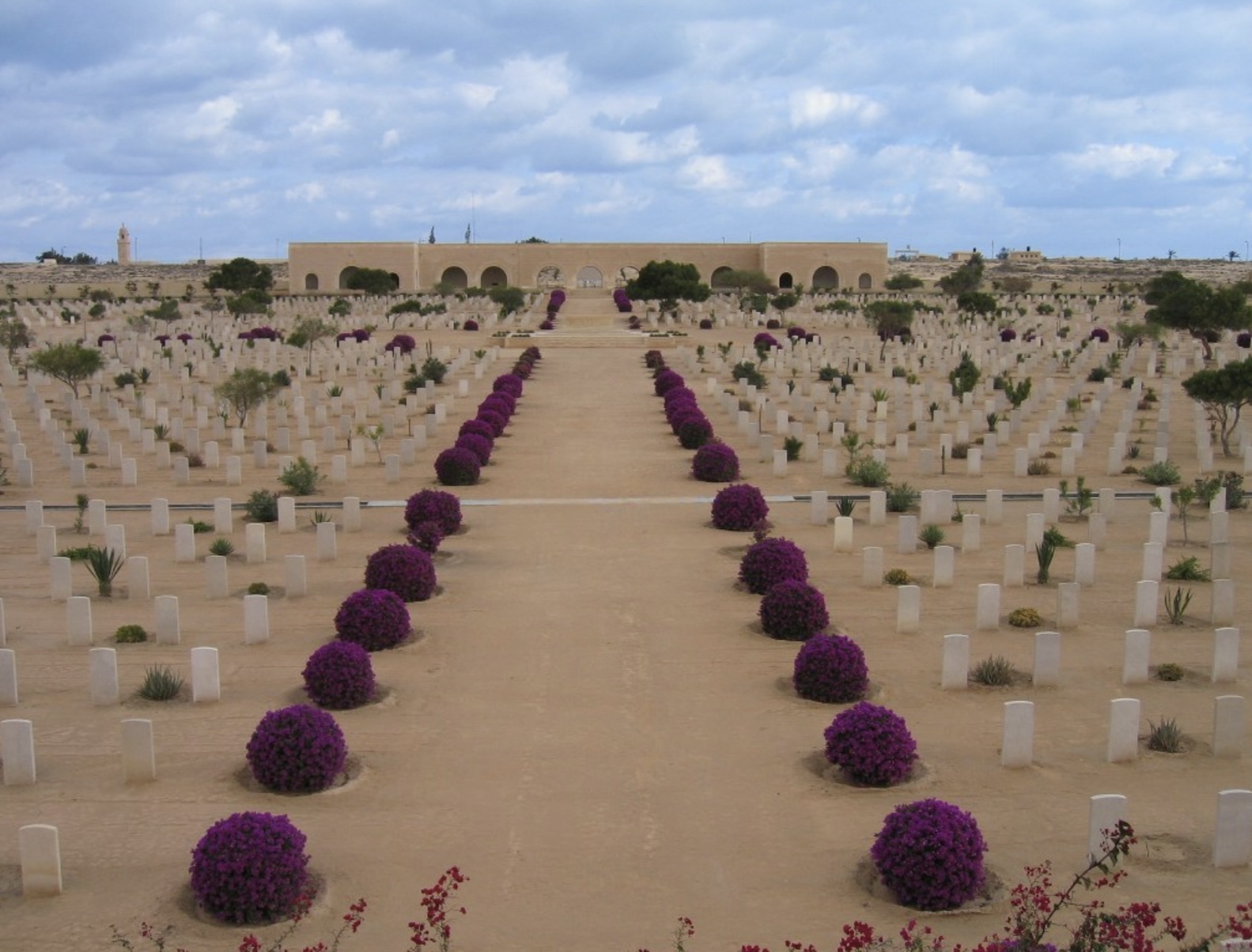
The huge El Alamein War Cemetery in Egypt which commemorates more than 20,000 fallen servicemen (Picture CWGC)

In response to my column about the six Smith Brothers of Barnard Castle, five of whom were killed in World War I, Lynn Catena contacted me to say: “My mum’s brother was killed in action on December 19th, 1941, at 24 years of age. Apart from a tatty telegram there was no further word (that I know of). Several years ago I discovered the Commonwealth War Graves Commission (CWGC). I messaged them with the scant details I had and within 24 hours they responded with a list of the deceased (including my uncle), along with the cemetery and memorial reference. His name is etched on Column 32 at the Alamein Memorial in Egypt. He was my grandparents’ only son.”

His name was Arthur Pearce, and Lynn’s grandmother was long gone before the record was found. I can’t imagine the grief she must have suffered knowing her only son died in a country more than 3,000 miles away. The lingering pain of not knowing where his remains lay, of not being able to visit his final resting place, must have been acute. Did the fact that many other familles were suffering in the same way at the same time help, alongside the fact that they died heroes defending the freedom of their home and country? Sadly, most of those who could answer this question are no longer with us, but do let me know if you have ever spoken to your relatives about it. They came from a generation that was not used to discussing such deep internal emotions, and therefore may not ever have felt able to express their memories openly.

Lynn’s message prompted me to visit the CWGC website again, to see if I could find her uncle’s record – and sure enough I did, but not before I had to scroll past pages and pages of names engraved on the Alamein Memorial. It was truly sobering to see hundreds of fallen men, most of whom were aged in their 20s and 30s. The oldest was 50, and the youngest a mere 16 years old. They came from the various countries that united in the North Africa campaign to oppose German and Italian forces in a battle over control of the Mediterranean. The sea gave access to the East via the Suez Canal, a vital supply route leading to Russia via the oil-rich Middle Eastern block. As well as the UK soldiers from the Royal Artillery, there was air support from Australia, and infantry from New Zealand, South Africa and a few other countries.

What caught my attention was that 9th December 1941 was a particularly bad day for casualties. Where most dates listed from a few deaths into the 10s and 20s, on 9th December more than 300 servicemen were killed. My knowledge of WWII is what you might call at ‘headline’ level, and I know even less about the North Africa campaign. I felt I owed it to the men whose memorial I was looking at to educate myself a bit more.

The 9th December 1941 was just two days after the Japanese bombing of the US naval base Pearl Harbour on the island of Hawaii which prompted the States and a number of other countries to officially enter the war. It was also around the mid-point of Operation Crusader, the allied offensive to once and for all take the strategically important Mediterranean port of Tobruk on the north Libyan coast, 150km west of the border with Egypt. Rommel’s German troops supported by Italian allies had been trying to capture the port since the previous April in what is called The Siege of Tobruk. The new offensive, made up of British, Indian, New Zealand, South African and Free French forces, drove the Germans and Italians back into Libya enabling allied troops to gain firm control of the port.

The Alamein Memorial forms part of the huge El Alamein War Cemetery where more than 20,000 fallen commonwealth soldiers are commemorated. There are around 8,000 graves (812 of which are unidentified), and nearly 12,000 more names listed on the memorial because, like Lynn’s uncle, their remains have never been located.

Statistics like that make me grateful that I have never had to face the horror of a world war. I hope such a thing is never allowed to happen again.

Do you have opinions, memories or ideas to share with me? Get in touch with me using the ‘Contact’ button on the top right.

This column appeared in the Darlington & Stockton Times on Friday 21st and the Ryedale Gazette and Herald on Wednesday 19th Nov 2025