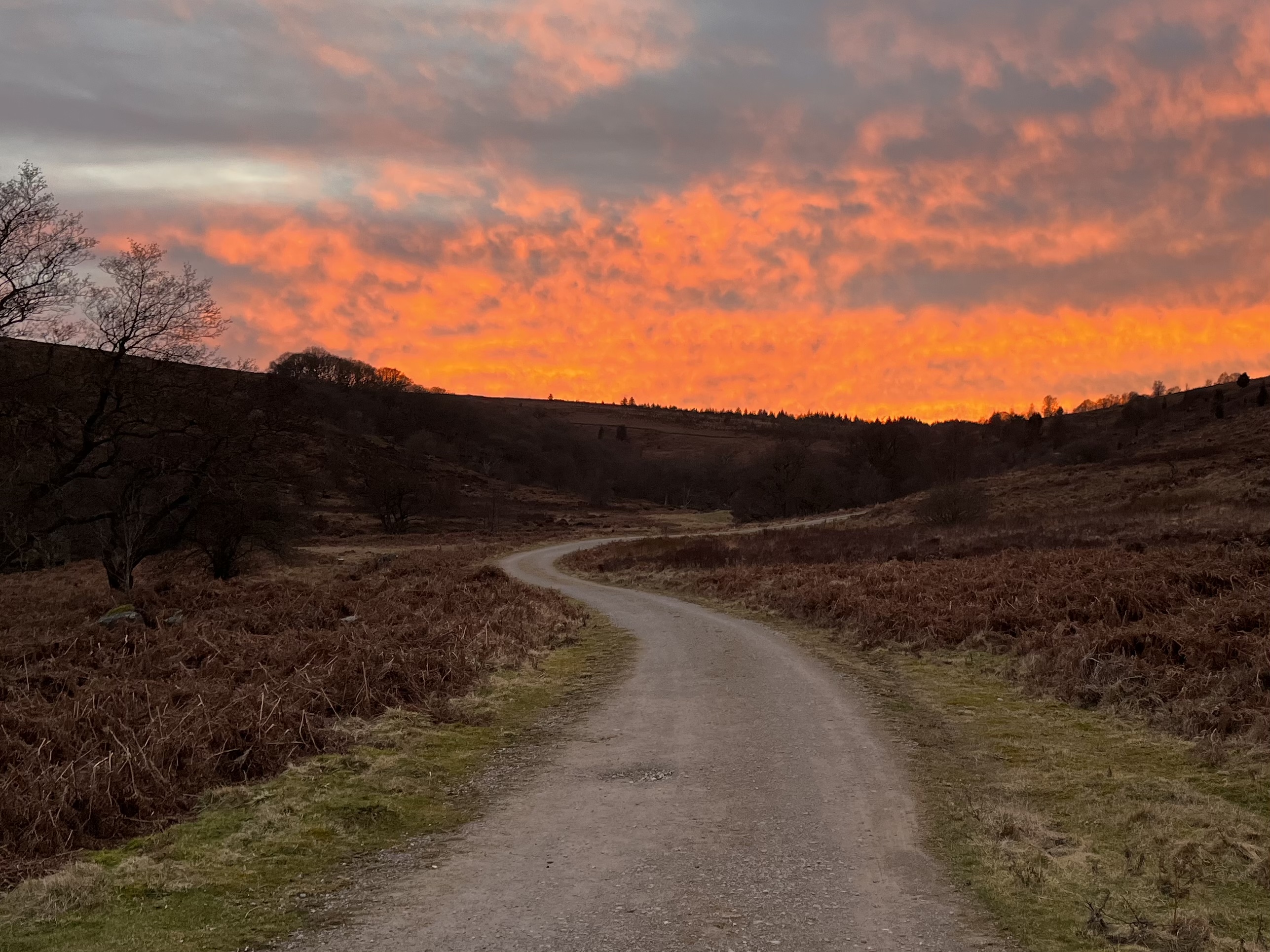
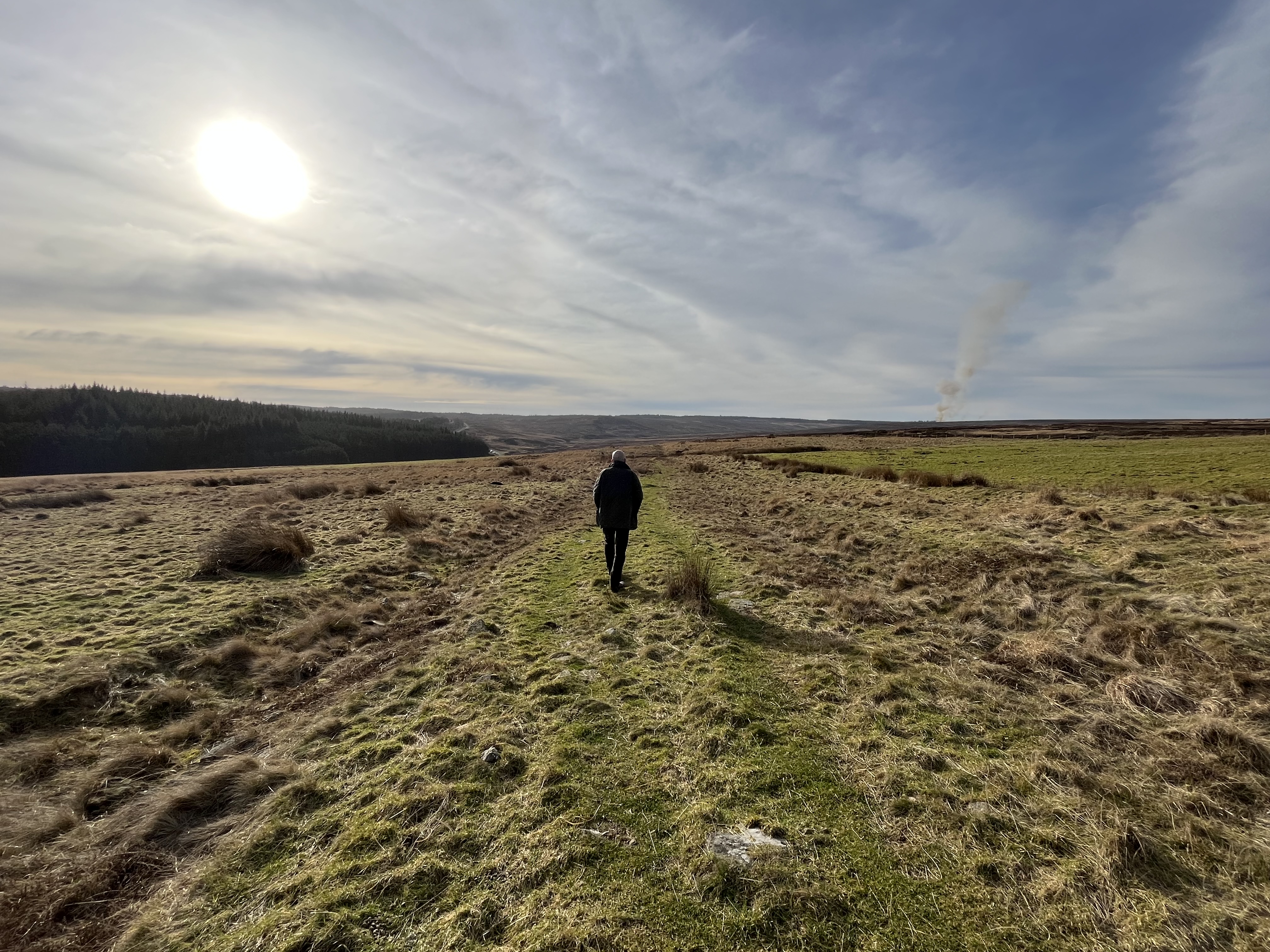
A wold of difference

IMG_7563
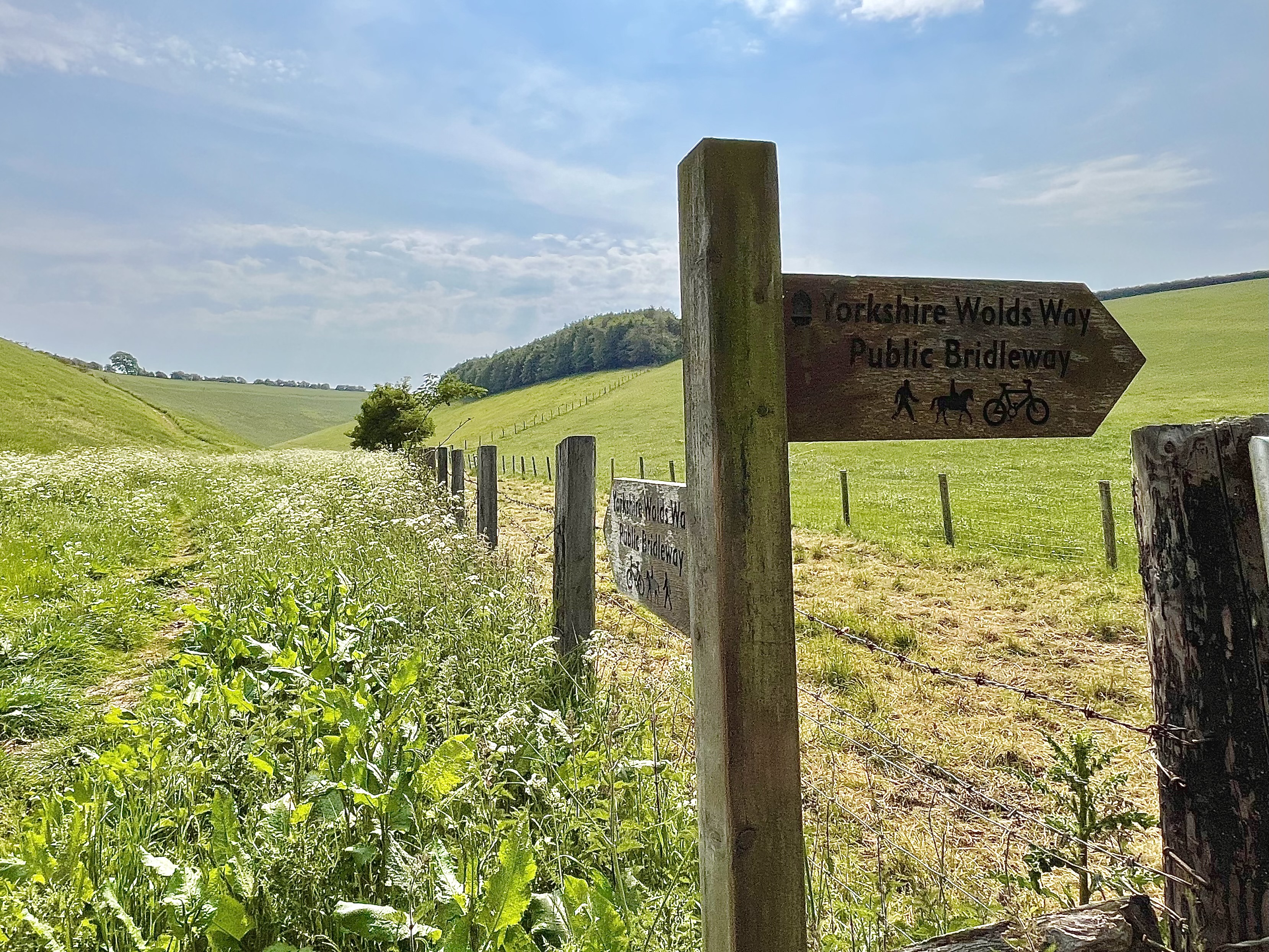
The Yorkshire Wolds seem to play bridesmaid to the more popular Moors and Dales.
IMG_7176
The sweeping valleys of the Yorkshire Wolds were created by the run-off from glaciers.
IMG_7558
The dales have smooth steep sides, but are completely dry due to the quick-draining chalky soil

I have said this before, but I’m not going to apologise for repeating that here in North Yorkshire we are blessed to have outstanding countryside on our doorstep. When you hear visitors from more urbanised areas eulogising about it, it does make you grateful to be able to experience it every day.

What is so special is that within our border, we have two national parks in the Yorkshire Dales and the North York Moors, as well as two areas of outstanding natural beauty (AONB) in the Howardian Hills and Nidderdale.

But what I want to know is why do the Yorkshire Wolds seem to play bridesmaid the two brides of the Moors and Dales? I’ve recently been spending a bit more time exploring this part of the world and in my opinion, it is equally as stunning, and yet very different, to other parts of North Yorkshire.

Famously, artist David Hockney has a studio in Bridlington where he has worked on some enormous pieces of Wolds-themed art. He describes painting in the winter near Warter, a village between Pocklington and Driffield:

“There was far more colour than I expected. Occasionally a farmer would come and talk to me. They didn’t think I exaggerated the colour. They thought my paintings were very accurate, and talking to them I noticed that they knew just how beautiful it is here.”

Of course, North Yorkshire cannot lay claim to all of the Wolds, much of which do lie in the East Riding, but the part I was visiting recently was around the gorgeous village of Thixendale and the abandoned mediaeval settlement of Wharram Percy, all of which falls within the border of our county. The landscape is markedly different to the areas with which I am familiar, with no heather or bracken cloaking the gently undulating hills and dales, but rather crops and grazing meadows, which give you a clue to the type of agriculture that prevails.

The word ‘wold’ derives from the old German word ‘wald’, and originally referred to forested land, later coming to mean ‘upland forest’ then, once the forest had disappeared, grew simply to refer to upland areas in general. The Yorkshire Wolds are the most northerly chalk hills in the UK, and stretch from the bank of the River Humber near Hessle, curving north and east in a wide boomerang shape, ending up at the stretch of coast between Filey and Bridlington. The characteristics of the geology can clearly be seen in the sheer white cliffs at places like Flamborough Head and Bempton.

The chalky nature of the ground is evident as you trek among the rolling hills, with white pebbles scattered across the earth like never-melting hailstones. What truly sets this apart from other areas of North Yorkshire is the appearance of the dales. The steep-sided green valleys slice acutely into the landscape, barely visible from the tops of the hills. The sides are so smooth and neat that they look almost man-made, as if they’ve been cut by a giant cake slice. Unusually, the valleys have no rivers or streams running through them. The chalk was formed from marine limestone and deposited during the Upper Cretaceous period between 80 – 100 million years ago, with the dales being formed at the end of the ice age, around 18,000 years ago, when melting glaciers led to fast-flowing streams coursing across frozen ground, ultimately creating deep channels in the surface of the land. The chalky ground meant water easily drained away, and so the resulting valleys that we see today remain dry.

In contrast to the Moors and Dales, the way the land is farmed is topsy-turvy, with crops like oil-seed rape, wheat and barley being grown across the tops of the hills, while sheep and cattle graze the valleys.

There is plenty of evidence that the land has been occupied since prehistoric times, and perhaps one of the most famous and impressive locations is that of Wharram Percy, a settlement that at its peak in the 14th century was home to around 200 people spread across 40 or so dwellings, including a number of Viking-style longhouses, the footprints of which can still be seen on the ground.

There is an application ongoing for the Yorkshire Wolds to be declared an Area of Outstanding Natural Beauty, and I do hope they achieve it. Having walked there a few times now, they surely deserve that accolade.

Read more at countrymansdaughter.com. Follow me on Twitter @countrymansdaug

This column appeared in the Darlington and Stockton Times on 28th July and Ryedale Gazette and Herald on 26th July 2023

And the beat goes on

IMG_7710
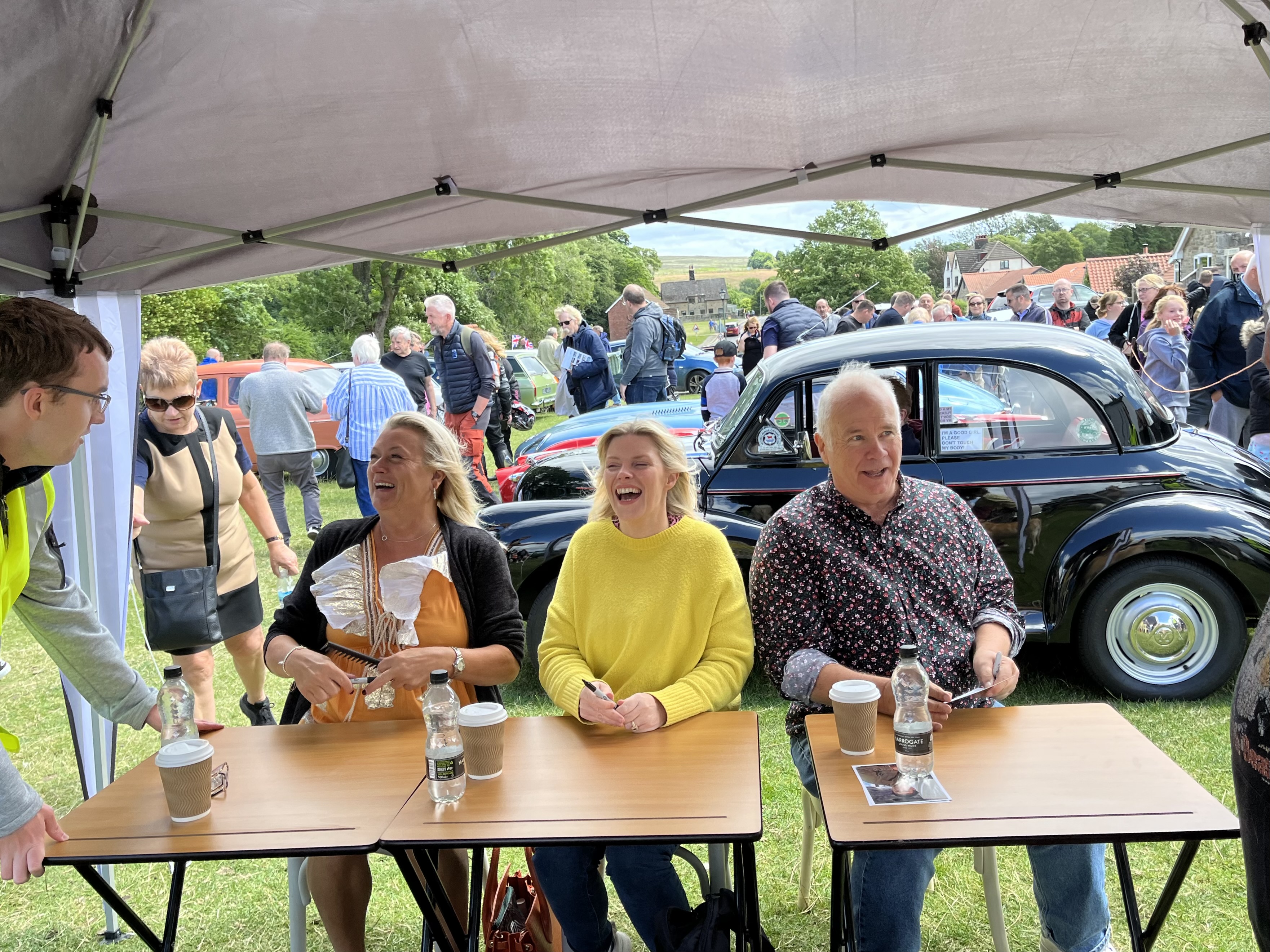
Patient Heartbeat stars Tricia Penrose, Vanessa Hehir and David Lonsdale spent hours signing autographs for fans.
IMG_7717
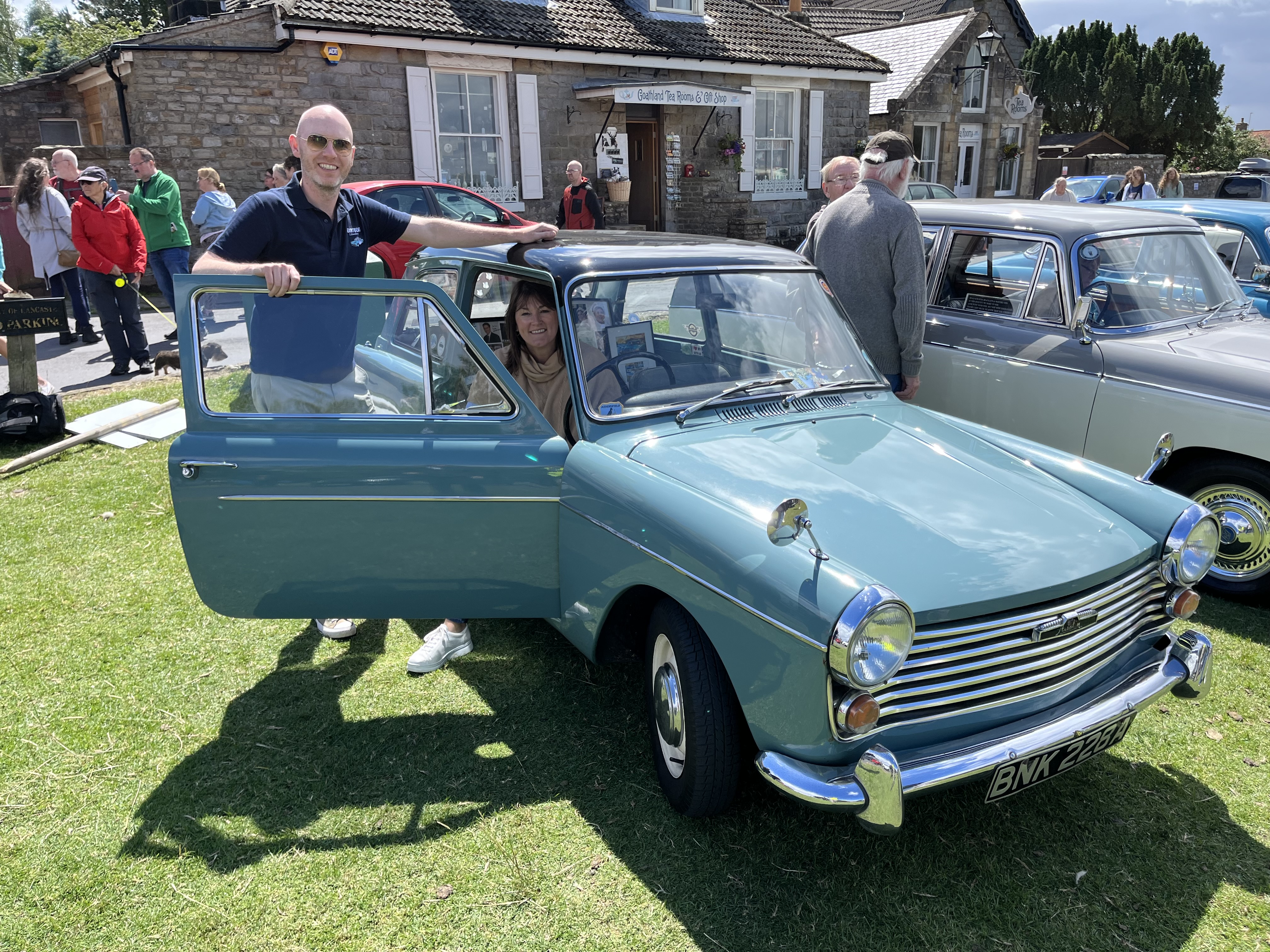
Myself with Heartbeat Vehicle Rally organiser Lee Jones, with his Austin A40 that was used by Dr Summerbee in the Heartbeat TV series

I had the pleasure recently to be able to join the annual Heartbeat Vehicle Rally that has taken place in Goathland for the past eleven years.

Thousands of fans flock to the village to see the impressive classic vehicles, some of which featured in the TV series inspired by my dad’s series of Constable books. It also attracts owners of other vintage cars, bikes, tractors and trucks as well as fans of the 1960s and families looking for an entertaining day out.

I was fortunate to have been invited by the organiser, Lee Jones, to join him and his merry band of helpers for the weekend. It’s not a money-making exercise, but simply a bunch of fans and vehicle enthusiasts who work together to create a memorable occasion all for the love of doing it.

Lee was supported by volunteers hailing from all over the country, including Wales, Scotland, the Midlands, Teesside, Durham, Lincolnshire and Suffolk to name just those I had the pleasure of meeting. Visitors came from even further afield, including from the USA, Sweden, Norway, Ireland, Devon, Cornwall, Dorset, Essex, Hampshire, Somerset, and even – wait for it – Lancashire!

A few of the stars were in attendance too, including Tricia Penrose, who played barmaid Gina Ward, David Lonsdale, who played hapless David Stockwell, and Vanessa Hehir who played Scripps Garage mechanic Rosie Cartright. Adoring and ever-patient fans queued for up to two hours in the bracing wind just for a chance to speak to their heroes. Despite sitting at tables exposed to the elements for several hours, the actors were completely gracious, and gave each individual the time for a short chat, an autograph and a photo, which clearly meant the world to them.

The considerable collection of classic vehicles was a significant draw, and the owners adore their cars with the kind of ferocious love that I save for my children (although it might be argued that they give their cars far more care and attention). The metal beauties were absolutely gleaming, and some were adorned with pictures of their appearances in the show, alongside Heartbeat memorabilia. A couple of owners (namely members of the Sunderland and District Classic Vehicle Society) dressed up as characters from the series, walking around rattling buckets to raise funds for Goathland Primary School and the Village Hall, while others were giving people lifts in these special cars for the same reason. It was a thoughtful touch to give something back to the community that hosted the event.

There was such a positive and friendly atmosphere, although for the villagers of Goathland, it must be rather daunting having so many people descend. I’d be intrigued to know how many people attended over the two days, and popularity like this is a double-edged sword, but I know the organisers were at pains to ensure the least upset to those who lived there. When the first short series was aired in 1992, no-one predicted that it would be so successful, that at its peak, Heartbeat would attract 18 million viewers, and last for 18 series over 18 years.

And yet, it is this kind of economical boost and public exposure that rural communities in North Yorkshire need, but very few get. I am sure some residents will object to the intrusion, and I absolutely understand that, but you cannot ignore the financial benefit that is brought into these often neglected areas by the tourism that results from film or TV success. Without the Heartbeat-inspired influx, how else would remote Goathland prosper? It is worth noting that almost all the businesses lining the village thoroughfare feature the word ‘Aidensfield’ either on their shop front or on the merchandise they are selling. My dad created that name, but our family does not benefit from any of it. All the money generated goes to those small businesses that sell it.

In 2023, we are 13 years on from when the last episode of Heartbeat was aired, but the popularity of the show is undiminished. It is repeated every day on ITV3 and available on various streaming services, remaining one of the most popular of all the British vintage shows. I do wonder what my dad, a humble soul, would think of it all, but I witnessed the years and years of hard graft that he put in to achieve that success.

I am one seriously proud countryman’s daughter.

Read more at countrymansdaughter.com. Follow me on Twitter @countrymansdaug

This column appeared in the Darlington and Stockton Times on 14th July and Ryedale Gazette and Herald on 12th July 2023

Hannah’s living relative found!

IMG_7335
Hannah Raw’s sampler that sparked my quest to find living descendants

IMG_1123

IMG_1124
Jennie Sanderson’s handwritten family tree that traces her line right back to Hannah’s parents and elder brother John

Something quite remarkable has happened this week, but before I tell you what it is, I am going to remind you of something I wrote back in March.

It concerns Hannah Raw, whose 19th century sampler we have on our kitchen wall, but about whom we knew nothing for many years. We had no idea how we came to have her sampler, which was found rolled up in a drawer at my late Nana’s house. Through the help of a mini-band of family history reader-sleuths, we managed to flesh out much of Hannah’s story, that she was born in 1825 to Matthew and Ellis Raw (nee Winspear) and was the third of seven children. By the time she had turned 13, Hannah was an orphan and living in service. In 1850, 24-year-old Hannah married joiner John Hall and they had two children, Sarah, and Ellis, and later eight grandchildren. Hannah died in 1890 at Lealholm aged 64 and John died in 1903 aged 87. Both are buried in the graveyard of the Church of St Thomas in Glaisdale. I was able to lay some flowers on her grave in February after tracking it down with the help of my merry band of reader-sleuths.

After several months of Hannah’s ever-evolving story, I wrote in March: “I feel it in my bones that we are not far away from tracking down the elusive living descendants of Hannah Raw!”

And guess what? It has happened – well, almost! We have found a living descendant of Hannah Raw’s family (not quite of Hannah herself, but pretty close nevertheless). We were contacted by Carol McLee from the Cleveland Family History Society (CFHS) who, as one of our reader-sleuths, had been so helpful in being able to flesh out some of Hannah’s story. Carol had received a letter from CFHS member Jennie Sanderson who had not seen any of my columns due to the fact she lives in London. However, being a society member, she was sent their journal in the post which contained a piece written by Carol about my appeal for descendants. I will let Jennie take it from here:

“How surprised and pleased I was to find a family link and appeal in the April CFHS journal under ‘Hannah’s Story’ as my 2x great-grandfather was John Raw, Hannah’s brother.”

Hannah’s brother? I nearly fell off my chair when I read that! And how serendipitous that despite living hundreds of miles away and not seeing any of my own appeals, she spotted the article in the CFHS journal, recognised the family link, and felt compelled to write to Carol, who then contacted us.

Jennie goes on to reveal the family line that descends from Hannah’s parents Ellis Winspear and Matthew Raw.

Jennie’s ancestor John Raw (spelled Roe in the birth register), was the second child of Ellis and Matthew and was born on 6th August 1823, two years before Hannah. In 1850, John married Mary Hebden, and their daughter Jane Raw married William Sanderson in 1877. William and Jane had nine children, including James Sanderson, born in 1888. James moved to County Durham and married Jane Ann Lowes in 1915 and the couple had eight children. Their son Frederick moved to London and married Doris Eileen Smith in 1945, and they had four children, and it is one of those children who is our Jennie Sanderson. Although not directly descended from Hannah, I am thrilled that we have at least tracked down a relative, a direct descendant of Hannah’s elder brother.

Jennie adds that she is delighted to discover that the 1835 sampler made by Hannah has survived and is in safe hands on our kitchen wall. “I wish Sarah Walker ‘good luck’ in finding descendants for Hannah, and to Sarah’s family for keeping the sampler safe for all these years, ‘thank you’.”

I am hoping to speak to Jennie in person soon (so far we have only communicated by letter), and all being well, I might one day even meet her. What would be the absolute icing on the cake would be somehow to trace someone who is directly descended from Hannah herself, and then, dear readers, I think we can say that our quest will be complete.

So if you think you have a tip, an inkling, or whatever little thing it is, no matter how small, do get in touch, either with this paper, or through my contact page at countrymansdaughter.com.

This column appeared in the Darlington and Stockton Times on 9th June and Ryedale Gazette and Herald on 7th June 2023

A walk of wonder

IMG_6899
The Hanging Stones Walk in Rosedale is a fantastic celebration of land and art

It may not have escaped your notice that I am rather fond of walking on the North York Moors. I only need half an excuse to head over there for a gallop in the heather. I recently gave a talk to the lovely people of Rosedale WI and someone there mentioned a walk that sounded absolutely fascinating.  

Known as the Hanging Stones Walk, it is much more than just your average bimble. It is an art project sponsored by the Ross Foundation (an organisation that supports initiatives related to art, community, sport, music and education). The foundation commissioned renowned sculptor Andrew Goldsworthy who is famous for his spectacular pieces of land art located in both rural and urban settings.   

The idea of the walk, which starts in Rosedale Abbey, is to create a living and experiential artwork using existing neglected or derelict farm buildings dotted around Northdale. The land belongs to the Rosedale Estate and a series of ancient pathways have been resurrected to link each building. Although the circular walk is not quite finished (there will ultimately be ten buildings to visit), the current series of nine buildings can be visited in four to six hours, depending on how fast you walk and how long you spend in each one. You have to be fairly fit, and able to read a map to locate the buildings. If you do find it a bit strenuous, you have the opportunity to take a breather at each stopping point.   

These old structures have been given a new lease of life, with the original stones being reused as far as possible. They have been constructed in a way that is sympathetic to their original use, and to the land that surrounds them, as if they have always belonged there. They are padlocked shut, so you have to book in advance, and places are limited, but it is well worth the effort. You collect a key and a map, and are let loose to find your way.  

Each installation has its own name, such as ‘Bog’s House’ and ‘Job’s Well’, and as you head towards each one, you begin to wonder what you might find when you arrive, to wonder about its past history and how it was used. What stories would the old building tell if it could speak? The anticipation grows as you put the little key in the lock, because from the outside there are very few visible clues as to what’s going on on the inside. I’m not going to say what is in each, because finding out is part of the enjoyment, but I can say that both of us who went declared ‘Wow’ several times. It was so impressive, and wonderful to just sit by ourselves inside these once neglected buildings to marvel at what they have now become. None of them had any electricity or mains services, and we were often sitting in near darkness with little sound except the calls of birds and the trickling of water. But it gave us some sense of what it must have been like back in the day, back in the times when the residents of these remote dales were not blessed with electric lights, or modern gadgets. It was incredibly peaceful, and a real tonic to be able to switch off from the constant sensual harassment inflicted upon us by everyday life.   

The walk in between each building was a delight in itself too, with expansive views down the valley towards Rosedale, which just served to highlight why it is one of the most beautiful dales in the whole of North Yorkshire.  

It was a privilege to be able to visit, and I marvel at how the creative mind of Andrew Goldsworthy has managed to conceive this amazing, breathtaking art, while at the same time pay homage to the nature and function of the old buildings and the land in which they sit.  

The day we went was overcast, so I plan to go back again on a warm summer’s day and do it all over again. The thing is, if it hadn’t have been for that tip-off resulting from my visit to Rosedale WI I would never have found out about this walk.  

What other wonders are hidden in North Yorkshire that I have yet to find?  

Read more at countrymansdaughter.com. Follow me on Twitter @countrymansdaug  

This column appeared in the Darlington and Stockton Times on 12th and Ryedale Gazette and Herald on 10th May 2023.

Writing and rewards

IMG_1507
My nana aged about three (seated) with her family outside the Thee Blast Furnaces pub, Glaisdale, in about 1919. Her mum, Sarah Jane Williamson, was the sister of reader Jeremy Williamson’s great-grandfather George Williamson.

One of the things I most enjoy about writing a weekly column is that fact that you lovely readers get in touch with comments, observations, recollections and feedback. Firstly, it gives me enormous satisfaction to know that my efforts to entertain are not in vain, and secondly, your messages often result in new opportunities to research topics which provide material for future columns.

This week I was showered with an embarrassment of riches on the ‘readers getting in touch’ front. No less than five people contacted me, all talking about different subjects.

Gillian Hunt (who was featured last week) furnished me with more fascinating details relating to aspects of sampler embroidery, which I may come back to at a later date, while Jeremy Williamson wrote to me revealing that we are related. My great-grandfather Thomas Rhea, who was licensee of the Three Blast Furnaces Inn (later the Anglers’ Rest) in Glaisdale, was married to Sarah Jane Williamson, Jeremy’s great aunt. Sarah Jane was sister to his grandfather George Henry Williamson, and George was landlord of the Robin Hood and Little John pub in Castleton from 1939 until the 1960s. Sadly, that pub went a similar way to the Angler’s Rest, and has been converted into a house. Jeremy has only recently found out that George Henry was one of nine children, and went on to father ten children. We have a wonderful picture of my nana’s family outside the Three Blast Furnaces when she was around three alongside her parents and five siblings (she did have two more, an elder brother who died when he was just two, and another younger brother yet to be born). Imagine buying Christmas presents for that lot. It makes me think my family of three children barely qualifies me to call myself a parent.

Terry Ashby got in touch after reading my column about pathways a few weeks back. Terry is a staunch advocate for the protection of historical footpaths, bridleways and boundaries and has written extensively on the subject. He laments the fact that many routes either disappear, or their original use becomes lost when not protected, observing: “There are many instances of, for example, bridleways which reach boundaries or other dividing obstacles and become footpaths on the other side. Some tracks or paths end for no apparent reason.” I wonder if any of you have encountered that problem? I imagine it must be very annoying if you’re out enjoying a leisurely hack when the bridleway you’re following suddenly disappears.

Peter Allen emailed me following my article about poltergeists, correcting me about ‘Lady Nunnington’. In fact there never was a Lady Nunnington – the ghost was actually known as ‘The Proud Lady of Nunnington’.

And lastly, Linda Chambers, in an old-school 20th century manner, wrote me an actual letter. She used to live in my home village, and recalled (as do many long-term residents), the sight of my dad climbing the local hill every day in his trademark white, cable-knit sweater. She came up with a question that I couldn’t answer, asking if I had heard of ‘King Henry’s Night’.

“I was told about this some years back by an elderly gentleman (now dead) who lived at Thorgill,” she says. “It apparently centred around young people going out on a particular night and meeting up with likely suitors. Not sure what their parents thought but no doubt it was eagerly anticipated.”

Naturally, I was straight into my dad’s vast collection of cuttings, files and books gathered over the sixty years of his writing career, but came up empty-handed. I also tried a few searches online, but they were pretty fruitless. So this is where you come in. Have you heard of it, and if so what can you tell us? Recent requests for help on all sorts of subjects have come up trumps, so I am hopeful that at least one of you reading this will either know, or has the means to find out.

Then I can write about it and take all the glory.

Read more at countrymansdaughter.com. Follow me on Twitter @countrymansdaug

This column appeared in the Darlington and Stockton Times on 28th and Ryedale Gazette and Herald on 26th April 2023

A path to inspiration

A0C69DB8-C839-42D4-B3FF-1BCB902E0992
Public footpaths have often existed for thousands of years

5F1EB9C6-750F-4799-B14D-F171AD5D722F
The familiar fat yellow arrows show which way to go after crossing the stile

As a follow-up to my last column about the tragic case of William Winter who lost his wife and three young children to Scarlet Fever in May 1889, I was planning this week to discuss the havoc the disease wreaked on England in the nineteenth century. But as I wrote, it dawned on me that the subject matter was thoroughly miserable. I questioned whether I, as a columnist for this esteemed paper, was serving you readers by showering you in melancholy and thus making you as miserable as I felt. Let’s face it, over recent weeks I’ve bombarded you with tales of disease, death and graveyards.

So I did what I always do when I’m faced with such a quandary; I stopped writing. As a writer, you have to trust that inspiration will come, and you learn not to struggle on when your ideas don’t work. By the next morning, I still had very little notion as to what misery-free topic I would write about and once I had exhausted all the usual procrastination-induced tasks (like hanging out washing, making pots of tea, watching Netflix), I did the next best thing. I went for a walk.

I’m lucky to have instant access to the beautiful North Yorkshire countryside outside my front door and, thanks to the kindness of a local farmer, am allowed to wander across his land up to the top of a hill where I can take in the glorious views over my home valley. It helps me clear my mind just a little bit.

The route through his field joins a public footpath across the top of the hills and I soon came to a stile where the way ahead was signposted by familiar fat yellow arrows put in place by the North York Moors National Park Authority. I didn’t need them though as the direction was clearly visible thanks to the many thousands of feet that had trodden it before me.

And that, dear people, is when the inspiration for this particular column finally arrived. How did this footpath get here, and how old was it?

A path across land can become an official right of way if it has been used continuously by the public for at least 20 years and, once approved, it is a classification bound by law. In many cases, these routes have existed for generations, and in the days before instant communication and motorised transport many were packhorse trails, used for delivering messages and shifting goods between settlements.

Different paths would be forged for different reasons, and there are clues as to their age and purpose. For example, if a path runs directly between two villages (and especially if those villages appear in the Doomsday Book), it is likely to have existed for thousands of years, originally linking tribal settlements to one another. Later on, from the first century AD until the fifth, we were occupied by the Romans who took highways and byways to a whole new level, being the first civilisation to construct formal paved roads, forging their way for many miles right across the landscape. It made it easier to move armies, weapons and supplies from one part of the country to another. Many Roman roads form the basis of our transport network today, while others have become public footpaths and bridleways, and the rest have been swallowed up by agricultural land or development, although their imprint can sometimes still be seen from the air.

Other public footpaths trace their roots back to specific purposes. A ‘monk’s trod’ ran between monasteries and religious sites, a ‘corpse trail’ was a path to church along which coffins would be borne, ‘miners’ tracks’ were formed in remote parts of the Dales and Moors when the land was exploited for tin and lead, and ‘drove roads’ were created to drive livestock to markets, sometimes stretching for hundreds of miles (much of the Cleveland Way is an old drove road).

These networks of paths provide insight into how our forbears went about their everyday lives. The one I was using led to a local historical monument, thought to be a late Bronze Age animal enclosure, which means I was following a route that was created around 3,000 years ago.

So next time you walk one of your local public footpaths, I wonder if you can work out its age, and how it came to be?

Read more at countrymansdaughter.com. Follow me on Twitter @countrymansdaug

This column appeared in the Darlington and Stockton Times on 7th and Ryedale Gazette and Herald on 5th April 2023

Photographic memories

1AEC0203-0410-4B06-AF2B-28E34E34ECB8
At the end of our skirmish across the North York Moors, we were blessed with the most stunning sunset, seen here from Wheeldale Gill. It was the perfect end to a perfect day.


60608942-DA1B-433C-8442-151208D3D267
The Esk Valley News Quarterly, and in the background on my iPad, the article about my dad which included the picture of my parents’ wedding that I had been searching for all day long.


On one of my recent skirmishes across the North York Moors, I particularly wanted to visit St Hedda’s Church in Egton Bridge because, as well as being a beautiful building, it is where my parents were married.

I wanted to show it to my companion because, although it doesn’t look that special on the outside, inside it is an absolutely stunning church. Designed in 1867 by notable architect Matthew Ellison Hadfield (who was also responsible for the Catholic cathedrals in Salford and Sheffield) when you open the doors you are greeted by a vision of colour and splendour, dominated by a spectacular curved sky blue ceiling decorated with gold stars. The altar is surrounded on all sides by brightly coloured paintings and panels depicting saints and scenes from the life of Jesus Christ. It is reminiscent of the ornate church interiors you see in places like Italy and Spain rather than in a remote corner of the North York Moors.

As we came out of the church, I was keen to show my friend a favourite picture of Mum and Dad leaving the church just after their wedding. They married on 10th January 1959 after a nasty snow storm, and it is a gorgeously atmospheric image taken by Whitby photographer John Tindale.

I scrolled through the photos on my phone, but could I find the picture in question? I could not. It may have had something to do with the fact there are, ridiculously, 30,000+ stored on there. I spent much of the rest of the day trying to locate it in between our various pit stops. I finally gave up and concentrated on the task in hand, which was looking for Hannah Raw’s grave (as featured last week) and visiting the Witching Post pub in Egton, which is has a witch post in the ceiling as you walk into the bar.

Once at the pub, we got chatting to the charming staff, explaining what we were doing. They suggested that I needed to get my hands on a copy of the local magazine, Esk Valley News, the latest edition of which had just come out. It had a piece on witch posts and they informed us that we could get hold of it at the Co-op in Grosmont, so that was our next destination. 

I must confess that I imagined this magazine would be some amateurish free pamphlet put together with the main aim of advertising local trades and suppliers. How wrong was I! I was presented with a very professionally-produced journal stretching to a whopping 165 pages. It is a quarterly publication, and this edition was a ‘folklore, witchcraft and tradition’ special, absolutely jam-packed with contributions from local writers and experts. Having a quick flick through I put it in my bag, planning to read it properly when I got home (Incidentally, if you are ever in Grosmont, then I recommend you visit this little Co-op because not only is it a very useful shop and post office, it also stocks delicious home-made pies, pastries and cakes, and we couldn’t resist indulging!).

It was a very successful trip, and provided me (as you may have noticed over recent weeks) with plenty of fodder for future columns. We ended the day with a walk along Wheeldale Gill, and on the way back were blessed with one the most glorious sunsets I have seen. It was the perfect end to a perfect day.

Once home, I handed my copy of Esk Valley News to my mum, who was born and bred there, and therefore was very interested to see it. In the meantime, I sat down to mull over the day’s events and examine the dozens of pictures I’d taken on the trip, deciding which ones would the best to accompany future columns (which explains why I have 30,000+ on my phone!). 

Mum’s voice interrupted me: “Did you buy this because your dad is in it?”

“What?” I took back the magazine, and sure enough, there was a two-page feature on my dad written by a childhood friend. I had no idea and had failed to spot it when I’d flicked through earlier.

And right there with the article was a picture of my parents at their wedding. Yes, the very same one I’d been looking for all day long. I think that is what one might call a rather serendipitous purchase.

Read more at countrymansdaughter.com. Follow me on Twitter @countrymansdaug

This column appeared in the Darlington and Stockton Times on 10th and Ryedale Gazette and Herald on 8th March 2023

Wheeling back time

DB895377-6239-4795-B7B5-75D14AF14164
Wheeldale Road on the North York Moors is often called the ‘Roman Road’, but is it actually Roman in origin?

On a recent outing across the North York Moors, my companion and I opted for a quiet back road from Pickering, up through Newton-on-Rawcliffe towards Stape and beyond, which ultimately ends up in the village where my parents were married, Egton Bridge.

It is a road that is not for the faint-hearted because more or less all the way it is barely wider than a single track, so you have to be constantly on your guard for traffic coming in the other direction. There is an unwritten code among moorland drivers that, when faced with an oncoming vehicle, both of you slow down, and the one nearest to a suitable place to pull in does so to allow the other to pass. A flash of the headlights or a raised hand is always in order to thank the person who gave way, and they usually respond with friendly wave. Patience is the virtue of the North York Moors driver.

There are, of course, those that ignore that code, those who feel that they own the roads and everyone else should get out of their way. They simply refuse to pull in and head towards you with a stubborn pig-headedness that is selfish and irritating. We have a name for these kinds of drivers that I won’t repeat here!

The occasional bad driver did not detract from this gorgeous route though, which took us past the old Wheeldale Road, also known as Wade’s Causeway after the legend where the giant Wade builds a way for his wife Bel to more easily drive her flock of  sheep across the inhospitable landscape. It’s an ancient route that many refer to as the Roman Road, thanks to it appearing on a 1720 map, and in historical texts, with that name.

The thing is, it might not be Roman at all, as its constriction differs from other roads that are confirmed to be Roman in origin. Archaeologists debate to this day about who built it and when. There are characteristics which point away from the Italian invaders, such as the fact that its upper surface is made up of large stone slabs, whereas Roman roads were covered in gravel. Roman roads are also renowned for being dead straight, whereas the Wheeldale Road has a number of curves.

Although only a short section is visible today, some believe it linked Whitby with a Roman settlement at Amotherby near Malton, passing through the camp at Cawthorn near Pickering. Traces of an ancient road have been found in that direction, which adds weight to the theory. However, other archaeologists suggest it is much later and of mediaeval construction, while others think it dates from even earlier than the Romans, and attribute it to the Neolithic or Bronze ages.

Is it possible that it is a mish-mash of all those ideas? Perhaps ancient man forged what they thought was the easiest route across the landscape, and then the Romans came along and rather than go to the trouble of digging out a whole new road, used what was already there to create a more formal and recognisable road. Then in the mediaeval period, moor dwellers patched it up a bit, and added their own features, and as such, sparked a debate which has divided historians ever since. Of course, I know absolutely nothing about it really, so am hopeful that some expert reading this will put me straight.

On the subject of ancient highways, I am fascinated by stories of the old drove roads that criss-cross North Yorkshire, particularly with the idea that men would move great herds of livestock all the way from Scotland to London to sell at the markets there. Drovers were renowned for being extremely hardy, and I found a cutting from 1985 in my Dad’s files about a Yorkshire Dalesman named Jammy O’Sarah’s who drove a flock of sheep up hill and down dale through days of freezing blizzards to get to their new owner in Skirethorns.

When he finally emerged at his destination, the sheep’s fleeces ‘were so burdened by rain, sleet and snow and frozen by the wind that they could scarcely trudge through the gathering drifts.’ And all Jammy said was: “It’s been what you might call a comfortless journey,” before collapsing where he stood with cold and exhaustion.

Thankfully, he was saved from death after being fed with ‘enough rum to kill a weaker man’.

Read more at countrymansdaughter.com. Follow me on Twitter @countrymansdaug

This column appeared in the Darlington and Stockton Times on 3rd and Ryedale Gazette and Herald on 1st March 2023

Flowers for Hannah

6DB04A9C-A0BA-4894-AD8C-CA853AD5CDD5
I had a quiet moment of reflection after placing my tulips on Hannah’s grave in Glaisdale.
5506F44B-683E-4744-80DB-E35BA3FC6E7A
The inscription on Hannah Raw/Hall’s grave, where she is buried. She died in 1890 at the age of 64. Readers’ detective work helped me track the grave down.


The quest to find out more about Hannah Raw has produced some excellent information, thanks in a large part to reader Marion Atkinson’s endeavours. Best of all, Marion told me where she was buried.

If you remember, nine-year-old Hannah’s 19th century sampler is on my mum’s kitchen wall alongside two by my ancestors Mary Atkinson and Jane Lacy. We didn’t know anything about Hannah or how we came to have her sampler, but for many years it was kept rolled up with Jane Lacy’s at my Nana’s home. I wanted to find out who Hannah was, and why we had possession of her pretty piece of sewing. Thanks to Marion, and to sampler and family history enthusiast Gillian Hunt, we had started to build a picture of Hannah’s life (we also discovered that, remarkably, Marion and I are distant relatives!).

We found out that sadly Hannah’s parents had died when she was young, her mum Ellis in the same year that Hannah created her sampler (1835) and her father Matthew when she was just 13. By the time of the 1841 census, 15-year-old orphan Hannah was in service living with the Adamson family. Initially we thought that there was no trace of her after the 1841 census. But we were wrong!

Thanks to Marion’s detective work, we can now flesh out much of the rest of Hannah’s story.

On 23rd December 1850 when she was 24, Hannah married John Hall, 34, a grocer and draper born in Castleton and they set up home in Lealholm. By the time of the next census ten years later, the couple had had two children, Sarah, aged nine, and six-year-old Ellis, named after Hannah’s late mother. Husband John was now listed as a joiner and wheelwright. Not much of note changed for the next ten years, but by the 1881 census, when Hannah was 55 and John 65, 26-year-old Ellis had left home, while 29-year-old Sarah, listed as a dressmaker, was still living with her parents.

In fact Sarah never married, and lived with Hannah and John all their lives. Sadly, Hannah died in 1890 at Lealholm aged 64 (and not in the Whitby district a year later, as we had wondered in my last piece about her). Marion also told me that John died in 1903 at Lealholm when he was aged 87 and that both were buried in the graveyard of the Church of St Thomas, Glaisdale.

Now I don’t need much of an excuse to go for a spin across the North York Moors, especially to the village where my dad was born, so last Sunday, a friend and I jumped in the car and set off on the hunt for Hannah’s grave. I was determined to lay some flowers and pay my respects to this child/woman whose nearly 200-year-old piece of embroidery on our kitchen wall sparked such curiosity, and whose start in life had been so difficult.

The grave wasn’t hard to find, as I was armed with a picture of it that was already available online. Finally I was as close as I was ever going to get to meeting Hannah Raw. I lay down my tulips, and read the inscription:

‘In Affectionate Remembrance OF HANNAH, BELOVED WIFE OF JOHN HALL, OF LEALHOLM BRIDGE, WHOE DIED JUNE 30, 1890, AGED 64 YEARS.

ALSO THE ABOVE, JOHN HALL, WHO DIED MAY 5TH 1903, AGED 87 YEARS.’

I spent a quiet moment thinking of Hannah, of how difficult her childhood must have been and hoping that, against the odds, she had found some happiness in life.

And it seems she did. Her youngest daughter Ellis married Glaisdale joiner William Hodgson in 1878, and thanks to them, Hannah became a grandmother to eight children, four boys and four girls.

Therefore, we can conclude that there must be some living descendants of Hannah Hall (nee Raw), and wouldn’t it be wonderful if one of them is reading this piece? If you think that is you, then please get in touch by either contacting this paper, or through my contact page at countrymansdaughter.com.

One of my goals was to find a picture of Hannah, but as photography was in still its infancy when she was alive, it’s unlikely one exists. There is a tiny glimmer of hope though. Famous Moors photographer Frank Meadow Sutcliffe (1853-1941) was active during Hannah’s lifetime, so who knows? Maybe he snapped our long lost lady!

Read more at countrymansdaughter.com. Follow me on Twitter @countrymansdaug

This column appeared in the Darlington and Stockton Times on 24th and Ryedale Gazette and Herald on 22nd February 2023

Hannah’s story goes on

Hannah Raw’s sampler that hangs on my mum’s wall

The letters MR and ER on the bottom right are her parent’s initials. The letters ‘ER’ are in dark thread showing that her mother, Ellis, was dead before Hannah made this sampler.

Following my pieces about North York Moors orphan Hannah Raw, I have been contacted by Gillian Hunt from Newcastle, who loves to study samplers and also enjoys tracing family histories. Great news for me, and for any of you who are also intrigued by this expanding tale.

If you recall, nine-year-old Hannah’s 19th century sampler is on the wall of my mum’s kitchen alongside two done by my ancestors Mary Atkinson and Jane Lacy. We didn’t know anything about Hannah or how we came to have her sampler, but for many years it was kept rolled up with Jane Lacy’s at my Nana’s home. We had some clues (featured in my last piece) from my distant relative Marion Atkinson, who believed that Hannah’s parents died when she was quite young. 

Gillian suggests that there may be a Scottish influence in the sampler design because the peacock with the fanned tail at the lower left corner and the band of capital letters across the top are very characteristic of that region. Scottish samplers also contain a lot of red and green threads, which Hannah used, although it may be that these were all she had available. She adds that Scottish samplers often featured the initials of other family members which, if sewn in black or dark thread, meant they pre-deceased the sampler’s creator. Hannah’s sampler has two sets of initials after the date; MR, which is in pale blue, and ER, which is in dark grey. 

Gillan says: “I picked up Hannah on the 1841 census, but it is of limited use to genealogists as it does not give places of birth, relationships between the members of a household, and the ages may be slightly inaccurate. On the Library edition of Ancestry.com, often more information is pulled through at the right hand side of the page if you click their name on the census list. For Hannah, it pulled up only a record of baptism: ‘Hannah Roe, baptised 23 September 1825 at Glaisdale, daughter of Matthew Roe, a labourer, and his wife, Ellis of Hartoff (Hartoft)’.”

Gillian goes on: “Hannah’s parents’ names fit the initials MR and ER on the sampler. If Hannah worked the sampler early in 1835, she would still be nine years old at the time. The fact that the name has been recorded as Roe rather than Raw is not particularly concerning – names were often misheard and misspelled, even by curates. Ellis as a female name is very unusual. It is common for a mother’s maiden name to be given to a son as a first name but I have never come across it as a daughter’s name. Is it a corruption of Alice or Elise/Elisa?”

Gillian discovered that there was a marriage recorded at Danby on 29 August 1820 of Matthew Raw to Ellis Winspear, which must be Hannah’s parents due to the unusual name of the bride. Both signed the register with their mark, which meant they could not write. She also found a record of Ellis Raw being buried at Danby on 15 February 1835. There will not be a death certificate for her as civil registration did not begin until 1837 and given that her children were born at approximately two-yearly intervals, Gillian thinks it is possible that Ellis died as a result of pregnancy or child birth. As the initials ER are in dark thread, it means Hannah completed the sampler after her mother died and sometime before 23 September 1835, as she would have turned 10 years old by that date.

“There is a burial for Matthew Raw in the Pickering registration district (which covered Hartoft) registered between April and June 1838. This fits with your information that Hannah’s parents died when she was young. I can’t find any other information about him, except for the baptisms of his children,” says Gillian.

In conclusion, Gillian writes: “Hannah was born in 1825, the third of seven children of Matthew, a farmer, and Ellis Raw of Hartoft. Her sampler was completed in 1835, prior to 23 September 1835. Both parents had died by the time Hannah was 13. This probably meant that Hannah had little choice but to go into service, living with the Adamson family in 1841. There is no trace of Hannah after 1841 although it is possible she died unmarried in the Whitby registration district between April and June 1891 aged 76.”

Read more at countrymansdaughter.com. Follow me on Twitter @countrymansdaug

This column appeared in the Darlington and Stockton Times on 20th and Ryedale Gazette and Herald on 18th January 2023