Solid as a rock

The unfinished millstone near Kildale. You can clearly see the markings made by the mason. But why was it never finished? Picture by John Buckworth

What happens when you suddenly pay attention to something that has not been on your radar before? That thing starts popping up everywhere! A couple of weeks ago I mentioned I’d spotted an old stone trough in the garden of a house near York that piqued my attention. Since then, I have seen them all over the place, in gardens, on roadsides, on footpaths and in fields. Clearly, the stonemasons of North Yorkshire were kept very busy a few centuries ago.

I posed a few questions in the hope that a knowledgeable reader would help me flesh out the history of these troughs. Stan Willis is that knowledgeable reader: “I was fascinated to read your article on stone troughs…The trough would certainly have been cut from a solid piece of rock. To cut a rock that size out of a quarry would have been an achievement in itself. Then it would be to square up before any cutting out was done. It would be dragged to its intended site. The mason wouldn’t risk many weeks of chipping out before transport in case the finished article broke on the final journey. Pickaxes would not be used to cut out the trough…The main cutting would be done with a hammer and cold chisel, a laborious task which probably took several weeks.”

The one pictured with my column was between five and six feet long, about two to three feet wide and almost the same in depth. Stan informed me that such a piece would have been transported on wooden rollers pulled by horses, and that it was likely a drinking trough for large livestock.

He added: “I had the privilege to meet a man from Barnard Castle who probably cut out the last one in the area 50 years ago. He also ran a haulage business; I think is name was Marwood.”

Gurli Svith, who contacted me all the way from Denmark, reads my columns online. She said: “When I saw the picture of a trough, my first thought was ‘The Curse of the Golden Trough’, written by your father.” Gurli was referring to the 5th book in Dad’s Inspector Montague Pluke series, where the eccentric inspector’s hobby, between solving murders, is to seek out and catalogue long forgotten drinking troughs on the North York Moors.

Gurli continued “I do not know much about troughs (we had one at home when I was a child), but since I read your father’s book I notice every trough I see. On some occasions I just take a look at it or into it, and at other times I take photos. But from now on I am sure I will look at the pattern if I see one.”

My column also prompted John Buckworth to contact me on a related subject: “Your article on the stone trough reminded me of the huge millstone in the middle of the moor west of Kildale…I’ve visited it a few times but it is not on a public footpath and difficult to locate when the bracken is up. It is about seven feet in diameter and the top face is finished and ready to flip over and face off the other side. It would take a good team of horses to move it. The nearest water source would be Kildale I assume. I have known about it for 50+ years…I would love to know more about it.” John, like me, imagined that it would have taken the mason many hours of hacking the stone out, and yet the other side remains unfinished. Why, after all that hard work, did he not complete the job?

I wonder if there are any readers out there who know the stone and the history of the area who has any suggestions as to why that is the case? (Please note: I have deliberately not published the exact location due to the fact it is not on a public footpath and there are nesting game birds that should not be disturbed).

Last time I wrote about troughs, I also bet that my dad had a file on them. Sure enough, on my last trip home I found it. But I’ve now run out of space, so I will have to leave what I have discovered for another day.

Do you have opinions, memories or ideas to share with me? Get in touch with me using the ‘Contact’ button on the top right.

This column appeared in the Darlington & Stockton Times on Friday 25th and the Ryedale Gazette and Herald on Wednesday 23rd April 2025

Tradition carved in stone

Screenshot
Screenshot

image0IMG_1869

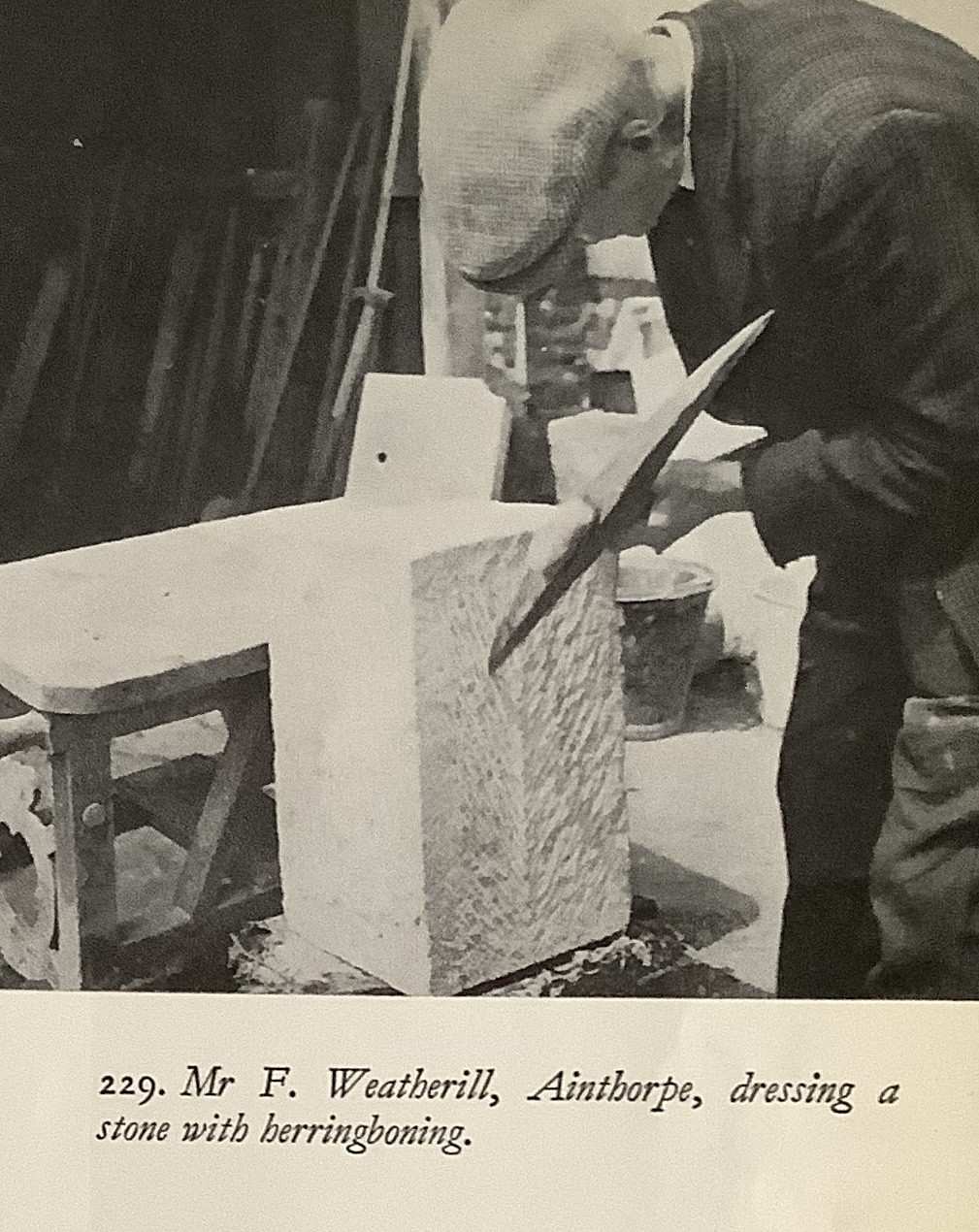
I’d like to thank John Severs who got in touch after my appeal a few weeks ago to know more about stone markings I had seen on a 19th century property near Chop Gate. I likened them to a repeating arrow pattern, like a feather or the skeleton of a fish.

John has a book entitled ‘Life in the Moorlands of North-East Yorkshire’ written in 1972 by Marie Hartley and Joan Ingilby. There was a section on this specific type of masonry along with some photographs. The wordy description reads: “The forms of finish are herringboning, scutching, slew axing, diamond hammering, batting, draughting used for margins, and the Victorian rock-faced (natural and deep rock) employed for instance on railway bridges. Herringbone, the earliest finish, and scutching, popular in the nineteenth to the early twentieth century are especially characteristic. The former inspired by the shape of the backbone and bones of a herring or kipper, developed two forms, a plain ribless (the rib being the backbone) generally used on farm buildings and simple dwellings, and the draughted finely axed, showing a neat rib, running horizontally across the centre of the wallstone, and employed on mansions and yeoman’s dwellings.”

The farm I visited had the stones without the higher-status ‘rib’ described above, and yet they were elegant in their varying shades of brown, sand and gold. There’s no explanation as to why these particular patterns were used, but being near to the coast, fishing played a large part in the lives of North York Moors folk which might explain the design. Herringbone dates back to Ancient Egyptian and Roman times when it was seen on jewellery and in block paved roads, then later used in flooring, brickwork and textiles. But why did the moorland stonemasons carve the pattern into their stones? Was it for a practical reason, or was it simply pride for a traditional technique of centuries past that made each stone look like a piece of art? I have heard that the surface would be scored to ensure the binding mortar would have a better purchase on the surface, however I don’t know if that is true. 

Regular reader Clare Proctor happened to be speaking to a couple of people who were very familiar with moorland stonemasonry. They were a builder and an architect who have spent all their working lives on the North York Moors. She wrote: “They tell me that the patterns are purely there because the stonemason was creating a flush face. The higher the status of the building the higher the quality of dressing the stone. So a grand house would have quite smooth stone but a shepherd’s hut would have just lumps of undressed stone. It’s sandstone so it’s quite easy to work. Ian Thompson and Peter Rayment were my sources of wisdom!”

Despite the information, I am still unsure as to whether the herringbone pattern has a practical purpose or is simply decorative. So do tell if you know! Reader Sarah Mason also got in touch about stone masonry, but this time referring to Australia where she used to live: “Bricks made by convicts were marked by arrows,” she wrote and directed me to the Museum of History New South Wales, based in Sydney.

Thanks to a programme of rapid urban development instigated by Major General Lachlan Macquarie, who was governor of the penal colony from 1810 to 1821, there was huge demand for bricks which were handmade by the convicts held there.

Prisoners would dig up clay to mix with water and sand and they would work it until it was soft enough to push into wooden moulds. The excess was scraped off, the brick pushed out and once dry, it would be fired in a kiln. In gangs of eight, the convicts were expected to produce 3,000 bricks like this every day.

After a number of thefts, a marking system using arrows was introduced to distinguish the Government-owned bricks made by the convicts from those made for private individuals. According to the 28th July 1928 edition of the Sydney Herald, ‘The Government bricks were not marked with the broad arrow until very lately; the men belonging to the gang are allowed to make bricks for other individuals in their own time, but they are not allowed to use the Government clay.’

I’d love to hear from you about your opinions, memories and ideas for columns. Use the ‘Contact’ button on the top right of this page to get in touch. This column appeared in the Darlington & Stockton Times on Friday 19th and the Ryedale Gazette and Herald on Wednesday 17th July 2024.